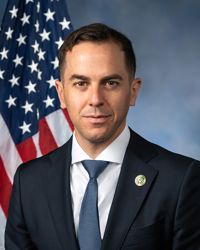
Robert Menendez
DDemocratNJ-8 · Representative
57
/ 100
Average
Attendance100
Avg: 96
Independence3
Avg: 4
Bipartisan Tone3
Avg: 15
Ethics Record100
Avg: 99
Transparency69
Avg: 53
Accountability Score — composite of attendance, independence, bipartisan tone, ethics record & transparency.
Methodology16
Bills Sponsored
0
Enacted into Law
1
Passed a Chamber
14
In Committee
All Sponsored Bills
HR5967In Committee
Strategic Task Force on Scam Prevention Act
The bill would establish a government task force dedicated to identifying, investigating, and stopping scams that target American consumers and businesses. The task force would work across different federal agencies to develop strategies for preventing fraud, protecting people's money and personal information, and holding scammers accountable. This would affect everyday people who shop online, use financial services, and anyone vulnerable to being tricked out of money or personal data.
HR7294Reported
AI for Secure Networks Act
AI for Secure Networks Act This bill requires the National Telecommunications and Information Administration (NTIA) to study and report to Congress on the impact of artificial intelligence (AI) technology on the security of telecommunications networks. The report must include an analysis of (1) how AI may be used to improve and increase the security of telecommunications networks, including in connection with Open Radio Access Network or virtualized security technologies; and (2) risks to telecommunications network security posed by AI. The NTIA must seek public comment on the report before finalizing it and submitting it to Congress.
HR9614In Committee
NRC Staff Pay Alignment Act
The legislation would modify federal law to allow the government to provide compensation packages to certain long-term nuclear regulatory employees who are appointed to specific career positions. This change would give federal agencies more flexibility in how they pay and retain experienced staff working in nuclear energy oversight and related fields. The bill is currently under review by the House Committee on Energy and Commerce.
HR8620In Committee
CARES Hotline Act
The bill would create a national hotline to help caregivers of people with developmental disabilities get information, support, and resources. This would give families and caregivers a single place to call for guidance on services, benefits, and assistance available to them. The measure aims to make it easier for people caring for individuals with conditions like intellectual disabilities or autism to find the help they need.
HR7943In Committee
Communications Equity and Diversity Council Act
This bill would create a new council within the federal government to study and address gaps in how communications services and technology jobs are distributed across different racial, ethnic, and socioeconomic groups. The council would work to identify barriers that prevent certain communities from accessing broadband internet, phone service, and careers in the communications industry, and recommend ways to improve equity. This would affect telecommunications companies, internet providers, and communities that currently have limited access to reliable communications technology.
HR7797In Committee
Toll Evasion Prevention and Plate Visibility Act of 2026
This bill would establish federal standards to prevent drivers from evading tolls by obscuring or tampering with license plates, and would require states to implement measures ensuring plates remain visible and readable for toll collection systems. The legislation would likely affect highway users, toll road operators, and state transportation departments by setting clearer rules about plate visibility and potentially imposing penalties for evasion. The bill aims to increase toll revenue collection and reduce fraud on the nation's toll roads and bridges.
HR7263In Committee
Safe Intersections for Buses and Pedestrians Act
This bill would require improvements to bus stops and pedestrian crossings to make them safer, likely including better lighting, clearer markings, and design changes to reduce accidents between buses, pedestrians, and other vehicles. The changes would affect public transit systems, cities, and pedestrians who rely on buses and walk near bus routes. The bill is still in early stages and has been sent to the House Committee on Transportation and Infrastructure for review.
HR6983In Committee
PRICE Act
The bill would establish new regulations and requirements for energy pricing and market practices to help control costs for consumers and businesses that use electricity and other energy sources. It aims to increase transparency in how energy prices are set and potentially give regulators more authority to monitor and address unfair pricing practices in the energy market. The measure would affect energy companies, utility providers, and millions of households and businesses that pay energy bills.
HR6984In Committee
Data Center Transparency Act
This bill would require large data centers to publicly report information about their energy use, water consumption, and environmental impact. The transparency requirements would help regulators and the public understand how much resources these facilities consume and potentially push companies to operate more efficiently. Data center operators and tech companies would be the primary entities affected by these new reporting obligations.
HR5804In Committee
Providing Robust Organics and Diets for Urban Communities Everywhere Act
Providing Robust Organics and Diets for Urban Communities Everywhere Act or the PRODUCE Act This bill extends through FY2030 the Department of Agriculture (USDA) Office of Urban Agriculture and Innovative Production, which coordinates across USDA agencies to update programs and engage with stakeholders to serve the needs of urban and innovative producers. The office also provides competitive grants to initiate or expand efforts of farmers, gardeners, citizens, government officials, schools, and other stakeholders in urban areas and suburbs.
HR6153In Committee
Communities Before Air Tourism Act
HR5049In Committee
Protecting Communities from Helicopter Noise Act
The legislation would establish new rules to reduce noise pollution from helicopters flying over residential areas and communities. It would likely require helicopter operators to follow stricter flight paths, altitude limits, or operational restrictions in populated zones, affecting both civilian helicopter services and potentially military operations. The goal is to protect residents from excessive noise while balancing the needs of emergency services, tour operators, and other helicopter users.
HR4985In Committee
Community Parks Revitalization Act
The proposal would provide funding and support to help communities repair, improve, and expand public parks in their neighborhoods. It would affect local governments, park departments, and residents who use public green spaces for recreation and community activities. The bill is currently being reviewed by two congressional committees to determine which parts each committee should handle.
HR1717Passed House
Communications Security Act
Communications Security Act This bill provides statutory authority for a council established by the Federal Communications Commission (FCC) to provide advice regarding the security, reliability, and interoperability of communications networks. (This advice is currently provided by the FCC’s Communications Security, Reliability, and Interoperability Council.) The bill specifies that the FCC may designate an existing advisory committee to fulfill this role, provided the committee’s membership is modified, as necessary, to comply with membership requirements set forth in the bill. Specifically, the bill requires the council to include, to the extent practicable, representatives of companies in the communications industry; public interest organizations or academic institutions; and federal, state, tribal, and local governments (with at least one member representing each level of government). Members are to be selected by the FCC's chair and generally may not include representatives of entities owned or controlled by, or subject to the influence of, a foreign adversary, or otherwise deemed to pose a threat to U.S. national security. Under current law, federal advisory committees must generally terminate after two years unless they are renewed or a statute specifies a different termination date. However, the bill exempts the council from this requirement.
HR2949In Committee
Working Families Task Force Act of 2025
The legislation would establish a task force to study and develop recommendations on how to better support working families through policies affecting wages, benefits, childcare, healthcare, and other economic challenges. The task force would bring together officials from multiple government agencies to identify problems families face and suggest solutions that could be addressed through federal programs and regulations. The recommendations would help Congress understand what changes might make it easier for working families to afford housing, healthcare, education, and other necessities.
HR2511In Committee
Sarah Katz Caffeine Safety Act
Sarah Katz Caffeine Safety Act This bill establishes labeling and disclosure requirements for caffeinated food, beverages, and supplements. Specifically, the bill requires foods and dietary supplements that contain more than 10 milligrams of caffeine to be labeled with (1) their total caffeine content, (2) a statement of whether the caffeine is naturally occurring or is an additive, and (3) an advisory statement indicating that the recommended daily limit of caffeine for healthy adults is 400 milligrams. Further, in restaurant chains with 20 or more locations, menus must indicate that an item contains high caffeine where the item contains added caffeine and has a total caffeine content of at least 150 milligrams. Restaurants must place the statement “high caffeine” or a similar indication adjacent to the name of a covered item on the menu. This requirement applies to both standard and temporary menu items. For standard menu items, the bill also expands the nutritional information that restaurants must make available to consumers in written form to include the number of milligrams of caffeine in an item. The Food and Drug Administration (FDA) must review the safety of caffeine and other stimulants in food, beverages, and dietary supplements and determine whether caffeine should be generally recognized as safe (GRAS) for healthy adults. (Currently, the FDA considers caffeine as GRAS for cola beverages up to a level of 0.02%.) Finally, the Government Accountability Office must study and report to Congress on the marketing of caffeinated beverages in restaurants, stores, and online.