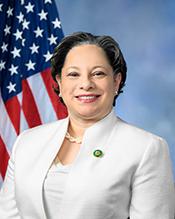
Jennifer L. McClellan
DDemocratVA-4 · Representative
64
/ 100
Average
Attendance100
Avg: 96
Independence1
Avg: 4
Bipartisan Tone19
Avg: 15
Ethics Record100
Avg: 99
Transparency97
Avg: 53
Accountability Score — composite of attendance, independence, bipartisan tone, ethics record & transparency.
Methodology18
Bills Sponsored
0
Enacted into Law
0
Passed a Chamber
17
In Committee
All Sponsored Bills
HR10240In Committee
Behavioral Health Crisis Services Expansion Act of 2026
HR5243In Committee
To amend title XVIII of the Social Security Act to increase data transparency for supplemental benefits under Medicare Advantage.
Medicare Advantage plans would be required to publicly disclose more detailed information about the extra benefits they offer to seniors, such as dental, vision, or transportation services, so people can better compare plans before enrolling. This increased transparency would help Medicare beneficiaries make more informed choices about which plan best meets their needs and understand what additional services are actually available to them. The change affects insurance companies offering Medicare Advantage plans and the millions of seniors who use these plans.
HRES1357In Committee
Acknowledging and apologizing for the mistreatment of, and discrimination against, lesbian, gay, bisexual, and transgender individuals who served the United States in the uniformed services, the Foreign Service, and the Federal civil service and committing to the pursuit of equal rights, protections, and respect for all LGBT servicemembers and Federal civil servants.
The federal government would formally acknowledge and apologize for past discrimination and mistreatment of LGBT individuals who served in the military, Foreign Service, and federal government jobs, while committing to ensuring equal rights and protections for all LGBT federal employees and service members going forward. This resolution recognizes historical wrongs against gay, lesbian, bisexual, and transgender workers in these sectors and pledges future fair treatment. The measure is currently being reviewed by multiple congressional committees that oversee military, veterans, foreign affairs, and government operations.
HR9177In Committee
Improving Mentorship in STEM Higher Education Act
The National Science Foundation would create a new mentorship program to help early-career scientists and researchers develop their skills and advance in their fields. This demonstration program would test different mentoring approaches to see what works best for supporting the next generation of innovators in science and technology. The program would ultimately help more young researchers succeed and stay engaged in scientific careers.
HR9155In Committee
CONSENT Act
I don't have enough information to write an accurate summary. The bill title "CONSENT Act" and subjects listed as "None" don't provide the specific details about what this legislation would do, who it affects, or what problem it addresses. To write a factual summary for a general audience, I would need access to the bill's actual text or a description of its provisions.
HR8853In Committee
Amtrak Grant Flexibility Act
The proposal would let Amtrak use federal grant money it receives to cover its required share of costs for other federal transportation grants, rather than having to find separate funding for those matching requirements. This change would make it easier for the passenger railroad to access federal transportation funding by reducing the amount of non-federal money it needs to come up with. The bill is currently under review by the House Committee on Transportation and Infrastructure.
HR7783In Committee
AI-Ready Networks Act
This bill would help telecommunications companies upgrade their networks to support artificial intelligence applications and advanced technologies. It likely includes provisions for funding, technical standards, or regulatory changes to make it easier for internet and phone providers to build infrastructure capable of handling AI-powered services. The changes would affect both the telecom industry and consumers who rely on these networks for internet and communications services.
HR7676In Committee
Career-Connected Learning Pathways Act of 2026
This bill would create programs connecting students with real-world job training and career experiences while they're still in school, helping young people explore different career fields and develop skills employers actually need. The legislation aims to bridge the gap between classroom learning and the job market by partnering schools with local businesses and industries. Students, schools, and employers would all benefit by having a clearer pathway from education directly into meaningful employment.
HR7341In Committee
GRAD Act
The GRAD Act appears to address education policy, though the specific details would depend on the bill's full text. Based on its referral to the House Committee on Education and Workforce, it likely aims to improve educational outcomes, student support, or workforce preparation for students and graduates. The bill is currently under review by the relevant House committee.
HRES877In Committee
Expressing support for the designation of "Prematurity Awareness Month".
This resolution expresses support for the designation of Prematurity Awareness Month.
HR5965In Committee
Student Veteran Work Study Modernization Act
Student Veteran Work Study Modernization Act This bill requires the Department of Veterans Affairs to implement a five-year pilot program to expand eligibility for the work-study allowance program to individuals who are pursuing programs of rehabilitation, education, or training at a rate equal to at least half of that required of a full-time student.
HR4894In Committee
Deceptive Practices and Voter Intimidation Prevention Act of 2025
Deceptive Practices and Voter Intimidation Prevention Act of 2025 This bill generally prohibits deceptive communications and voter interference regarding federal elections. Specifically, the bill prohibits any person, within 60 days before a federal election, from communicating, causing to be communicated, or producing for communication certain information on voting, if the person (1) knows such information to be materially false, and (2) has the intent to impede or prevent another person from voting in an election. Additionally, the bill prohibits any person, within 60 days before a federal election, from using an artificial intelligence system to produce certain information on voting, if the person has the intent to use the system to (1) produce false information, and (2) impede or prevent another person from voting in an election. The bill also prohibits hindering, interfering with, or preventing voting or registering to vote. A private right of action for preventive relief is established for persons aggrieved by violations of these prohibitions. Criminal penalties are also established for violations. If the Department of Justice (DOJ) receives a credible report that materially false information has been or is being communicated in violation of the prohibitions on deceptive communications, and state and local election officials have not adequately communicated corrected information, then DOJ must communicate to the public accurate information designed to correct the materially false information. The bill extends the prohibition on certain types of intimidation in federal elections to also prohibit intimidation for processing ballots or tabulating, canvassing, or certifying votes.
HR4703In Committee
To establish a system to track, record, and report all instances in which a United States citizen or individual lawfully admitted for permanent resident was, for the purpose of immigration enforcement, detained or removed by the Department of Homeland Security, and for other purposes.
The bill would require the Department of Homeland Security to create a comprehensive database that tracks and publicly reports every time a U.S. citizen or legal permanent resident is detained or deported for immigration enforcement purposes. This system would provide transparency about who is being detained, where they're being held, and what happens to them, allowing citizens and lawmakers to see patterns in immigration enforcement actions. The goal appears to be ensuring that immigration authorities don't mistakenly detain or remove people who have the legal right to stay in the country.
HRES585In Committee
Recognizing the threat of extreme weather to children's health and well-being, and expressing the sense of Congress that solutions must be rapidly and equitably developed and deployed to address the unique vulnerabilities and needs of children.
This resolution expresses the sense that adaptations to and protections from extreme weather conditions must be developed and deployed rapidly and equitably, with consideration for the physical and mental health needs of current and future generations of young people.
HR3054In Committee
RESEARCHER Act
The RESEARCHER Act likely aims to support scientific research and development by providing funding, tax incentives, or regulatory changes that help universities, private companies, and government labs conduct studies in areas like technology and communications. The bill would probably affect researchers, scientists, educational institutions, and technology companies by making it easier or more affordable for them to pursue innovation and discovery. The specific details of how it would help—whether through grants, tax breaks, or streamlined approval processes—would depend on the bill's full text.
HR2313Reported
Celestial Time Standardization Act
This bill would establish a unified time standard for space-based systems and satellite communications to prevent conflicts and improve coordination between different space agencies and private companies operating satellites. It affects technology companies, telecommunications providers, and government space programs that need to synchronize their operations across different orbits and missions. The measure aims to reduce technical problems and safety risks that can occur when space systems use different time references.
HR2141In Committee
To designate the facility of the United States Postal Service located at 409 South Hicks Street in Lawrenceville, Virginia, as the "James Solomon Russell Post Office".
This bill designates the facility of the United States Postal Service located at 409 South Hicks Street in Lawrenceville, Virginia, as the "James Solomon Russell Post Office".
HR1331In Committee
Teacher and School Leader Quality Partnership Grants Act
Teacher and School Leader Quality Partnership Grants Act This bill reauthorizes through FY2031 and expands the Teacher Quality Partnership program (which provides grants to improve the quality of teachers and enhance professional development activities). Specifically, the bill expands the program to include training and professional development opportunities for principals and other school leaders. Currently under the program, eligible partnerships must be comprised of (1) a high-need local educational agency; (2) a high-need school or early childhood education program; (3) a partner institution; and (4) certain schools, departments, or programs within a partner institution. The bill requires these partnerships, in their preparation or residency programs, to use evidence-based methods and adhere to an evaluation plan that includes comprehensive performance objectives. Additionally, the bill authorizes grants for the establishment of professional development programs for teachers who remain in the classroom while also carrying out formalized leadership responsibilities. The bill also establishes an advisory committee within the Department of Education to conduct a feasibility study that, among other things, compiles best practices for educating and training profession-ready teachers and school leaders.