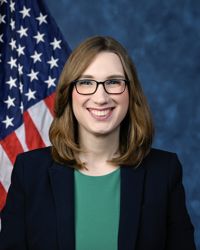
Sarah McBride
DDemocratDE · Representative
55
/ 100
Average
Attendance99
Avg: 96
Independence3
Avg: 4
Bipartisan Tone18
Avg: 15
Ethics Record100
Avg: 99
Transparency38
Avg: 53
Accountability Score — composite of attendance, independence, bipartisan tone, ethics record & transparency.
Methodology10
Bills Sponsored
0
Enacted into Law
0
Passed a Chamber
10
In Committee
All Sponsored Bills
HR9809In Committee
Disabled Access Credit Modernization Act
The proposal would change how businesses can claim tax credits when they make their buildings and services accessible to people with disabilities. Currently, businesses can get a credit of up to $5,000 per year for accessibility improvements, but this bill would modify those rules to potentially make the credit more generous or easier to use. The change would affect small and large businesses that want to remove barriers for customers and employees with disabilities.
HR6461In Committee
READ AI Models Act
Resources for Evaluating and Documenting AI Models or the READ AI Models Act This bill requires the National Institute of Standards and Technology (NIST) to develop a customizable template for information to accompany artificial intelligence (AI) models. Specifically, NIST must initiate a pilot program to establish a structured template that may be used to document information about an artificial intelligence model and any associated data, such as the model’s name, the developer, and the cutoff date for the model’s training data. The template must be modular to enable users to adopt and complete various sections to suit their needs and intended audience. NIST must also provide technical guidelines to accompany the template that incorporate consensus-based standards and industry best practices, as appropriate. In developing these materials, NIST must collaborate with and conduct periodic outreach to various stakeholders, including private sector entities, international standards organizations, and institutions of higher education. NIST must publish and solicit public comment on a draft of the template and guidelines. Within 12 months of the start of the pilot program, NIST must publish the finished products and report to Congress with an assessment of the program.
HR9412In Committee
Stop Scamming Americans Act
The legislation would update rules governing how the U.S. State Department operates its foreign service, which includes diplomats and staff who work at embassies and consulates around the world. The changes would modernize hiring, training, and management practices for these government employees who represent American interests abroad. The bill affects State Department workers, international relations operations, and how the U.S. conducts diplomacy with other countries.
HR8980In Committee
Holiday Pay Act
The bill would require employers to pay workers at least 1.5 times their normal hourly rate when they work on federal holidays like Thanksgiving or Christmas. This change would apply to most private sector employees covered by federal wage laws, giving them extra compensation for giving up their holiday time. The proposal is currently under review by the House Committee on Education and Workforce.
HR8268In Committee
Biotechnology for All High School Students Act
This bill would likely work to make biotechnology education more accessible to high school students across the country, possibly through funding, curriculum development, or teacher training programs. The goal appears to be ensuring that students from all backgrounds and school districts have the opportunity to learn about biotechnology and related science fields, rather than having these courses limited to well-funded schools. This could help prepare more young people for careers in science and technology.
HR7505In Committee
Flexible Leave Act
The bill would likely give workers more flexibility in how they use paid leave by allowing them to take time off in smaller increments or for different purposes than currently allowed under federal law. This could affect both private sector employees and federal workers by changing rules around vacation days, sick leave, or personal time. The exact details of what flexibility would be permitted are not yet clear from the referral stage.
HR6151In Committee
Global Respect Act
Based on the vague title and international affairs focus, this bill likely aims to strengthen America's diplomatic relationships or enhance how the U.S. is perceived globally, though the specific policy details are unclear from the title alone. The bill has been sent to both the Foreign Affairs and Judiciary committees, suggesting it may involve changes to how the government handles international relations, treaties, or laws affecting foreign policy. Without more detailed information about the bill's contents, the exact impact on Americans, businesses, or international partners cannot be determined.
HR3404In Committee
FAIR Leave Act
The bill would establish new requirements for employers to provide paid leave to workers, likely ensuring that employees can take time off for personal or family needs without losing pay. The legislation would affect private employers and possibly federal workers, aiming to give workers more flexibility to handle life events like illness, childcare, or family emergencies. The bill is currently being reviewed by multiple House committees to determine which parts fall under each committee's area of responsibility.
HR2868In Committee
SAVE Our Poultry Act
Supporting Avian Virus Eradication Act or the SAVE Our Poultry Act This bill includes research on highly pathogenic avian influenza (HPAI) as a Department of Agriculture (USDA) high-priority research and extension area. Under the bill, USDA may award grants to land-grant colleges and universities to study HPAI for the purposes of (1) developing and improving the efficacy of vaccines for poultry, and (2) enhancing biosecurity procedures for poultry producers.
HR306In Committee
ESCRA Act
Ending Scam Credit Repair Act or the ESCRA Act This bill revises the Credit Repair Organizations Act and creates additional requirements for credit repair organizations (CROs). Under current law, it is illegal for a person (including a CRO) to make false or misleading statements regarding a consumer’s creditworthiness or standing to a consumer reporting agency or to a consumer credit provider. The bill additionally prohibits making such statements to the Consumer Financial Protection Bureau, the Federal Trade Commission, or law enforcement. To be subject to this prohibition, the bill also requires such statements to be made knowingly. The bill also revises CRO obligations to consumers. A CRO is prohibited from charging a consumer for a service (e.g., getting inaccurate information removed from a credit report) until the CRO provides proof of success not less than six months after providing the service. The bill also requires additional disclosures to consumers, requires the retention of any recorded telephone calls, and increases the time records must be retained from two to five years. In addition, consumers must be given copies of all communications sent on their behalf. Under the bill, all persons must be licensed by a state to act as a CRO. The bill also restricts a CRO’s ability to submit multiple credit disputes regarding the same information. The bill also sets a minimum liability amount for damages of $500 for each violation of the Credit Repair Organizations Act.