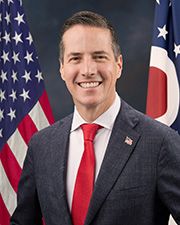
Bernie Moreno
RRepublicanOH · Senator
55
/ 100
Average
Attendance99
Avg: 97
Independence23
Avg: 23
Bipartisan Tone8
Avg: 14
Ethics Record100
Avg: 100
Transparency28
Avg: 47
Accountability Score — composite of attendance, independence, bipartisan tone, ethics record & transparency.
Methodology22
Bills Sponsored
0
Enacted into Law
0
Passed a Chamber
19
In Committee
All Sponsored Bills
S5688In Committee
Acquired Lands Revenue Modernization Act
S5689In Committee
A bill to prohibit Federal and State incentives for the development or commercial operations of data centers.
S5666In Committee
NO CHEATS Act
S4429Reported
Connected Vehicle Security Act of 2026
Connected Vehicle Security Act of 2026 This bill prohibits the importation, manufacture, sale, resale, or introduction into U.S. interstate commerce of connected vehicles and related software and hardware components associated with China, Russia, Iran, or North Korea. Connected vehicle means a vehicle that (1) integrates onboard networked hardware with automotive software systems to communicate with any other network or device using certain methods (e.g., wireless spectrum connectivity); or (2) is designed, manufactured, or originally equipped to communicate via such methods, regardless of whether such capability is enabled, disabled, or removed at the time the vehicle enters the United States. Current regulations administered by the Department of Commerce's Bureau of Industry and Security (BIS) prohibit transactions involving vehicle connectivity system hardware and covered software designed, developed, manufactured, or supplied by persons owned by, controlled by, or subject to the jurisdiction or direction of China or Russia. The bill expands the BIS regulatory framework, including by (1) expanding the countries covered by the prohibition to include China, Russia, Iran, and North Korea (Current BIS regulations apply only to China and Russia.); and (2) specifying that certain artificial intelligence components are covered by the prohibition. By January 1, 2027, BIS must publish a list of items that are authorized for the importation, manufacture, sale, resale, or introduction into U.S. interstate commerce and would otherwise be subject to the bill's prohibition. The bill also includes enforcement mechanisms, including that BIS must assess civil penalties for violations of the prohibition.
S5383In Committee
End Gas Station Heroin Act
SJRES210In Committee
A joint resolution providing for congressional disapproval under chapter 8 of title 5, United States Code, of the rule submitted by the Environmental Protection Agency relating "California State Nonroad Engine Pollution Control Standards; Commercial Harbor Craft Regulations; Notice of Decision".
S5239In Committee
American Glove Act of 2026
S4983In Committee
Harry Reid Immigration Stabilization Act
This bill aims to strengthen border security and control immigration by addressing concerns about criminal activity, terrorism, and labor market competition. It would affect immigrants, workers competing for jobs, border enforcement agencies, and communities near the border by implementing stricter immigration policies and enforcement measures. The specific details of how these goals would be achieved are under review by the Judiciary Committee.
SRES708Introduced
A resolution amending rule XXXVII of the Standing Rules of the Senate to prohibit Senators from trading on prediction markets.
Senators would be banned from betting on prediction markets, which are platforms where people wager money on the outcomes of future events like elections or policy decisions. This rule change prevents lawmakers from potentially profiting off their own legislative actions or inside knowledge about upcoming votes and political developments. The restriction aims to reduce conflicts of interest and maintain public trust in Congress.
SRES663In Committee
A resolution honoring the service and sacrifice of the Ohio Air National Guard airmen who were killed in the Boeing KC-135 Stratotanker crash in Iraq during Operation Epic Fury.
This resolution honors Ohio Air National Guard members who died when their Boeing KC-135 Stratotanker aircraft crashed in Iraq during a military operation. The resolution recognizes their service and sacrifice to the country. It has been referred to the Armed Services Committee for consideration.
S3889In Committee
American Lending Fairness Act of 2026
This bill would likely establish new rules for how banks and lenders treat borrowers when making loans, potentially addressing concerns about unfair lending practices or discrimination in the loan approval process. The changes would affect banks, credit unions, and other financial institutions that issue mortgages, personal loans, and other forms of credit, as well as the millions of Americans who apply for loans. The specific details of what fairness measures it includes would depend on the bill's full text, but the intent appears to be protecting borrowers from discriminatory or predatory lending practices.
S3746In Committee
Stopping Transfers of Public Funds Abroad Act
This bill would restrict the federal government's ability to send taxpayer money to foreign countries or international organizations without explicit congressional approval. The measure aims to give Congress more direct control over which international programs and aid initiatives receive U.S. funding, potentially affecting foreign aid, international development projects, and contributions to global institutions.
S3283In Committee
Exclusive Citizenship Act of 2025
S3089In Committee
STOP Act
S1492Reported
Deploying American Blockchains Act of 2025
The legislation would encourage the development and use of blockchain technology within the United States by establishing federal support for American-based blockchain systems and potentially creating standards or incentives for their adoption in commerce. This could affect technology companies, financial institutions, and businesses looking to use blockchain for transactions or record-keeping, while aiming to help the U.S. compete with other countries developing their own blockchain infrastructure. The bill has advanced through the Senate committee process and is ready for a full Senate vote.
SRES445In Committee
A resolution congratulating President Donald J. Trump for achieving peace in the Middle East.
This resolution expresses congressional congratulations to President Trump for his efforts toward achieving peace in the Middle East. The measure has been referred to the Foreign Relations Committee for consideration but does not create any new laws or policies. Resolutions of this type are symbolic statements that recognize achievements rather than authorize government actions or spending.
S2976In Committee
HIRE Act
Halting International Relocation of Employment Act or the HIRE Act This bill imposes a 25% federal excise tax on and disallows tax deductions related to payments made to foreign persons for labor or services benefiting consumers in the United States (outsourcing payments). The bill also provides funding for workforce development initiatives. Specifically, the excise tax applies to outsourcing payments , which the bill defines as any premium, fee, royalty, service charge, or other payment made in the course of a trade or business, to a foreign person (excluding a corporation or partnership organized under the laws of the United States or a U.S. possession), and for labor or services which benefit (directly or indirectly) U.S. consumers. Further, a federal tax deduction is not allowed for outsourcing payments or the excise tax on such payments. Under the bill, the Internal Revenue Service may require persons to report information related to outsourcing payments. The bill imposes penalties for failing to report such information or pay the excise tax. The bill also establishes and provides funding for the Domestic Workforce Fund, which is to be used for workforce development and retraining programs, apprenticeship programs and partnerships with industry to expand domestic employment in sectors impacted by outsourcing, and state grants for workforce development for communities with high levels of job displacement. The funding provided by the bill for the Domestic Workforce Fund is equivalent to the amounts received from the tax and penalties imposed by the bill.
S2320In Committee
Compressed Gas Cylinder Safety and Oversight Improvements Act of 2025
Compressed Gas Cylinder Safety and Oversight Improvements Act of 2025 This bill expands the application, testing, and inspection requirements for a foreign manufacturer of cylinders used for transporting hazardous materials in the United States (e.g., compressed gas cylinders). Current regulations require a foreign manufacturer to apply for approval from the Pipeline and Hazardous Materials Safety Administration (PHMSA) of the Department of Transportation (DOT) for testing such cylinders outside of the United States. The bill requires that, to obtain an approval, a foreign manufacturer must answer in their application specified questions, including whether the manufacturer is or has been subject to various civil or criminal penalties. Further, DOT must establish a process for any interested party to request a reevaluation of an approval for a foreign manufacturer's cylinders to review the accuracy and safety of the manufacturer's actions. DOT must also revise the foreign inspection regulations to require that annual inspections of foreign manufacturers be carried out if DOT determines there is good cause; specify that a refusal of inspection shall result in the loss of good standing; allow DOT to request testing and production records and random sample testing; and allow for the recovery of the costs of foreign inspections, including travel and time. The bill limits an approval to one year; however, DOT may extend an approval for five years for a manufacturer who meets certain requirements. On an annual basis, DOT must publish a list of approved foreign manufacturers of cylinders on the department's website.
S1771In Committee
Larry Henderson Act
S1388In Committee
PROTECT Act of 2025
Providing Rigorous Oversight Through Evaluation of Concerning Transactions Act of 2025 or the PROTECT Act of 2025 This bill requires the Committee on Foreign Investment in the United States (CFIUS) to review certain real estate investments made by a foreign country of concern in the United States. The bill defines foreign country of concern as China, North Korea, Russia, Iran, or any other country determined to be a country of concern by the Department of State. Specifically, CFIUS must review any investment by a foreign person that (1) involves the acquisition of real estate in the United States and the establishment of a U.S. business on such real estate, and (2) could result in direct or indirect control of that U.S. business by a foreign country of concern. A party to any such investment must submit to CFIUS a declaration containing basic information regarding the transaction.
S849In Committee
The Allegiance Act of 2025
The bill would likely establish new requirements or procedures related to loyalty oaths, security clearances, or allegiance declarations for federal employees and officials. Based on its referral to the Homeland Security committee, it probably aims to strengthen vetting processes or loyalty standards for government workers who handle sensitive information or national security matters. The specific details would affect federal employees, contractors, and potentially others seeking government positions or access to classified materials.
S200In Committee
RULES Act
Refugees Using Legal Entry Safely Act or RULES Act This bill requires non-U.S. nationals ( aliens under federal law) applying for asylum to arrive and apply at a U.S. port of entry. Applicants are prohibited from being paroled into the U.S. pending approval of such application. Further, individuals apprehended in the U.S. without legal immigration status are ineligible for asylum. Applicants rejected for asylum are barred from applying for asylum in the future. Under current law, an applicant may reapply in changed or extraordinary circumstances.