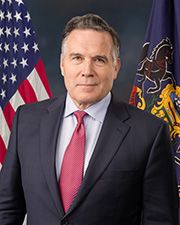
David McCormick
RRepublicanPA · Senator
52
/ 100
Average
Attendance97
Avg: 97
Independence22
Avg: 23
Bipartisan Tone7
Avg: 14
Ethics Record100
Avg: 100
Transparency14
Avg: 47
Accountability Score — composite of attendance, independence, bipartisan tone, ethics record & transparency.
Methodology41
Bills Sponsored
0
Enacted into Law
1
Passed a Chamber
35
In Committee
All Sponsored Bills
S4395Passed Senate
Terrorism Risk Insurance Program Reauthorization Act of 2026
Terrorism Risk Insurance Program Reauthorization Act of 2026 This bill reauthorizes the Terrorism Risk Insurance Program through 2034. The program covers a portion of the losses incurred by private insurers for property and casualty insurance coverage for terrorism risk.
S5360In Committee
Rural and Municipal Utility Cybersecurity Act
S3524In Committee
American Battlefield Protection Program Amendments Act of 2025
This bill would modify the federal program that protects historic Civil War and other American battlefields from development and damage. The changes likely aim to expand protections, improve how the government manages these sites, or provide more funding and resources to preserve them for future generations. The bill affects landowners, state and local governments, and organizations that work to maintain these historically significant locations.
S5548In Committee
Securing National Security Systems from Chinese Optical Transceivers Act of 2026
S4238Reported
Endless Mountains National Heritage Area Act
This bill would designate a region in Pennsylvania called the Endless Mountains as a National Heritage Area, which means the federal government would help fund and coordinate efforts to preserve the area's natural landscapes, historical sites, and cultural resources. Local communities and organizations in the region would work with federal agencies to manage tourism, conservation projects, and economic development while protecting what makes the area special. The designation would bring federal resources and support to help residents balance economic growth with environmental and historical preservation.
SRES847In Committee
A resolution commending and congratulating the Pennsylvania State University Nittany Lions men's wrestling team for winning the 2026 National Collegiate Athletic Association Division I National Championship.
S3835Reported
A bill to designate the facility of the United States Postal Service located at 10 East Main Street in Mahaffey, Pennsylvania, as the "Robert Allen Bishop, Sr., Post Office Building".
This bill designates the facility of the United States Postal Service located at 10 East Main Street in Mahaffey, Pennsylvania, as the "Robert Allen Bishop, Sr., Post Office Building".
S5305In Committee
Campus Lifeline Act
S5295In Committee
NIH Mentorship Modernization Act
S5263In Committee
Workforce Recovery and Resilience Act
S5203In Committee
TURBO Act
The legislation would change tax rules for certain bonds that help finance public facilities like airports, docks, and water systems. These bonds currently allow investors to earn interest without paying federal income taxes, and the bill would adjust how these tax-exempt bonds can be used and what projects qualify for this special treatment. The changes would affect state and local governments that issue these bonds to fund infrastructure projects, as well as investors who buy them.
S3900Reported
Iran Human Rights, Internet Freedom, and Accountability Act of 2026
This bill would authorize the U.S. government to impose sanctions and take other actions against Iranian officials and entities responsible for human rights abuses, internet censorship, and suppression of free speech. It aims to support Iranian citizens' ability to access information online and hold the Iranian government accountable for violations like arbitrary detention and torture. The legislation would likely direct the State Department and Treasury Department to identify and punish those involved in these abuses through financial penalties and travel restrictions.
S5079In Committee
AG2PI Act of 2026
Genome to Phenome Initiative Reauthorization Act of 2026 or the AG2PI Act of 2026 This bill reauthorizes the Agricultural Genome to Phenome Initiative (AG2PI) of the National Institute of Food and Agriculture through FY2031. The AG2PI competitive grant program seeks to (1) expand knowledge concerning genomes and phenomes of crops and animals that are of importance to the U.S. agriculture sector, and (2) support and coordinate research.
S4904In Committee
Risk-based Oversight for Integrity Act
The government would study how to improve its inspection system for organic farms and food producers by focusing resources on the highest-risk operations that could compromise organic standards. The bill would define what "risk to organic integrity" means and give the Department of Agriculture authority to make regulatory changes based on the study's findings. This affects organic farmers, food companies, and consumers who buy organic products.
S4930In Committee
Unmanned System Command and Control Integration Assessment Act of 2026
The Department of Defense would be required to study whether it can adopt open-architecture systems for controlling unmanned drones and robots across all military branches and levels, learning from how allied countries currently manage their unmanned systems. The study would examine the feasibility and benefits of making these control systems more standardized and flexible so different types of unmanned equipment can work together more easily. The findings would be reported back to Congress to help inform future decisions about military drone and robot operations.
S4686In Committee
National Commission on Robotics Act
The legislation would create a new federal commission to study and make recommendations about robotics technology, including how it affects jobs, safety, and the economy. This commission would bring together experts to examine current robotics developments and advise Congress on policies needed as the technology becomes more widespread in manufacturing, healthcare, and other industries.
S4633In Committee
Unmanned and Autonomous Systems Strategy Act of 2026
The federal government would be required to develop a comprehensive plan for using unmanned and autonomous systems (like drones and robots) across the Indo-Pacific region and the Western Hemisphere to strengthen military defense, combat drug trafficking, and encourage allied nations to contribute more to regional security efforts. This strategy would outline how to deploy, operate, and expand these technologies while making them compatible with partner countries' military systems. The plan aims to modernize U.S. military capabilities while distributing security responsibilities more evenly among American allies.
S4630In Committee
A bill to prioritize the finalization of design requirements for new Ready Reserve Force vessels, and for other purposes.
The federal government would speed up the process of determining design specifications for new ships that would be kept in reserve for emergency use during national crises or military operations. This affects the Navy and shipbuilding companies that construct these vessels, potentially allowing them to begin construction sooner once design requirements are finalized. The bill aims to strengthen the nation's ability to quickly mobilize additional ships if needed for defense or disaster response.
S4606In Committee
Increasing Opportunity For Reindustrialization Act
The proposal would allow certain neighborhoods built on or near closed military bases to qualify for special tax breaks that encourage investment and business development in those areas. These tax incentives would help attract companies and investors to revitalize communities that lost economic activity when military installations shut down. Workers and businesses in these designated areas could benefit from reduced taxes on capital gains and other investments made there.
S4527In Committee
Improving Emerging Tech Opportunities for Veterans Act of 2026
The bill would expand educational benefits for veterans to include training programs in emerging technologies like artificial intelligence, cybersecurity, and renewable energy. Veterans would have greater flexibility in using their education benefits to pursue these in-demand fields through various training providers, not just traditional colleges. This aims to help veterans develop skills for modern job markets and improve their employment prospects after military service.
S4475In Committee
Unlock American Energy and Jobs Act of 2026
The bill would streamline the federal permitting process for infrastructure projects, aiming to reduce the time and complexity required to get approval for activities like construction, energy development, and environmental permits. By establishing clearer timelines and procedures for federal agencies to review and approve permits, the legislation could help speed up projects that affect businesses, workers, and communities while maintaining environmental and safety standards.
S4469In Committee
Prediction Market Act of 2026
The bill would change federal rules about how certain types of contracts related to events (like sports games or award shows) can be traded and regulated. These modifications could affect financial companies, traders, and potentially consumers who participate in event-based betting or prediction markets. The changes would be overseen by agricultural and commodity trading regulators.
S3947In Committee
REWIRE Act
The REWIRE Act aims to modernize the nation's electrical grid infrastructure to better integrate renewable energy sources like solar and wind power. The bill would likely fund upgrades to transmission lines and grid technology that allow electricity to flow more efficiently from renewable energy facilities to homes and businesses across the country. This would affect energy companies, utility providers, and consumers by potentially making the grid more reliable and supporting the transition away from fossil fuels.
S3269In Committee
Liquid Cooling for AI Act of 2025
This bill would likely establish standards or incentives for using liquid cooling systems in artificial intelligence data centers to reduce their energy consumption and heat output. AI data centers currently use enormous amounts of electricity for computing and cooling, so the bill aims to make them more efficient by promoting liquid cooling technology, which is more effective than traditional air cooling. This would affect tech companies operating large AI facilities and could help lower energy costs and environmental impact from the growing AI industry.
S4228In Committee
ACE Nuclear Energy Act of 2026
This bill likely aims to promote American nuclear energy exports and international nuclear energy cooperation by removing trade barriers and expanding financing options for U.S. nuclear technology and equipment sold abroad. It would affect nuclear power companies, their suppliers, and potentially American workers in the nuclear industry by making it easier to compete in global markets. The measure focuses on international trade and finance mechanisms to support this sector's growth overseas.
S3749In Committee
Expanding WKSI Eligibility Act
This bill would expand who qualifies for WKSI (Well-Known Seasoned Issuer) status, a Securities and Exchange Commission designation that allows certain companies to raise money through securities offerings with fewer regulatory requirements and faster approval times. By broadening eligibility for this status, the bill aims to make it easier for more businesses to access capital markets and conduct public offerings more efficiently. The change would primarily affect mid-sized and smaller companies seeking to raise funds through stock or bond sales.
S3662In Committee
ACCESS Act of 2026
The bill aims to improve financial access and competition in the banking and financial services industry, likely by removing barriers that prevent consumers and small businesses from using alternative financial services or accessing credit more easily. The specific changes would affect banks, financial institutions, and the customers and businesses that rely on them for loans, accounts, and other financial products. The exact details of what access barriers the bill targets will become clearer as the Banking Committee reviews it.
SRES288In Committee
A resolution condemning the rise in ideologically motivated attacks on Jewish individuals in the United States, including the recent violent assault in Boulder, Colorado, and reaffirming the commitment of the Senate to combating antisemitism and politically motivated violence.
The Senate formally condemned recent violent attacks targeting Jewish people in the United States, including a specific assault in Boulder, Colorado, and reaffirmed its commitment to fighting antisemitism and politically motivated violence. The resolution passed unanimously and serves as an official statement of the Senate's stance against hate crimes and discrimination based on ideology or religion. This action does not create new laws but expresses the chamber's strong disapproval of such attacks and support for protecting Jewish Americans from violence and harassment.
S3519In Committee
Remote Access Security Act
The legislation would establish security requirements and oversight for remote access systems used in financial institutions and international trade operations to protect against foreign threats and cyberattacks. Banks, trading companies, and other financial firms would need to follow new standards for monitoring and controlling who can access their systems from outside the country. The goal is to prevent foreign actors from gaining unauthorized access to sensitive financial data and infrastructure while allowing legitimate business operations to continue.
S3513In Committee
Decreasing Russian Oil Profits Act of 2025
This bill would likely impose new trade restrictions or financial penalties on Russian oil exports to reduce revenue flowing to Russia's government, particularly in response to its military actions. The measures could include sanctions on companies that buy or transport Russian oil, or requirements for the U.S. and its allies to reduce their dependence on Russian energy. The policy would affect oil prices, energy companies, and consumers who rely on global oil markets.
S3130In Committee
Veterans TBI Adaptive Care Opportunities Nationwide Act of 2025
This bill would expand and improve care options for veterans who have suffered traumatic brain injuries (TBI), likely by creating new treatment programs, increasing access to specialized services, and potentially funding adaptive care facilities across the country. The legislation aims to help veterans with TBI manage their recovery and daily lives through better medical support and rehabilitation services. Veterans with brain injuries from combat or military service would be the primary beneficiaries of these expanded care opportunities.
S3076In Committee
Nitazene Control Act
SRES461In Committee
A resolution expressing support for the designation of the week of October 20 to October 24, 2025, as "Careers in Energy Week".
This resolution would officially recognize the week of October 20-24, 2025, as "Careers in Energy Week" to promote awareness of job opportunities in the energy industry. The designation aims to encourage students and job seekers to learn about and consider pursuing careers in energy production, renewable energy, and related fields. The resolution is largely symbolic and does not create new programs or funding, but expresses congressional support for highlighting energy sector employment.
S2861In Committee
Protecting the USMCA from Harmful Chinese Investment Act
The proposal would restrict Chinese investment in companies that benefit from the U.S.-Mexico-Canada trade agreement, aiming to prevent China from gaining access to preferential trade benefits through backdoor ownership stakes. It would require companies seeking trade advantages under this agreement to disclose Chinese ownership and potentially face restrictions if foreign ownership exceeds certain thresholds. The measure targets manufacturers and businesses that want to take advantage of reduced tariffs and trade benefits under the agreement.
S1780Reported
Mexico Security Assistance Accountability Act
This bill would require the U.S. government to track and report on how military and security aid given to Mexico is actually being used, ensuring the money goes toward legitimate law enforcement and anti-drug efforts rather than being misused or diverted. It would hold both the U.S. and Mexican governments accountable by requiring regular updates to Congress on whether the assistance is achieving its intended goals and not ending up in the wrong hands. The measure affects how American taxpayer dollars are spent on international security partnerships with Mexico.
S1900Reported
Taiwan Non-Discrimination Act of 2025
Taiwan Non-Discrimination Act of 2025 This bill requires actions to support Taiwan's participation in the International Monetary Fund (IMF). The U.S. Governor of the IMF must advocate for (1) Taiwan's admission into the IMF as a member, to the extent Taiwan seeks to be a member; (2) Taiwan's participation in the IMF's regular surveillance activities relating to Taiwan's economic and financial policies; (3) employment opportunities at the IMF for Taiwan nationals; and (4) Taiwan's ability to receive IMF technical assistance and training.
S2044In Committee
Office of Fossil Energy and Carbon Management Relocation Act of 2025
This bill would move the federal Office of Fossil Energy and Carbon Management from its current location to a new one, likely as part of broader changes to how the government organizes its energy programs. The relocation could affect where federal employees work and how fossil fuel and carbon capture research and development programs are managed. The bill is still in early stages and has been sent to the Senate's energy committee for review.
S1808In Committee
Access to Small Business Investor Capital Act
This bill would likely make it easier for small businesses to raise money from investors by relaxing some of the rules that currently limit who can invest in startups and small companies. The changes would probably allow more regular people and smaller investors to participate in funding small businesses, rather than restricting investment opportunities mainly to wealthy individuals and large institutions. Small business owners would benefit from having access to a broader pool of potential investors to help them grow their companies.
S1695In Committee
HUD-USDA-VA Interagency Coordination Act
SJRES48In Committee
A joint resolution proposing an amendment to the Constitution of the United States to limit the number of terms an individual may serve as a Member of Congress.
S938In Committee
Joint Task Force to Counter Illicit Synthetic Narcotics Act of 2025