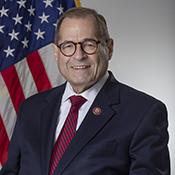
Jerrold Nadler
DDemocratNY-12 · Representative
57
/ 100
Average
Attendance89
Avg: 96
Independence1
Avg: 4
Bipartisan Tone26
Avg: 15
Ethics Record100
Avg: 99
Transparency60
Avg: 53
Accountability Score — composite of attendance, independence, bipartisan tone, ethics record & transparency.
Methodology14
Bills Sponsored
0
Enacted into Law
0
Passed a Chamber
14
In Committee
All Sponsored Bills
HR10372In Committee
FABRIC Act
HR9995In Committee
Restoring Justice for Workers Act
The legislation would prevent employers from requiring workers to sign agreements that force them to resolve workplace disputes through private arbitration instead of going to court or filing complaints with government agencies. This would give employees more options when dealing with issues like wage theft, discrimination, or unsafe working conditions, allowing them to pursue cases in public courts where there's typically more transparency and the ability to appeal decisions. The change would primarily affect workers across all industries and the companies that employ them.
HR9996In Committee
No Surprise Bills for New Moms Act
The bill would require health insurance plans to automatically cover newborns from birth without requiring parents to take additional steps to add them to their policy. This change would affect workers with employer-sponsored insurance, people who buy insurance on their own, and insurance companies by ensuring babies have immediate health coverage after they're born. The proposal aims to eliminate gaps in coverage that can occur when newborns aren't formally enrolled in their parents' health plans.
HR8522In Committee
PROTECT Act
The proposal would prevent the federal government from naming, renaming, or dedicating any federal buildings, lands, or other government assets after Donald J. Trump. This would apply to all federal properties going forward, affecting decisions made by federal agencies and Congress about how to honor or designate government facilities. The bill is currently under review by three House committees that handle transportation, natural resources, and government oversight.
HR8226In Committee
Helicopter Safety Parity Act of 2026
This bill would require helicopters used for emergency medical services and rescue operations to meet the same safety standards and equipment requirements as commercial airplanes, potentially including improved crash protection and emergency systems. The measure aims to reduce injuries and deaths among patients, medical crews, and rescue personnel who depend on helicopter transport in urgent situations. Helicopter operators and manufacturers would need to upgrade their fleets to comply with these new standards.
HRES985In Committee
Expressing opposition to the use of onychectomy, also known as declawing, for elective surgery in cats.
This resolution expresses Congress's opposition to declawing cats for non-medical reasons, calling the procedure harmful to the animals' health and welfare. The measure reflects growing concern among lawmakers and veterinarians that elective declawing—removing a cat's claws surgically—causes pain, behavioral problems, and long-term complications for pets. The resolution does not ban the practice but signals that Congress believes cat owners and veterinarians should avoid the procedure except when medically necessary.
HR5068In Committee
MORE Act
Marijuana Opportunity Reinvestment and Expungement Act or the MORE Act This bill decriminalizes marijuana. Specifically, it removes marijuana from the list of scheduled substances under the Controlled Substances Act and eliminates criminal penalties for an individual who manufactures, distributes, or possesses marijuana. The bill replaces statutory references to marijuana and marihuana with cannabis . The bill also makes changes related to the economic impact of decriminalization, including the following: requires the Bureau of Labor Statistics to regularly publish demographic data on cannabis business owners and employees, establishes a trust fund to support various programs and services for individuals and businesses in communities impacted by the war on drugs, imposes an excise tax on cannabis products produced in or imported into the United States and an occupational tax on cannabis production facilities and export warehouses, and makes Small Business Administration loans and services available to entities that are cannabis-related legitimate businesses or service providers. The bill also makes changes to other federal programs and legal processes to account for decriminalization, including the following: prohibits the denial of federal public benefits to a person on the basis of certain cannabis-related conduct or convictions, prohibits the denial of benefits and protections under immigration laws on the basis of an event (e.g., conduct or conviction) relating to possession or use of cannabis that is no longer prohibited under the bill, and establishes a process to expunge convictions and conduct sentencing review hearings related to federal cannabis offenses.
HR6806In Committee
Antisemitism Response and Prevention Act of 2025
This bill would establish federal measures to combat antisemitism and protect Jewish Americans from discrimination and harassment. It likely includes provisions for education programs, law enforcement training, and support for communities experiencing antisemitic incidents, while potentially addressing antisemitism in schools and public spaces. The bill affects schools, law enforcement agencies, and Jewish communities across the country.
HR4605In Committee
End Prescription Drug Ads Now Act
The proposal would ban pharmaceutical companies from advertising prescription drugs directly to consumers on television, radio, and online platforms. Currently, drug makers spend billions of dollars on ads encouraging people to ask their doctors about specific medications, but this bill would eliminate that advertising while still allowing ads for over-the-counter drugs and medical devices. The change would primarily affect pharmaceutical companies' marketing budgets and could reduce the number of medication requests patients bring to their doctors' appointments.
HR4108In Committee
Refuge From Cruel Trapping Act
HR3196In Committee
Improving Helicopter Safety Act of 2025
Improving Helicopter Safety Act of 2025 This bill generally prohibits the operation of a civil helicopter within a 20-mile radius of the Statue of Liberty National Monument in New York, New York. The bill includes an exception for flights carried out for the purposes of (1) public health and safety (e.g., for law enforcement or the provision of medical services), or (2) heavy-lift operations in support of construction and infrastructure maintenance. The Federal Aviation Administration must issue or update regulations to carry out the requirements of this bill.
HR3045In Committee
West Bank Violence Prevention Act of 2025
This bill aims to address violence in the West Bank region, likely through measures such as sanctions, restrictions on aid, or diplomatic actions targeting individuals or groups responsible for attacks. The legislation would affect U.S. foreign policy toward the Israeli-Palestinian territories and could impact American funding or trade relationships in the region. Congress is currently reviewing the bill to determine which committees should handle different parts of it.
HR2339In Committee
Children’s Health Protection Act of 2025
This bill would strengthen environmental protections specifically aimed at safeguarding children's health by limiting their exposure to harmful chemicals and pollutants. It likely establishes new rules or enforcement mechanisms for industries and products that could affect children, such as restrictions on toxic substances in consumer goods, food, water, or air quality standards. Families with children, manufacturers of children's products, and environmental agencies would be the primary groups affected by these new protections.
HR1135In Committee
Polluters Pay Climate Fund Act of 2025
This bill would create a new tax or fee on companies that emit greenhouse gases or produce fossil fuels, with the money collected going into a fund to support climate-related projects and initiatives. The revenue would likely be used for things like renewable energy development, infrastructure upgrades, or climate adaptation efforts, shifting some of the financial burden of addressing climate change onto the industries that produce the most pollution. The proposal affects oil, gas, coal, and other energy companies, as well as potentially large manufacturers and industrial polluters.