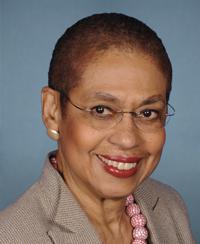
Eleanor Holmes Norton
DDemocratDC · Representative
52
/ 100
Average
Attendance92
Avg: 96
Independence4
Avg: 4
Bipartisan Tone2
Avg: 15
Ethics Record100
Avg: 99
Transparency55
Avg: 53
Accountability Score — composite of attendance, independence, bipartisan tone, ethics record & transparency.
Methodology68
Bills Sponsored
0
Enacted into Law
2
Passed a Chamber
66
In Committee
All Sponsored Bills
HRES1571In Committee
Expressing support for the designation of September 23, 2026, as "Mary Church Terrell Day", and calling on Congress to recognize Mary Church Terrell's lasting contributions to the civil rights and women's rights movements.
HR10396In Committee
No Fencing at the United States Capitol Complex Act
HR9104In Committee
Rock Creek National Park Act of 2026
The proposal would change Rock Creek Park's official designation from a national park to a national park, giving it a new name and potentially adjusting its management structure. This change would primarily affect how the park in Washington, D.C. is administered and could impact visitors, local residents, and park management agencies. The bill is currently under review by the House Committee on Natural Resources.
HRES1518In Committee
Expressing support for the designation of September 2026 as National Campus Sexual Assault Awareness Month.
This resolution supports the designation of National Campus Sexual Assault Awareness Month.
HR10172In Committee
To amend title 38, United States Code, to extend eligibility for survivors' and dependents' educational assistance to the dependent parent of a person who dies of a service-connected disability or has a total and permanent service-connected disability, and for other purposes.
HRES1502In Committee
Expressing support for the designation of September 2026 as "Peace Month" and calling on Congress to take action to promote peace.
HRES1485In Committee
Expressing support for the designation of August 22, 2026, as "Chuck Brown Day", and honoring Chuck Brown's contributions to music and to the District of Columbia.
HRES1480In Committee
Honoring the lives, work, and sacrifice of Joseph Curseen, Jr., and Thomas Morris, Jr., the 2 United States Postal Service employees who died as a result of their contact with anthrax while working at the United States Postal facility located at 900 Brentwood Road NE, Washington, DC, during the anthrax attack in the fall of 2001; United States Postal Service employees, who have continued to work diligently in service to the people of the United States notwithstanding the anthrax attack; as well as the other 3 Americans who died and the 17 who became ill in the attack.
HR10062In Committee
Promoting National Service and Reducing Unemployment Act
HR10035In Committee
Protecting Independent Contractors from Discrimination Act of 2026
The proposal would require companies to classify independent contractors as employees, giving them the same workplace protections and benefits as regular employees including protection from discrimination based on race, age, disability, and genetic information. This would affect millions of gig workers, freelancers, and contractors across industries like delivery, rideshare, and consulting by entitling them to minimum wage, overtime pay, and other labor standards. The change would expand legal protections for independent workers but could increase costs for companies that rely on contractor workforces.
HR10034In Committee
RECOVER PII Act
When federal agencies experience data breaches that expose people's personal information like Social Security numbers or addresses, this bill would require the government to provide free identity protection services (such as credit monitoring and fraud alerts) to affected individuals. The measure extends protections that were previously available only temporarily, making them available to more people whose data was compromised in recent breaches at federal agencies. This would help protect Americans from identity theft and fraud that could result from their personal information being stolen.
HR9967In Committee
Congress Leads by Example Act of 2026
Congress would strengthen workplace safety rules and whistleblower protections for its own employees, giving them the same kinds of protections that apply to workers in private companies and other government agencies. The changes would allow Congress's internal oversight body to enforce safety standards more effectively and protect staff members who report unsafe conditions or illegal activity from retaliation. Currently, legislative branch employees have fewer workplace protections than other American workers.
HR9815In Committee
Federal Bureau of Prisons Voting Assistance Act of 2026
The federal government would be required to give prisoners information about how to register to vote and cast ballots while incarcerated or after release. This would ensure that inmates understand their voting rights and have access to the resources needed to participate in elections, affecting millions of people currently in federal prisons and those preparing for reentry into society.
HR9685In Committee
No New Fencing At the White House Act
The proposal would ban the use of any federal, state, foreign, or private money to build permanent fencing around the White House and its surrounding grounds. This would affect the Secret Service and other government agencies responsible for White House security, as well as any private donors or foreign entities that might contribute funding for such construction. The measure essentially prevents the installation of a permanent barrier fence around the presidential complex regardless of the funding source.
HR9654In Committee
National Capital Revitalization and Self-Government Improvement Act of 1997 Technical Corrections Act of 2026
This bill would expand survivor benefits for families of DC police officers, firefighters, and teachers by treating domestic partners the same as married spouses when determining who receives death benefits. It would also allow surviving spouses to remarry at a younger age without losing their benefits, matching the rules that apply to families of federal employees. The changes would apply to both federal and DC government-paid survivor benefit programs.
HR9386In Committee
United States Commission on an Open Society with Security Act of 2026
United States Commission on an Open Society with Security Act of 2026 This bill establishes the United States Commission on an Open Society with Security to study how the government may provide for both security in, and public access to, federal buildings and other federal property and sites. The commission shall examine (1) government and private security practices and proposals, building design, public space management, counterterrorism needs, and refurbishment of existing federal facilities; (2) the effect of access to public facilities and spaces on constitutional rights and civil liberties, economies of affected jurisdictions, architectural aesthetics, traffic and congestion, and employee job performance; (3) technology to augment or replace traditional modes of security; and (4) methods of assessing the risks posed by terrorism, balanced against the needs and values of open access.
HR9597In Committee
Civil War Defenses of Washington National Historical Park Act
The proposal would create a new national historical park dedicated to the Civil War defenses that protected Washington, D.C., bringing together existing park lands across the District of Columbia, Virginia, and Maryland along with related sites from the 1864 Shenandoah Valley Campaign. It would also direct the National Park Service to study how to better present and teach Civil War history from both Northern and Southern perspectives to visitors. This would affect history enthusiasts, educators, and tourists interested in Civil War sites and interpretation.
HR9598In Committee
No Fencing at Lafayette Square Act
The proposal would prevent the government from using any federal, state, foreign, or private money to build permanent fencing around Lafayette Square, the public park near the White House in Washington, D.C. This affects federal agencies, state governments, and private organizations that might otherwise fund such construction projects. The bill essentially protects public access to the park by blocking funding for barriers that could restrict who can enter the area.
HR9525In Committee
Federal Bureau of Prisons Medical Care Act of 2026
The proposal would restrict prisons from charging inmates fees for medical care and treatment. Currently, some correctional facilities charge prisoners for doctor visits, medications, and other health services, which this bill would limit or eliminate. The change would affect incarcerated people who need medical attention while in prison.
HR9362In Committee
District of Columbia Courts Judicial Vacancy Reduction Act
The proposal would change how judges are selected for Washington D.C.'s courts by allowing them to be appointed automatically without needing approval from the U.S. Senate, which currently has a say in the process. This would give D.C. more control over its own judicial system, though it represents a significant shift in how federal oversight of the district's courts currently works. The change would primarily affect D.C. residents and the local court system that handles their cases.
HR9198In Committee
National Commission to Combat Workplace Sexual Harassment Act
The proposal would establish a national commission to investigate and address sexual harassment in workplaces across the country, bringing together experts to study the problem and recommend solutions. The commission would work to develop strategies that help employers prevent harassment, support victims, and hold wrongdoers accountable, affecting workers in all industries and the companies that employ them.
HR9038In Committee
No Fencing at the United States Supreme Court Act
The federal government would be banned from spending money to build permanent fences around the Supreme Court building or its surrounding grounds. This measure would prevent the installation of lasting physical barriers that could restrict public access to the area around the nation's highest court. The proposal is currently under review by the House Committee on Transportation and Infrastructure.
HRES1304In Committee
Recognizing on Memorial Day, May 25, 2026, the denial of voting representation in Congress and full local self-government through statehood for active duty servicemembers, National Guard members, reservists, veterans, and their families who are residents of the District of Columbia.
This resolution would use Memorial Day 2026 to highlight that active-duty military members, National Guard and reserve personnel, veterans, and their families living in Washington, D.C. cannot vote for members of Congress or have full local self-government because D.C. is not a state. The resolution calls attention to the fact that these service members and their families lack the same voting rights and representation as Americans living in the 50 states.
HR8731In Committee
Federal Employee Short-Term Disability Insurance Act of 2026
Federal employees would gain access to a new short-term disability insurance program that covers injuries and illnesses unrelated to their jobs, filling a gap in current benefits that only cover work-related disabilities. This program would help federal workers maintain income during recovery periods for conditions like surgery recovery or illness, similar to what many private sector employees receive. The proposal is currently under review by the House Committee on Oversight and Government Reform.
HR8663In Committee
Fair Pay Act of 2026
The legislation would strengthen federal law to make it illegal for employers to pay workers different wages based on their sex, race, or national origin, and would give workers better tools to challenge unfair pay practices. This would affect all private employers and could help close wage gaps that currently exist between different groups of workers. The bill is currently under review by the House Committee on Education and Workforce.
HRES1244In Committee
Recognizing the disenfranchisement of District of Columbia residents, calling for statehood for the District of Columbia through the enactment of the Washington, D.C. Admission Act, and expressing support for the designation of May 1, 2026, as "D.C. Statehood Day".
This resolution calls for Washington, D.C. to become a state with full representation in Congress, arguing that the district's residents are denied voting rights that other Americans have. The measure also proposes designating May 1, 2026, as "D.C. Statehood Day" to recognize the push for equal political representation for the roughly 700,000 people who live in the nation's capital but currently cannot vote for members of Congress or have voting senators.
HR8420In Committee
Veterans Legal Support Act of 2026
The legislation would provide funding and resources to help veterans access legal assistance for issues like disability benefits claims, housing disputes, and other legal matters they face after leaving military service. Veterans would be able to get free or low-cost legal help through expanded programs and partnerships with law firms and nonprofits. This would make it easier for former service members to navigate the legal system and protect their rights without having to pay for expensive lawyers.
HRES1180In Committee
Recognizing the enduring cultural and historical significance of emancipation in the Nation's capital on the anniversary of President Abraham Lincoln's signing of the District of Columbia Compensated Emancipation Act, which established the "first freed" on April 16, 1862, and celebrating passage of the District of Columbia statehood bill in the House of Representatives.
This resolution honors the historical significance of April 16, 1862, when President Lincoln signed the law that freed enslaved people in Washington, D.C., making them the first to be emancipated by federal action during the Civil War. It also celebrates the House's passage of a bill to make Washington, D.C. a state. The resolution is primarily ceremonial and does not create new laws or policies.
HR8227In Committee
Paul Laurence Dunbar Commemorative Coin Act
The government would create and sell special commemorative coins honoring Paul Laurence Dunbar, a celebrated African American poet and writer from the late 1800s. Revenue from coin sales would likely go toward educational programs or monuments related to Dunbar's legacy. This type of commemorative coin is a way for the U.S. to recognize important historical figures while generating funds for related causes.
HR7650In Committee
McIntire-Stennis Act District of Columbia Equality Act
This bill would extend federal forestry research funding and programs that currently apply to states to also include Washington, D.C., treating the nation's capital the same way as states for agricultural and forest management purposes. The change would allow D.C. to access grants and participate in forestry research initiatives that help develop better practices for managing forests and addressing agricultural challenges. This primarily affects D.C. residents and local government agencies involved in land management and environmental research.
HR8164In Committee
Ensuring Child Health Coverage Compensation in Divorce Act of 2026
When parents divorce, this bill would require courts to ensure that health insurance coverage for children is properly maintained and that one parent compensates the other if they lose coverage or face higher costs as a result of the split. The law would apply to families going through divorce proceedings and aims to prevent children from losing health insurance or experiencing gaps in coverage during and after a divorce. It affects divorced parents, their children, and potentially health insurance companies involved in these family situations.
HR8062In Committee
Ensuring Full Participation in the Census Act of 2026
This bill aims to increase participation rates in the decennial census by making it easier and more accessible for all Americans to respond. The legislation likely includes measures such as extending response deadlines, improving outreach to hard-to-count populations, or simplifying the census form itself. Higher census participation directly affects how federal funding and congressional representation are distributed among states and communities.
HR7946In Committee
Jury Duty Exemption for Breastfeeding Act of 2026
Jury Duty Exemption for Breastfeeding Act of 2026 This bill allows an individual who is breastfeeding to be excused from jury duty in a federal court or a court of the District of Columbia upon request by the individual.
HR7881In Committee
District of Columbia Juror Pay Parity Act
This bill would increase the daily pay that jurors receive when serving on cases in Washington, D.C. courts to match what federal jurors earn elsewhere in the country. Currently, D.C. jurors are paid less than their counterparts in federal courts, which can create financial hardship for ordinary citizens called to serve on juries and may discourage people from showing up for jury duty.
HRES1094In Committee
Calling on the Senate to ratify the Convention on the Elimination of All Forms of Discrimination Against Women.
This resolution calls on the Senate to ratify the UN Convention on the Elimination of All Forms of Discrimination Against Women, also known as CEDAW.
HR7629In Committee
Pittman-Robertson Wildlife Restoration Act and Dingell-Johnson Sport Fish Restoration Act District of Columbia Equality Act of 2026
This bill would extend federal wildlife and sport fish restoration funding programs to Washington, D.C., allowing the district to receive grants for conservation projects and outdoor recreation facilities that are currently available only to the 50 states. The funding comes from excise taxes on hunting and fishing equipment, and D.C. would use these grants to manage wildlife habitats, improve fishing areas, and support outdoor recreation programs for residents. This change would give D.C. equal access to federal conservation resources that other jurisdictions have used for decades.
HR7441In Committee
Bayard Rustin Stamp Act
This bill would authorize the U.S. Postal Service to issue a commemorative stamp honoring Bayard Rustin, a civil rights activist and organizer of the 1963 March on Washington. The stamp would recognize Rustin's contributions to the civil rights movement and American history. This is a symbolic gesture that allows the government to celebrate an important historical figure through postal service.
HR7317In Committee
Golden Thirteen Congressional Gold Medal Act
Golden Thirteen Congressional Gold Medal Act This bill provides for the posthumous award of a Congressional Gold Medal to the Golden Thirteen (i.e., the first 13 Black officers in the U.S. Navy), in recognition of their contributions to the country.
HR7162In Committee
To amend title 40, United States Code, to permit commercial filmmaking and photography on the United States Capitol grounds, and for other purposes.
The proposal would allow film and photography companies to shoot commercial movies and TV shows on the grounds of the U.S. Capitol building, something that is currently restricted. This would affect production companies and filmmakers who want to use the iconic Capitol as a backdrop for their projects, while also potentially generating revenue for the government through filming permits and fees. The change would need to go through Congress's committee process before it could become law.
HR6950In Committee
District of Columbia Transportation Funding Equality Act
District of Columbia Transportation Funding Equality Act This bill makes the District of Columbia eligible for certain Department of Transportation (DOT) grant programs by treating the District as a state under the programs. Specifically, the bill applies to the Bus and Bus Facilities Grant Program, which provides funding for capital expenses to purchase and rehabilitate buses and to construct bus-related facilities. Under the program, a state is eligible for higher payments than a territory. Currently, the District is treated as a territory under the program. The bill also treats the District as a state under two additional DOT programs. The National Culvert Removal, Replacement, and Restoration Grant Program provides competitive grants to eligible entities for projects that meaningfully improve or restore fish passage for certain types of fish. The Safe Streets and Roads for All grant program supports initiatives to prevent roadway deaths and serious injuries. Currently, the District is not included under either of these programs. Further, the bill treats the District as a state for purposes of the Growing States and High Density States Formula, which provides additional money to some places (e.g., states with a population density greater than 370 persons per square mile) and is distributed through the Urbanized and Rural Area Formula Programs. Currently, the District is not included under the formula.
HR6929In Committee
Thrift Savings Plan Emergency Withdrawal Act of 2025
This bill would allow federal employees and military members to withdraw money from their Thrift Savings Plan retirement accounts early without the usual tax penalties in cases of financial hardship or emergency. Currently, people who take money out before retirement age face significant taxes and penalties, but this legislation would create an exception for qualifying emergencies. The change would help federal workers and service members access their own savings during crises without losing a large portion to taxes.
HR6807In Committee
Marijuana in Federally Assisted Housing Parity Act of 2025
The proposal would allow people living in federally funded housing to use marijuana for medical purposes without risking eviction or losing their housing assistance, bringing federal housing rules in line with state marijuana laws. Currently, public housing authorities can evict residents for any marijuana use, even in states where it's legal, because federal law still classifies marijuana as illegal. This change would affect millions of low-income renters who depend on federal housing programs.
HR5856In Committee
District of Columbia Government Title Equality Act
District of Columbia Government Title Equality Act This bill amends the District of Columbia (DC) Home Rule Act to change the titles of DC elected officials and offices so that the titles correspond to terms used by state governments. Under the bill, the Office of the Mayor becomes the Office of the Governor, the Council becomes the Legislative Assembly, and the Chairman of the Council becomes the Speaker of the Legislative Assembly.
HR5805In Committee
Federal Government Advertising Equity Accountability Act
HR5698In Committee
District of Columbia Clemency Home Rule Act
District of Columbia Clemency Home Rule Act This bill authorizes the District of Columbia to legislate the terms and conditions under which clemency may be granted for violations of District criminal laws. Under the bill, clemency is defined as a pardon, reprieve, or a commutation of a sentence, or a remission of a fine or other financial penalty.
HRES763In Committee
Expressing support for the designation of September 2025 as National Campus Sexual Assault Awareness Month.
This resolution supports the designation of National Campus Sexual Assault Awareness Month.
HRES753In Committee
Expressing support for the designation of September 2025 as "Peace Month" and calling on Congress to take action to promote peace.
This resolution expresses support for designating September 2025 as "Peace Month" and encourages Congress to take steps promoting peace, though it does not create any binding requirements or new laws. The measure is largely symbolic, calling attention to peace-related initiatives without establishing specific programs or funding. It has been referred to the House Committee on Oversight and Government Reform for consideration.
HR2693In Committee
District of Columbia Electronic Transmittal of Legislation Act
District of Columbia Electronic Transmittal of Legislation Act This bill authorizes the District of Columbia (DC) Council to transmit legislation, including amendments to the DC Charter, to Congress by electronic means. (Current law requires most nonemergency DC legislation to be transmitted to Congress for a period of congressional review.)
HR5093In Committee
District of Columbia National Guard Home Rule Act
This bill would give the District of Columbia more control over its own National Guard operations instead of having them controlled by the federal government, similar to how states manage their National Guard units. The change would affect how the D.C. National Guard is organized, funded, and deployed, potentially giving local leaders more say in military readiness decisions that affect the district. This is part of a broader effort to expand D.C.'s self-governance in areas traditionally reserved for the federal government.
HR5092In Committee
District of Columbia Police Home Rule Act
The proposal would give Washington, D.C. more control over its own police department by reducing federal oversight and allowing local officials to make decisions about police operations, budgets, and policies. This change would affect D.C. residents and police officers by shifting power from Congress to the city's elected government, similar to how police departments operate in other U.S. cities. The measure reflects an ongoing debate about whether the nation's capital should have the same self-governing authority as other municipalities.
HR5070In Committee
Federal Police Camera and Accountability Act
Federal Police Camera and Accountability Act This bill establishes requirements for federal law enforcement officers to wear body cameras and for federal law enforcement agencies to install video cameras in patrol cars.
HR4934In Committee
Albert Pike Statue Removal Act
Albert Pike Statue Removal Act This bill directs the National Park Service to remove the statue of Albert Pike near Judiciary Square in the District of Columbia. The Department of the Interior may donate the statue to a museum or other similar entity, as determined appropriate by Interior to ensure its preservation and interpretation in an indoor setting. The recipient of the statue may not store, display, or exhibit the statue outdoors. If the statue is stored, displayed, or exhibited outside, ownership of the statue will revert back to the federal government.
HR4608In Committee
Francis G. Newlands Memorial Removal Act
The proposal would remove a memorial dedicated to Francis G. Newlands from public lands, likely a statue or monument on federal property. This affects how the government manages public spaces and what historical figures are commemorated on taxpayer-owned land. The House Committee on Natural Resources is currently reviewing the measure.
HR4574In Committee
District of Columbia Courts Home Rule Act
District of Columbia Courts Home Rule Act This bill authorizes the District of Columbia (DC) Council to pass legislation related to the organization and jurisdiction of the DC courts. Current law prohibits such legislation from being enacted.
HR3650In Committee
Federal Gift Shop Tax Act
Federal Gift Shop Tax Act This bill allows each U.S. state, the District of Columbia, American Samoa, Guam, the Northern Mariana Islands, Puerto Rico, and the U.S. Virgin Islands (or a political subdivision of the state or territory) to impose a sales tax on any purchase made in person or online at a gift shop located on federal property.
HRES440In Committee
Recognizing on Memorial Day, May 26, 2025, the denial of voting representation in Congress and full local self-government through statehood for active duty servicemembers, National Guard members, reservists, veterans, and their families who are residents of the District of Columbia.
This resolution calls for recognizing on Memorial Day 2025 that active duty military members, National Guard members, reservists, veterans, and their families living in Washington, D.C. cannot vote for representatives in Congress or have full local control over their government because D.C. is not a state. The resolution highlights the irony that these service members and their families lack voting representation despite their military service to the country.
HR3299In Committee
Restroom Access Act of 2025
Restroom Access Act of 2025 This bill requires businesses to allow a customer to use a nonpublic restroom if the customer has an eligible medical condition (e.g., inflammatory bowel disease) that requires immediate access to a restroom and other conditions are met. The Department of Labor must establish a system of identification cards for customers with eligible medical conditions to present to businesses.
HRES374In Committee
Recognizing the disenfranchisement of District of Columbia residents, calling for statehood for the District of Columbia through the enactment of the Washington, D.C. Admission Act, and expressing support for the designation of May 1, 2025, as "D.C. Statehood Day".
This resolution calls for making Washington, D.C. a state rather than a federal district, which would give its roughly 700,000 residents voting representation in Congress and the ability to elect a senator and representative like other states. Currently, D.C. residents can vote in presidential elections but have no voting members in Congress, making them unable to directly influence federal laws that affect them. The resolution also designates May 1, 2025, as "D.C. Statehood Day" to recognize this issue.
HRES333In Committee
Recognizing the enduring cultural and historical significance of emancipation in the Nation's capital on the anniversary of President Abraham Lincoln's signing of the District of Columbia Compensated Emancipation Act, which established the "first freed" on April 16, 1862, and celebrating passage of the District of Columbia statehood bill in the House of Representatives.
This resolution honors April 16, 1862, when President Lincoln signed the law that freed enslaved people in Washington, D.C., making them the first freed under federal authority, and also celebrates the House's passage of a bill to make D.C. a state. The measure recognizes the historical importance of emancipation in the nation's capital and acknowledges this milestone in American history. It does not create new laws or policies but rather serves as a formal statement of recognition by Congress.
HR2219In Committee
Salary History Question Prohibition Act
Employers would be banned from asking job applicants about their previous salaries or salary history during the hiring process. The law aims to help workers, especially women and minorities who have historically faced wage discrimination, by preventing employers from using past low pay to justify offering lower salaries. This change would apply to most private employers and could help reduce pay gaps by allowing workers to negotiate based on the job's value rather than what they earned before.
HR2007In Committee
Salary Transparency Act
This bill would require employers to disclose salary ranges in job postings and provide pay information to current employees, making it easier for workers to understand what they should be earning and compare compensation across companies. The law would apply to most private employers and could help reduce wage gaps by increasing transparency around how much different jobs and positions actually pay. Workers and job seekers would benefit by having clearer information about compensation before applying, while employers would need to adjust their hiring practices to comply with the new disclosure requirements.
HR1537In Committee
District of Columbia Superior Court Jury Duty for Seniors Opt Out Act of 2025
This bill would allow people age 75 and older in Washington, D.C. to opt out of jury duty without having to provide a reason or appear in court. The change would make it easier for seniors to avoid the time commitment of serving on juries while still allowing younger residents to fulfill this civic responsibility.
HR1429In Committee
Activating National Parks in Cities Act
This bill would establish or expand national parks and protected natural areas in or near major cities to give more Americans access to outdoor recreation and green spaces without having to travel far. The legislation aims to bring the benefits of national parks—like hiking trails, wildlife viewing, and nature education—to urban and suburban communities that currently lack nearby federal parkland. This would affect city residents, outdoor enthusiasts, and local communities by creating new recreational opportunities and potentially boosting tourism in urban areas.
HR1022In Committee
Words Matter for the District of Columbia Courts Act
HR880In Committee
Household Goods Shipping Consumer Protection Act
Household Goods Shipping Consumer Protection Act This bill allows the Federal Motor Carrier Safety Administration (FMCSA) to assess civil penalties against motor carriers, brokers, and freight forwarders for violations related to the interstate transportation of household goods and provides states with additional related authorities. As background, a broker is the “middle person” between a shipper and a motor carrier and arranges for the transportation of household goods. A freight forwarder organizes shipments for individuals or corporations. Unlike a broker, freight forwarders assume responsibility for transportation and may transport the freight itself. The bill expands the FMCSA registration requirements to require motor carriers, brokers, and freight forwarders to designate a principal place of business (i.e., a single physical location where management officials report to work, a significant portion of the transportation business is conducted, and records are maintained). FMCSA may withhold, suspend, amend, or revoke any part of a registration for failure to designate. In addition, brokers and freight forwarders must disclose any common ownership, management, control, or familial relationship with any other carrier, freight forwarder, broker, or applicant in the previous three years. Under current law, motor carriers must disclose this information. Further, states may use certain grant funds to enforce federal household goods statutes and regulations for the interstate transportation of these goods by motor carriers and brokers. This applies to Motor Carrier Safety Assistance Program (MCSAP) grant funds and MCSAP High Priority discretionary grant funds. A state shall retain collected fines that are a result of enforcement.
HR189Passed House
Securities and Exchange Commission Real Estate Leasing Authority Revocation Act
Securities and Exchange Commission Real Estate Leasing Authority Revocation Act This bill revokes the authority of the Securities and Exchange Commission (SEC) to lease general purpose office space and instead provides for the General Services Administration to lease such space for the SEC. The bill's provisions do not affect those leases entered into by the SEC before this bill's enactment. The Government Accountability Office must (1) complete a review under which it shall update a 2016 report with respect to independent leasing authorities, and (2) report to Congress on the review.
HR51In Committee
Washington, D.C. Admission Act
Washington, D.C. Admission Act This bill provides for the establishment of the State of Washington, Douglass Commonwealth, and its admission into the United States. The state is composed of most of the territory of the District of Columbia (DC), excluding a specified area that encompasses the U.S. Capitol, the White House, the U.S. Supreme Court building, federal monuments, and federal office buildings adjacent to the National Mall and the U.S. Capitol. The excluded territory shall be known as the Capital and serve as the seat of the government of the United States, as provided for in Article I of the Constitution. The state may not impose taxes on federal property except as Congress permits. The bill provides for the DC Mayor to issue a proclamation for the first elections to Congress of two Senators and one Representative of the state. The bill eliminates the office of Delegate to the House of Representatives. The bill applies current DC laws to the state. DC judicial proceedings and contractual obligations shall continue under the state’s authority. The bill also provides for specified federal obligations to transfer to the state upon its certification that it has funds and laws in place to assume the obligations. These include maintaining a retirement fund for judges and operating public defender services. The bill establishes a commission that is generally comprised of members who are appointed by DC and federal government officials to advise on an orderly transition to statehood.
HR5494Passed House
To direct the Secretary of the Interior to transfer certain properties to the District of Columbia.
(This measure has not been amended since it was reported to the House on September 16, 2010. The summary of that version is repeated here.) Directs the Secretary of the Interior to transfer specified lands to the District of Columbia.