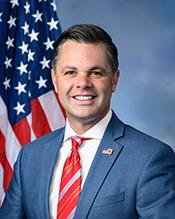
Zachary Nunn
RRepublicanIA-3 · Representative
61
/ 100
Average
Attendance95
Avg: 96
Independence4
Avg: 4
Bipartisan Tone9
Avg: 15
Ethics Record100
Avg: 99
Transparency100
Avg: 53
Accountability Score — composite of attendance, independence, bipartisan tone, ethics record & transparency.
Methodology41
Bills Sponsored
0
Enacted into Law
6
Passed a Chamber
35
In Committee
All Sponsored Bills
HR2978Passed House
GUARD Act
Guarding Unprotected Aging Retirees from Deception Act of 2026 or the GUARD Act of 2026 This bill allows state, local, and tribal law enforcement agencies and grantees that receive funds from certain law enforcement grant programs to use the funds to investigate general financial fraud, elder financial fraud, and pig butchering. Pig butchering refers to a confidence and investment fraud in which a victim is gradually lured into transferring increasing amounts of money, generally in the form of cryptocurrency, into a fake virtual investment. The bill allows federal law enforcement agencies to assist state, local, and tribal law enforcement agencies and fusion centers in the use of tracing tools for blockchain and related technology tools. Finally, the bill requires the Financial Crimes Enforcement Network (FinCEN) to report on efforts to combat general financial fraud, elder financial fraud, pig butchering, and scams, including an evaluation of any legislative recommendations to improve the efforts. The bill also requires FinCEN to report on the state of general financial fraud, elder financial fraud, pig butchering, and scams in the United States, including trends in the crimes.
HRES1553In Committee
Expressing support for the designation of the week of September 21, 2026, as the "Ray Gaesser Memorial Farm Safety Week" to recognize the life and legacy of Ray Gaesser, who passed away in a tragic farming accident, and promote farm safety in the honor of Ray Gaesser.
HR4936In Committee
TRAPS Act
The TRAPS Act addresses financial regulations and practices in the banking and financial services sector, though the specific provisions are not detailed in the available information. Based on its referral to the House Financial Services Committee, the bill likely aims to modify how financial institutions operate, potentially affecting banks, investment firms, and their customers. The exact impact on consumers, businesses, or financial markets would depend on the bill's specific requirements once it moves through the legislative process.
HR10234In Committee
CLEAR Forms Act
HR10283In Committee
Congressional Pension Accountability Act
HR7187In Committee
Clarity for Compensation Act
Clarity for Compensation Act This bill allows individuals who work for registered brokers to receive compensation for their services through their own personal businesses without having to register with the Securities and Exchange Commission (SEC). Specifically, the bill exempts certain personal services entities from SEC broker regulations. As background, brokers (persons engaged in the business of making securities transactions on behalf of others) must register with the SEC and become members of a self-regulatory organization (SRO). Under this bill, a personal services entity is an entity established by a registered representative to receive compensation for services from the registered representative's broker. A registered representative works for the broker (deemed an associated person of the broker) and is registered with the appropriate SRO. Under this bill, a personal services entity is not considered a broker for SEC regulatory purposes when receiving compensation from the registered representative's broker on the registered representative's behalf if the broker approves and maintains records of the payment, the personal services entity does not hold itself out as a broker or otherwise engage in broker or dealer activity, the broker exercises adequate supervision and control over the registered representative, the broker and personal services entity have a written agreement regarding their relationship and compensation arrangement, and the personal services entity is owned by the representative, the representative's family, or other similar entities. The personal services entity must maintain certain records and make them available to the SEC and the appropriate SRO upon request.
HR9686In Committee
FARM AI Act of 2026
The proposal would expand the Department of Agriculture's programs to help farmers and rural communities gain better access to artificial intelligence tools and technology. This could help agricultural businesses use AI for tasks like crop monitoring, predicting yields, managing resources more efficiently, and making better farming decisions. The measure affects farmers, agricultural companies, and rural areas that currently have limited access to these advanced technologies.
HR9321In Committee
To temporarily expand the authorized uses of grants awarded under the Veterans Legacy Program of the National Cemetery Administration, and for other purposes.
The proposal would allow the Veterans Legacy Program, which provides grants to help preserve and maintain veterans' cemeteries and memorials, to use those funds for additional purposes beyond their current restrictions. This would give cemetery administrators more flexibility in how they spend grant money to support their facilities and honor veterans. The change would affect veterans' organizations, cemetery operators, and communities that maintain burial grounds for military service members.
HR2152In Committee
AI PLAN Act
Artificial Intelligence Practices, Logistics, Actions, and Necessities Act or the AI PLAN Act This bill requires the Department of the Treasury, the Department of Homeland Security (DHS), and the Department of Commerce to submit a report on the risks posed by the use of artificial intelligence in the commission of financial crimes by adversarial actors. The report must describe interagency, intergovernmental, and public-private partnership activities, policies, and procedures to defend U.S. interests against the national and economic security risks posed by the use of artificial intelligence in the commission of financial crimes; provide a list of readily available resources that can be immediately deployed by federal agencies to combat these risks, and provide a list of resources needed by federal agencies to combat these risks. Risks that must be considered by the report include deepfakes, voice cloning, foreign election interference, synthetic identities, false flags that disrupt market operations, AI-supported social engineering, and general digital fraud. After submission of this report, Treasury, DHS, and Commerce must make recommendations for legislation and best practices for businesses and government entities to address these risks.
HR9072In Committee
HOME for Foster Youth Act
The proposal would change the rules for which young people can receive government help paying rent through existing housing assistance programs. Specifically, it would expand or modify who qualifies as an "eligible youth" to access rental vouchers that subsidize housing costs for low-income individuals. This would affect young people struggling to afford housing and potentially the landlords and housing agencies that administer these rental assistance programs.
HRES1315In Committee
Expressing support for the designation of May 2026 as "Renewable Fuels Month" to recognize the important role that renewable fuels play in lowering fuel prices for consumers, lessening reliance on foreign adversaries, supporting rural communities, and reducing carbon impacts.
This resolution asks Congress to officially recognize May 2026 as "Renewable Fuels Month" to highlight the benefits of renewable energy sources like ethanol and biodiesel. The designation aims to draw attention to how these fuels can help lower gas prices for everyday drivers, reduce dependence on foreign oil, support farmers and rural economies, and cut carbon emissions. It's a symbolic measure with no direct legal effect, but it signals congressional support for renewable fuel development and use.
HCONRES96Passed House
Expressing support for law enforcement officers.
This concurrent resolution expresses support for law enforcement officers. It also appreciates the contributions and recognizes the sacrifices of law enforcement officers.
HRES1233In Committee
Expressing support for the recognition of April as National Foster Sibling Connections Month.
This resolution designates April as National Foster Sibling Connections Month to raise awareness about the importance of maintaining relationships between siblings who are in the foster care system. The measure aims to highlight how sibling bonds can provide emotional support and stability for children in foster care, and to encourage policies and practices that keep brothers and sisters connected when they enter the system. The recognition would affect foster care agencies, social workers, and advocacy organizations working with children in the foster care system.
HR8383In Committee
Protecting Americans’ Savings Act
This bill would change the rules for how shareholders vote on company decisions through proxy voting, which is when investors authorize someone else to vote their shares at corporate meetings. The specific changes would likely affect how companies handle shareholder votes and what information they must provide to investors, though the exact requirements would depend on the bill's detailed provisions. This would impact publicly traded companies and their shareholders who participate in corporate governance.
HR8119In Committee
HOPE with Fertility Services Act
This bill would expand health coverage for fertility services and treatments, likely making it easier and more affordable for people struggling to have children to access options like in vitro fertilization and other reproductive medical care. The legislation would probably require health insurance plans to cover these services, affecting both individuals seeking fertility treatment and the insurance companies that provide health coverage.
HR7771In Committee
Agency Wide Resource Synchronization and Enterprise Network for Authoritative Logistics Act of 2026
This bill would create a unified system to help federal agencies better coordinate their resources, share information, and manage their supply chains and logistics operations more efficiently. The goal is to reduce waste and duplication across government by allowing different agencies to work together using a common network and data system. This would primarily affect how federal agencies operate internally, potentially saving taxpayer money through better resource management.
HR7511In Committee
Iowa National Guard Heroes Commemoration Act
This bill would establish a way to honor and commemorate Iowa National Guard members who have served or died in military service. The legislation likely creates memorials, recognition programs, or official designations to celebrate their contributions and sacrifice. It affects veterans, active-duty National Guard members, and their families in Iowa.
HRES375Passed House
Expressing support for the designation of May 2025 as Renewable Fuels Month to recognize the important role that renewable fuels play in reducing carbon impacts, lowering fuel prices for consumers, supporting rural communities, and lessening reliance on foreign adversaries.
Congress is officially recognizing May 2025 as "Renewable Fuels Month" to highlight how biofuels and other renewable energy sources help reduce pollution, keep fuel prices down for drivers, support farmers and rural economies, and reduce America's dependence on foreign oil. The resolution is largely symbolic and doesn't create new laws or programs, but it signals congressional support for expanding renewable fuel use across the country. This affects consumers who buy fuel, farmers who grow crops for biofuel production, and energy companies developing renewable alternatives.
HR2878In Committee
Daniel J. Harvey, Jr. and Adam Lambert Improving Servicemember Transition to Reduce Veteran Suicide Act
Daniel J. Harvey, Jr. and Adam Lambert Improving Servicemember Transition to Reduce Veteran Suicide Act This bill requires the Department of Veterans Affairs (VA) and Department of Defense (DOD) to provide additional information and assistance related to mental health care to veterans in the Solid Start program and members of the Armed Forces in the Transition Assistance Program. Specifically, the bill requires that counseling provided under DOD’s Transition Assistance Program include additional mental health information, including information about the risk of suicide and other potential stressors associated with separation from the Armed Forces. The bill also expands the activities that must be carried out by the VA under the Solid Start program, which is an outreach program for veterans in their first year of separation from service. Specifically, under the program, the VA must (1) assist eligible veterans who elect to enroll in the VA health care system, and (2) educate veterans about mental health and counseling services available through the Veterans Health Administration.
HR5004In Committee
Next Generation of Farmers Act of 2025
The legislation would create new programs and funding to help young and beginning farmers get started in agriculture, including assistance with purchasing land, equipment, and obtaining credit. It aims to make farming more accessible to people entering the industry by reducing financial barriers that often prevent new farmers from establishing their operations. The bill would affect aspiring farmers, agricultural lenders, and rural communities looking to sustain farming as a viable career path.
HR5280In Committee
Protecting Farmers from Natural Disasters Act of 2025
Protecting Farmers from Natural Disasters Act of 2025 This bill amends the Emergency Watershed Protection (EWP) Program to allow the Department of Agriculture (USDA) to provide for certain restoration activities. The EWP Program offers technical and financial assistance, including the purchase of floodplain easements, to safeguard people and property from floods, drought, fires, windstorms, and other natural disasters that impair a watershed. Under the bill, USDA may allow restoration above pre-disaster conditions if that restoration is in the best interest of the long-term health and protection of the watershed.
HRES957In Committee
A resolution honoring the service and sacrifice of United States Army Sergeant William Nathaniel Howard and United States Army Sergeant Edgar Brian Torres-Tovar, who were killed in action in Palmyra, Syria, in a targeted assault against United States service members on December 13, 2025.
HR5598In Committee
Revitalizing Rural Communities Act of 2025
Revitalizing Rural Communities Act of 2025 This bill reauthorizes the Department of Agriculture's Rural Economic Development Loan and Grant program through FY2030 to provide funding for rural projects through local utility organizations.
HR4346In Committee
PEACE Act of 2025
The legislation aims to promote peaceful conflict resolution and diplomatic efforts in international disputes by establishing new frameworks for mediation and dialogue between nations. It would affect foreign policy decisions, international relations, and potentially reduce military interventions by encouraging countries to pursue negotiated settlements instead. The bill has been reviewed by relevant committees and is ready for consideration by the full House of Representatives.
HR5052In Committee
Train More Nurses Act
The proposal would increase funding and support for nursing education programs to help train more nurses across the country. This would affect nursing schools, students pursuing nursing careers, and ultimately patients who need healthcare services. The bill aims to address nursing shortages by making it easier and more affordable for people to become nurses.
HR4957In Committee
Rural Housing Service Reform Act of 2025
The proposal would make changes to how the federal government provides housing loans and assistance to people in rural areas, likely making it easier or more affordable for rural residents to buy homes or improve their properties. The bill has been sent to two congressional committees that handle financial services and agriculture to review different parts of the proposal and determine whether it should move forward.
HR4935In Committee
Rural Microentrepreneur Assistance Program Act of 2025
Rural Microentrepreneur Assistance Act of 2025 This bill reauthorizes through FY2030 and revises the Rural Microentrepreneur Assistance Program (RMAP). This Department of Agriculture program provides loans and grants to eligible microenterprise development organizations to (1) capitalize revolving loan funds that provide loans to qualified rural microenterprises (i.e., sole proprietorships located in rural areas or business entities with not more than 10 full-time employees located in a rural area), and (2) provide related training and technical assistance. The bill increases the amount a rural microenterprise may borrow to up to $75,000 (from up to $50,000). The bill also increases the maximum allowable federal cost share to 100% (from 75%). The bill further specifies that a RMAP project loan may not be used to cover more than 50% of any demolition, construction, or related costs of real estate improvements.
HR4860In Committee
U.S.-Taiwan Defense Innovation Partnership Act
The bill would establish a formal partnership between the U.S. and Taiwan to collaborate on military technology development and defense innovation, allowing the two governments to share research, conduct joint projects, and strengthen their defense capabilities. This would affect defense contractors, military researchers, and government agencies in both countries by creating new opportunities for cooperation on advanced weapons systems and security technologies. The partnership aims to deepen the defense relationship between the U.S. and Taiwan in response to regional security concerns.
HR4713In Committee
Safe Schools and Communities Act of 2025
The proposal would establish new safety measures and protocols for schools to help protect students and staff from violence and other threats. It would likely require schools to implement security improvements, emergency response training, and mental health resources, while potentially providing federal funding to support these efforts. The changes would affect school administrators, teachers, students, and families across the country.
HR2384Passed House
Financial Technology Protection Act of 2025
Financial Technology Protection Act of 2025 This bill establishes the Independent Financial Technology Working Group to Combat Terrorism and Illicit Financing. The working group must study and report on terrorist and illicit use of digital assets and other related emerging technologies and develop proposals to improve anti-money laundering and counterterrorist financing efforts. The working group terminates four years after the bill's enactment or after the working group completes any ongoing activities, whichever is later. In addition, the Department of the Treasury must (1) report on the potential use of digital assets and other emerging technologies by states, nonstate actors, and terrorist groups for the purpose of evading sanctions to threaten the national security of the United States; and (2) describe a strategy to mitigate and prevent this usage.
HR3301Passed House
ELEVATE Act of 2025
This bill provides statutory authority for certain requirements related to registration statements submitted to the Securities and Exchange Commission (SEC). First, the bill allows under statute an emerging growth company to submit profit and loss statements from the previous two years, rather than the previous three years as is required of other reporting companies. In addition, the bill allows under statute any issuer of securities to submit a draft registration statement to the SEC for confidential review prior to a public filing.
HR4046In Committee
Cybersecurity in Agriculture Act of 2025
Cybersecurity in Agriculture Act of 2025 This bill directs the National Institute of Food and Agriculture (NIFA) to establish an agriculture cybersecurity program. Under the program, NIFA must provide grants to or enter into cooperative agreements with eligible colleges or universities. These institutions must establish a network of five Regional Agriculture Cybersecurity Centers to carry out research, development, and education on agriculture cybersecurity related to seed agriculture, horticulture, animal agriculture, and the agriculture supply chain. An eligible college or university must have programs in food and agriculture sciences and cybersecurity that coordinate regional industry partners, cooperatives, government authorities, and other stakeholders to (1) strengthen security, privacy, and resiliency; (2) bolster the independent networks; and (3) develop a skilled workforce. The program must also establish a national network of such regional centers and designate one college or university to coordinate the national network's activities.
HR4014In Committee
Preventing Lethal Agricultural and National Threats (PLANT) Act
The legislation would create new federal crimes and penalties related to threats against agricultural systems and national food security, likely targeting sabotage, bioterrorism, or intentional contamination of crops and livestock. It would give law enforcement additional tools to investigate and prosecute people who threaten or damage agricultural infrastructure that the country depends on for food production. Farmers, food producers, and agricultural workers could benefit from increased protection, while those who commit such crimes would face federal charges and potential imprisonment.
HR3887In Committee
SNAP Anti-Theft and Victim Compensation Act of 2025
The legislation would create new protections and compensation measures for people whose SNAP benefits (food stamps) are stolen or fraudulently used. It would establish a process for victims to report theft and receive reimbursement for lost benefits, while also requiring stronger security measures to prevent unauthorized access to SNAP accounts. The bill affects low-income individuals and families who rely on SNAP to purchase food.
HR3197In Committee
Fortifying U.S. Markets From Chinese Military Aggression Act
This bill would restrict U.S. investment in Chinese companies that support or are connected to China's military, potentially blocking American investors and retirement funds from putting money into these businesses. The goal is to prevent U.S. capital from helping fund military capabilities that could threaten American interests, affecting investment firms, pension funds, and individual investors who currently hold Chinese stocks or bonds.
HR2570In Committee
Maximum Pressure Act
Based on the title and referral to multiple committees, this bill likely aims to strengthen U.S. economic and diplomatic pressure on foreign countries through sanctions, trade restrictions, or other enforcement measures. The broad committee involvement suggests it could affect international trade, financial regulations, intelligence operations, and government oversight of these policies. The bill would probably give the government more tools to pressure adversarial nations on issues like human rights, nuclear weapons, or regional conflicts.
HR1538In Committee
Delivering for Rural Seniors Act of 2025
Delivering for Rural Seniors Act of 2025 This bill directs the Food and Nutrition Service (FNS) to award competitive grants to state agencies under a home delivery pilot program for participants in the Commodity Supplemental Food Program (CSFP). As background, the CSFP works to improve the health of low-income persons at least 60 years of age by supplementing their diets with nutritious Department of Agriculture foods. Under the pilot program, a state agency must distribute grant funds to an eligible entity (i.e., a local agency or subdistributing agency) to operate projects that facilitate home delivery of commodities to CSFP participants. Grant funds may be used for costs associated with transportation and distribution of commodities to CSFP participants, staffing required to operate home delivery services, and home delivery outreach to CSFP participants or potential participants. A state agency must prioritize eligible entities that serve CSFP participants who reside in rural areas. A state agency must also submit an annual report to FNS about the project, including best practices regarding the use of home delivery to improve the effectiveness of the CSFP.
HR2008In Committee
Infant Formula Made in America Act of 2025
HR736Passed House
Protect Small Businesses from Excessive Paperwork Act of 2025
Protect Small Businesses from Excessive Paperwork Act of 2025 This bill extends the deadline for certain companies that are required to file beneficial ownership information with the Financial Crimes Enforcement Network (FinCEN). Specifically, the bill requires companies formed or registered before January 1, 2024, to submit this information to FinCEN by January 1, 2026, instead of by January 1, 2025, as required under current regulations.
HR358In Committee
No Corruption in Government Act
No Corruption in Government Act This bill lengthens the limitations on former Congress Members' contact with the legislative branch and restricts certain financial transactions by Members and their spouses. Specifically, the bill lengthens the cooling off period that prohibits former Members from contacting Members, officers, or employees of the House or Senate on behalf of a third party. During this post-employment waiting period, a former Member may not communicate with the intent to influence the official actions of a Member, officer, or employee of the House of Representatives or Senate. The bill lengthens the waiting period from one to three years after a Member of the House leaves office and from two to six years after a Senator leaves office. Next, the bill prohibits Members of Congress and their spouses from holding, buying, or selling financial instruments such as stocks, securities futures, and commodities while the Member holds office. However, covered financial instruments may be held in a qualified blind trust. A Member or spouse who violates this provision must disgorge any resulting profits, may not take a related financial loss as an income tax deduction, and may be fined up to $50,000. The supervising ethics office of each chamber must audit Members' compliance with these requirements every two years. Additionally, the bill eliminates automatic annual increases to Members' pay beginning in the 120th Congress.
HJRES10In Committee
Proposing a balanced budget amendment to the Constitution of the United States.
This joint resolution proposes a constitutional amendment prohibiting total outlays for a fiscal year from exceeding total receipts for that fiscal year unless Congress authorizes the excess by a three-fifths roll call vote of each chamber. The prohibition excludes outlays for repayment of debt principal and receipts derived from borrowing. The amendment requires a three-fifths roll call vote of each chamber to increase the public debt limit. It prohibits a bill to increase revenue from becoming law unless it has been approved by a majority roll call vote of each chamber. The amendment also requires the President to submit an annual budget in which total outlays do not exceed total receipts. Congress may waive these requirements due to a declaration of war or a military conflict that causes an imminent and serious military threat to national security.