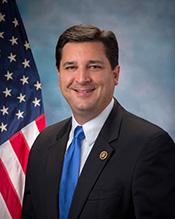
David Rouzer
RRepublicanNC-7 · Representative
55
/ 100
Average
Attendance98
Avg: 96
Independence1
Avg: 4
Bipartisan Tone28
Avg: 15
Ethics Record100
Avg: 99
Transparency31
Avg: 53
Accountability Score — composite of attendance, independence, bipartisan tone, ethics record & transparency.
Methodology14
Bills Sponsored
0
Enacted into Law
2
Passed a Chamber
12
In Committee
All Sponsored Bills
HR8765In Committee
Prioritizing Primary Care Act of 2026
The federal government would be required to track and report how much money it spends on primary care services (like doctor visits and preventive care) through programs like Medicare and Medicaid. Additionally, the bill would create a working group to study primary care spending and develop recommendations for how federal health programs can better support primary care doctors and services. These changes aim to give policymakers better information about primary care costs and help improve access to basic medical services for patients.
HRES1199In Committee
Recognizing linemen, the profession of linemen, the contributions of these brave men and women who protect public safety, and expressing support for the designation of April 18, 2026, as "National Lineman Appreciation Day".
This resolution designates April 18, 2026, as National Lineman Appreciation Day to honor electrical linemen and other utility workers who maintain power lines and infrastructure while facing dangerous working conditions. The measure recognizes these workers' contributions to public safety and essential services that keep electricity flowing to homes and businesses across the country. This is a symbolic gesture with no direct impact on laws or regulations, but it brings official recognition to a profession that often works in hazardous environments.
HR8125In Committee
CFTC Proprietary Information Act of 2026
This bill would protect sensitive business information that companies share with the Commodity Futures Trading Commission (CFTC), a federal agency that oversees futures markets and derivatives trading, by limiting when that information can be publicly disclosed or shared with other agencies. The legislation aims to give financial firms, traders, and other market participants more confidence that their proprietary data—such as trading strategies, pricing models, or business plans—won't be released to competitors or the public. This could affect how transparent the CFTC's regulatory oversight is while potentially encouraging companies to more freely share information with regulators.
HRES1134In Committee
Celebrating the 100th anniversary of the American Shore and Beach Preservation Association.
This resolution honors the 100-year history of the American Shore and Beach Preservation Association, an organization that works to protect and maintain beaches and coastal areas across the country. The resolution recognizes the association's contributions to coastal conservation, erosion control, and public beach access over the past century. This is a ceremonial measure that does not create new laws or programs.
HR5688In Committee
Non-Domiciled CDL Integrity Act
This bill would prevent people from obtaining commercial driver's licenses (CDLs) in states where they don't actually live, closing a loophole that allows truck drivers and other commercial vehicle operators to get licenses from multiple states or avoid stricter licensing requirements in their home state. The measure aims to improve road safety and ensure consistent standards for who can operate large trucks and buses by requiring drivers to hold licenses only in their state of residence. This would primarily affect professional truck drivers, bus operators, and the transportation industry.
HR6410In Committee
Atlantic Coast Shipping Safety Act
HRES952In Committee
Recognizing the self-determination of Gibraltar to determine its status as a British Overseas Territory.
This resolution honors Gibraltar's contribution to advancing U.S. security interests in the Mediterranean region and expresses support for the people of Gibraltar.
HR5721In Committee
Protect Our Judiciary Act of 2025
Protect Our Judiciary Act of 2025 This bill removes the intent requirement for the criminal offense related to picketing or parading in or near a building or residence used by a judge, juror, witness, or court officer.
HR4721In Committee
Healthy H2O Act
Healthy Drinking Water Affordability Act or the Healthy H2O Act This bill directs the Department of Agriculture (USDA) to establish a program under which USDA awards grants for improving the quality of drinking water in certain rural areas. Grants may be given to individuals or entities, such as home owners, renters, and licensed child-care facilities, that have demonstrated the presence of one or more health contaminants in their drinking water. Grants may also be given to nonprofit organizations to help individuals and entities test their water, analyze the results of the tests, and reduce the contamination.
HR2390Passed House
Maritime Supply Chain Security Act
Maritime Supply Chain Security Act This bill authorizes the Maritime Administration to competitively award grants under the Port Infrastructure Development Program (PIDP) to upgrade or replace port cranes or parts of port cranes maintained, installed, provided, controlled, or sponsored by China or any of its departments, ministries, centers, agencies, or instrumentalities. The bill further specifies that grant funds may be used to upgrade or replace port cranes' hardware or software. PIDP grants fund eligible projects that aim to improve the safety, efficiency, or reliability of the movement of goods through U.S. ports.
HRES337In Committee
Recognizing linemen, the profession of linemen, the contributions of these brave men and women who protect public safety, and expressing support for the designation of April 18, 2025, as "National Lineman Appreciation Day".
This resolution designates April 18, 2025, as National Lineman Appreciation Day to honor electrical and telecommunications linemen who work on power lines and infrastructure to keep communities connected and safe. The measure recognizes the dangerous and essential work these professionals do, often in difficult weather conditions and at heights, to maintain the electrical grid and communication systems that Americans depend on daily. The resolution is largely ceremonial and expresses congressional support for celebrating this workforce.
HRES120In Committee
Condemning the treatment of Dr. Gubad Ibadoghlu by the Government of Azerbaijan and urging his immediate release, and for other purposes.
This resolution condemns Azerbaijan for its treatment of Dr. Gubad Ibadoghlu, practice of wrongful detention, and suppression of academic freedom. The resolution also calls for Dr. Ibadoghlu's immediate and unconditional release and for the Department of State to prioritize his well-being and release in all engagements with Azerbaijan.
HR834In Committee
Disaster Assistance Fairness Act
Disaster Assistance Fairness Act This bill makes common interest communities, such as housing cooperatives (co-ops) and condominiums, and manufactured housing communities eligible for the same assistance from the Federal Emergency Management Agency (FEMA) as other homeowners. Specifically, the bill adds definitions of residential common interest community, condominium, housing cooperative, and manufactured housing community to the Robert T. Stafford Disaster Relief and Emergency Assistance Act; requires FEMA to issue rules for the removal of debris or wreckage from real estate owned by a residential common interest community, condominium, co-op, or manufactured housing community resulting from a major disaster and deems such removal to be in the public interest when a state or local government determines in writing that such debris or wreckage constitutes a threat to life, public health or safety, or the economic recovery of such community; and provides for the repair of essential common elements of a condominium, co-op, or manufactured housing community damaged by a disaster under FEMA's Individuals and Households Program.
HR192Passed House
Amtrak Executive Bonus Disclosure Act
Amtrak Executive Bonus Disclosure Act This bill requires Amtrak to publicly disclose the annual base pay and bonus compensation paid to an Amtrak executive in a required annual report to Congress. Specifically, Amtrak must incorporate into the annual report the annual base pay and any bonus compensation paid to a member of the executive leadership team. This must include the criteria and metrics used to determine any bonus compensation. Further, Amtrak must make the annual report available on Amtrak's public website.