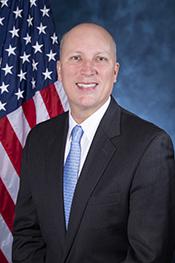
Chip Roy
RRepublicanTX-21 · Representative
58
/ 100
Average
Attendance94
Avg: 96
Independence20
Avg: 4
Bipartisan Tone27
Avg: 15
Ethics Record100
Avg: 99
Transparency35
Avg: 53
Accountability Score — composite of attendance, independence, bipartisan tone, ethics record & transparency.
Methodology50
Bills Sponsored
0
Enacted into Law
8
Passed a Chamber
42
In Committee
All Sponsored Bills
HR10132In Committee
ARTICLE ONE Act
HR9773In Committee
Permanent Trump Secure Border Act
This bill would strengthen U.S. border security through measures that likely include increased enforcement, funding for barriers or technology, and changes to immigration policies. The legislation would affect border patrol agents, immigrants seeking entry to the country, and communities near the U.S. borders. The bill has been sent to two congressional committees for review and debate before any vote takes place.
HR9656In Committee
Illegal Alien Patient Reporting Act
Hospitals that receive federal funding would be required to collect and report information about patients' immigration status to the government. The requirement would apply to hospitals participating in Medicare, Medicaid, and other federal health care programs. This would affect both the hospitals' operations and potentially influence how patients access care at these facilities.
HR9200In Committee
Secure the Border Act of 2026
This legislation aims to strengthen U.S. border security through measures that would likely include increased enforcement, funding, and personnel at the southern border, affecting immigration enforcement agencies, border communities, and people seeking to enter the country. The bill has been referred to multiple congressional committees including Judiciary, Homeland Security, and Ways and Means, suggesting it addresses border control, immigration policy, and related funding issues.
HR9199In Committee
Permanent Trump Secure Border Act
The proposal would strengthen U.S. border security through measures that likely include increased enforcement, funding for barriers or technology, and changes to immigration policies, affecting border communities, immigration agencies, and people seeking to enter or cross the country. The bill has been sent to multiple congressional committees for review, including those handling homeland security, taxes, and foreign relations, suggesting it may also involve funding decisions and international coordination.
HR9254In Committee
Stop the SPLC Act of 2026
This bill would remove the Southern Poverty Law Center's tax-exempt status, meaning the organization would no longer qualify for the special tax benefits that nonprofits typically receive. The change would affect the organization's ability to operate as a charity and could impact donors who currently receive tax deductions for contributions. This would essentially treat the Southern Poverty Law Center like a regular business rather than a nonprofit organization for tax purposes.
HR9230In Committee
Statutory Term Limits on Congressional Pay and Power Act
This bill would establish term limits for members of Congress, restricting how long they can serve in the House and Senate. It would also limit the pay and benefits that members of Congress can receive during their time in office. The proposal affects current and future members of Congress and would change how long elected officials can remain in their positions.
HR9157In Committee
American White-Collar Worker Jobs Act of 2026
The legislation would make changes to the H-1B visa program, which allows U.S. companies to temporarily hire foreign workers in specialty occupations. The reforms would affect both employers seeking to hire international talent and workers competing for these positions, though the specific changes are under review by the House Judiciary Committee.
HR9019In Committee
POWER Act
The federal government would require the Department of Energy to study and report back to Congress about how much electricity and water large data centers use, helping lawmakers understand the environmental impact of the computing infrastructure that powers the internet and cloud services. This information would give Congress a clearer picture of whether data centers need new regulations or efficiency standards as they continue to grow in size and number across the country.
HR8995In Committee
REMITTANCE Act
The proposal would change how the federal government taxes money transfers sent from the United States to other countries, which affects millions of immigrants and their families who regularly send money home. The bill would modify the current excise tax rules that apply to these remittance transfers, potentially making it cheaper or more expensive for people to send money abroad depending on how the changes are structured. This could impact both individual workers sending money to relatives and the companies that process these international money transfers.
HR8941In Committee
No Housing Welfare for Illegal Aliens Act
This bill would stop federal housing grants from going to cities that don't fully cooperate with immigration enforcement, and would prevent housing assistance programs from helping households that include undocumented immigrants. The changes would affect local governments, housing agencies, and families who receive federal housing aid, potentially reducing available assistance in certain communities and for mixed-status households where some members are citizens or legal residents and others are not.
HR8906In Committee
Ban Chinese Communist and Islamist Home Ownership Act
The proposal would ban foreign governments, hostile nations, and certain foreign companies from buying residential properties in the United States and require them to sell any housing they currently own. The goal is to keep American homes available for U.S. citizens and prevent foreign entities—particularly those considered adversaries—from controlling parts of the nation's housing supply. This would affect foreign investors and property owners while potentially making more homes available for American buyers.
HR8905In Committee
Inhibiting Militant Adversarial Mullahs Act
The proposal would change immigration rules to prevent leaders of certain religious groups from entering the United States on special visas designed for religious workers. Currently, religious leaders can come to the U.S. temporarily to work at churches, temples, mosques, and other faith organizations, but this bill would block some denominations from using that pathway. The measure is still in early stages and has been sent to the House Judiciary Committee for review.
HR8833In Committee
Sister City Transparency Act
The federal government would hire an independent auditor to investigate how sister city partnerships work in the United States, looking at what activities they do and how effective they are. Sister cities are formal relationships between U.S. cities and cities in other countries that promote cultural exchange, business connections, and diplomatic ties at the local level. The study would help Congress understand whether these partnerships are achieving their goals and operating properly.
HR8766In Committee
Deal Death, Face Death Act
The proposal would make it possible to sentence someone to death if they knowingly sell fentanyl to a person who dies from using it. This would be one of the most severe penalties in U.S. law and would apply to drug dealers involved in fatal overdoses. The change would affect how the criminal justice system handles fentanyl-related deaths, potentially impacting drug traffickers and dealers across the country.
HR8628In Committee
End U Visa Abuse Act
The proposal would eliminate the U visa program, which currently allows certain crime victims who cooperate with law enforcement to obtain temporary legal status and work authorization in the United States. This change would affect immigrants who have been victims of serious crimes like human trafficking, domestic violence, or labor exploitation and have helped police investigate these crimes. Removing this program would eliminate a key tool that law enforcement agencies use to encourage victims to come forward and assist in criminal investigations.
HRES1189Passed House
Providing for consideration of the bill (H.R. 4690) to amend the Energy Conservation and Production Act to repeal certain Federal building energy efficiency performance standards, and for other purposes; providing for consideration of the resolution (H. Res. 1182) expressing support for rural communities across the United States as stewards of the environment, major suppliers of United States energy resources, critical providers of food production and manufacturing capacity, and drivers of national economic stability, and recognizing the work of the House of Representatives in the 119th Congress in support of those vital communities; providing for consideration of the bill (H.R. 1897) to amend the Endangered Species Act of 1973 to optimize conservation through resource prioritization, incentivize wildlife conservation on private lands, provide for greater incentives to recover listed species, create greater transparency and accountability in recovering listed species, streamline the permitting process, eliminate barriers to conservation, and restore congressional intent; and providing for consideration of the bill (H.R. 5587) to amend the Geothermal Steam Act of 1970 to waive the requirement for a Federal drilling permit for certain activities, to exempt certain activities from the requirements of the National Environmental Policy Act of 1969, and for other purposes.
This resolution provides for the consideration of the bill (H.R. 4690) to amend the Energy Conservation and Production Act to repeal certain Federal building energy efficiency performance standards, and for other purposes; providing for consideration of the resolution (H. Res. 1182) expressing support for rural communities across the United States as stewards of the environment, major suppliers of United States energy resources, critical providers of food production and manufacturing capacity, and drivers of national economic stability, and recognizing the work of the House of Representatives in the 119th Congress in support of those vital communities; providing for consideration of the bill (H.R. 1897) to amend the Endangered Species Act of 1973 to optimize conservation through resource prioritization, incentivize wildlife conservation on private lands, provide for greater incentives to recover listed species, create greater transparency and accountability in recovering listed species, streamline the permitting process, eliminate barriers to conservation, and restore congressional intent; and providing for consideration of the bill (H.R. 5587) to amend the Geothermal Steam Act of 1970 to waive the requirement for a Federal drilling permit for certain activities, to exempt certain activities from the requirements of the National Environmental Policy Act of 1969, and for other purposes.
HR8387In Committee
Measures Against Marxism’s Dangerous Adherents and Noxious Islamists Act of 2026
This bill would make it illegal for immigrants to become U.S. citizens or enter the country if they are members of, affiliated with, or advocate for socialist, communist, Marxist, or Islamic fundamentalist groups, and would allow the government to strip citizenship from naturalized Americans and deport immigrants based on these beliefs or associations. The measure would affect immigrants seeking to enter or stay in the United States, as well as people who have already become citizens, by expanding grounds for deportation and denaturalization beyond current law.
HR2159Passed House
Count the Crimes to Cut Act
Count the Crimes to Cut Act of 2025 This bill establishes public databases of federal criminal offenses. Specifically, the bill requires the Department of Justice to report on and create a public database of all criminal statutory offenses. Additionally, the bill requires federal agencies to report on and create public databases of criminal regulatory offenses that they enforce.
HR8236In Committee
Designating Hamas Affiliates in America Act of 2026
This bill would allow the U.S. government to officially identify and designate organizations operating in America that are affiliated with Hamas, the Palestinian militant group. Once designated, these organizations could face legal restrictions, financial penalties, and potential criminal consequences for their activities. The bill would affect charities, nonprofits, and other groups suspected of supporting or being connected to Hamas, as well as individuals who donate to or work with such organizations.
HR8206In Committee
Homeland Security and Further Additional Continuing Appropriations Act, 2026
This bill would provide temporary funding to keep the Department of Homeland Security and other government agencies operating through 2026 while Congress works on permanent spending plans. It affects federal employees, border security operations, immigration enforcement, and other homeland security functions that depend on this funding to continue their work. The bill has been sent to the relevant committees for review before a vote.
HR8064In Committee
Career Criminal Accountability Act of 2026
This bill would likely increase penalties and enforcement measures against people with multiple criminal convictions, aiming to keep repeat offenders off the streets longer. It would affect individuals with prior criminal records, law enforcement agencies, and the court system by potentially changing how judges handle sentencing for people convicted of crimes after previous convictions. The bill focuses on holding career criminals more accountable through stricter legal consequences.
HR7776In Committee
Highway Formula Fairness Act
This bill would change how the federal government distributes highway funding to states, likely shifting money between regions based on new formulas for calculating each state's share. The changes would affect state transportation departments, local governments, and construction companies that build and maintain roads, as some states would receive more federal highway dollars while others would receive less. The goal appears to be making the funding system fairer by adjusting how factors like population, road usage, or maintenance needs are weighted in the distribution formula.
HRES1057Passed House
Providing for consideration of the bill (S. 1383) to establish the Veterans Advisory Committee on Equal Access, and for other purposes; providing for consideration of the bill (H.R. 2189) to modernize Federal firearms laws to account for advancements in technology and less-than-lethal weapons, and for other purposes; providing for consideration of the bill (H.R. 261) to amend the National Marine Sanctuaries Act to prohibit requiring an authorization for the installation, continued presence, operation, maintenance, repair, or recovery of undersea fiber optic cables in a national marine sanctuary if such activities have previously been authorized by a Federal or State agency; providing for consideration of the bill (H.R. 3617) to amend the Department of Energy Organization Act to secure the supply of critical energy resources, including critical minerals and other materials, and for other purposes; and waiving a requirement of clause 6(a) of rule XIII with respect to consideration of certain resolutions reported from the Committee on Rules.
This resolution provides for the consideration of the bill (S. 1383) to establish the Veterans Advisory Committee on Equal Access, and for other purposes; providing for consideration of the bill (H.R. 2189) to modernize Federal firearms laws to account for advancements in technology and less-than-lethal weapons, and for other purposes; providing for consideration of the bill (H.R. 261) to amend the National Marine Sanctuaries Act to prohibit requiring an authorization for the installation, continued presence, operation, maintenance, repair, or recovery of undersea fiber optic cables in a national marine sanctuary if such activities have previously been authorized by a Federal or State agency; providing for consideration of the bill (H.R. 3617) to amend the Department of Energy Organization Act to secure the supply of critical energy resources, including critical minerals and other materials, and for other purposes; and waiving a requirement of clause 6(a) of rule XIII with respect to consideration of certain resolutions reported from the Committee on Rules.
HR7296In Committee
SAVE America Act
Safeguard American Voter Eligibility Act or the SAVE America Act This bill requires individuals to provide documentary proof of U.S. citizenship when registering to vote, and requires photo identification to vote, in federal elections. Specifically, the bill prohibits states from accepting and processing an application to register to vote in a federal election unless the applicant presents documentary proof of U.S. citizenship. The bill specifies what documents are considered acceptable proof of U.S. citizenship, such as identification that complies with the REAL ID Act of 2005 that indicates U.S. citizenship. Further, the bill (1) prohibits states from registering an individual to vote in a federal election unless, at the time the individual applies to register to vote, the individual provides documentary proof of U.S. citizenship; and (2) requires states to establish an alternative process to demonstrate U.S. citizenship. Each state must take affirmative steps on an ongoing basis to ensure that only U.S. citizens are registered to vote, which shall include establishing a program to identify individuals who are not U.S. citizens using information supplied by certain sources. Additionally, states must remove noncitizens from their official lists of eligible voters. The bill (1) provides for a private right of action for certain violations, and (2) establishes criminal penalties for certain offenses. Individuals voting in federal elections must present an eligible photo identification document. An individual who votes by absentee ballot must submit a copy of their identification document with both the request for, and the submission of, the absentee ballot.
HR6225In Committee
PAUSE Act of 2025
The PAUSE Act would temporarily halt or slow down immigration processing and admissions into the United States, likely affecting people seeking to enter the country through various legal pathways as well as immigration agencies handling applications. The bill targets immigration policy broadly, though the specific details of which programs would be paused and for how long would depend on the final legislation. This would impact prospective immigrants, their families, employers who rely on foreign workers, and immigration courts and agencies managing the system.
HRES782Passed House
Expressing condolences and support for the victims of the July 4 flooding in Texas, honoring acts of heroism, and committing to stand with those impacted by these floods.
This resolution expresses that the House of Representatives mourns the loss of the victims of the flooding in central Texas on July 4, 2025, honors the individuals who responded, and supports rebuilding infrastructure and providing assistance for those affected by the flooding.
HR5890In Committee
No Tax Exemptions For Terror Act
This bill would prevent organizations designated as terrorist groups from receiving tax-exempt status, meaning they would have to pay federal taxes like regular businesses instead of getting special tax breaks. The measure targets nonprofits and charities that support or are linked to terrorism, affecting both the organizations themselves and potentially donors who currently get tax deductions for contributions to such groups. It aims to cut off a potential funding source for terrorist activities while closing what supporters view as a loophole in current tax law.
HR5722In Committee
Preserving a Sharia-Free America Act
This bill would prohibit the application or enforcement of Islamic religious law (Sharia) in U.S. courts and legal proceedings, affecting immigrants and citizens alike. It aims to ensure that American legal decisions are based solely on U.S. constitutional and statutory law rather than religious legal systems from other countries.
HRES354Passed House
Providing for consideration of the joint resolution (H.J. Res. 60) providing for congressional disapproval under chapter 8 of title 5, United States Code, of the rule submitted by the National Park Service relating to "Glen Canyon National Recreation Area: Motor Vehicles"; providing for consideration of the joint resolution (H.J. Res. 78) providing for congressional disapproval under chapter 8 of title 5, United States Code, of the rule submitted by the United States Fish and Wildlife Service relating to "Endangered and Threatened Wildlife and Plants; Endangered Species Status for the San Francisco Bay-Delta Distinct Population Segment of the Longfin Smelt"; providing for consideration of the joint resolution (H.J. Res. 87) providing congressional disapproval under chapter 8 of title 5, United States Code, of the rule submitted by the Environmental Protection Agency relating to "California State Motor Vehicle and Engine Pollution Control Standards; Heavy-Duty Vehicle and Engine Emission Warranty and Maintenance Provisions; Advanced Clean Trucks; Zero Emission Airport Shuttle; Zero-Emission Power Train Certification; Waiver of Preemption; Notice of Decision"; providing for consideration of the joint resolution (H.J. Res. 88) providing congressional disapproval under chapter 8 of title 5, United States Code, of the rule submitted by the Environmental Protection Agency relating to "California State Motor Vehicle and Engine Pollution Control Standards; Advanced Clean Cars II; Waiver of Preemption; Notice of Decision"; providing for consideration of the joint resolution (H.J. Res. 89) providing congressional disapproval under chapter 8 of title 5, United States Code, of the rule submitted by the Environmental Protection Agency relating to "California State Motor Vehicle and Engine and Nonroad Engine Pollution Control Standards; The "Omnibus" Low NOX Regulation; Waiver of Preemption; Notice of Decision"; and for other purposes.
Congress is considering votes to reject five federal regulations: one allowing more motorized vehicles in Glen Canyon National Recreation Area, one protecting an endangered fish species in California, and three EPA rules that would tighten pollution standards for trucks and cars in California. If approved, these rejections would block these environmental and wildlife protection rules from taking effect. This measure affects outdoor recreation users, environmental groups, the auto industry, and California's air quality.
HR5106In Committee
Restore Trust in Congress Act
This bill aims to address public confidence in Congress by establishing new rules or standards for how members conduct themselves and operate. While the specific provisions aren't detailed in the available information, bills with this title typically focus on ethics reforms, transparency requirements, or accountability measures that would apply to members of the House and Senate. The changes would affect how Congress functions internally and how the public can monitor their representatives' activities.
HR5005In Committee
Sanctuary Penalty and Public Protection Act of 2025
This bill would penalize cities and states that limit cooperation with federal immigration enforcement by withholding federal funding and grants from them. It would affect local governments, law enforcement agencies, and immigrants living in sanctuary jurisdictions that have policies restricting how much they help Immigration and Customs Enforcement (ICE) with deportations and immigration investigations.
HR4201In Committee
TPS Reform Act of 2025
TPS Reform Act of 2025 This bill changes the procedures for designating a country with temporary protected status (TPS) and places restrictions on who is allowed to benefit from this status. (Qualified nationals of a TPS-designated country are eligible for work authorization and may not be removed from the United States while the status is in effect.) Specifically, the bill requires an act of Congress to designate a TPS country, whereas currently the Department of Homeland Security has such authority. The initial act of designating a TPS country must include a time period for the designation of up to 18 months and also contain certain information, including an estimate of the number of individuals who would benefit from the status. Congress may also pass an act to terminate or extend a designation. The bill also establishes that a non-U.S. national ( alien under federal law) who lacks lawful immigration status may not receive the benefits of temporary protected status.
HR589In Committee
FACE Act Repeal Act of 2025
FACE Act Repeal Act of 2025 This bill repeals provisions of federal criminal law that prohibit conduct intended to injure, intimidate, or interfere with persons who are seeking to (1) obtain or provide reproductive health services, or (2) exercise their right of religious freedom at a place of religious worship.
HR3464In Committee
State Border Security Assistance Act
The proposal would provide federal funding and resources to help states strengthen security along their borders with other countries and with each other. States could use this assistance to deploy additional personnel, technology, and equipment to monitor and control who crosses their borders. The funding would primarily affect state law enforcement agencies, border communities, and immigration enforcement efforts.
HRES405Passed House
Providing for consideration of the bill (H.R. 2240) to require the Attorney General to develop reports relating to violent attacks against law enforcement officers, and for other purposes; providing for consideration of the bill (H.R. 2243) to amend title 18, United States Code, to improve the Law Enforcement Officer Safety Act and provisions relating to the carrying of concealed weapons by law enforcement officers, and for other purposes; and providing for consideration of the bill (H.R. 2255) to allow Federal law enforcement officers to purchase retired service weapons, and for other purposes.
Congress approved a procedural measure to consider three separate bills aimed at supporting law enforcement: one requiring the Attorney General to track and report on violent attacks against police officers, another strengthening protections for law enforcement officers carrying concealed weapons, and a third allowing federal law enforcement officers to buy their retired service weapons. These bills would help document threats to police safety, clarify rules around officers carrying guns off-duty, and let officers purchase firearms they've used during their careers. The measure passed the House and allows these bills to move forward for further consideration.
HR22Passed House
SAVE Act
Safeguard American Voter Eligibility Act or the SAVE Act This bill requires individuals to provide documentary proof of U.S. citizenship when registering to vote in federal elections. Specifically, the bill prohibits states from accepting and processing an application to register to vote in a federal election unless the applicant presents documentary proof of U.S. citizenship. The bill specifies what documents are considered acceptable proof of U.S. citizenship, such as identification that complies with the REAL ID Act of 2005 that indicates U.S. citizenship. Further, the bill (1) prohibits states from registering an individual to vote in a federal election unless, at the time the individual applies to register to vote, the individual provides documentary proof of U.S. citizenship; and (2) requires states to establish an alternative process under which an applicant may submit other evidence to demonstrate U.S. citizenship. Each state must take affirmative steps on an ongoing basis to ensure that only U.S. citizens are registered to vote, which shall include establishing a program to identify individuals who are not U.S. citizens using information supplied by certain sources. Additionally, states must remove noncitizens from their official lists of eligible voters. The bill allows for a private right of action against an election official who registers an applicant to vote in a federal election who fails to present documentary proof of U.S. citizenship. The bill establishes criminal penalties for certain offenses, including registering an applicant to vote in a federal election who fails to present documentary proof of U.S. citizenship.
HR2275In Committee
SCHOOL Act of 2025
Support Children Having Open Opportunities for Learning Act of 2025 or the SCHOOL Act of 2025 This bill allows certain federal funds for elementary and secondary education to follow the student to the school that they attend (i.e., public, private, or home school), regardless of whether the student is learning in person or remotely. These funds may be used for educational and instructional materials, tutoring, tuition for private school, and extracurricular activities.
HR2276In Committee
CRT Act
Combating Racist Teaching in Schools Act or the CRT Act This bill prohibits federal funds from being awarded to elementary or secondary schools or institutions of higher education that promote certain race-based theories or compel teachers or students to affirm belief in such theories in a manner that discriminates on the basis of race, color, or national origin.
HR1432In Committee
LIABLE Act
Let Injured Americans Be Legally Empowered Act or the LIABLE Act This bill prohibits COVID-19 vaccine manufacturers from being immune under federal law from lawsuits relating to their vaccines. Specifically, the bill prohibits any federal law from providing immunity for COVID-19 vaccine manufacturers from civil suits or liability, or limiting liability, with respect to the administration or use of their vaccines. Additionally, individuals may not be precluded from bringing a civil suit against a COVID-19 vaccine manufacturer because the individual sought or received compensation through specified federal vaccine injury compensation programs, nor does the bill preclude individuals from seeking compensation through these programs. The bill applies to vaccine administrations that occur before, on, or after the bill's date of enactment.
HR1345In Committee
Gas Can Freedom Act of 2025
The legislation would allow manufacturers to produce and sell gasoline containers that don't meet current federal safety standards, which require spill-proof and flame-arrestor features designed to prevent fires and spills. This would affect consumers who buy gas cans, gas station operators, and container manufacturers by giving them more product options, though potentially with fewer safety protections than currently required. The change would remove federal regulations that have been in place to reduce the risk of gasoline-related accidents and injuries.
HR1139In Committee
Passport Sanity Act
The bill would make changes to how the U.S. government issues and manages passports, likely aiming to streamline the application process or address delays that American travelers have experienced. The specific reforms would affect anyone who needs to apply for, renew, or use a U.S. passport for international travel. The House Committee on Foreign Affairs will review the proposal to determine whether to move it forward.
HR885In Committee
Drug Cartel Terrorist Designation Act
Drug Cartel Terrorist Designation Act This bill directs the Department of State to designate four specified drug cartels as foreign terrorist organizations. (Among other things, such a designation allows the Department of the Treasury to require U.S. financial institutions to block transactions involving the organization.) The four specified cartels in the bill are the Gulf Cartel, the Cartel Del Noreste, the Cartel de Sinaloa, and the Cartel de Jalisco Nueva Generacion. The bill also requires the State Department to submit a detailed report on those four cartels and any other cartels it may identify. Based on this report, the State Department must designate as a foreign terrorist organization any such identified cartel (or faction thereof) that meets certain criteria for designation as a foreign terrorist organization. The bill specifies that it may not be construed to expand eligibility for asylum.
HR23Passed House
Illegitimate Court Counteraction Act
Illegitimate Court Counteraction Act This bill imposes sanctions against foreign persons (individuals and entities) who assist the International Criminal Court (ICC) in investigating, arresting, detaining, or prosecuting certain individuals. The bill categorizes as protected persons (1) any U.S. individual, U.S. entity, or person in the United States, unless the United States is a state party to the Rome Statute of the ICC and provides formal consent to ICC jurisdiction; and (2) any foreign person that is a citizen or lawful resident of a U.S. ally that is not a state party to the Rome Statute or has not consented to ICC jurisdiction. If the ICC attempts to investigate, arrest, detain or prosecute a protected person, the President must impose visa- and property-blocking sanctions against the foreign persons that engaged in or materially assisted in such actions, as well as against foreign persons owned by, controlled by, or acting on behalf of such foreign persons. The President must also apply visa-blocking sanctions to the immediate family members of those sanctioned. Upon enactment, the bill rescinds all funds appropriated for the ICC and prohibits the subsequent use of appropriated funds for the ICC.
HR809In Committee
Securing America’s Land from Foreign Interference Act
Securing America's Land from Foreign Interference Act This bill requires the President to take actions as necessary to prohibit members of the Chinese Communist Party (and entities owned, controlled, or influenced by the party) from purchasing real estate located in the United States, U.S. territories, or U.S. possessions.
HR632In Committee
Protecting Life on College Campus Act of 2025
Protecting Life on College Campus Act of 2025 This bill prohibits the award of federal funds to an institution of higher education (IHE) that hosts or is affiliated with a school-based service site that provides abortion drugs or abortions to its students or to employees of the IHE or the site. An IHE that hosts or is affiliated with a site must, in order to remain eligible for federal funds, annually certify that the site does not provide abortion drugs or abortions to students or employees.
HR400In Committee
No taxpayer funding for United Nations Human Rights Council Act
No taxpayer funding for United Nations Human Rights Council Act This bill requires the Department of State to withhold from the U.S. contribution to the United Nations (U.N.) the amount that would be allocated to the U.N. Human Rights Council. Such withheld funds must be rescinded and must not be considered arrears to be repaid to any U.N. entity. The bill also prohibits the State Department from making voluntary contributions to the U.N. Human Rights Council.
HR401In Committee
No Taxpayer Funding for the World Health Organization Act
No Taxpayer Funding for the World Health Organization Act This bill prohibits the United States from providing any assessed or voluntary contributions to the World Health Organization.
HR317In Committee
Healthcare Freedom Act of 2025
Healthcare Freedom Act of 2025 This bill renames health savings accounts (HSAs) as health freedom accounts (HFAs), modifies the eligibility requirements and contribution limits for such accounts, and expands the definition of qualified medical expenses. The bill also eliminates the exclusion from income of employer contributions to a health plan for certain individuals. Under current law, individuals may establish and contribute to an HSA if covered under an HSA-eligible high-deductible health plan (HDHP). For 2025, HSA contributions are limited to $4,300 for self-only coverage or $8,550 for family coverage (adjusted annually). Individuals 55 or older may make an additional HSA contribution of up to $1,000 per year. Further, HSA distributions are tax-free if used to pay for qualified medical expenses. The bill allows individuals to establish and contribute to an HFA without being enrolled in an HDHP, contribute up to $12,000 ($24,000 for joint filers) per year to an HFA (adjusted annually), and contribute an additional $5,000 per year to an HFA if 55 or older. The bill also expands the definition of qualified medical expenses to include expenses related to direct primary care, health care sharing ministries, and medical cost sharing organizations. For individuals hired at least five years after the bill's enactment (1) employer contributions to an HFA may be excluded from the employee's income, and (2) the bill eliminates the exclusion from income of employer contributions to other health plans. (Under current law, employer contributions to a health plan generally are not included in the individual’s income.)
HR318In Committee
Border Safety and Security Act of 2025
Border Safety and Security Act of 2025 This bill requires the Department of Homeland Security (DHS) to suspend the entry of any non-U.S. nationals ( aliens under federal law) without valid entry documents during any period when DHS cannot detain such an individual or return the individual to a foreign country contiguous to the United States. A state may sue DHS to enforce this requirement. (Under current law, non-U.S. nationals who arrive at the border without entry documents are generally subject to expedited removal. However, if such an individual is found to have a credible fear of persecution, they are typically subject to detention while their asylum claim is being considered.) The bill also authorizes DHS to suspend the entry of non-U.S. nationals without entry documents at the border if DHS determines that such a suspension is necessary to achieve operational control over such a border.