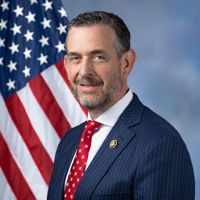
Michael A. Rulli
RRepublicanOH-6 · Representative
52
/ 100
Average
Attendance95
Avg: 96
Independence4
Avg: 4
Bipartisan Tone19
Avg: 15
Ethics Record100
Avg: 99
Transparency22
Avg: 53
Accountability Score — composite of attendance, independence, bipartisan tone, ethics record & transparency.
Methodology18
Bills Sponsored
0
Enacted into Law
1
Passed a Chamber
17
In Committee
All Sponsored Bills
HR10791In Committee
Italian Heroes and Heritage Act
HRES1604In Committee
Urging the people of the United States to observe the month of October 2026 as Italian and Italian American Heritage Month.
HR10636In Committee
Medicaid Fraud Prevention Act
Medicaid Fraud Prevention Act This bill requires state Medicaid programs to regularly assess their programs for fraud and take corrective actions. Specifically, states must complete a fraud risk assessment on at least an annual basis, implement a corrective action plan to address any identified vulnerabilities, and report on the results to the Centers for Medicare & Medicaid Services (CMS). The CMS must analyze this information and annually report the information to Congress. The fraud risk assessments must include a comprehensive assessment of the risks of fraud across the entirety of a state's Medicaid program, including with respect to managed care entities and eligibility and enrollment systems. The assessments must, to the extent practicable, utilize data from specified existing program integrity systems (e.g., Medicaid fraud control units). The CMS must issue guidelines on how states may identify areas that are at the highest risk of fraud.
HR10398In Committee
CHC REBASE Act of 2026
HR10174In Committee
GRANITE Act
HR9295In Committee
Stop Serial Litigation Act of 2026
This bill would cap the amount of money that lawyers and experts can be paid when they win cases against federal agencies in administrative hearings. The limits would apply to fees and expenses awarded to people who successfully challenge government decisions, potentially making it harder for individuals and small organizations to afford legal representation in disputes with federal agencies.
HR9107In Committee
Patient Choice and Access Act of 2026
Health insurance companies would no longer be required to maintain networks of doctors and hospitals under this proposal, meaning they could offer plans that let patients see any healthcare provider they want without restrictions. This change would affect people buying insurance through the health law's marketplaces, potentially giving them more freedom to choose their doctors but possibly affecting costs and coverage details. Insurance companies and patients would be the main groups impacted by this shift in how health plans operate.
HR8630In Committee
PEAT Act of 2026
The proposal would change how the government classifies certain medications made from living cells or organisms, preventing regulators from treating a drug as a biologic product just because it contains a protein that doesn't actually affect how the medicine works. This could affect pharmaceutical companies by potentially allowing some drugs to be classified under simpler approval pathways rather than the more complex biologic drug process. The change aims to streamline drug development and approval for medications where inactive proteins are present but not medically relevant.
HRES1217In Committee
Expressing support for the citizens of the United Kingdom as they continue to face assaults on their rights to free speech and freedom of expression.
This resolution expresses the U.S. Congress's support for British citizens' rights to free speech and freedom of expression, which the resolution claims are under threat. The measure has been referred to multiple congressional committees for review but does not create any new laws or direct government action. It is primarily a symbolic statement of solidarity with the United Kingdom regarding civil liberties concerns.
HR8431In Committee
Third-Party Certification and Inspection Modernization Act of 2026
The legislation would update how third-party organizations inspect and certify health-related products and facilities, modernizing the approval process to reflect current technology and practices. This would affect manufacturers, healthcare providers, and inspection companies by streamlining certification requirements while potentially improving safety standards for patients and consumers. The changes aim to reduce unnecessary delays in getting health products to market without compromising quality or safety oversight.
HR7725In Committee
Stop Child Care Fraud Act of 2026
This bill would create new rules and penalties to prevent fraud in child care assistance programs, which help low-income families pay for child care services. It likely aims to catch providers or families who illegally claim benefits they don't qualify for, while making sure legitimate families can still access the help they need. The changes would affect child care providers, families receiving subsidies, and the government agencies that manage these programs.
HR7846In Committee
Halo Act
The Halo Act would establish new law enforcement policies or programs related to crime prevention and public safety, though the specific details would depend on the bill's provisions. Based on its referral to the House Judiciary Committee, it likely affects how police departments operate, how crimes are investigated, or how communities work with law enforcement to reduce crime. The bill would impact law enforcement agencies, crime victims, and communities seeking to improve public safety.
HRES1085In Committee
Censuring Representative Al Green of Texas.
This resolution censures Representative Al Green.
HR2958In Committee
Balance the Scales Act
This bill would strengthen workers' ability to take legal action against their employers by limiting the use of forced arbitration clauses in employment contracts, which currently require disputes to be settled privately rather than in court. The change would allow more workers—particularly those in lower-wage jobs—to pursue class action lawsuits against employers for wage theft, discrimination, or unsafe working conditions instead of being locked into individual arbitration proceedings. The bill aims to level the playing field between workers and large employers by giving workers more options to seek justice and hold companies accountable.
HR6724In Committee
Protecting Supplemental Security Income for Disaster Victims Act
This bill would protect people receiving Supplemental Security Income (a federal program for elderly, blind, and disabled individuals with limited income) from losing their benefits if they receive disaster relief money. Currently, disaster assistance counts toward income limits that can disqualify people from the program, so this change would let disaster victims keep both their emergency aid and their regular benefits without penalty. The bill affects low-income seniors, people with disabilities, and blind individuals who live in disaster-affected areas.
HR3015Passed House
National Coal Council Reestablishment Act
National Coal Council Reestablishment Act This bill provides statutory authority for the National Coal Council and directs the Department of Energy to reestablish the council in accordance with the charter that was in effect on November 19, 2021. Established in 1984, the council made recommendations to DOE on matters relating to coal and the coal industry. In addition, the bill removes the requirement under the Federal Advisory Committee Act for the council to be re-chartered every two years.
HRES497In Committee
Expressing support for the designation of a "Veterans Appreciation Month".
This resolution supports the designation of a Veterans Appreciation Month.
HR3079In Committee
Medicaid Empowerment Act of 2025
Medicaid Empowerment Act of 2025 This bill allows state Medicaid programs to renew home- and community-based services waivers (also known as Section 1915(c) waivers) in 10-year periods. Currently, these waivers may be extended in five-year periods; waivers allow state Medicaid programs to cover long-term care services that are provided in home or community settings rather than in institutional settings.