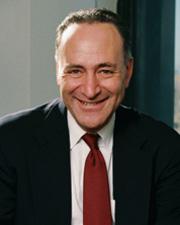
Charles E. Schumer
DDemocratNY · Senator
66
/ 100
Above Average
Attendance100
Avg: 97
Independence14
Avg: 23
Bipartisan Tone16
Avg: 14
Ethics Record100
Avg: 100
Transparency100
Avg: 47
Accountability Score — composite of attendance, independence, bipartisan tone, ethics record & transparency.
Methodology31
Bills Sponsored
0
Enacted into Law
0
Passed a Chamber
28
In Committee
All Sponsored Bills
S5619In Committee
Restoring Essential Plan Coverage Act
S5461In Committee
Strategic Fertilizer Reserve Act of 2026
S5390In Committee
End Trump’s Tariff Tax Act
S5323In Committee
A bill to designate a building of the Chancery of the United States in Pristina, Kosovo, as the "Elliot L. Engel Building".
S5212In Committee
No Payoffs for Pardons Act
The proposal would change the rules for how the President can grant pardons and commute sentences, likely establishing new procedures or standards for reviewing clemency requests. This would affect people currently in prison or with criminal convictions who might seek forgiveness or sentence reduction from the President, as well as the staff who process these applications. The specific reforms would be determined by Congress as the bill moves through the legislative process.
S5183In Committee
Anti-Corruption Bureau Creation Act
The bill would create a new government agency called the Anti-Corruption Bureau to investigate and combat corruption involving federal officials and programs. This agency would have authority to look into misconduct by government employees, contractors, and others involved in federal activities, potentially affecting how federal money is spent and how government operates. The bill is currently under review by the Senate Finance Committee.
SRES771Introduced
A resolution congratulating the New York Knicks on winning the 2026 National Basketball Association Finals.
Congress is formally recognizing and congratulating the New York Knicks basketball team for winning the NBA championship in 2026. This resolution has no practical effect on laws or policies—it's simply an official statement of praise from the Senate for the team's athletic achievement. The resolution was approved unanimously by senators without any changes.
S4796In Committee
Stock Buyback Accountability Act of 2026
The bill would increase the federal tax that companies pay when they buy back their own stock from shareholders. This tax increase would affect large corporations that repurchase shares and could potentially change how companies decide to return money to investors. The revenue from the higher tax could be used for other government purposes.
S4791In Committee
A bill to abolish the Anti-Weaponization Fund, and for other purposes.
The proposal would eliminate a federal fund that was created to investigate and address potential misuse of government agencies' powers against American citizens. This would affect oversight mechanisms designed to prevent federal agencies from using their authority in politically motivated or discriminatory ways.
S4781In Committee
Make More in America Act of 2026
The Export-Import Bank, a government agency that helps American companies finance international sales, would expand its role to specifically support domestic industries that produce critical goods and services needed by the U.S. economy. The bank would prioritize lending and financing for companies that create American jobs and help the country compete globally in key industries. This change aims to strengthen both domestic manufacturing and employment while boosting U.S. competitiveness in international markets.
SJRES149In Committee
A joint resolution providing for congressional disapproval under chapter 8 of title 5, United States Code, of the rule submitted by the Bureau of Consumer Financial Protection relating to the withdrawal of the rule relating to "Truth in Lending (Regulation Z); Consumer Protections for Home Sales Financed Under Contracts for Deed".
Congress is considering blocking a decision by the Consumer Financial Protection Bureau to withdraw protections for people buying homes through contracts for deed, which are alternative financing arrangements that often lack the safeguards of traditional mortgages. If approved, this resolution would force the agency to keep the consumer protections in place, preventing lenders from removing rules designed to protect buyers in these transactions. The measure affects home buyers, particularly lower-income consumers who may use contracts for deed as an alternative to traditional bank financing.
S4124Introduced
A bill to prohibit funds made available to the Department of Justice from being used to make a personal payment to the President in connection with a claim that is subject to the Federal Tort Claims Act, whether in the form of a settlement or any other payment from the Judgment Fund for the personal benefit of the President.
This bill would prevent the Department of Justice from using federal money to pay settlements or judgments to the President in personal lawsuits covered by the Federal Tort Claims Act, which normally allows people to sue the government for damages. The measure blocks the use of the federal "Judgment Fund"—money set aside to pay court-ordered settlements against the government—for any personal payments to a sitting President. It essentially ensures that if the President faces a personal legal claim, taxpayer money cannot be used to cover any resulting settlement or judgment.
S4007In Committee
Family Grocery and Farmer Relief Act
This bill would likely provide financial assistance or tax relief to family farms and grocery stores to help them manage costs and stay in business. It may include measures to support farmers dealing with rising expenses or help grocery retailers serve communities, particularly in areas where food access is limited. The exact details would depend on the specific provisions once the bill moves through the committee review process.
S3911In Committee
A bill to designate the Pride flag as an authorized flag eligible for display at units of the National Park System, to express the sense of the Senate that the Pride flag should be on display at the Stonewall National Monument in the State of New York, and for other purposes.
The bill would allow the Pride flag to be officially displayed at national parks and other federal lands managed by the National Park Service, and specifically calls for it to be shown at the Stonewall National Monument in New York, which commemorates the historic site of the 1969 uprising that launched the modern LGBTQ+ rights movement. This would give the Pride flag the same official status as other authorized flags at these public sites. The change would affect how national parks and monuments can express their commitment to recognizing LGBTQ+ history and inclusion.
S3838In Committee
Venezuela Oil Proceeds Transparency Act
This bill would require the U.S. government to publicly report on how money from Venezuelan oil sales is being used, particularly focusing on whether funds are going to the Venezuelan government or being held in trust. The legislation aims to increase transparency around oil revenue that may be controlled by the U.S. or international organizations, helping Congress and the public understand the financial dealings related to Venezuela's oil resources.
S3815In Committee
Virginia's Law
I don't have enough information to write an accurate summary. The title "Virginia's Law" is too vague, and the subjects listed (Crime and Law Enforcement) are broad categories that could cover many different policies. To provide a meaningful explanation of what this bill would actually do, I would need to see the bill's text or a more specific description of its contents.
SRES597In Committee
A resolution providing for the authority to initiate litigation for actions by the President and Department of Justice officials inconsistent with their duties under the laws of the United States.
This resolution would allow Congress to sue the President and Justice Department officials if they believe these officials are breaking federal laws or not doing their jobs properly. It gives Congress the legal authority to take the executive branch to court when it thinks they're acting outside their powers or ignoring their legal responsibilities. The resolution is currently being reviewed by the Senate committee that handles congressional procedures.
S3385Introduced
Lower Health Care Costs Act
Lower Health Care Costs Act This bill extends for three years, through 2028, temporary changes enacted by the American Rescue Plan Act of 2021 (ARPA) and the Inflation Reduction Act of 2022 (IRA) that generally expand eligibility for and increase the amount of the premium tax credit. Currently, eligible taxpayers may be able to claim the premium tax credit, which applies toward the cost of obtaining health insurance through health insurance exchanges. To be eligible for the premium tax credit, a taxpayer’s household income must meet or exceed 100% of the federal poverty level (FPL) and, after 2025, may not exceed 400% of the FPL (maximum income limit). For 2021-2025, the ARPA and IRA eliminated the maximum income limit, which generally expands eligibility for the premium tax credit. Further, under current law, the amount of the premium tax credit is (1) generally the plan premium (conditions apply), minus (2) the taxpayer’s household income multiplied by the applicable percentage. The applicable percentage is a specific percentage that varies depending on which of six income ranges (adjusted for inflation after 2025) the taxpayer’s household income falls within. For 2021-2025, the ARPA and IRA lowered the applicable percentages and eliminated the adjustment of the applicable percentages for inflation, which generally increases the amount of the premium tax credit. The bill extends for three years, through 2028, the elimination of the 400% maximum income limit, the lower applicable percentages, and the elimination of the inflation adjustment for the applicable percentages.
SRES533In Committee
A resolution condemning white supremacy, hate, and antisemitism, and efforts to give a platform to these dangerous ideologies.
S2925In Committee
MIND Act of 2025
SRES402In Committee
A resolution recognizing Lloyd Ashburn Williams's unparalleled dedication to fostering economic empowerment, cultural pride, and social equity in Harlem.
SRES368In Committee
A resolution commemorating the continuation of the semicentennial of hip hop and designating August 11, 2025, as "Hip Hop Celebration Day", designating August 2025 as "Hip Hop Recognition Month", and designating November 2025 as "Hip Hop History Month".
S2556In Committee
Protecting Health Care and Lowering Costs Act
Protecting Health Care and Lowering Costs Act This bill makes permanent temporary provisions that generally expand eligibility for and increase the amount of the premium tax credit. This bill also repeals multiple Medicaid, Medicare, and health-related tax provisions enacted by the One Big Beautiful Bill Act (OBBBA). Currently, eligible taxpayers may claim the premium tax credit, which applies toward the cost of obtaining health insurance through health insurance exchanges. To qualify, a taxpayer’s household income must meet or exceed 100% of the federal poverty level (FPL) and, after 2025, may not exceed 400% of the FPL (maximum income limit). For 2021-2025, the maximum income limit is eliminated, which generally expands eligibility for the premium tax credit. Further, under current law, the amount of the premium tax credit is partially based on the taxpayer’s household income multiplied by the applicable percentage. The applicable percentage varies depending on which of six income ranges (adjusted for inflation after 2025) the taxpayer’s household income falls within. For 2021-2025, the applicable percentages are lowered and the adjustment of the applicable percentages for inflation is eliminated, which generally increases the amount of the premium tax credit. The bill permanently eliminates the 400% maximum income limit, lowers the applicable percentages, and eliminates the inflation adjustment for the applicable percentages. Finally, the bill repeals multiple Medicaid, Medicare, and health-related tax provisions enacted by the OBBBA, including certain Medicare and Medicare eligibility and verification requirements, the reduced window for retroactive Medicaid coverage, and premium tax credit verification requirements.
S1929In Committee
SEPSIS Act
The SEPSIS Act would likely improve how hospitals identify and treat sepsis, a life-threatening condition where the body's response to infection causes organ damage, by establishing better screening procedures, treatment protocols, and training requirements for healthcare workers. The bill would affect hospitals and medical staff by requiring them to follow standardized guidelines to catch sepsis earlier and treat it more quickly, which could save lives among patients with severe infections.
S1741In Committee
Truth in Tariffs Act
S877In Committee
Roberto Clemente Commemorative Coin Act
Roberto Clemente Commemorative Coin Act This bill directs the Department of the Treasury to mint and issue coins in recognition of the life of Roberto Clemente, baseball player and human rights activist. All sales of coins issued under this bill must include a surcharge to be paid to the Roberto Clemente Foundation.
S2948In Committee
African Burial Ground International Memorial Museum and Educational Center Act
African Burial Ground International Memorial Museum and Educational Center Act - Establishes the African Burial Ground International Memorial Museum and Educational Center at the African Burial Ground National Monument in New York, New York. Directs the Secretary of the Interior, acting through the Director of the National Park Service (NPS), to: (1) acquire for the Museum property that is located adjacent to the National Monument or in any other area of the African Burial Ground National Historic Landmark in the city other than the location adjacent to the Monument; and (2) plan, design, and construct the Museum on the acquired property. Provides for operation of the Museum by the Secretary. Establishes within the Department of the Interior the African Burial Ground Advisory Council to: (1) make recommendations to the Secretary on the planning, design, and construction of the Museum; and (2) advise and assist the Secretary on all matters relating to the administration, operation, maintenance, and preservation of the Museum. Requires the Secretary to appoint a Director for the Museum, who shall manage it.
S1957In Committee
A bill to amend the Public Utility Regulatory Policies Act of 1978 to authorize the Secretary of Energy to make loans to publicly owned electric utilities to finance and refinance projects to comply with any Federal energy efficiency resource standard, and for other purposes.
Amends the Public Utility Regulatory Policies Act of 1978 (PURPA) to instruct the Secretary of Energy to make loans to publicly owned electric utilities to carry out qualified projects, approved by the Secretary, which comply with federal energy efficiency resource standards. Authorizes such loans to be used to: (1) finance or refinance the costs of the acquisition, construction, or improvement of an electric generation, transmission, distribution facility, or utility property or assets, including the costs of any indirect acquisition of such facility, utility property or assets; and (2) refinance bonds issued by specified state utilities. Authorizes the Secretary to disapprove a loan application for a project if the Secretary determines that revenues available to repay the loan are unlikely to be sufficient to cover its repayment obligations. Sets a maximum loan terms of 30 years. Authorizes appropriations.
S1168In Committee
A bill to authorize the acquisition and protection of nationally significant battlefields and associated sites of the Revolutionary War and the War of 1812 under the American Battlefield Protection Program.
Amends the Omnibus Public Land Management Act of 2009 (the Act), with respect to the Battlefield Acquisition Grant Program, to: (1) include under the definition of "battlefield report" the document titled "Report to Congress on the Historic Preservation of Revolutionary War and War of 1812 Sites in the United States"; (2) authorize grants to eligible entities to pay the federal share of the cost of acquiring eligible sites for the preservation and protection of those sites; (3) permit eligible entities to acquire eligible sites using such grants in partnership with nonprofit organizations; (4) require the non-federal share of the total cost of acquisition of eligible sites to be not less than 50% of the total; and (5) subject acquired eligible sites to the Land and Water Conservation Fund Act's prohibition against conversion to other than public outdoor recreation uses without the Secretary's approval. Requires acquisitions of lands or interests under the Act to be from willing sellers only. Requires the Secretary of the Interior, acting through the Program, to submit to Congress a report on activities carried out under the Act, including: (1) preservation carried out at the battlefields and associated sites identified in the battlefield report; (2) changes in their condition; and (3) other relevant developments related to such battlefields and sites.
S1456In Committee
Land-In-Trust Schools and Local Governments Equitable Compensation Act
Land-In-Trust Schools and Local Governments Equitable Compensation Act - Directs the Secretary of the Interior to pay each local educational agency and local government annually such amounts as are necessary to ensure that the agency and local government receive full payment for the amount of property tax revenues lost as a result of lands in their jurisdiction being held in trust by the United States for the benefit of a federally recognized Indian tribe or an individual Indian. Directs the Secretary of the Treasury to transfer the necessary amounts directly to the Secretary of Interior from the Treasury's general fund without further appropriation. Allows such an agency or local government, notwithstanding those requirements, to enter into a written agreement with the Secretary of the Interior, the appropriate state, and, if appropriate, any federally recognized Indian tribe or individual Indian under which all parties agree that the amounts shall be: (1) waived in whole or in part; (2) limited for an agreed upon number of years; or (3) otherwise adjusted, including the timing of any payment or payments.
S548In Committee
Save American Energy Act
Save American Energy Act - Amends the Public Utility Regulatory Policies Act of 1978 to establish a federal energy efficiency resource standard for retail electricity and natural gas distributors. Requires the Secretary of Energy to: (1) establish a program to implement, enforce, review, and adjust performance standards for specified cumulative electricity and natural gas savings for 2012 through 2020; (2) promulgate regulations establishing performance standards for 2021 through 2030 and for subsequent years by specified deadlines; and (3) set such standards at levels reflecting the maximum achievable level of cost-effective energy efficiency potential, taking into account cost-effective energy savings achieved by leading retail electricity and natural gas distributors, opportunities for new codes and standard savings, technology improvements, and other indicators of cost-effective energy efficiency potential. Prohibits standards for any year from being lower than the standard for 2020. Requires the Secretary, at 10-year intervals, to review and increase the most recent standards if additional cost-effective energy efficiency potential is achievable. Requires each retail electricity and natural gas distributor to submit a report annually demonstrating that it has achieved required savings, which the Secretary shall review to verify that performance standards have been met. Authorizes distributors to use electricity or natural gas savings purchased from another distributor, a state, or a third party efficiency provider to meet such standards. Provides for state administration of an energy efficiency program to meet the requirements of this Act. Requires the Secretary to direct the state to correct deficiencies found in a review, and to report to the Secretary on progress not later than 180 days after the date of the receipt of review results. Requires the Secretary to contract with the National Academy of Sciences to submit a comprehensive evaluation of all aspects of the program established by this Act by July 1, 2017, and every 10 years thereafter.