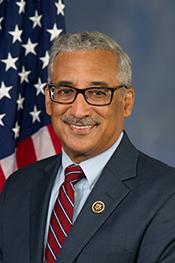
Robert C. "Bobby" Scott
DDemocratVA-3 · Representative
59
/ 100
Average
Attendance99
Avg: 96
Independence1
Avg: 4
Bipartisan Tone22
Avg: 15
Ethics Record100
Avg: 99
Transparency64
Avg: 53
Accountability Score — composite of attendance, independence, bipartisan tone, ethics record & transparency.
Methodology19
Bills Sponsored
0
Enacted into Law
2
Passed a Chamber
17
In Committee
All Sponsored Bills
HR10703In Committee
Protecting Workers’ Benefits Act
HR10702In Committee
Workers’ Retirement Savings Protection Act of 2026
HR10704In Committee
Direct CARE Opportunity Act of 2026
HR6893Passed House
Chesapeake Bay Watershed Advancement for Training, Education, Restoration, and Science (WATERS) Act
Chesapeake Bay Watershed Advancement for Training, Education, Restoration, and Science (WATERS) Act This bill reauthorizes the National Oceanic and Atmospheric Administration's Chesapeake Bay Office and modifies requirements concerning the office and its activities, such as new consultation requirements. (The office partners with the Chesapeake Bay Program to improve the health of the Chesapeake Bay.) The bill also provides statutory authority for the office's Chesapeake Bay watershed education and training program for elementary and secondary schools. Further, the bill authorizes the office to establish a program to support coordinated management, protection, characterization, and restoration of priority Chesapeake Bay habitats and living resources.
HR10373In Committee
Protecting Workers' Wages from Medical Debt Act
HR7340In Committee
Rebuild America’s Schools Act of 2026
Rebuild America's Schools Act of 2026 This bill provides support for long-term improvements to public elementary and secondary school facilities. First, the bill sets forth allocations to states and establishes a need-based grant program for local educational agencies (LEAs) to improve school facilities. Further, the bill specifies allowable uses of grant funds, including carrying out major repairs, improving indoor air quality, and making facilities accessible to individuals with disabilities. Additionally, the bill requires LEAs that receive funds for new construction, modernization, or renovation projects to comply with hazard-resistance building codes and performance criteria under the WaterSense program of the Environmental Protection Agency. Further, the bill requires such LEAs to adopt certain green practices (environmental standards) and requires the use of iron, steel, and manufactured products that are made in the United States (Buy America). The bill restores school infrastructure tax credit bonds. The bill also sets forth reporting requirements, including annual reports on grant program projects and a report by the Government Accountability Office that requires a study of the geographic distribution of projects, the impact of selected projects on student and staff health and safety, and the accessibility of projects to high-needs schools. The bill also establishes the Office of School Infrastructure and Sustainability within the Department of Education. Next, the bill extends through FY2031 the Impact Aid Construction program. Finally, the bill establishes a grant program to assist LEAs with repairing or replacing concrete foundations affected by pyrrhotite (an iron sulfide material linked to crumbling foundations).
HR6597In Committee
LET’S Protect Workers Act
The bill aims to strengthen protections for workers in the United States, though the specific provisions are not detailed in the available information. Based on its referral to committees overseeing labor, government operations, and administration, it likely addresses workplace safety, employee rights, or labor standards that affect private sector and potentially federal employees. The bill is currently under review by multiple congressional committees to determine which parts fall under each committee's jurisdiction.
HR5740In Committee
WIC Benefits Protection Act
This bill would protect the Women, Infants, and Children (WIC) nutrition program by preventing cuts to benefits or eligibility requirements without congressional approval. The legislation aims to ensure that low-income pregnant women, new mothers, and young children continue receiving food assistance and nutrition support without disruption from administrative changes.
HR4862In Committee
LOAN Act
Lowering Obstacles to Achievement Now Act or the LOAN Act This bill revises federal student aid programs, including the Federal Pell Grant program and the Public Service Loan Forgiveness (PSLF) program. It also repeals the education provisions that were enacted under P.L. 119-21 (commonly known as the One Big Beautiful Bill Act). Among other provisions, the bill revises the Federal Pell Grant program by (1) providing funding to increase the maximum award for each eligible student, and (2) allowing income-eligible graduate students to utilize their remaining Pell Grant eligibility toward their first graduate degree. Changes to the PSLF program include (1) reducing the number of monthly loan payments required for loan forgiveness, and (2) removing the requirement that a borrower must be employed in a public service job at the time of forgiveness. The bill makes Dreamer students (i.e., students who have been granted Deferred Action for Childhood Arrivals status and who entered the United States before the age of 18) who meet certain educational criteria eligible for federal financial aid. The bill also (1) establishes refinancing programs for federal and private student loans; (2) creates a new income-driven repayment plan; and (3) repeals origination fees for Direct Subsidized Loans, Direct Unsubsidized Loans, and Direct PLUS Loans. The bill repeals the education provisions that were enacted under P.L. 119-21. For example, the act addressed the amount of federal financial aid available to students by changing the mix and availability of student loans. (For more information, see CRS Report R48727 .)
HR4771In Committee
Transformation to Competitive Integrated Employment Act
This bill would change how the government supports people with disabilities in finding and keeping jobs, shifting away from segregated sheltered workshops toward regular competitive employment in the community. It would require states to transition individuals with disabilities into mainstream workplaces where they earn regular wages alongside non-disabled coworkers, rather than working in separate facilities at lower pay rates. The changes would affect people with disabilities seeking employment, employers hiring workers, and state vocational rehabilitation agencies that administer these programs.
HR4418In Committee
Child Care for Working Families Act
This bill would help working families afford child care by providing financial assistance or tax benefits to lower and middle-income parents who need to pay for childcare while they work. The legislation aims to make child care more accessible and affordable so parents—particularly mothers—can stay in the workforce without spending a huge portion of their income on care costs. Families with young children and working parents would be the primary beneficiaries of this support.
HR3606In Committee
Equity and Inclusion Enforcement Act of 2025
HR3605In Committee
Strength in Diversity Act of 2025
The legislation would require schools and universities to maintain or increase diversity in their student bodies and workforces, likely through admissions and hiring practices that consider race, ethnicity, and other demographic factors. It would affect students applying to colleges and universities, as well as school employees and administrators who develop admissions and hiring policies. The bill aims to ensure that educational institutions reflect the diversity of the broader population.
HRES435Passed House
Expressing the profound sorrow of the House of Representatives on the death of the Honorable Gerald E. Connolly.
The House of Representatives passed a resolution expressing its official condolences following the death of Representative Gerald E. Connolly, a longtime member of Congress. This type of resolution is a ceremonial action that allows the chamber to formally acknowledge the passing of one of its members and honor their service. The resolution has completed its passage through the House.
HR3522In Committee
Protecting Older Workers Against Discrimination Act of 2025
This bill would strengthen legal protections for workers age 40 and older against age-based discrimination in hiring, firing, pay, and promotions. It aims to make it easier for older workers to prove they were treated unfairly because of their age and could increase penalties for companies that violate these protections. The changes would affect millions of older Americans in the workforce and employers across all industries.
HRES237In Committee
Of inquiry requesting the President and directing the Secretary of Education to transmit, respectively, certain documents to the House of Representatives relating to the reduction in force and other downsizing measures at the Department of Education.
This resolution requests that the President provide, and directs the Department of Education (ED) to provide, to the House of Representatives all documents and materials related to the closure of ED; any reduction in force or other downsizing measures at ED; any actions taken pursuant to a specified March 3, 2025, communication to ED staff; any actions taken pursuant to any executive order directing the closure of ED; and any determinations made by the President, the Secretary of ED, or other ED staff that the staff remaining at ED after any reduction in force, other downsizing measure, or closure are sufficient to faithfully execute specified federal laws, including the Individuals with Disabilities Education Act, the Elementary and Secondary Education Act of 1965, and the Higher Education Act of 1965.
HR2743In Committee
Raise the Wage Act of 2025
This bill would increase the federal minimum wage, which is the lowest hourly rate employers are legally allowed to pay workers. The change would affect millions of low-wage workers across the country, potentially increasing their paychecks while also raising labor costs for businesses that employ minimum wage workers.
HR1954In Committee
Do No Harm Act
Based on the title and subjects, this bill likely aims to protect civil rights and prevent discrimination against minority groups, though the specific protections would depend on the bill's detailed language. The bill has been sent to the House Judiciary Committee for review, which handles civil rights legislation. Without seeing the full text, the general intent appears to be ensuring that laws and policies don't harm vulnerable populations or violate their legal protections.
HR20In Committee
Richard L. Trumka Protecting the Right to Organize Act of 2025
The legislation would strengthen workers' rights to form unions and bargain collectively by making it easier to organize, protecting workers from retaliation by employers, and increasing penalties for companies that violate labor laws. It would also expand the types of workers eligible to unionize and change how the National Labor Relations Board handles disputes between workers and employers. These changes would primarily affect private-sector employees seeking to join unions and the companies that employ them.