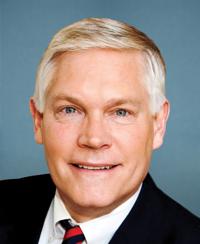
Pete Sessions
RRepublicanTX-17 · Representative
56
/ 100
Average
Attendance100
Avg: 96
Independence1
Avg: 4
Bipartisan Tone13
Avg: 15
Ethics Record100
Avg: 99
Transparency53
Avg: 53
Accountability Score — composite of attendance, independence, bipartisan tone, ethics record & transparency.
Methodology16
Bills Sponsored
0
Enacted into Law
2
Passed a Chamber
13
In Committee
All Sponsored Bills
HR9972In Committee
American Patients First Act of 2026
The proposal would change how Medicare pays for artificial skin products used to treat severe burns and other serious wounds. This could affect hospitals and wound care centers that use these products, as well as Medicare beneficiaries who need these treatments. The bill is currently being reviewed by two congressional committees to determine whether the payment adjustments are appropriate.
HCONRES111In Committee
Recognizing the 25th anniversary of the terrorist attacks of September 11, 2001, honoring the memory of the victims, recognizing the courage and sacrifice of the heroes who answered the call to serve, acknowledging the charitable organizations that continue to support survivors and victims' families, and reaffirming the enduring commitment of the United States to defend freedom and never forget.
This resolution marks the 25th anniversary of the September 11, 2001 terrorist attacks by honoring the victims who died, recognizing the first responders and military members who risked their lives, and acknowledging charitable groups helping survivors and families affected by the tragedy. The resolution also reaffirms America's commitment to protecting freedom and ensuring the attacks are never forgotten.
HR8290Reported
China Exchange Rate Accountability Act of 2026
This bill would likely give the U.S. government tools to monitor and potentially take action against countries that manipulate their currency values to gain unfair trade advantages, affecting American workers and businesses competing in global markets. The measure would probably require the Treasury Department to identify countries engaging in currency manipulation and could lead to trade penalties or negotiations to address the practice. Workers in manufacturing and export industries would be the primary beneficiaries if the bill successfully levels the playing field in international trade.
HR8312Passed House
Fraud Prevention and Accountability Act
Fraud Prevention and Accountability Act This bill (1) assigns financial integrity, improper payment prevention, and spending transparency functions to the Bureau of the Fiscal Service (BFS) within the Department of the Treasury; (2) establishes an Office of the Inspector General for Fraud, Accountability, and Recovery (OIGFAR) within Treasury; and (3) requires Treasury to enter into data sharing agreements with other federal agencies and allowable private entities to prevent fraud and improper payments. Functions assigned to BFS by the bill include administering the Do Not Pay system (which provides federal agencies and federally funded state-administered programs the ability to verify recipient identity and eligibility before making an award or issuing a payment); maintaining a voluntary governmentwide program to provide data sharing and analysis to federal agencies and to state, local, or tribal governments responsible for administering a federally funded program in order to detect fraud and prevent improper payments that result in financial loss; and supporting OIGFAR by providing access to information technology and data. The duties of OIGFAR include auditing and investigating the use of certain federal funds, such as funds, loans, and tax credits made available by various coronavirus response laws; any federal award of $50,000 or more; and emergency spending related to disaster relief or economic recovery. OIGFAR must ensure the expeditious reporting of suspected violations of federal criminal law to the Department of Justice. OIGFAR is authorized to provide investigative support to prosecutive and enforcement authorities to protect program integrity and prevent, detect, and prosecute fraud.
HRES1350In Committee
Expressing support of the goal of celebrating a "National Day of Honor and Respect" in conjunction with "Constitution Day and Citizenship Day".
This resolution expresses congressional support for designating a "National Day of Honor and Respect" to be celebrated alongside the existing Constitution Day and Citizenship Day on September 17th. The measure aims to recognize and honor the Constitution and the civic values of American citizenship through this combined observance. The proposal has been referred to the House Judiciary Committee for consideration.
HR3420In Committee
Words Matter Act of 2025
Words Matter Act of 2025 This bill removes outdated terminology in specified statutes by replacing references to mentally retarded and mental retardation with intellectual disability .
HR7953In Committee
FAIR ACT
I don't have enough information to write an accurate summary. The title "FAIR Act" is too generic, and without knowing the specific policy details, I cannot determine what this bill would actually do or who it affects. To provide a meaningful summary, I would need the bill's full text or more detailed subject information beyond just "Health."
HR7270In Committee
Stop Identity Fraud and Identity Theft Act of 2026
This bill aims to strengthen protections against identity fraud and theft by likely requiring financial institutions and companies to improve how they safeguard personal information and notify people when their data is compromised. It would affect banks, credit card companies, retailers, and other businesses that handle sensitive personal information, as well as the consumers whose data they protect. The specific requirements would be determined as the bill moves through the relevant congressional committees.
HR7050In Committee
Homeopathic Drug Product Safety, Quality, and Transparency Act
The legislation would require homeopathic products sold in the United States to meet stricter safety and quality standards, similar to those for conventional drugs, and would mandate that manufacturers clearly disclose their ingredients and manufacturing processes on product labels. This would affect homeopathic remedy makers and sellers, as well as consumers who use these products, by ensuring greater transparency about what they're buying and how it was made. The bill aims to give the FDA more authority to oversee the homeopathic industry, which currently operates under looser regulations than pharmaceutical drugs.
HR6412In Committee
Independence Investment Fund Act
This bill would likely establish a new investment fund or financial mechanism designed to promote economic independence, though the specific details aren't yet clear from the title alone. Based on its referral to the House Financial Services Committee, it probably aims to help individuals or small businesses access capital or investment opportunities that might otherwise be difficult to obtain. The bill could affect workers, entrepreneurs, or investors depending on how the fund operates and who is eligible to participate.
HR5125Passed House
District of Columbia Judicial Nominations Reform Act of 2025
District of Columbia Judicial Nominations Reform Act This bill terminates the District of Columbia (DC) Judicial Nomination Commission. Currently, the commission recommends to the President nominees for judges for DC's Superior Court and Court of Appeals, who must then be confirmed by the Senate. The commission also appoints the chief judges for these courts. The bill terminates the commission's involvement in nominations and requires the President to appoint the chief judges.
HR4863In Committee
Fairness for Khobar Act of 2025
Fairness for Khobar Act of 2025 This bill authorizes lump sum catch-up payments from the United States Victims of State Sponsored Terrorism (USVSST) Fund to certain victims of the 1983 Beirut barracks bombing or the 1996 Khobar Towers bombing who did not apply for catch-up payments during the application period. The USVSST Fund is administered by the Department of Justice (DOJ) and provides compensation to certain U.S. persons injured in acts of international state sponsored terrorism and their immediate family members. The Fairness for 9/11 Families Act, enacted in 2022, authorized and provided funding for lump sum catch-up payments from the USVSST Fund to victims of the 1983 Beirut barracks bombing or the 1996 Khobar Towers bombing. Claimants who were previously found eligible for regular payment distributions from the USVSST Fund were also eligible for lump sum payments, but the act required them to apply from December 29, 2022, to June 27, 2023. In a 2024 report, the Government Accountability Office found that up to 274 eligible victims did not apply for lump sum catch-up payments because of DOJ guidance that stated, in part, that claimants who were previously found eligible for regular payment distributions are not eligible for the lump sum catch-up payments.
HR3417In Committee
Websites and Software Applications Accessibility Act of 2025
This bill would require websites and software applications to be designed so that people with disabilities—including those who are blind, deaf, or have mobility limitations—can use them effectively. It would establish accessibility standards that companies and organizations need to follow, similar to how physical buildings must have ramps and elevators for wheelchair users. The law would likely apply to most businesses and government agencies that operate online, making digital services accessible to millions of Americans with disabilities.
HR1175In Committee
Blind Americans Return to Work Act of 2025
Blind Americans Return to Work Act of 2025 This bill requires the Social Security Administration to carry out a demonstration project during which blind Social Security Disability Insurance (SSDI) beneficiaries receive reduced benefits commensurate with income above certain thresholds. Under current law, only individuals who earn under a specified monthly income, known as the substantial gainful activity (SGA) threshold, are considered disabled and thereby eligible for SSDI benefits. For blind workers, this limit is $2,700 per month in 2025. SSDI beneficiaries may earn beyond the SGA threshold for a limited period of time, known as the trial work period , before their benefits are suspended and ultimately terminate. The bill establishes a 20-year demonstration project during which individuals who are entitled to SSDI benefits by reason of blindness and who earn above the SGA threshold continue to receive benefits at an amount gradually reduced commensurate with their earnings beyond a specified amount. During this period, blind workers’ SSDI benefits must be reduced by $1 for every $2 that a worker earns above the sum of (1) the SGA threshold, and (2) the worker’s expenses reasonably attributable to their work. The SGA threshold may not be used to determine whether an individual is disabled during this period, and blind workers’ SSDI benefits may not be terminated due to work-related earnings. The trial work period also must not apply. After 10 years, affected beneficiaries may opt out of the modified benefits structure.
HR572In Committee
RED TAPE Act
The bill aims to reduce government regulations and bureaucratic requirements that businesses, particularly small companies, say create unnecessary costs and delays. It would likely streamline or eliminate certain federal rules and paperwork requirements to make it easier for companies to operate. The measure has been sent to the Judiciary and Small Business committees for review.
HR216In Committee
SEC Act of 2025
Securities Enforcement Clarity Act of 2025 or the SEC Act of 2025 This bill specifies when separate occurrences of securities law violations must be considered as a single violation for purposes of calculating penalties. Specifically, separate occurrences must be counted as a single violation when the acts in question are the result of (1) a common or a substantially overlapping cause, (2) the same misstatement or omission, or (3) a continuing failure to comply. The bill applies to various violations of securities law, including those involving the registration, offer, and sale of securities; and the conduct of brokers, dealers, and investment advisers.