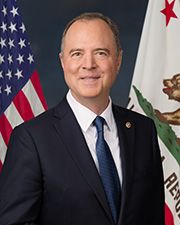
Adam B. Schiff
DDemocratCA · Senator
56
/ 100
Average
Attendance98
Avg: 97
Independence18
Avg: 23
Bipartisan Tone6
Avg: 14
Ethics Record100
Avg: 100
Transparency47
Avg: 47
Accountability Score — composite of attendance, independence, bipartisan tone, ethics record & transparency.
Methodology86
Bills Sponsored
0
Enacted into Law
0
Passed a Chamber
82
In Committee
All Sponsored Bills
S5604In Committee
Improving Species Recovery Act
SRES932In Committee
A resolution requesting information on Venezuela's human rights practices pursuant to section 502B(c) of the Foreign Assistance Act of 1961.
S5569In Committee
Oil Company Windfall Profits Tax Act of 2026
S5432In Committee
Food for Thought Act of 2026
S5439In Committee
A bill to direct the Secretary of Agriculture to improve safety standards for wildland firefighters.
S3720Reported
Bay Area Ridge National Scenic Trail Feasibility Study Act
The bill would authorize the federal government to study whether a new scenic hiking trail connecting ridges around the San Francisco Bay Area is feasible to build and maintain. The study would examine the route, costs, environmental impacts, and local support needed to create this trail system that would benefit hikers and outdoor enthusiasts in the region. If approved, this would be a first step toward potentially establishing the trail, though the study itself would not commit the government to actually building it.
S5429In Committee
Hot Meals for College Students Act of 2026
SJRES204In Committee
A joint resolution providing for congressional disapproval under chapter 8 of title 5, United States Code, of the rule submitted by the United States Fish and Wildlife Service and the National Oceanic and Atmospheric Administration relating to "Rescinding the Definition of 'Harm' Under the Endangered Species Act".
Congress is considering blocking a rule change that would narrow what counts as "harm" to endangered species under federal law, which could make it easier for businesses and developers to operate in ways that affect protected animals without needing special permits. If approved, this would overturn the Fish and Wildlife Service and National Oceanic and Atmospheric Administration's attempt to limit protections for endangered species. The change would primarily affect companies involved in construction, logging, and other development projects, as well as conservation groups working to protect wildlife.
S2432Reported
A bill to designate the facility of the United States Postal Service located at 6444 San Fernando Road in Glendale, California, as the "Paul Ignatius Post Office".
This bill designates the facility of the United States Postal Service located at 6444 San Fernando Road in Glendale, California, as the "Paul Ignatius Post Office".
S5368In Committee
Water Cyber Shield Act of 2026
S5276In Committee
Reducing Red Tape for Rebuilding Act
S5297In Committee
American Pharmaceutical Security Act
S5291In Committee
Small Business Cybersecurity Assistance Evaluation Act of 2026
S5324In Committee
Fairness to Freedom Act of 2026
S5234In Committee
Human-Wildlife Conflict Reduction Act of 2026
S5182In Committee
Tracking Plastic Act of 2026
The government would create a working group to develop ways to track and verify that plastic products actually contain recycled plastic as claimed by manufacturers. This affects companies that make or sell plastic products, consumers who want to buy environmentally friendly goods, and regulators trying to prevent false "green" claims. The goal is to establish standards so people can trust when products are labeled as containing recycled plastic content.
S5135In Committee
AI Ads Act
The proposal would update federal election laws to make it illegal for campaigns and political groups to use AI-generated content to deceive voters about who authorized a message or to fraudulently collect donations. This would close a loophole that currently doesn't specifically address deepfakes and other artificial intelligence-created materials used in misleading political advertising. The change would protect voters and donors from being tricked by realistic-looking but fake campaign content.
S5136In Committee
Promoting Authenticity with Influencer Disclaimers Act
Political committees would be required to include clear disclaimers on their advertisements and communications telling voters who paid for the ads, making it easier for people to see which groups are funding political messages. The requirement would apply to various types of campaign communications, helping voters understand the sources behind the political content they encounter. This change aims to increase transparency in campaign spending so the public knows who is behind the ads they see.
S5103In Committee
Stop MUSK Act
The bill would require federal employees and officials to step aside from decisions that could financially benefit their former employers, helping prevent conflicts of interest when government workers move between private industry and government jobs. This rule would apply across all executive branch agencies and departments, affecting career civil servants, political appointees, and other federal employees who previously worked in the private sector. The measure aims to ensure that government decisions are made based on the public interest rather than personal financial gain.
S5102In Committee
Closing Bribery Loopholes Act
The legislation would clarify what counts as illegal bribery when dealing with federal officials and witnesses, making the laws against corruption clearer and potentially easier to enforce. This would affect federal employees, government officials, and anyone involved in legal cases who might be tempted to offer improper payments or gifts to influence decisions. The bill is currently under review by the Senate Judiciary Committee.
S5105In Committee
Collaboration on Adversarial Threats and Security Risks Act
The bill would allow companies developing advanced artificial intelligence systems to share information about potential risks and safety concerns with each other without violating antitrust laws that normally prevent competitors from collaborating. This would let AI companies work together on identifying and addressing dangers from cutting-edge AI models while protecting them from legal liability for that cooperation. The measure aims to balance competition concerns with the need for the AI industry to coordinate on safety issues.
S5107In Committee
No Corporate Crooks Act
The bill would prevent people who have been convicted of corruption-related crimes from working as chief executive officers in federal government agencies. This restriction would apply to executives in the executive branch of government, which includes federal agencies and departments. The measure aims to ensure that people convicted of corruption crimes cannot hold top leadership positions in the federal government.
S5070In Committee
MAIL Act
The bill would allow homeless individuals and people facing housing instability to get free post office boxes so they can receive mail and important documents. This would help people experiencing homelessness maintain a mailing address for job applications, government benefits, and other services that require a physical address. The proposal is currently being reviewed by the Senate committee that oversees the postal service.
S5064In Committee
Higher Education Accreditation Accountability Act
Colleges and universities would be able to more easily switch which accrediting organization oversees them, making it simpler to change from one accreditation body to another. This change would affect students, faculty, and administrators at higher education institutions by potentially giving schools more flexibility in choosing their oversight agency. The bill also includes other related provisions to support this accreditation process.
S3131In Committee
USS Frank E. Evans Act
USS Frank E. Evans Act This bill requires the Department of Defense to authorize inclusion on the Vietnam Veterans Memorial Wall in the District of Columbia of the names of the 74 crew members of the USS Frank E. Evans killed on June 3, 1969.
S5033In Committee
Judicial FOIA Expansion Act
The proposal would give the public greater access to court records and documents from federal courts by amending federal law to establish clearer rights about what records people can view and obtain. This would affect anyone involved in federal court cases, journalists reporting on the courts, researchers studying the legal system, and ordinary citizens interested in following what happens in federal courtrooms. The bill is currently under review by the Senate Judiciary Committee.
S5036In Committee
Judicial Integrity Act
Federal judges and court employees would be banned from making official decisions that could benefit their own personal finances, such as ruling on cases involving companies where they own stock or have other financial stakes. The law would close potential conflicts of interest where someone in the judicial system could profit from their own decisions. This applies to all officers and employees working in federal courts across the country.
S5032In Committee
Justice is BLIND Act of 2026
Federal judges, including Supreme Court justices, would be required to place certain financial assets into blind trusts—special accounts they cannot see or control—to prevent conflicts of interest, with the same requirement applying to their spouses and dependent children. This rule aims to ensure judges make decisions based on the law rather than personal financial gain by keeping them unaware of which companies or investments their money is in. The requirement would apply to all levels of federal courts, from bankruptcy judges to the highest court in the land.
S4715In Committee
Offshore Leasing Standards and Accountability Act of 2026
The bill would require offshore oil and gas companies operating on federal waters to meet certain safety and financial standards before being allowed to drill, and would require them to set aside money in escrow accounts to pay for cleaning up and removing their equipment when operations end. This aims to protect taxpayers from having to cover decommissioning costs if a company goes bankrupt or abandons its facilities. The measure affects oil and gas operators working in U.S. ocean waters.
S4967In Committee
Stop TNR Act of 2026
The bill would increase criminal penalties for foreign governments or their agents who target, threaten, or harm U.S. citizens or people in the United States as part of efforts to suppress political opposition or dissent in their home countries. This would apply to actions like kidnapping, intimidation, or violence carried out by authoritarian regimes against their critics who have fled to America. The law aims to protect vulnerable people from transnational repression while deterring foreign governments from extending their control into U.S. territory.
SJRES200In Committee
A joint resolution to direct the removal of United States Armed Forces from hostilities within or against the Islamic Republic of Iran that have not been authorized by Congress.
This resolution would require the President to withdraw U.S. military forces from any military actions against Iran unless Congress has specifically authorized those actions through a formal vote. It essentially reasserts Congress's constitutional power to decide when the country goes to war, rather than allowing the President to conduct military operations independently. The measure affects military personnel, defense policy, and the balance of power between the President and Congress over decisions to use armed force.
S4951In Committee
Opening Programs to Organic Farms Act
The Agriculture Department would be required to study and report back to Congress about what obstacles prevent organic farmers and farms considering switching to organic methods from fully participating in USDA programs. The report would identify specific barriers these farms face, helping lawmakers understand what changes might be needed to make it easier for farmers to adopt or maintain organic practices. This affects organic farmers, conventional farmers interested in transitioning, and the USDA programs designed to support agricultural operations.
S4957In Committee
A bill to improve the administration of the Hollings Manufacturing Extension Partnership, and for other purposes.
The bill would strengthen how the Hollings Manufacturing Extension Partnership operates, a federal program that helps small and medium-sized manufacturers improve their competitiveness and productivity. The changes would affect manufacturing companies across the country that rely on this partnership for technical assistance, training, and business support services.
S4948In Committee
SBA IT Modernization Reporting Act
The Small Business Administration would be required to update and improve its computer systems and technology infrastructure based on specific recommendations to make its operations more efficient and effective. This modernization would help the agency better serve small business owners by improving how it processes loans, provides assistance, and manages its internal operations. The changes would primarily affect how the SBA delivers services to entrepreneurs and small business applicants.
S4868In Committee
American Rescuers of the Holocaust Congressional Gold Medal Act of 2026
The government would award a Congressional Gold Medal to recognize Americans who risked their lives to rescue and protect Jews and other refugees fleeing Nazi persecution during the Holocaust. This honor acknowledges the heroic actions of these individuals, whose efforts saved tens of thousands of people from death. The medal represents the nation's gratitude for their courage and humanitarian work during one of history's darkest periods.
S4841In Committee
Fresh Produce for Families Act of 2026
The bill would let food banks and emergency food programs buy fresh fruits and vegetables through the same ordering system that the Department of Defense uses to purchase produce, potentially making it easier and cheaper to get healthy food to people in need. This change would apply to the emergency food assistance program that helps distribute food to low-income individuals and families across the country. By using the military's existing supply chain, the program could streamline how it obtains fresh produce for distribution.
S4842In Committee
American Food Supply Chain Resiliency Act
The bill would make permanent a federal program that helps communities build stronger local food systems and create regional hubs where farmers and food producers can connect with buyers and consumers. This would support farmers, food businesses, and communities by providing funding and infrastructure to reduce dependence on long-distance food supply chains and create more resilient local markets. The measure is currently being reviewed by the Senate Agriculture Committee.
SRES778In Committee
A resolution recognizing and honoring Cambodian veterans of the Khmer National Armed Forces for their sacrifices, their support of the Armed Forces of the United States, and their defense of freedom in Southeast Asia.
This resolution recognizes the contributions of Cambodian veterans of the Khmer National Armed Forces who fought alongside the United States in the early 1970s. The resolution expresses gratitude for their partnership.
S4713In Committee
Preventing Payouts for Insurrectionists Act
The proposal would prevent people convicted of participating in an insurrection against the U.S. government from receiving federal payments, benefits, or settlements. This would affect individuals found guilty of insurrection-related crimes, potentially blocking access to things like federal employee pensions, Social Security, or lawsuit settlements involving the government. The bill is currently under review by the Senate Judiciary Committee.
S4697In Committee
HALO Act of 2026
The federal government would establish safety and design standards that weapons systems with autonomous or semi-autonomous features must meet before military use. These requirements would apply to the Department of Defense and defense contractors developing such weapons, ensuring they include safeguards like human oversight and the ability to be shut down or controlled by operators. The measure aims to prevent unintended harm and maintain human control over lethal military decisions.
S4654In Committee
Expanding Market Access Act
The bill would modify existing agricultural trade laws to help American farmers and food producers access more international markets for their products. It aims to remove trade barriers and expand opportunities for U.S. agricultural exports, which could increase sales and income for farmers and rural communities. The measure is currently under review by the Senate Agriculture Committee.
S4661In Committee
Ensuring Disaster Recovery and Resilience for Specialty Crops Act
The bill would create a permanent system to help specialty crop farmers (like fruit, vegetable, and nut growers) recover from natural disasters such as droughts, floods, and freezes, rather than requiring Congress to approve emergency aid each time a disaster occurs. This would give farmers more reliable financial support when weather or other natural events damage their crops, similar to disaster programs that already exist for major crops like corn and wheat.
S4651In Committee
Increasing Insurance Access for Specialty Crops Act
The bill would make it easier for farmers who grow specialty crops—like fruits, vegetables, and nuts—to get federal crop insurance to protect against losses from bad weather or other disasters. Currently, specialty crop farmers have fewer insurance options compared to farmers growing major crops like corn and soybeans, so this change would help level the playing field and give these farmers better protection for their harvests.
S4650In Committee
Improving Pest and Disease Preparedness for Specialty Crops Act
The legislation would strengthen the government's ability to prevent and respond to plant pests and diseases that threaten specialty crops like fruits, vegetables, and nuts. It would give federal agriculture officials better tools and resources to detect outbreaks early, coordinate responses across states, and help farmers protect their harvests from destructive pests and diseases. Specialty crop farmers and consumers who depend on these products would benefit from improved disease prevention and food security.
S4660In Committee
Economic Relief for Specialty Crops Act
The federal government would allocate money to the Department of Agriculture to pay farmers who grow specialty crops like fruits, vegetables, and nuts. These payments would help support producers of crops that are more perishable and market-sensitive than major commodities like corn and wheat. The bill is currently under review by the Senate Agriculture Committee.
S4652In Committee
Advancing Automation Research and Development in Agriculture Act
The bill would extend funding for research programs that help farmers grow fruits, vegetables, and other specialty crops more efficiently, and would create a new program focused on developing machines and automated technology to harvest and process these crops. These changes would support agricultural researchers, farmers who grow specialty crops, and equipment manufacturers working to modernize farming practices. The bill is currently under review by the Senate Agriculture Committee.
S4645In Committee
No Payouts for Political Insiders Act
The federal government currently pays out judgments and settlements when it loses lawsuits, but this bill would cap how much money can be paid out in any single case. The limits would apply to court judgments, arbitration awards, and negotiated settlements involving federal agencies, potentially reducing the amount of compensation that individuals or organizations can receive when they successfully sue the government.
S4644In Committee
Drain the Slush Fund Act
The federal government currently pays out settlements and judgments when it loses lawsuits, and this bill would set new limits on how much money can be awarded in these cases. The changes would affect anyone suing the federal government for damages, potentially reducing the compensation they could receive if they win their case. The bill is currently under review by the Senate Judiciary Committee.
S4603In Committee
Golden Mussel Eradication and Control Act of 2026
The bill would create a test program to study and control golden mussels, an invasive species that damages water infrastructure like pipes and dams by attaching to them and clogging water systems. The program would help states and water utilities develop better methods to prevent golden mussels from spreading to new waterways and to remove them from areas where they've already established themselves. This affects water companies, farmers who rely on irrigation systems, and communities that depend on clean water supplies.
S4599In Committee
Scratch Cooked Meals for Students Act of 2026
The proposal would create a test program to help schools prepare meals from basic ingredients rather than relying on pre-made foods, with the goal of improving nutrition and teaching cooking skills to students. Schools participating in the pilot would receive support and resources to implement scratch cooking in their cafeterias. This would affect school lunch programs, students, cafeteria workers, and potentially local food suppliers.
S4559In Committee
Energy Cost Fairness and Reliability Act of 2026
The bill would require the Federal Energy Regulatory Commission to create new rules making it easier and faster for large industrial facilities and data centers to connect to the nation's electrical grid. This would affect companies that use significant amounts of electricity and want to build new operations or expand existing ones by streamlining the approval process for grid connections. The change aims to reduce delays and uncertainty for businesses planning major energy-intensive projects.
S4558In Committee
PETSAFE Act
The federal government would be required to include plans for protecting and caring for pets and service animals during disasters and emergencies, similar to how it plans for human evacuees. This would affect disaster relief agencies, pet owners, and animal shelters by establishing standards for how companion animals are handled during evacuations and emergency response operations. The changes update existing disaster relief laws to recognize that families often won't evacuate without their pets, and that service animals need special consideration during crises.
SRES718Introduced
A resolution commending and congratulating the University of California, Los Angeles Bruins women's basketball team for winning the 2026 National Collegiate Athletic Association Division I Women's Basketball National Championship.
Congress is formally recognizing and congratulating the UCLA Bruins women's basketball team for winning the 2026 NCAA Division I national championship. This resolution honors the players, coaches, and staff for their athletic achievement and represents an official acknowledgment of their accomplishment by the federal government. The resolution passed unanimously in the Senate without any changes.
S4453In Committee
LINK Act
The federal government would require the Agriculture and Interior departments to make their computer systems and cybersecurity protections work together seamlessly, so the two agencies can share information and protect themselves against hacking more effectively. This affects millions of Americans who depend on these departments' services, from farmers receiving agricultural support to people using public lands and natural resources. The bill aims to close gaps where outdated or incompatible systems might leave sensitive government data vulnerable to cyber attacks.
SJRES184In Committee
A joint resolution to direct the removal of United States Armed Forces from hostilities within or against the Islamic Republic of Iran that have not been authorized by Congress.
This joint resolution directs the President to remove U.S. Armed Forces from hostilities within or against Iran unless a declaration of war or authorization to use military force for such purpose has been enacted. The resolution specifies that it shall not be construed to prevent the United States from defending against an attack on the United States or its personnel or facilities in other nations.
S4414In Committee
LIFT AI Act
Literacy in Future Technologies Artificial Intelligence Act or the LIFT AI Act This bill authorizes the National Science Foundation to make merit-based grants to institutions of higher education, nonprofit organizations, and consortia of such entities to support artificial intelligence (AI) literacy for K-12 students and educators. Grants may be used for research and development of educational curricula, instructional material, professional development for teachers, and evaluation methods for AI literacy at the K-12 level.
S4402In Committee
A bill to require a report on the use of artificial intelligence with respect to access to unminimized information collected pursuant to the Foreign Intelligence Surveillance Act of 1978, and for other purposes.
The government would be required to report on how it uses artificial intelligence to search through and analyze sensitive intelligence information collected under foreign surveillance laws. This affects national security agencies and oversight committees that need to understand whether AI tools are being used appropriately when accessing classified materials gathered on foreign targets. The report would help Congress and the public understand the scope and safeguards around AI use in intelligence operations.
S4361In Committee
Pets Belong with Families Act
The legislation would prevent landlords from charging extra fees or deposits specifically for pets, and would require that pet policies be applied fairly and consistently across all tenants. This would help renters, especially low-income families, afford to keep their pets while living in rental housing by limiting the financial barriers landlords can impose on pet owners.
S4319In Committee
Rehabilitation Through Reading Act of 2026
The federal government would have to use an independent review process before removing books from prison libraries, rather than allowing individual prison officials to make those decisions alone. This would give inmates and outside reviewers a chance to challenge book bans and ensure decisions are made fairly and consistently across all federal prisons. The change aims to protect access to reading materials while still allowing prisons to maintain security and order.
S4320In Committee
Prison Libraries Act of 2026
Prison Libraries Act of 2026 This bill directs the Department of Justice to establish a grant program to provide library services for incarcerated individuals.
S4289In Committee
Preparing Superfund for Climate Change Act of 2026
This bill would require the federal government to update how it manages and cleans up heavily polluted sites (known as Superfund sites) to account for climate change impacts like flooding, extreme weather, and rising sea levels. The changes would help ensure that cleanup efforts and long-term protections at these contaminated locations remain effective as climate conditions shift, protecting nearby communities and workers from exposure to hazardous materials during environmental disasters.
SJRES146In Committee
A joint resolution providing for congressional disapproval under chapter 8 of title 5, United States Code, of the rule submitted by the Bureau of Consumer Financial Protection relating to the withdrawal of the rule relating to "Application of Regulation Z's Ability-To-Repay Rule to Certain Situations Involving Successors-In-Interest".
Congress is considering blocking a decision by the Consumer Financial Protection Bureau to withdraw a rule that protected people who inherit mortgages or take over loan obligations from having to meet strict ability-to-repay requirements. If approved, this would force the agency to keep the protections in place for successors-in-interest on mortgages. The measure affects borrowers who inherit property with existing loans and the lenders who work with them.
S4160In Committee
Prediction Markets Are Gambling Act
This bill would classify prediction markets—platforms where people bet money on the outcomes of future events like elections, sports games, or weather—as gambling rather than allowing them to operate under different regulatory frameworks. The change would subject these markets to gambling laws and regulations, potentially restricting who can participate and how they operate. This would affect both the companies running prediction markets and the millions of people who currently use them to place bets on various outcomes.
S4094In Committee
Corruption Clawback Act
This bill would allow the government to recover money or benefits that were improperly given to federal officials or contractors through corrupt dealings, even after those officials have left office or contracts have ended. It aims to prevent corruption by making sure that people who obtained government funds or positions through illegal means can be forced to return what they gained. The measure would affect federal employees, contractors, and anyone else who receives government money or benefits.
S4035In Committee
DEATH BETS Act
This bill would regulate or restrict the practice of betting on people's deaths, which involves financial contracts where investors profit when someone dies. The legislation aims to address concerns about these "death bets" in the financial markets by establishing rules around who can place such bets and under what conditions, potentially protecting individuals from having strangers financially benefit from their deaths. The bill affects insurance companies, financial firms, and investors who currently participate in these types of contracts.
SJRES117In Committee
A joint resolution to direct the removal of United States Armed Forces from hostilities within or against the Islamic Republic of Iran that have not been authorized by Congress.
This joint resolution directs the President to remove U.S. Armed Forces from hostilities within or against Iran unless a declaration of war or authorization to use military force for such purpose has been enacted. The resolution specifies that it shall not be construed to prevent the United States from defending against an attack on the United States or its personnel or facilities in other nations.
S3961In Committee
Stop Post-Disaster Vultures Act
This bill would prevent contractors and companies from charging excessive prices for emergency supplies and repair services in the aftermath of natural disasters and other emergencies. It aims to protect disaster victims and communities from price gouging by establishing penalties for businesses that dramatically raise prices on essential goods and services when people are most vulnerable and desperate. The legislation would give federal emergency management authorities tools to monitor and enforce fair pricing during disaster recovery periods.
S3928In Committee
SCOPE Act of 2026
Based on the title and environmental protection focus, this bill likely aims to expand or clarify the scope of environmental regulations and protections, though the specific details are not yet clear from its early stage in Congress. The bill has just been introduced and referred to the relevant committee for review, so its exact provisions—whether addressing air quality, water protection, land use, or other environmental concerns—will be determined as it moves through the legislative process. Workers, businesses, and communities affected by environmental regulations would be the primary stakeholders watching how this legislation develops.
S3827In Committee
Financial Disclosure Modernization Act
This bill would update the financial disclosure rules that federal officials must follow, likely making it easier for them to file their required paperwork and potentially changing what information they have to report about their finances and investments. The changes would affect members of Congress, federal judges, and other government employees who currently have to disclose their financial holdings to prevent conflicts of interest. The bill is still in the early stages and has been sent to a Senate committee for review.
S3813In Committee
CLEAR Act
Without access to the specific text of this CLEAR Act bill, I cannot provide an accurate summary of what it would do. The title "CLEAR Act" is too vague on its own, and the subject line "Commerce" is broad enough to cover many different types of legislation. To write a factual summary, I would need to know the bill's specific provisions—for example, whether it addresses consumer protection, business regulations, trade, or another commerce-related area.
SRES577Introduced
A resolution observing the 1-year anniversary of the 2025 Southern California wildfires.
This resolution marks the one-year anniversary of the 2025 Southern California wildfires by officially recognizing the event in Congress. The measure honors those affected by the fires, including residents who lost homes and property, firefighters and first responders who battled the blazes, and communities that worked together to recover. The Senate passed it unanimously, making it a formal statement of remembrance and acknowledgment of the disaster's impact.
S3528In Committee
Producing Real Opportunities for Technology and Entrepreneurs Investing in Nutrition Act
This bill would likely create new programs or funding to support entrepreneurs and technology companies working on nutrition and food-related innovations, with the goal of improving how Americans access and understand healthy food options. The legislation would probably affect startup founders, agricultural businesses, and food companies developing new nutrition technologies or solutions. By encouraging investment in this area, the bill aims to address nutrition challenges while supporting economic growth in the food and agriculture sector.
S3464In Committee
Housing BOOM Act
S1870In Committee
Rim of the Valley Corridor Preservation Act
This bill would protect a large area of land around the Los Angeles area known as the Rim of the Valley from development by designating it as a national monument or protected corridor. The protection would preserve open space, wildlife habitat, and recreational areas for the public while limiting where companies and developers can build. Local communities, hikers, and wildlife would benefit from keeping the land undeveloped, though some property owners and developers might face restrictions on how they can use their land.
S3326In Committee
Temporary Immigration Judge Integrity Act
This bill would establish temporary measures to address concerns about the integrity and conduct of immigration judges who hear cases involving asylum seekers, deportations, and other immigration matters. The legislation likely aims to improve oversight, accountability, or ethical standards for these judges, who make decisions that directly affect immigrants' legal status and ability to stay in the United States. The bill is currently under review by the Senate Judiciary Committee.
SJRES76In Committee
A joint resolution providing for congressional disapproval under chapter 8 of title 5, United States Code, of the rule submitted by the Environmental Protection Agency relating to "Extension of Deadlines in Standards of Performance for New, Reconstructed, and Modified Sources and Emissions Guidelines for Existing Sources: Oil and Natural Gas Sector Climate Review Final Rule".
This joint resolution nullifies the rule issued by Environmental Protection Agency titled Extension of Deadlines in Standards of Performance for New, Reconstructed, and Modified Sources and Emissions Guidelines for Existing Sources: Oil and Natural Gas Sector Climate Review Final Rule and published on July 31, 2025. The rule extended (1) certain deadlines for performance standards concerning control devices, equipment leaks, storage vessels, process controllers, and vent systems at crude oil and natural gas facilities; (2) the date for future implementation of the Methane Super Emitter Program; and (3) a state plan submittal deadline. Thus, the joint resolution restores the original deadlines that were applicable before the extensions made by the rule.
S3183In Committee
Healthy Lungs for Heroes Act of 2025
This bill would protect workers, particularly veterans and first responders, from lung damage caused by exposure to harmful substances like burn pits, asbestos, and other occupational hazards. It likely aims to improve workplace safety standards, expand health monitoring programs, or increase compensation and medical benefits for people whose lungs have been damaged by their jobs. The bill focuses on ensuring these workers receive proper healthcare and support for respiratory illnesses related to their service or employment.
S3182In Committee
No Torts for Trump Act
This bill would prevent lawsuits against former President Trump related to actions he took while in office, shielding him from civil legal claims that arise from his presidential conduct. The measure would affect anyone who might otherwise sue the former president in court, potentially limiting access to the legal system for people who believe they were harmed by his official decisions or statements.
S3184In Committee
Tribal Internet Expansion Act of 2025
S2838In Committee
Protecting Our Democracy Act
This bill likely aims to strengthen election security and voting protections, though the specific measures aren't detailed in the available information. Based on its referral to the Homeland Security committee, it probably addresses issues like election administration, voter access, or safeguards against interference in federal elections. The bill would affect voters, election officials, and potentially federal agencies responsible for overseeing elections.
SJRES78In Committee
A joint resolution proposing an amendment to the Constitution of the United States relating to the authority of Congress and the States to regulate contributions and expenditures intended to affect elections and to enact public financing systems for political campaigns.
This joint resolution proposes a constitutional amendment authorizing Congress and the states to (1) regulate and impose reasonable viewpoint-neutral limitations on the raising and spending of money by candidates and others to influence elections; and (2) regulate and enact public campaign financing systems, including those designed to restrict the influence of private wealth by offsetting the raising and spending of money by candidates and others with increased public funding. The amendment grants Congress and the states the power to implement and enforce this amendment by legislation. They are allowed to distinguish between natural persons and corporations or other artificial entities created by law, including by prohibiting such entities from spending money to influence elections.
S2731In Committee
Empowering Striking Workers Act of 2025
This bill would give workers who go on strike access to unemployment benefits while they're not working, treating strike periods similarly to other temporary job losses. It would help striking workers pay their bills during labor disputes without having to find temporary work elsewhere. The change would primarily affect unionized workers and those involved in organized labor actions.
S2219In Committee
BEACON Act
Without access to the bill's specific text, the BEACON Act appears to address government operations and administration based on its referral to the Homeland Security and Governmental Affairs Committee. The bill likely aims to improve how federal agencies operate, coordinate, or share information, though the exact changes would depend on its detailed provisions. Once the committee reviews it, they'll determine whether these proposed government reforms should move forward.
S2188In Committee
ATF DATA Act
ATF Data and Anti-Trafficking Accountability Act or the ATF DATA Act This bill directs the Bureau of Alcohol, Tobacco, Firearms and Explosives to report to Congress and make publicly available certain data sets regarding firearms tracing data.
S2088In Committee
Firearm Destruction Licensure Act of 2025
S1531In Committee
Assault Weapons Ban of 2025
Assault Weapons Ban of 2025 This bill makes it a crime to knowingly import, sell, manufacture, transfer, or possess a semiautomatic assault weapon (SAW) or large capacity ammunition feeding device (LCAFD). The prohibition does not apply to a firearm that is (1) manually operated by bolt, pump, lever, or slide action, except for certain shotguns; (2) permanently inoperable; (3) an antique; (4) only capable of firing rimfire ammunition; or (5) a rifle or shotgun specifically identified by make and model. The bill also exempts from the prohibition the following, with respect to a SAW or LCAFD: importation, sale, manufacture, transfer, or possession related to certain law enforcement efforts, or authorized tests or experiments; importation, sale, transfer, or possession related to securing nuclear materials; and possession by a retired law enforcement officer. The bill permits continued possession, sale, or transfer of a grandfathered SAW, which must be securely stored. A licensed gun dealer must conduct a background check prior to the sale or transfer of a grandfathered SAW between private parties. The bill permits continued possession of, but prohibits sale or transfer of, a grandfathered LCAFD. Newly manufactured LCAFDs must display serial number identification. Newly manufactured SAWs and LCAFDs must display the date of manufacture. The bill also allows a state or local government to use Edward Byrne Memorial Justice Assistance Grant Program funds to compensate individuals who surrender a SAW or LCAFD under a buy-back program.