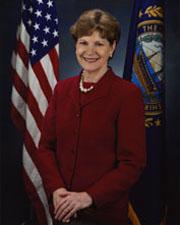
Jeanne Shaheen
DDemocratNH · Senator
58
/ 100
Average
Attendance96
Avg: 97
Independence26
Avg: 23
Bipartisan Tone5
Avg: 14
Ethics Record100
Avg: 100
Transparency50
Avg: 47
Accountability Score — composite of attendance, independence, bipartisan tone, ethics record & transparency.
Methodology77
Bills Sponsored
0
Enacted into Law
0
Passed a Chamber
62
In Committee
All Sponsored Bills
S5633In Committee
STEP Improvement Act of 2026
SRES924Introduced
A resolution designating October 7, 2026, as "Energy Efficiency Day" in celebration of the economic and environmental benefits that have been driven by private sector innovation and Federal energy efficiency policies.
This resolution designates October 7, 2026, as Energy Efficiency Day.
SRES895Introduced
A resolution designating the week of October 4, 2026, through October 10, 2026, as "National Community Policing Week".
SRES855In Committee
A resolution acknowledging that it is in the national interest of the United States to support democratic actors in the Russian Federation, commending the work of Russian civil society and independent media to expose and respond to the crimes of the government of Vladimir Putin and pursue accountability for such crimes.
S4189Reported
INSULIN Act of 2026
This bill would likely work to make insulin more affordable and accessible for Americans with diabetes by addressing high drug prices through measures such as capping out-of-pocket costs, increasing transparency in pricing, or expanding insurance coverage. The changes would primarily affect diabetic patients who struggle to afford their medication, as well as insurance companies and pharmaceutical manufacturers that produce insulin. The bill is currently under review by the Senate committee responsible for health policy.
SRES841In Committee
A resolution celebrating the 35th anniversary of the independence of Ukraine from the former Soviet Union.
S5286In Committee
Supporting Disabled Entrepreneurs Act
S5356In Committee
Lebanon Sanctions, Stabilization, and Support Act
SRES835In Committee
A resolution celebrating the July 2026 North Atlantic Treaty Organization Summit in Ankara, Turkiye, and reaffirming priorities pertaining to transatlantic security and the United States commitment to NATO.
S3172Reported
A bill to repeal certain Acts that impose sanctions upon Syria.
The proposal would remove existing economic and trade penalties that the United States has placed on Syria, allowing American companies and individuals to do business with the Syrian government and economy again. This would affect American businesses, workers in trade-related industries, and could change how the U.S. relates to Syria internationally. The bill is currently under review by the Senate Foreign Relations Committee.
S4570Reported
U.S. Tech PATH Act
The bill would make it easier and more attractive for foreign governments that are U.S. allies to buy American-made cybersecurity and digital technology products and services. It aims to streamline the approval process for these sales while offering incentives to encourage foreign partners to choose U.S. technology over competitors from other countries. This would benefit American tech companies by expanding their international markets while strengthening the technological ties between the U.S. and its allies.
S4577Reported
Reassessing the United States-Tanzania Bilateral Relationship Act
The legislation would direct the U.S. government to review and evaluate its relationship with Tanzania, examining areas of cooperation and potential concerns between the two countries. The review would likely assess trade, security, diplomatic ties, and other bilateral matters to inform future U.S. policy decisions toward Tanzania.
S2252Reported
Saving Lives and Taxpayer Dollars Act
The legislation would modify how the U.S. government spends money on international programs and foreign aid, with the goal of reducing costs while maintaining effectiveness in areas like humanitarian assistance and diplomatic efforts. The bill has been revised by the Foreign Relations Committee and is moving toward a vote in Congress. It would affect how federal agencies manage overseas spending and could impact both American taxpayers and people who receive U.S. international assistance.
S4877In Committee
Military Sexual Trauma Accountability Act
Service members and veterans who experience sexual assault or harassment while in the military would be able to sue the federal government for damages, similar to how civilians can sue for injuries caused by government negligence. Currently, military personnel have very limited ability to take legal action against the government for these traumatic experiences. This change would give them a legal pathway to seek compensation and hold the government accountable.
S4918In Committee
Right Start Child Care and Education Act of 2026
The government would offer tax breaks and financial incentives to students who earn degrees in child care fields and then work at child care facilities, aiming to attract more qualified workers to an industry that often struggles with staffing shortages. This would help both students manage the cost of education in this field and help child care centers find and keep trained staff. The proposal is currently under review by the Senate Finance Committee.
S4929In Committee
EBOLA Act
The United States would be required to maintain its membership and participation in the World Health Organization, preventing the country from withdrawing from the international health agency. This affects American involvement in global disease monitoring, pandemic response coordination, and health emergencies that cross borders. The bill ensures the U.S. continues contributing to and benefiting from the WHO's work on infectious disease prevention and international health cooperation.
S4911In Committee
Investing in State Energy Act of 2026
The bill would speed up how quickly states and local communities receive federal money and information for energy efficiency and renewable energy projects under two existing federal programs. This would help states and cities move faster on initiatives like home weatherization and clean energy installations that reduce energy costs and consumption. The changes affect state energy offices, local governments, and residents who benefit from these energy improvement programs.
S4895In Committee
Turn the Tide Act
The legislation would allocate federal funding to support various drug addiction and mental health programs established under the SUPPORT Act, which helps communities address the opioid crisis and provides treatment services to patients struggling with substance abuse. The money would go toward initiatives like medication-assisted treatment, recovery support services, and prevention programs in states and local communities. This funding would affect people battling addiction, healthcare providers offering treatment, and communities working to combat the opioid epidemic.
SRES775In Committee
A resolution reaffirming the importance of the United States promoting the safety, health, and well-being of refugees and displaced persons in the United States and around the world.
This resolution reaffirms the U.S. commitment to protect the safety, health, and well-being of refugees and asylum seekers. The resolution calls upon the Department of State, the Department of Homeland Security, the Department of Health and Human Services, and the U.S. Mission to the United Nations to partner with the international community to solve existing conflicts, prevent new conflicts from emerging, and tackle the root causes of involuntary migration.
S4617In Committee
Exchange Stabilization Fund Transparency Act
The Treasury Department currently has broad authority to use a special fund called the Exchange Stabilization Fund to provide financial assistance to foreign countries, sometimes without telling Congress first. This bill would require the Treasury Department to notify Congress before using this fund to help other nations, making the process more transparent and giving lawmakers a chance to review these decisions. The change would affect how the federal government conducts international financial assistance and ensure Congress has oversight over these spending decisions.
SRES754In Committee
A resolution reaffirming congressional support for the Taiwan Relations Act and longstanding bipartisan Taiwan policy.
Congress would formally reaffirm its commitment to the Taiwan Relations Act, a 1979 law that guides U.S. relations with Taiwan and commits the U.S. to provide Taiwan with defensive military equipment and maintain unofficial diplomatic ties. The resolution expresses support for the longstanding bipartisan approach to Taiwan policy that has been followed by both Democratic and Republican administrations. This affects U.S. foreign policy toward Taiwan and China, as well as American defense contractors and Taiwan's security interests.
S4613In Committee
Manufactured Housing Community Sustainability Act of 2026
The proposal would let businesses claim a tax credit when they sell real property that will be used as a manufactured home community, potentially making it more financially attractive for developers to create or convert land into spaces for mobile homes. This tax incentive could affect real estate developers, investors, and potentially manufactured home residents by encouraging more affordable housing options in communities. The bill is currently under review by the Senate Finance Committee.
S4612In Committee
SCREEN for Type 1 Diabetes Act of 2026
The government would launch a public awareness campaign to educate Americans about screening for type 1 diabetes, a condition where the body's immune system attacks cells that produce insulin. This campaign would help people, especially children and families, recognize early warning signs and seek medical testing sooner, potentially leading to earlier diagnosis and treatment. The bill also includes other provisions related to diabetes prevention and management.
S4614In Committee
Stars and Stripes Editorial Independence Act of 2026
The Stars and Stripes, a military newspaper that reports news to service members and their families, would be protected from political pressure or interference in its editorial decisions under this proposal. The bill aims to ensure that military leadership cannot suppress or control what stories the publication covers or how it covers them, preserving the organization's ability to report independently on military issues. This affects military personnel and their families who rely on the publication for trustworthy news.
SRES707In Committee
A resolution expressing concern about the increasing influence of the People's Republic of China in Latin America and the Caribbean and calling for strengthened United States economic, security, and diplomatic engagement in the region.
This resolution expresses commitment to countering the influence of China in Latin America and the Caribbean and emphasizes the importance of U.S. investment and engagement in the region. The resolution also encourages countries in Latin America and the Caribbean to review foreign investments in strategic sectors that risk undermining their security.
S4436In Committee
Protecting Human Rights and Public Health in Foreign Assistance Act
The bill would overturn specific regulations that govern how the U.S. government provides aid to other countries. This would affect foreign aid programs and potentially change how American taxpayer money is distributed internationally, impacting both the countries that receive assistance and the federal agencies responsible for managing these programs.
S4387In Committee
Protect Moms From Domestic Violence Act
The government would fund a study to understand how intimate partner violence increases the risk of serious health problems or death during pregnancy and childbirth. Researchers would examine the connection between domestic abuse and maternal health outcomes to help doctors and public health officials better protect pregnant women who are experiencing violence. This research could lead to improved screening and support services for pregnant women in abusive relationships.
S4275In Committee
BLOCK PUTIN Act
This bill aims to impose sanctions and restrictions on Russia and its leaders in response to Russian aggression, likely targeting Vladimir Putin and Russian government officials, oligarchs, or entities through measures like asset freezes, trade restrictions, or travel bans. The legislation would affect American businesses and individuals who do business with Russia, as well as Russian entities and their international partners. The bill is currently under review by the Senate Foreign Relations Committee.
S4257In Committee
Resources To Prevent Youth Vaping Act
This bill would provide funding and resources to help prevent young people from using e-cigarettes and vaping products, likely through education programs, public awareness campaigns, and support for schools and health organizations. The legislation aims to reduce youth vaping by giving communities and health agencies the tools they need to discourage teenagers from starting or continuing to use these nicotine products.
S4215In Committee
AFFIRM Act of 2026
The bill appears to address agricultural policy, though the specific provisions aren't detailed in the available information. Based on its referral to the Agriculture Committee, it likely affects farmers, food producers, or agricultural programs, but without seeing the full text, the concrete impacts cannot be determined. If you have access to the bill's summary or text, that would clarify what changes it proposes.
S3758In Committee
End Veterans Overdose Act of 2026
This bill would help prevent overdose deaths among veterans by expanding access to overdose-reversal medications like naloxone and improving mental health and substance abuse treatment programs through the Department of Veterans Affairs. The legislation aims to address the opioid crisis affecting military veterans by making these life-saving tools and counseling services more readily available at VA facilities and to veterans in their communities. Veterans struggling with addiction and their families would be the primary beneficiaries of these expanded prevention and treatment resources.
S4114In Committee
Student Protection and Success Act
Student Protection and Success Act This bill establishes certain consequences for institutions of higher education (IHEs) that have low student loan repayment rates or high student loan balances among their students. Specifically, the bill makes an IHE ineligible for federal student financial aid programs for three fiscal years if only 15% or less of its students are able to start repaying the principal of their loans by specified deadlines. Additionally, the bill creates a grant program through which the Department of Education must award grants to eligible IHEs (i.e., IHEs with a student loan repayment rate above 25%) that have a strong record of supporting low- and moderate-income students. The bill funds the grants by requiring IHEs with certain nonrepayment loan balances to make risk-sharing payments. Grants may be used to increase college access and success for the students using investments and practices such as awarding additional need-based financial aid, enhancing academic and student support services, and establishing or expanding accelerated learning opportunities. The bill also requires the National Center for Education Statistics to collect information on student service expenditures, student service resources, and recruitment and marketing expenditures.
SRES640In Committee
A resolution supporting the goals of International Women's Day.
This resolution expresses Congress's support for the goals and values of International Women's Day, which focuses on advancing women's rights and gender equality around the world. The resolution does not create new laws or programs, but rather serves as a statement of congressional support for women's empowerment and equal opportunity globally. It affects how the U.S. positions itself on international women's issues and may influence diplomatic priorities and foreign aid decisions related to gender equality.
S4037In Committee
Diabetes Act
The Diabetes Act would likely establish new programs or funding to help prevent, treat, or manage diabetes in the United States, potentially affecting millions of Americans living with the disease as well as healthcare providers and insurers. The bill may include provisions for research, patient education, improved access to medications and supplies, or changes to how diabetes care is covered by insurance. The proposal is currently under review by the Senate Finance Committee, which handles healthcare and insurance matters.
S4030In Committee
Supporting After-School STEM Educators Act
This bill would provide support and resources for teachers and instructors who run after-school science, technology, engineering, and math programs for students. The legislation aims to help schools and organizations offer more STEM learning opportunities outside regular class hours, potentially through funding, training, or other assistance for educators leading these programs.
S4006In Committee
Fair Housing for Survivors Act of 2026
This bill would protect domestic violence and sexual assault survivors from housing discrimination by allowing them to break leases early, hide their personal information from landlords, and receive reasonable accommodations like changing locks without penalty. It aims to help survivors safely relocate away from abusers without losing their housing security or facing financial penalties from landlords. The law would apply to rental properties and affect both survivors seeking new housing and landlords' rental practices.
S3983In Committee
End Foreign Abuse of United States Courts Act
This bill would make it harder for foreign individuals and companies to sue people or businesses in U.S. courts by requiring them to post a bond (a financial deposit) to cover potential legal costs if they lose their case. The measure aims to prevent what supporters see as frivolous lawsuits filed by foreign parties who have little connection to the United States, while potentially discouraging legitimate claims from international plaintiffs who cannot afford the upfront costs.
SRES612In Committee
A resolution acknowledging the fourth anniversary of Russia's illegal invasion of Ukraine, reaffirming support for the people of Ukraine, and emphasizing the importance of robust United States security guarantees within a transatlantic commitment to Ukraine's sovereignty.
This resolution marks the fourth anniversary of Russia's invasion of Ukraine and expresses Congress's continued backing for Ukraine's independence and security. It calls for the United States to provide strong military and diplomatic support to Ukraine as part of a broader commitment from Western allies to protect Ukrainian sovereignty. The measure emphasizes that defending Ukraine remains important to American interests and transatlantic security.
S3894In Committee
Respect for Local Communities Act
This bill would give states and local communities more control over immigration enforcement and policy decisions that currently rest with the federal government. It likely aims to let cities and states set their own rules about cooperating with federal immigration authorities and handling immigration-related issues within their borders. The measure would affect how local police departments, state officials, and federal immigration agencies work together on enforcement.
S3249Reported
Strategic Subsea Cables Act of 2026
This bill aims to strengthen U.S. involvement in the development and protection of undersea fiber optic cables that carry internet and telecommunications data around the world, likely by increasing government support, investment, or oversight of these critical infrastructure projects. The legislation would help ensure that American companies and interests play a larger role in building and securing these cables, which are essential for global communications and could be vulnerable to foreign interference or damage. This affects telecommunications companies, internet service providers, and potentially national security by reducing dependence on foreign-controlled cable infrastructure.
SRES599In Committee
A resolution expressing the sense of the Senate that protecting and advancing the rights of women and girls in the Republic of Haiti is critical to the success of Haiti's transition from crisis and its future stability, condemning the failure to center women's leadership and distinct needs to date, and calling for urgent measures to secure all human rights of women and girls in Haiti.
The Senate is expressing its view that Haiti's recovery and long-term stability depend on protecting women's and girls' rights and giving women leadership roles in the country's rebuilding efforts. The resolution criticizes past approaches for failing to prioritize women's needs and calls on the U.S. government and international partners to take urgent action to ensure women and girls in Haiti have their human rights fully protected.
S3698In Committee
Mental Health and MAMA Act of 2026
This bill would expand mental health services and support for mothers and maternal health, likely by increasing funding for mental health treatment programs, improving access to care for pregnant women and new mothers, and addressing postpartum depression and anxiety. The legislation would affect pregnant women, new mothers, healthcare providers, and mental health professionals who work with this population. The bill aims to reduce maternal mental health complications and ensure more women have access to affordable mental health care during pregnancy and after childbirth.
S3659In Committee
SECURE Minerals Act of 2026
This bill would likely establish new policies to secure the supply of minerals critical for energy production and storage, such as those needed for batteries, solar panels, and wind turbines. It probably aims to reduce dependence on foreign sources of these minerals by supporting domestic mining, processing, or recycling efforts. The bill would affect energy companies, mining operations, and potentially consumers who rely on renewable energy technology.
S3624In Committee
NATO UP Act
The NATO UP Act likely aims to strengthen the United States' commitment to NATO and increase support for the military alliance, though the specific details would depend on the bill's provisions. Based on the title, it probably addresses ways to enhance NATO's capabilities, increase U.S. contributions, or improve coordination among member countries. This would affect military personnel, defense spending, and America's relationships with European allies.
S3626In Committee
Federal Correctional Officer Paycheck Protection Act of 2026
This bill would protect federal prison guards from losing pay or benefits during government shutdowns by ensuring they continue to receive paychecks even when Congress hasn't passed a budget. The measure aims to keep correctional facilities staffed and secure by guaranteeing that officers working in federal prisons don't face financial hardship when the government temporarily runs out of funding authority.
S3598In Committee
Better Care for PFAS Patients Act of 2026
This bill would establish new healthcare requirements and protections for people exposed to PFAS (a group of toxic chemicals found in some drinking water, food packaging, and industrial products). The legislation likely aims to improve medical screening, treatment access, and support for patients suffering health problems from PFAS exposure, while potentially requiring healthcare providers and insurers to better recognize and cover PFAS-related illnesses.
S1088In Committee
World War II Women's Memorial Location Act
World War II Women's Memorial Location Act This bill allows the commemorative work for women who worked on the home front during World War II to be located in either (1) the Reserve, an area that generally extends from the United States Capitol to the Lincoln Memorial, and from the White House to the Jefferson Memorial; or (2) the area just outside the Reserve, known as Area I. (This map shows the Reserve in red and Area I in yellow.)
S3334In Committee
LAB Personnel Act of 2025
SRES514Introduced
A resolution designating November 2025 as "American Diabetes Month".
This resolution designates November 2025 as American Diabetes Month.
S3136In Committee
Heroes Business Opportunity Act of 2025
S3014In Committee
Ensuring Timely Access to Generics Act of 2025
The legislation would speed up the process for generic drug manufacturers to bring cheaper alternative versions of brand-name medications to the market, potentially reducing wait times from years to months. By streamlining FDA approval procedures and reducing regulatory barriers, the bill aims to help patients and insurance companies save money on prescription drugs while giving generic manufacturers a faster path to compete. The changes would primarily affect pharmaceutical companies, the FDA, patients who rely on affordable medications, and health insurers.
SRES448Introduced
A resolution designating October 1, 2025, as "Energy Efficiency Day" in celebration of the economic and environmental benefits that have been driven by private sector innovation and Federal energy efficiency policies.
This resolution designates October 1, 2025, as Energy Efficiency Day.
SRES441Introduced
A resolution designating the week of October 5, 2025, through October 11, 2025, as "National Community Policing Week".
This resolution designates the week of October 5-October 11, 2025, as National Community Policing Week.
SRES392Introduced
A resolution expressing support for the designation of November 16, 2025, as "National Warrior Call Day" and recognizing the importance of connecting members of the Armed Forces and veterans in the United States to support structures necessary to transition from the battlefield, especially peer-to-peer connection.
This resolution supports the designation of November 16, 2025, as National Warrior Call Day and encourages individuals to engage with warriors (i.e., members of the Armed Forces and veterans) to connect and provide support.
S2204In Committee
Protecting America’s Diplomatic Workforce Act
The bill would strengthen protections and support for U.S. diplomats and embassy staff working overseas, addressing workplace safety, security measures, and employee benefits for the diplomatic workforce. It aims to ensure that American diplomats have the resources and safeguards they need while representing the country abroad, potentially affecting how the State Department manages and protects its employees in foreign posts.
S2180In Committee
Global Respect Act of 2025
The proposal would establish new diplomatic protocols and standards for how the United States conducts international relations and represents itself abroad. It aims to strengthen America's relationships with other countries by promoting respect and cooperation in global affairs. The bill has been sent to the Senate Foreign Relations Committee for review and discussion.
S2183In Committee
Community Wood Facilities Assistance Act of 2025
Community Wood Facilities Assistance Act of 2025 This bill makes changes to grant programs administered by the Forest Service to promote wood products. Specifically, the bill reauthorizes through FY2030, modifies, and renames the Community Wood Facilities Grant program. Currently named the Community Wood Energy and Wood Innovation Program, this program provides competitive grants to fund a portion of the capital costs for installing community wood energy systems or building innovative wood products facilities. Modifications to the program include increasing the maximum grant amount per facility, increasing the portion of a project's cost that may be covered by a grant, and changing the grant selection criteria. The bill also modifies the Wood Innovation Grant Program, which provides grants to develop and expand the market for innovative wood products. Specifically, the bill increases the portion of a project's cost that may be covered by such a grant. The bill also modifies both programs to prioritize grants for the construction, use, or retrofitting of forest products manufacturing.
S2184In Committee
Srebrenica Genocide Remembrance Act of 2025
S2122In Committee
Jury ACCESS Act of 2025
Jury Access for Capable Citizens and Equality in Service Selection Act of 2025 or the Jury ACCESS Act of 2025 This bill prohibits the exclusion of individuals from jury service on the basis of their sexual orientation or gender identity.
S2133In Committee
A bill to repeal the Caesar Syria Civilian Protection Act of 2019.
This bill would eliminate the Caesar Syria Civilian Protection Act, which currently imposes economic sanctions on Syria and foreign companies that do business with the Syrian government. Repealing this law would remove these financial penalties and allow more international trade and investment with Syria. The change would primarily affect U.S. foreign policy toward Syria, foreign businesses operating in the region, and potentially humanitarian aid efforts in the country.
SRES287In Committee
A resolution reaffirming the importance of the United States promoting the safety, health, and well-being of refugees and displaced persons in the United States and around the world.
This resolution expresses Congress's support for the United States to prioritize the safety, health, and well-being of refugees and displaced people both within the country and globally. It affirms a commitment to humanitarian efforts that help vulnerable populations fleeing conflict, persecution, or disaster. The resolution is currently under review by the Senate Foreign Relations Committee.
S1925In Committee
Expanding Access to Diabetes Self-Management Training Act of 2025
Expanding Access to Diabetes Self-Management Training Act of 2025 This bill expands Medicare coverage of diabetes outpatient self-management training. Specifically, the bill specifies that in addition to physicians, other health care practitioners may also provide such services. It also specifies that coverage includes an initial 10 hours of training until used, as well as an additional 2 hours of training per year. The bill also prohibits the Centers for Medicare & Medicaid Services from limiting training that is deemed medically necessary. Additionally, the Center for Medicare and Medicaid Innovation must test a model in which such training is provided virtually and evaluate any effects on costs, services, and health outcomes.
S1897In Committee
A bill to amend the Omnibus Crime Control and Safe Streets Act of 1968 to establish the Adverse Childhood Experiences Response Team grant program, and for other purposes.
This bill requires the Department of Justice, in coordination with the Department of Health and Human Services, to award grants for states, tribal nations, localities, and community-based organizations to establish response teams to address adverse childhood experiences associated with exposure to trauma.
S1765In Committee
Connecticut River Watershed Partnership Act
The proposal would establish a partnership program to help protect and restore the Connecticut River and its surrounding watershed across multiple states. It would coordinate efforts among federal agencies, state governments, local communities, and conservation groups to address water quality, wildlife habitat, and recreational access in the region. Residents, businesses, and environmental organizations in the Connecticut River basin would benefit from improved water management and ecosystem health.
S868Reported
MEGOBARI Act
The bill addresses international affairs matters and has advanced through the Senate committee process, indicating lawmakers have reviewed and approved it for consideration by the full Senate. Once placed on the legislative calendar, the measure is ready for debate and voting by all senators, though the specific policy changes it would make are not detailed in the available information about its current status.
S1500In Committee
Access to Breast Cancer Diagnosis Act of 2025
The legislation would expand access to breast cancer screening and diagnostic services by requiring insurance coverage for mammograms and related imaging tests without cost-sharing requirements for eligible women. It aims to help women detect breast cancer earlier by removing financial barriers that might prevent them from getting recommended screenings and follow-up diagnostic procedures.
SRES106Reported
A resolution supporting the goals of International Women's Day.
This resolution expresses the Senate's support for the goals and ideals of International Women's Day, which celebrates women's achievements and advocates for gender equality worldwide. The measure does not create new laws or spending, but rather serves as a formal statement of Congress's commitment to women's rights and empowerment globally.
S1324In Committee
A bill to amend the Safe Drinking Water Act to modify eligibility for the State response to contaminants program, and for other purposes.
S1093Reported
Coordinated Support for Rural Small Businesses Act
SJRES43In Committee
A joint resolution proposing an amendment to the Constitution of the United States relating to contributions and expenditures intended to affect elections.
This joint resolution proposes a constitutional amendment authorizing Congress and the states to set reasonable limits on the raising and spending of money by candidates and others to influence elections. The amendment grants Congress and the states the power to implement and enforce this amendment by legislation. They are allowed to distinguish between natural persons and corporations or other artificial entities created by law, including by prohibiting such entities from spending money to influence elections.
S1194In Committee
Manufactured Housing Tenant’s Bill of Rights Act of 2025
Manufactured Housing Tenant's Bill of Rights Act of 2025 This bill requires manufactured home communities and home parks to meet minimum consumer protections to be eligible for certain federally-backed loans for the construction, substantial rehabilitation, or purchase of these communities. Specifically, the Department of Housing and Urban Development is prohibited from insuring such a loan, and Fannie Mae and Freddie Mac are prohibited from purchasing such a loan, unless a borrower provides specified tenant protections, including one-year renewable lease terms, unless there is good cause for nonrenewal; at least a 60-day advance notice of any increase in rent, or of a sale or closure of the community; a five-day grace period for rent payments; and a right for a tenant to sell a manufactured home within a reasonable time period after eviction. The bill sets forth penalties for violations of these protections. The bill also establishes the Manufactured Home Community Lending Standards Commission to propose additional consumer protection standards.
S885In Committee
Strategy and Investment in Rural Housing Preservation Act of 2025
S783In Committee
Assistance for Rural Water Systems Act of 2025
This bill would provide financial assistance and support to rural water systems that struggle to maintain safe drinking water infrastructure and services for their communities. It likely aims to help small towns and agricultural areas upgrade aging pipes, treatment facilities, and equipment that many cannot afford on their own. Rural residents and farmers who depend on these water systems would be the primary beneficiaries.
S329In Committee
Keeping Drugs Out of Schools Act of 2025
Keeping Drugs Out of Schools Act of 2025 This bill allows the Office of National Drug Control Policy to award grants for eligible entities to implement school-community partnerships for preventing and reducing substance use and misuse among youth. Eligible entity refers to a coalition that (1) receives or has received a grant under the Drug-Free Communities Support Program, and (2) has a memorandum of understanding in effect with not less than one local school to establish a school-community partnership.
S202In Committee
Helping Small Businesses THRIVE Act
S46In Committee
Health Care Affordability Act of 2025
Health Care Affordability Act of 2025 This bill makes permanent temporary changes enacted by the American Rescue Plan Act of 2021 (ARPA) and the Inflation Reduction Act of 2022 (IRA) that generally expand eligibility for and increase the amount of the premium tax credit. Currently, eligible taxpayers may be able to claim the premium tax credit, which applies toward the cost of obtaining health insurance through health insurance exchanges. To be eligible for the premium tax credit, a taxpayer’s household income must meet or exceed 100% of the federal poverty level (FPL) and, after 2025, may not exceed 400% of the FPL (maximum income limit). For 2021-2025, the ARPA and IRA eliminated the maximum income limit, which generally expands eligibility for the premium tax credit. Further, under current law, the amount of the premium tax credit is (1) generally the plan premium (conditions apply), minus (2) the taxpayer’s household income multiplied by the applicable percentage. The applicable percentage is a specific percentage that varies depending on which of six income ranges (adjusted for inflation after 2025) the taxpayer’s household income falls within. For 2021-2025, the ARPA and IRA lowered the applicable percentages and eliminated the adjustment of the applicable percentages for inflation, which generally increases the amount of the premium tax credit. The bill makes permanent the elimination of the 400% maximum income limit, the lower applicable percentages, and the elimination of the inflation adjustment for the applicable percentages.
S3780In Committee
Recovery Through Building Renovation Act of 2010
Recovery Through Building Renovation Act of 2010 - Amends the Energy Policy Act of 2005 to authorize the Secretary of Energy (DOE) to provide credit support for debt or repayment obligations incurred in connection with financing the installation of efficiency or renewable energy measures (efficiency obligations) in commercial, industrial, municipal, university, school, and hospital facilities. Directs the Secretary to establish guidelines for such credit support, including: (1) standards for assessing, and threshold levels for, the expected energy savings; (2) examples of financing mechanisms that qualify as efficiency obligations; (3) eligibility criteria; and (4) lien priority requirements. Requires the Secretary to prioritize: (1) the maximization of energy savings with the available credit support funding; (2) the establishment of a clear application and approval process; and (3) the distribution of projects receiving credit support across states or geographical regions. Directs the Secretary to: (1) establish an initial minimum energy savings requirement for eligible projects that results in the greatest amount of energy savings on a per project basis; and (2) annually adjust that requirement and any other credit support terms deemed necessary taking into account market conditions and available funding. Limits credit support to 90% of the principal amount of the efficiency obligation or $10 million for any single project. Authorizes the Secretary to charge reasonable fees for such credit support. Directs the Secretary to establish: (1) the MUSH Building Efficiency Program to provide grants to state revolving funds to finance energy efficiency retrofit projects for buildings that are owned or controlled by a municipality, a state or public university, a school or school district, or a publicly owned hospital; and (2) a program that provides grants to state or tribal governments to support property assessed clean energy bonds and other tax assessment-based financing mechanisms to support building retrofit projects expected to produce significant energy efficiency gains.