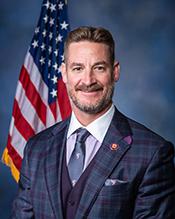
W. Gregory Steube
RRepublicanFL-17 · Representative
61
/ 100
Average
Attendance97
Avg: 96
Independence10
Avg: 4
Bipartisan Tone24
Avg: 15
Ethics Record100
Avg: 99
Transparency68
Avg: 53
Accountability Score — composite of attendance, independence, bipartisan tone, ethics record & transparency.
Methodology74
Bills Sponsored
1
Enacted into Law
3
Passed a Chamber
70
In Committee
Bills That Became Law
All Sponsored Bills
HR10607In Committee
American Fuel Affordability Act
HR10606In Committee
FLAFO Act
HR9498Passed House
Taxpayer Advocate Participation Act
Taxpayer Advocate Participation Act This bill authorizes the National Taxpayer Advocate to appear as amicus curiae and submit amicus briefs in a U.S. court in cases involving federal tax law. Further, the bill requires federal courts to permit such appearances. (An amicus curiae is a person or group that is not a party in a court case but has an interest in the case and may be permitted to submit a brief, known as an amicus brief, to the court in relation to the case.) Under the bill, the National Taxpayer Advocate may present the views of the National Taxpayer Advocate in such a case only with respect to an issue which may broadly affect certain rights of taxpayers. As background, the National Taxpayer Advocate leads the Taxpayer Advocate Service, which is an independent organization within the Internal Revenue Service (IRS) responsible for helping taxpayers resolve problems with the IRS. The National Taxpayer Advocate is also responsible for proposing administrative and legislative changes to mitigate such problems. Under current law, the National Taxpayer Advocate is not authorized to appear as amicus curiae or submit amicus briefs in cases involving federal tax law.
HR5366Enacted
Doug LaMalfa Federal Disaster Tax Relief Certainty Act
Doug LaMalfa Federal Disaster Tax Relief Certainty Act This act extends the federal tax deduction for qualified disaster-related personal casualty losses and the exclusion from gross income of qualified wildfire relief payments. Under current law, unreimbursed personal casualty losses arising in a qualified disaster area (qualified disaster-related personal casualty losses) are deductible (as an itemized tax deduction or as part of the standard tax deduction) if such losses exceed $500 per casualty. A qualified disaster area is an area with respect to which a major disaster has been declared during the period beginning in 2020 and ending 60 days after July 4, 2025, if the incident period begins on or after December 28, 2019, and on or before July 4, 2025. The act extends the federal tax deduction for qualified disaster-related personal casualty losses by defining a qualified disaster area as an area with respect to which a major disaster has been declared if the incident period begins on or after December 28, 2019, and before January 1, 2027. The act provides that the exclusion from gross income of qualified wildfire relief payments applies to such payments attributable to forest or range fires declared a federal disaster after 2014 and before 2027, regardless of when such payments are received. (Currently, qualified wildfire relief payments attributable to forest or range fires declared a federal disaster after 2014 and received after 2019 and before 2026 may be excluded from gross income.) The act also provides statutory authority for several related tax rules.
HR10117In Committee
GATOR Act of 2026
HR642In Committee
Myakka Wild and Scenic River Act of 2025
This bill would protect a section of Florida's Myakka River by designating it as a Wild and Scenic River, which means the federal government would work with state and local officials to preserve the river's natural character and prevent large-scale development along its banks. The designation would restrict certain activities like dam construction and mining in the protected area while allowing existing uses like fishing and recreation to continue. The protection would affect landowners, local communities, and conservation groups in the region around the river.
HR10178In Committee
SHIELD Act
HR10148In Committee
Safeguarding America’s Nonprofits Act
HR10104In Committee
Restoring Economic Diesel Fuel Act of 2026
HR10078In Committee
Dollar-for-Dollar Deficit Reduction Act
Dollar-for-Dollar Deficit Reduction Act The bill establishes a framework to require legislation that increases or suspends the public debt limit to include spending reductions that are equal to or greater than the projected increase in debt that will occur under the legislation. The bill allows the spending reductions to be phased in over the period that includes the current and next 10 fiscal years. Specifically, the bill requires the Department of the Treasury to notify the House Ways and Means Committee and the Senate Finance Committee when it determines that the federal government will reach the debt limit within 60 days without the implementation of extraordinary measures. The notification must also indicate when extraordinary measures may be necessary to prolong the funding of the federal government in the absence of a debt limit increase. In addition, the bill requires any formal presidential request to increase the debt limit to include (1) the amount of the proposed increase, and (2) proposed legislation to reduce spending by an amount that is equal to or greater than the amount of the requested increase. Finally, the bill establishes budget points of order that may be raised in the House of Representatives and the Senate against legislation that increases or suspends the debt limit and does not contain net spending reductions that are equal to or greater than the increase in the debt that will occur under the legislation.
HR10006In Committee
Increasing Opportunity For Reindustrialization Act
The proposal would allow certain economically disadvantaged areas that contain closed military bases to be designated as "opportunity zones," which are special areas where investors get tax breaks for putting money into local businesses and real estate development. This would help communities around former military installations attract investment and create jobs by making it more financially attractive for businesses to invest there. The change would affect investors, local businesses, and residents in communities near decommissioned military bases.
HRES1411In Committee
Providing for consideration of the bill (H.R. 2162) to provide for the protection of the integrity of honey marketed in the United States, and for other purposes.
This resolution provides for the consideration of the bill (H.R. 2162) to provide for the protection of the integrity of honey marketed in the United States, and for other purposes.
HR9767In Committee
Craft Distilled Spirits Direct-to-Consumer Shipping Act of 2026
Small distilleries would be allowed to ship their products directly to consumers across state lines, similar to how some wineries and breweries currently operate. This would let craft distillery owners reach customers in more states without going through traditional wholesale distributors, potentially lowering costs for consumers and helping small producers compete with larger companies. The change would affect craft distilleries, consumers who want access to specialty spirits, and the alcohol distribution industry.
HRES1431In Committee
Impeaching John Edwin Steele, Senior District Judge for the United States District Court for the Middle District of Florida, for high crimes and misdemeanors.
Congress is considering removing Senior District Judge John Edwin Steele from his position in the Middle District of Florida based on allegations of serious misconduct. If approved by the House and Senate, this would end his federal judgeship and bar him from holding future federal office. The case has been sent to the House Judiciary Committee for investigation and consideration.
HR9662In Committee
Birthright CLAIM Act of 2026
The proposal would change which children born in the United States automatically become U.S. citizens, potentially restricting birthright citizenship for children whose parents are not citizens or are in the country illegally. Currently, anyone born on U.S. soil is automatically a citizen regardless of their parents' immigration status, but this bill would alter that rule. The change would affect millions of children born to immigrant families and could require them to go through additional steps to gain citizenship.
HR9109In Committee
Stop ANTIFA Act of 2026
The proposal would officially label Antifa—a decentralized anti-fascist movement rather than a traditional organization—as a domestic terrorist group, which would allow federal law enforcement to pursue participants more aggressively and potentially freeze their financial assets. It also includes broader measures to combat domestic terrorism and organized political violence, affecting how federal agencies investigate and prosecute people involved in such activities. The bill has been sent to multiple congressional committees for review but has not yet been voted on.
HR9568In Committee
HUSTLE Act
The proposal would allow student-athletes to set up special tax-advantaged savings accounts for money they earn from using their name, image, or likeness in endorsements and sponsorships. Similar to how people can save for retirement or education with tax breaks, student-athletes could put earnings from these deals into these accounts and potentially reduce their tax burden. This would affect college and university athletes who are now permitted to profit from their personal brand.
HR9369In Committee
GHOSTRUCK Act
Truck drivers and their employers would be allowed to make corrections or add notes to electronic logging device records (the digital systems that track driving hours) as long as the person making the change is physically in North America and the driver approves the edit. This change would make it easier for drivers and companies to fix mistakes or clarify information in these records while maintaining oversight through driver approval. The rule currently restricts who can modify these records, so this would loosen those restrictions.
HR9324In Committee
Government Bailout Prevention Act
This bill would prevent the federal government from using taxpayer money to bail out state and local governments or school districts that fail to pay their debts, and would block the Federal Reserve and Treasury Department from providing financial assistance to these entities if they default on their obligations. The measure aims to hold states, cities, and school districts financially accountable by forcing them to manage their own budgets without federal rescue funds. It would affect state and local officials, school administrators, and potentially taxpayers in those jurisdictions.
HR9302In Committee
Student Athlete Act of 2026
The legislation would set federal standards for which student athletes can compete in college sports, likely addressing issues like transfer rules, eligibility requirements, and participation standards across schools. This would affect college athletes, universities, and athletic programs by creating uniform national rules rather than allowing each school or conference to set their own policies. The bill has been sent to the House Committee on Education and Workforce for review and debate.
HRES1354In Committee
Impeaching John McConnell, Jr., Chief Judge of the United States District Court for the District of Rhode Island, for high crimes and misdemeanors.
A federal judge in Rhode Island would face removal from office if the House of Representatives votes to impeach him based on allegations of serious wrongdoing. The measure has been sent to the House Judiciary Committee for investigation and consideration of whether the charges warrant a full House vote on impeachment. If the House votes to impeach, the case would then go to the Senate for a trial to determine whether the judge should be permanently removed from his position.
HRES1353In Committee
Expressing the sense of the House of Representatives supporting the Department of State's efforts to prevent the Islamic Revolutionary Guard Corps (IRGC) from embedding themselves within the Iranian National Football Delegation during the 2026 FIFA World Cup and to limit the delegation's presence in the United States to the minimum time necessary for scheduled match play.
The House is expressing support for the State Department to prevent Iran's Islamic Revolutionary Guard Corps (a military organization) from using the 2026 FIFA World Cup as an opportunity to establish a presence in the United States by embedding members within Iran's national soccer team. The resolution calls for limiting Iran's delegation's time in the U.S. to only what's necessary for their scheduled matches, rather than allowing them to stay longer. This is a non-binding statement of congressional opinion rather than a law that would change existing rules.
HR9160In Committee
No Safe Haven for Terrorist Families Act
The proposal would make it harder for close family members of designated foreign terrorists to enter or stay in the United States by creating a new legal reason to deny them entry or immigration benefits. This would affect people trying to immigrate or visit the country who have relatives involved in terrorist organizations abroad. The measure is currently being reviewed by the House Judiciary Committee.
HR9078In Committee
LEASH Act of 2026
The proposal would require law enforcement agencies to report felony convictions for animal cruelty to a national crime database, similar to how they currently report other serious crimes. This would help track patterns of animal abuse across the country and could assist prosecutors and judges in making decisions about sentencing and bail. The change affects police departments, prosecutors, and the criminal justice system's ability to monitor this category of crime.
HR8942In Committee
GME Transparency Act of 2026
Hospitals that receive Medicare funding to train doctors in residency programs would be required to report whether their resident doctors are U.S. citizens or not. This would affect teaching hospitals across the country that participate in Medicare's graduate medical education funding. The information would help track the citizenship status of doctors in training at federally-funded medical programs.
HR8943In Committee
Our Doctors First Act of 2026
Medicare would stop paying for the training costs of doctors and medical residents who are not U.S. citizens or nationals. This change would affect hospitals and medical training programs that rely on federal funding to help cover the salaries and education expenses of foreign-trained medical professionals during their residency years. The proposal aims to redirect those federal education dollars exclusively to training American citizens and nationals.
HR8805In Committee
ICE FROST Act
The bill would authorize extra payments to federal employees who work on immigration enforcement operations, such as border patrol agents and immigration officers. These supplemental payments would compensate workers for the demanding nature of immigration enforcement work. The legislation has been referred to congressional committees for review and consideration.
HRES1055In Committee
Providing for the consideration of the bill (H.R. 7378) to amend the Calder Act to permanently adjust American time, and for other purposes.
This is a procedural measure that would allow the House to debate and vote on a bill to make daylight saving time permanent year-round in the United States, eliminating the twice-yearly clock changes that currently affect all Americans. The bill would apply to the general public, businesses, and government agencies that would need to adjust their operations under a permanent daylight saving schedule. The measure is currently in the House Rules Committee, which decides the terms under which bills are debated on the House floor.
HR6495Passed House
Taxpayer Notification and Privacy Act
Taxpayer Notification and Privacy Act This bill expands the Internal Revenue Service (IRS) notice requirements for contacting a third party (e.g., employer or bank) for information related to a taxpayer’s federal tax liability and the rights of the taxpayer in such situation. (Conditions and exceptions apply.) Currently, the IRS must notify a taxpayer at least 45 days in advance of a time period during which the IRS intends to contact a third party for information related to the taxpayer’s tax liability but is not required to specify what information is being sought. The bill requires the IRS to specify in a notice to a taxpayer each item of information sought from a third party when (1) the IRS has not previously requested such information from the taxpayer, and (2) the taxpayer can reasonably provide such information. This requirement does not apply if the IRS determines such third-party information is necessary. Further, under the bill, a taxpayer is allowed no less than 45 days (or more if requested by the taxpayer and deemed reasonable) to respond before the IRS contacts such third party.
HR8471In Committee
PRIMATE Act
The proposal would ban the importation of nonhuman primates (like monkeys and apes) into the United States, preventing companies and research facilities from bringing these animals into the country. This would affect zoos, medical research institutions, and pet importers who currently rely on obtaining primates from other countries. The measure is intended to restrict the trade in these animals, though it has been referred to the House Committee on Ways and Means for further consideration.
HR8314In Committee
OPTIONS Act
This bill would allow employers to give workers a choice in how they receive certain tax-advantaged benefits, such as deciding between different types of retirement savings plans or health insurance options rather than accepting a single employer-chosen plan. The change would give employees more flexibility in selecting benefits that better match their individual needs while still receiving the same tax breaks that employers currently offer. Workers in companies that adopt this approach could customize their benefits packages to prioritize what matters most to them.
HR8026In Committee
CLEAR Act
Without access to the specific text of this CLEAR Act bill, I cannot provide an accurate summary of what it would do. The title "CLEAR Act" is too vague to determine its concrete effects—it could relate to criminal justice reform, law enforcement procedures, crime prevention, or numerous other crime-related policies. To write a factual summary, I would need to know the bill's actual provisions and which specific aspects of crime and law enforcement it addresses.
HR7925In Committee
American Families First Assistance Act
The bill would provide financial assistance and support to American families, likely through expanded or new welfare programs and tax benefits. The specific assistance could include direct payments, tax credits, or enhanced benefits for low- and middle-income households dealing with economic hardship. The proposal is currently under review by the House committee responsible for tax and spending policies.
HR7635In Committee
CHARGE Act
The CHARGE Act appears to address international trade and financial matters, though the specific details would depend on the bill's full text. Based on its referral to the House Ways and Means Committee, it likely involves tariffs, trade agreements, or how the U.S. conducts business with other countries, potentially affecting American businesses that import or export goods and consumers who buy foreign products.
HR1028In Committee
Protection of Women in Olympic and Amateur Sports Act of 2026
Protection of Women in Olympic and Amateur Sports Act This bill requires certified national governing bodies (NGBs) of amateur sports (e.g., USA Gymnastics) to prohibit a person whose sex is male from participating in an amateur athletic competition that is designated for females, women, or girls. Under the bill, male means an individual who has, had, will have—or would have, but for a developmental or genetic anomaly or historical accident—the reproductive system that at some point produces, transports, and utilizes sperm for fertilization.
HR7451In Committee
EXILE Act
The EXILE Act would establish new penalties and restrictions targeting immigrants in the United States, likely focusing on deportation procedures or immigration enforcement measures. Based on its referral to the House Judiciary Committee, the bill would affect immigrants, immigration courts, and federal enforcement agencies responsible for immigration policy. The specific details of how it would change current immigration law depend on the bill's full text, which would be reviewed during the committee process.
HR7450In Committee
Disaster Zone Energy Affordability and Investment Act
This bill would likely provide tax breaks or financial incentives to help people and businesses in disaster-affected areas afford energy and rebuild their power infrastructure after major disasters. The tax measures would probably aim to reduce energy costs for residents and encourage investment in rebuilding energy systems in communities recovering from hurricanes, floods, wildfires, or other disasters. It affects homeowners, businesses, and energy companies operating in disaster zones.
HR7452In Committee
Air Quality Act
The bill would establish or modify rules to improve air quality and reduce pollution from sources like vehicles, factories, and power plants. It affects environmental agencies, businesses that emit pollutants, and the general public by potentially requiring stricter emissions standards or new monitoring systems. The proposal is currently being reviewed by multiple congressional committees that handle energy, transportation, and environmental matters.
HR7453In Committee
CLEAN Act
The bill would modify tax rules related to clean energy and environmental initiatives, though the specific provisions are not yet detailed in the referral stage. It has been sent to two committees—Ways and Means (which handles taxes) and Energy and Commerce (which oversees energy policy)—suggesting it likely involves tax incentives or credits for clean energy projects, renewable energy companies, or environmental compliance. The exact impact on businesses, workers, or consumers will depend on what the committees decide as they develop the legislation.
HR7378In Committee
Daylight Act of 2026
The Daylight Act would likely establish or modify rules around daylight saving time, potentially making daylight saving permanent year-round or allowing states more flexibility in choosing their time zones. This would affect when Americans set their clocks, impacting everything from school schedules and work hours to when sunrise and sunset occur. The change would touch nearly every American household, business, and institution that relies on coordinated timekeeping.
HR7165In Committee
WATCH Act
The WATCH Act would establish new monitoring and oversight requirements for health-related activities, though the specific provisions are not detailed in the available information. Based on its referral to the House Committee on Energy and Commerce, the bill likely affects healthcare providers, patients, or health product manufacturers. Without access to the full bill text, the exact impact on individuals and organizations cannot be determined.
HR5080In Committee
Department of War Restoration Act of 2025
This bill would rename the Department of Defense back to the Department of War, changing the official name of the agency that oversees the military and national defense operations. The change is primarily symbolic, affecting how the department is officially called rather than changing what it actually does or how it operates. The proposal would impact military personnel, defense contractors, and government employees who work within the department, though their day-to-day responsibilities would remain the same.
HR5075In Committee
GRACE Act
The proposal would allow students who have defaulted on federal student loans to rehabilitate their loans and improve their credit standing through a structured repayment plan. It aims to give borrowers a second chance to get back on track with their education debt without facing permanent damage to their credit history. This would primarily benefit former students struggling with loan repayment and could help them access future credit for homes, cars, or other major purchases.
HR4972In Committee
Create Accountable Respectful Environments (CARE) for Children Act
This bill would establish new standards and requirements for childcare facilities and programs to ensure safe, respectful environments for children in their care. It likely includes provisions for training staff, setting safety protocols, and possibly providing funding or tax incentives to help childcare providers meet these standards. The legislation would affect childcare workers, parents using childcare services, and childcare facility operators across the country.
HR4940In Committee
AIRFARE Act
Accommodating Individuals Requesting Familial Assistance in Riding Efficiently Act or the AIRFARE Act This bill directs the Transportation Security Administration (TSA) to allow caregivers, parents, and guardians to accompany minors and passengers needing assistance to their flights. Specifically, the TSA must establish a system to expedite gate passes and flight access procedures for these individuals. The system must ensure that air carriers may offer up to two gate passes to caregivers, parents, and guardians who are accompanying a minor or a passenger needing assistance to a departing flight; and these individuals may apply their existing TSA PreCheck privileges to such gate passes. The TSA PreCheck program expedites traveler screening through participating TSA security checkpoints.
HR4820In Committee
Freedom from Government Surveys Act
This bill would limit the federal government's ability to conduct surveys of the public by requiring congressional approval before agencies can spend money on most surveys and setting stricter rules for how surveys are designed and used. The measure aims to reduce what supporters see as unnecessary government data collection and spending on surveys, though it could affect how federal agencies gather information needed to understand public health, economic conditions, and other policy areas. The bill would primarily impact federal agencies and the public by changing which surveys get conducted and how often.
HR4618In Committee
Jamie Reed Protecting Our Kids from Child Abuse Act
The bill aims to strengthen protections for children by enhancing reporting requirements and enforcement mechanisms related to child abuse and neglect. It would affect healthcare providers, educators, social workers, and other professionals who work with children by potentially requiring them to report suspected abuse more consistently and giving authorities better tools to investigate and prevent child harm. The legislation is currently being reviewed by multiple congressional committees to determine which parts fall under their areas of responsibility.
HR4554In Committee
Restoring Biological Truth to the Workplace Act
This bill would likely restrict workplace protections and policies related to gender identity, potentially allowing employers to make decisions based on biological sex rather than gender identity in hiring, employment, and workplace accommodations. It would affect transgender and non-binary workers by limiting their legal protections against discrimination in the workplace. The bill has been referred to the House Committee on Education and Workforce for consideration.
HR4051In Committee
Addressing Hostile and Antisemitic Conduct by the Republic of South Africa Act of 2025
This bill would authorize the U.S. government to take diplomatic and potentially economic actions against South Africa in response to what lawmakers view as hostile treatment of Israel and antisemitic conduct by the South African government. The measure would likely give the State Department tools to pressure South Africa through sanctions, reduced aid, or other penalties unless the country changes its policies toward Israel and addresses antisemitism. The bill affects U.S.-South Africa relations and could impact American businesses and citizens with ties to South Africa.
HR3660In Committee
Make Autorail Great Again Act
Make Autorail Great Again Act This bill prohibits the Washington Metropolitan Area Transit Authority (WMATA) from receiving any federal funding until the Washington Metropolitan Area Transit Authority Compact is amended to rename (1) WMATA as the Washington Metropolitan Authority for Greater Access or the WMAGA, and (2) the Metrorail as the Trump Train.
HR3469In Committee
Tax Relief for Victims of Crimes, Scams, and Disasters Act
This bill would allow people who lose money or property due to crimes, scams, or disasters to deduct those losses from their taxes, reducing the amount they owe. Currently, most personal casualty losses can only be deducted if they exceed a high threshold, making it difficult for victims to get tax relief. The change would help crime victims, disaster survivors, and people defrauded by scams recover some of their financial losses through the tax system.
HR3311In Committee
Eliminating Leftover Expenses for Campaigns from Taxpayers (ELECT) Act of 2025
Eliminating Leftover Expenses for Campaigns from Taxpayers (ELECT) Act of 2025 This bill terminates (1) the taxpayer election (on the federal income tax form) to designate $3 of income tax liability to be paid to the Presidential Election Campaign Fund (which would otherwise go into the general fund of the Treasury) for financing of presidential election campaigns, (2) the Presidential Election Campaign Fund, and (3) the Presidential Primary Matching Payment Account. The bill also requires funds remaining in the Presidential Election Campaign Fund to be transferred to the general fund of the Treasury for the sole purpose of reducing the deficit.
HR3207In Committee
DEFENSE Act
Disabling Enemy Flight Entry and Neutralizing Suspect Equipment Act or the DEFENSE Act This bill allows the Department of Homeland Security (DHS) or the Department of Justice (DOJ) to deputize state or local law enforcement officers to take certain drone countermeasures to protect stadiums and other public gatherings. Specifically, DHS or DOJ may provide state or local law enforcement officers with the authority to identify, monitor, and track drones; warn drone operators; disrupt or take control of drones; or use reasonable force to disable, damage, and seize or destroy drones deemed to pose a threat. This authority applies for the purposes of protecting an event, stadium, or venue; certain large public gatherings (e.g., gatherings that are primarily outdoors with an estimated attendance of at least 100,000 people); or other public gatherings protected by specific temporary flight restrictions imposed by the Federal Aviation Administration (FAA). Prior to being deputized, a state or local law enforcement officer must complete training in the use of the drone countermeasure authority. DHS or DOJ, in coordination with the Department of Transportation and the FAA, must exercise oversight over the use of this authority by deputized state or local law enforcement officers. Finally, the bill limits the equipment authorized for detecting, identifying, monitoring, or tracking drones to systems or technologies that are included on a list of authorized equipment maintained by DHS, in coordination with DOJ, the FAA, the Federal Communications Commission, and the National Telecommunications and Information Administration.
HR2581In Committee
Iranian Terror Prevention Act
This bill would establish new measures to prevent Iran-related terrorist activities and strengthen U.S. enforcement against individuals and organizations with ties to Iranian terrorism. The legislation would likely affect foreign policy, law enforcement agencies, and potentially American citizens or companies doing business with Iran by imposing stricter penalties and monitoring requirements. The bill is currently being reviewed by committees that handle foreign affairs and legal matters to determine which parts fall under each committee's authority.
HRES287In Committee
Providing for the consideration of S.J. Res. 18, S.J. Res 24, H.R. 1526, and H.R. 22.
This is a procedural measure that sets the rules for how Congress will debate and vote on four separate bills and resolutions dealing with various policy matters. The House Rules Committee will determine the specific procedures, time limits, and amendments allowed for considering these four pieces of legislation on the House floor. Once the committee approves the rules, lawmakers will be able to discuss and vote on each of these measures according to those established guidelines.
HR2162In Committee
Honey Integrity Act
This bill would establish stricter standards and labeling requirements for honey sold in the United States to ensure consumers know what they're actually buying and prevent fraudulent or adulterated honey from entering the market. It likely aims to protect both consumers who want genuine honey and legitimate beekeepers and honey producers who compete against cheaper imported or mislabeled products. The measure has been sent to the House Committee on Energy and Commerce for review.
HR2015In Committee
GIFT Act of 2025
The bill addresses health policy matters and has been sent to two House committees for review—the Ways and Means Committee and the Energy and Commerce Committee—to determine which parts each committee should handle before moving forward. Without the full bill text available, the specific health changes being proposed cannot be detailed, but the dual committee referral suggests the legislation likely involves both healthcare financing and regulatory aspects that fall under both committees' jurisdictions.
HR966In Committee
Veterans Cannabis Use for Safe Healing Act
Veterans Cannabis Use for Safe Healing Act This bill prohibits the Department of Veterans Affairs (VA) from denying a veteran any VA benefit due to participation in a state-approved marijuana program. For veterans participating in these approved programs, the VA must ensure its health care providers (1) discuss marijuana use with such veterans and adjust treatment plans accordingly, and (2) record such use in the veterans' medical records. Under the bill, the VA shall authorize physicians and other VA health care providers to provide recommendations to veterans who are residents of states with approved programs.
HR1506In Committee
SWIM Act of 2025
The bill would allow people to set aside money in special tax-advantaged savings accounts specifically for swimming lessons and water safety training. These accounts would work similarly to existing education savings plans, letting families save money without paying taxes on the growth, as long as the funds are used for qualified swimming instruction and water safety programs. This would help make swimming lessons more affordable for families while encouraging water safety education for children and adults.
HR244In Committee
Veterans’ True Choice Act of 2025
This bill would give veterans more options for where and how they receive healthcare by expanding their ability to use private doctors and facilities outside the Veterans Affairs system while still receiving VA coverage. The legislation aims to let veterans choose between VA hospitals and clinics or private healthcare providers, potentially reducing wait times and giving them greater control over their medical care. Veterans would benefit from increased flexibility in accessing treatment, while the VA would need to adjust how it manages healthcare coverage and payments.
HR1157In Committee
ACCESS Act
Without access to the bill's specific text, this legislation appears to address health care access issues, though the exact provisions remain unclear from the title alone. Based on its referral to committees handling healthcare and taxation matters, it likely proposes changes to how Americans can obtain or afford health services, potentially affecting patients, insurance companies, or healthcare providers. The bill is currently under review to determine which committee provisions fall under.
HR539In Committee
Chiropractic Medicare Coverage Modernization Act of 2025
Chiropractic Medicare Coverage Modernization Act of 2025 This bill expands Medicare coverage of chiropractic services to include all services provided by chiropractors, rather than only subluxation corrections through manual manipulation of the spine.
HR456In Committee
Protecting Dogs Subjected to Experiments Act
Protecting Dogs Subjected to Experiments Act This bill prohibits the National Institutes of Health from funding biological, medical, or behavioral research that involves testing dogs.
HR453In Committee
Religious Insignia on Dog Tags Act
Religious Insignia on Dog Tags Act This bill directs the Department of Defense (DOD) to allow trademarks owned or controlled by DOD to be combined with religious insignia on commercial identification tags (i.e., dog tags) and to be sold by lawful trademark licensees. The bill applies retroactively to September 13, 2013.
HR454In Committee
Safe Bases Act of 2025
Safe Bases Act of 2025 This bill provides statutory authority for the Department of Defense (DOD) to allow a service member to carry a concealed firearm while on any military installation. DOD must establish a single authority within the department to issue permits for this purpose. To be eligible for a permit, the service member must be on active duty and must not be prohibited under federal law from purchasing, owning, or possessing a firearm.
HR458In Committee
Protecting our Land Act
Protecting our Land Act This bill requires the President to direct federal agencies to promulgate rules and regulations to prohibit foreign adversaries or state sponsors of terrorism from purchasing real estate located in the United States.
HR461In Committee
Eliminate DEI in the Military Act
Eliminate DEI in the Military Act This bill prohibits the use of federal funds for diversity, equity, and inclusion activities (e.g., training) of the Armed Forces, national service academies, or the Department of Defense.
HR28Passed House
Protection of Women and Girls in Sports Act of 2025
Protection of Women and Girls in Sports Act of 2025 This bill generally prohibits school athletic programs from allowing individuals whose biological sex at birth was male to participate in programs that are for women or girls. Specifically, the bill provides that it is a violation of Title IX of the Education Amendments of 1972 for federally funded education programs or activities to operate, sponsor, or facilitate athletic programs or activities that allow individuals of the male sex to participate in programs or activities that are designated for women or girls. (Title IX prohibits discrimination on the basis of sex in federally funded education programs or activities, including in public elementary and secondary schools and in colleges and universities.) Under the bill, sex is based on an individual's reproductive biology and genetics at birth. The bill does not prohibit male individuals from training or practicing with programs or activities for women or girls as long as such training or practice does not deprive any female of corresponding opportunities or benefits. The Government Accountability Office must report on the benefits for women or girls in single-sex sports that would be lost as a result of male participation. In particular, the report must document the negative psychological, developmental, participatory, and sociological effects of male participation on girls.
HR455In Committee
Protecting Higher Education from Foreign Threats Act
Protecting Higher Education from Foreign Threats Act This bill prohibits an institution of higher education (IHE) from receiving federal funds for an award year in which the IHE employs an instructor who, while employed at the IHE and providing direct instruction to students, received funds from the Chinese Community Party. An IHE may regain eligibility for federal funds by demonstrating to the Department of Education that it no longer employs such instructor.
HR459In Committee
STAND Act
Securing Taxpayer Assistance during Natural Disasters Act or the STAND Act This bill prohibits the Department of State and the U.S. Agency for International Development from obligating or expending federal funds for bilateral, multilateral, or humanitarian non-defense foreign assistance within the first 60 days following a presidentially declared major disaster. The prohibition may be waived if a joint resolution of Congress providing for such a waiver is enacted into law.
HRES47In Committee
Concerning the National Collegiate Athletic Association policy for eligibility in women's sports.
This resolution calls on the National Collegiate Athletic Association (NCAA) to revoke its transgender student-athlete eligibility policy and urges the NCAA to require its member conferences to conform to a biological sex-based policy across all sports and all divisions.
HR462In Committee
No Support for Terror Act
No Support for Terror Act This bill establishes measures to prevent the allocation or use of certain funds to support genocide or terrorism. Specifically, the bill requires the Department of the Treasury to instruct the U.S. Executive Director at the International Monetary Fund (IMF) to oppose the allocation of Special Drawing Rights to any country that is a perpetrator of genocide or a state sponsor of terrorism and to advocate that the IMF adopt a rule prohibiting such an allocation. (Special Drawing Rights are international reserve assets created by the IMF to supplement member countries' official foreign exchange reserves.) Further, the bill requires Treasury, the Department of State, and the U.S. Agency for International Development to jointly review and report on assistance provided to nongovernmental organizations and international organization to ensure such assistance is not being provided to the Taliban or other terrorist organizations. Each prime awardee of this assistance must provide evidence that all subawardees are complying with U.S. anti-terrorism financing laws.
HR457In Committee
Passport Notification Act of 2025
Passport Notification Act of 2025 This bill requires the Bureau of Consular Affairs to notify U.S. citizens at least 180 days prior to the date on which their passport is scheduled to expire. The notification must include information on the process for renewal and identify locations where renewal applications may be submitted. The notification may be in electronic or paper form.
HR460In Committee
CCP Visa Disclosure Act of 2025
Chinese Communist Party Visa Disclosure Act of 2025 or the CCP Visa Disclosure Act of 2025 This bill requires an applicant for an F, J, or M (student or exchange visitor) visa to disclose in the application certain information about whether the applicant has received or will receive funds from the Chinese government, the Chinese Communist Party (CCP), or an entity controlled by either. If an individual receives such funds after receiving such a visa, the individual must inform the Department of Homeland Security and the Department of State. Any visa issued to an individual who violates these disclosure requirements may be revoked.