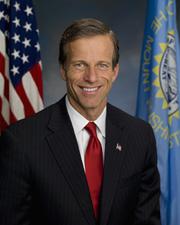
John Thune
RRepublicanSD · Senator
66
/ 100
Above Average
Attendance100
Avg: 97
Independence24
Avg: 23
Bipartisan Tone8
Avg: 14
Ethics Record100
Avg: 100
Transparency100
Avg: 47
Accountability Score — composite of attendance, independence, bipartisan tone, ethics record & transparency.
Methodology34
Bills Sponsored
1
Enacted into Law
3
Passed a Chamber
12
In Committee
Bills That Became Law
All Sponsored Bills
S5359In Committee
Pennington County Land Conveyance Act
SRES928Introduced
A resolution to authorize testimony, document production, and representation by the Senate Legal Counsel in the case of United States v. Terry.
S3723Reported
Western South Dakota Water Supply Project Feasibility Study Act
This bill would authorize a study to examine whether a water supply project could be built in western South Dakota to provide reliable water access to rural communities and agricultural areas in the region. The study would evaluate the project's feasibility, costs, environmental impacts, and benefits before any construction decisions are made. This would help local officials and residents understand whether such a project is practical and worth pursuing.
S3725Reported
Lewis and Clark Regional Water System Expansion Feasibility Study Act
This bill would authorize a study to examine whether expanding the Lewis & Clark Regional Water System in South Dakota is feasible and practical. The study would help determine if the system can be enlarged to serve more communities and agricultural areas in the region, and would likely inform future decisions about funding and construction. This affects residents and farmers in the affected areas who depend on reliable water supplies.
SRES839Introduced
A resolution to authorize representation by the Senate Legal Counsel in Federal Trade Commission v. Key Investment Group, LLC, et al.
SRES840Introduced
A resolution to authorize testimony and representation by the Senate Legal Counsel.
SRES817Introduced
An executive resolution authorizing the en bloc consideration in Executive Session of certain nominations on the Executive Calendar.
This resolution provides for the en bloc consideration of nominations for various executive officers, judges, ambassadors, and related positions. Agencies in which the executive officers shall serve include the Departments of Defense, Energy, the Interior, State, and the Treasury. Additional nominees shall represent the United States to, among others, the United Nations, the Organization for Economic Cooperation and Development (OECD), Brazil, Cambodia, Cyprus, and the Gambia. Nominees are also appointed to the National Labor Relations Board, National Transportation Safety Board, Consumer Product Safety Commission, and District of Columbia (DC) courts.
SCONRES37Passed Senate
A concurrent resolution authorizing the use of the rotunda of the Capitol for a ceremony to honor the late Senator Lindsey O. Graham.
This concurrent resolution authorizes the Capitol rotunda to be used on July 28, 2026, for a tribute to the late Senator Lindsey O. Graham of the state of South Carolina.
S4448In Committee
Accelerating Broadband Permits Act of 2026
The federal government would be required to create better tracking systems to monitor how organizations are spending broadband expansion grants meant to bring internet access to underserved communities. The bill also aims to speed up the government's process for approving communications-related applications so they meet legal deadlines. These changes would help ensure broadband funding reaches communities that need it and that government agencies process permits and applications more efficiently.
SRES810Introduced
A resolution to constitute the majority party's membership on certain committees for the One Hundred Nineteenth Congress, or until their successors are chosen.
The Senate has approved the official list of which majority party members will serve on various committees during the 119th Congress. This resolution formally assigns senators to their committee positions, which determine which policy areas they'll work on and help shape legislation. Once approved, these assignments remain in place until the senators are replaced or choose to leave their positions.
S5015In Committee
Broadband MAP Act of 2026
The Federal Communications Commission would be required to review and improve how it creates and updates maps showing where broadband internet is available across the country. This affects rural communities, internet service providers, and government agencies that rely on accurate broadband coverage data to make decisions about expanding internet access and allocating funding for infrastructure improvements.
SRES745Introduced
A resolution to authorize production of records to the United States Attorney.
The Senate agreed to allow the production of certain records to be handed over to the United States Attorney's office for use in legal proceedings or investigations. This type of resolution typically permits the release of documents or information that might otherwise be protected by congressional privilege or confidentiality rules. The measure passed without any objections from senators.
SRES690Introduced
An executive resolution authorizing the en bloc consideration in Executive Session of certain nominations on the Executive Calendar.
This resolution authorizes the en bloc consideration of 49 nominations for various roles, including executive officers and ambassadors. For example, nominees are appointed to serve in the Departments of Commerce, Justice, State, and Transportation. The package also includes nominations to serve as U.S. ambassador to Iceland, Slovenia, Sri Lanka, and Vietnam.
S723Enacted
Tribal Trust Land Homeownership Act of 2025
Tribal Trust Land Homeownership Act of 2025 This act sets forth requirements for the processing of a proposed residential leasehold mortgage, business leasehold mortgage, land mortgage, or right-of-way document by the Bureau of Indian Affairs (BIA). The BIA must notify lenders upon receipt of such documentation, perform a preliminary review of such documents not later than 10 days after receipt, and approve or disapprove of such documents within 20 or 30 days, depending on the type of application. Additionally, the act sets forth requirements for the BIA regarding (1) response times for the completion of certified title status reports, (2) notification of delays in processing, and (3) the form of notices and delivery of certain reports. The act also provides relevant federal agencies and Indian tribes with read-only access to the Trust Asset and Accounting Management System maintained by the BIA. The Government Accountability Office must report on digitizing documents for the purpose of streamlining and expediting the completion of mortgage packages for residential mortgages on Indian land. Finally, the act establishes within the BIA's Division of Real Estate Services the position of Realty Ombudsman.
SRES664Introduced
A resolution to constitute the majority party's membership on certain committees for the One Hundred Nineteenth Congress, or until their successors are chosen.
This resolution officially assigns which members of the majority party will serve on various Senate committees during the 119th Congress. The Senate has already approved it unanimously, which means all senators agreed on the committee assignments that will determine which lawmakers oversee different areas of government like defense, healthcare, and finance.
S4152In Committee
Fertilizer Transparency Act of 2026
This bill would require fertilizer manufacturers and sellers to provide clearer information about the contents and safety of their products to farmers and the public. The measure aims to help agricultural workers and consumers better understand what chemicals are in fertilizers and any potential environmental or health risks associated with their use. Farmers and gardeners would benefit from more transparent labeling that makes it easier to compare products and make informed purchasing decisions.
SRES609Introduced
A resolution to authorize testimony and representation in United States v. Crouse.
This resolution allows Congress to authorize its lawyers to testify and represent the legislative branch in a court case called United States v. Crouse. The resolution was approved by the Senate without any objections, enabling congressional legal counsel to participate in the lawsuit on behalf of Congress.
S3543In Committee
Trade Cheating Restitution Act of 2025
This bill would create a way for American workers and businesses harmed by unfair foreign trade practices to receive compensation from the federal government. It likely aims to address situations where other countries violate trade agreements or use illegal tactics like dumping products at artificially low prices, which can hurt U.S. companies and their employees. The bill would establish a process to identify victims of these trade violations and distribute restitution funds to help them recover losses.
SRES520Introduced
An executive resolution authorizing the en bloc consideration in Executive Session of certain nominations on the Executive Calendar.
This resolution would allow the Senate to vote on multiple presidential nominations at once in a closed-door session rather than debating each one individually. The measure failed to advance when it did not receive the 60 votes needed to proceed, with senators splitting 43-37 on whether to move forward.
SRES412Introduced
An executive resolution authorizing the en bloc consideration in Executive Session of certain nominations on the Executive Calendar.
The Senate agreed to allow itself to vote on multiple presidential nominations all at once in a private session rather than debating each one individually. This procedural move speeds up the confirmation process for several executive branch positions that the President has nominated, though it prevents public debate on each specific nominee.
SRES413Introduced
A resolution authorizing the use of funds from the Senators' Official Personnel and Office Expense Account for security enhancements and services provided to Senators.
The Senate would authorize spending money from its regular office budget to pay for improved security measures and services that protect individual senators. This allows senators to use existing funds designated for their offices and staff to cover security costs without needing separate approval or additional funding.
SRES377Introduced
An executive resolution authorizing the en bloc consideration in Executive Session of certain nominations on the Executive Calendar.
This resolution provides for the en bloc consideration in Executive Session of nominations for various executive officers and ambassadors. The agencies in which the executive officers shall serve include the Departments of Defense, Energy, the Interior, and Labor. The ambassadors shall represent the United States to Argentina, Greece, Liechtenstein, and Sweden.
S2608In Committee
CRP Improvement and Flexibility Act of 2025
CRP Improvement and Flexibility Act of 2025 This bill increases federal assistance and incentives for eligible participants and entities in the Conservation Reserve Program (CRP) of the Farm Service Agency. CRP is a land conservation program that provides an annual rental payment to farmers in exchange for farmers removing environmentally sensitive land from agricultural production and planting species that will improve environmental health and quality. The bill increases the CRP annual rental payment limitation from $50,000 to $125,000. The bill also permanently establishes a continuous enrollment procedure for land that will be enrolled under the State Acres for Wildlife Enhancement Initiative. Additionally, the bill provides federal cost sharing payments for the establishment of grazing infrastructure on all CRP contracts and practices, if grazing is included in the conservation plan and addresses a resource concern. It also provides federal cost sharing payments under CRP for management activities to implement the conservation plan that are not related to haying or grazing. Further, the bill allows emergency haying on CRP land during the primary nesting season in response to drought, flooding, wildfire, or other emergencies if certain conditions are met. It also modifies the conditions under which haying and grazing may be permitted on CRP land.
S2426In Committee
Equitable Community Access to Pharmacist Services Act
Equitable Community Access to Pharmacist Services Act This bill provides for permanent coverage under Medicare of certain pharmacist services. Specifically, the bill provides for permanent coverage of testing and treatment services provided by pharmacists relating to (1) COVID-19, influenza, respiratory syncytial virus (RSV), and streptococcal pharyngitis (strep throat); and (2) other public health needs in relation to a declared public health emergency. (Similar authorities were temporarily granted during the COVID-19 public health emergency.) Such services must be provided in accordance with the applicable state laws governing pharmacists' scope of practice.
S1509In Committee
Strengthening Local Processing Act of 2025
Strengthening Local Processing Act of 2025 This bill revises provisions related to meat and poultry processing establishments, including by establishing grants and a database to assist smaller establishments (i.e., at least 10 but fewer than 500 employees) and very small establishments (i.e., fewer than 10 employees or annual sales of less than $2.5 million). For example, the Department of Agriculture (USDA) must establish a searchable database of peer-reviewed validation studies for use in developing Hazard Analysis and Critical Control Points plans for smaller and very small establishments. The bill increases the maximum federal cost shares for (1) state meat and poultry inspection programs (from 50% to 65%), and (2) the Cooperative Interstate Shipment (CIS) program (from 60% to 80%). The CIS program allows state-inspected facilities to operate as federally-inspected facilities and ship their products in interstate commerce and internationally. Additionally, USDA must conduct outreach to states that have meat and poultry inspection programs, but do not participate in the CIS program. The bill also allows certain establishments with up to 50 employees (currently up to 25 employees) to participate in the program. USDA must also award grants to increase resiliency and diversification of the meat processing system, including activities that support (1) the health and safety of meat and poultry plant employees, suppliers, and customers; (2) increased processing capacity; and (3) the resilience of the small meat and poultry processing sector. Further, the bill establishes a grant program for meat and poultry processing career training programs, including structured apprenticeships.
SRES170Introduced
A resolution to authorize representation by the Senate Legal Counsel in the case of Desmond Bellard v. Ronald Wyden, U.S. Senator.
The Senate is authorizing its legal counsel to represent Senator Ronald Wyden in a lawsuit filed by Desmond Bellard. This allows the Senate's legal team to defend the senator in court proceedings rather than requiring him to hire private attorneys. The resolution was approved unanimously by the Senate.
S1443In Committee
Mobile Workforce State Income Tax Simplification Act of 2025
Workers who travel between states for their jobs would only have to pay income taxes to their home state, rather than potentially owing taxes to multiple states where they work. This would simplify tax filing for mobile employees, contractors, and companies that employ people across state lines, reducing the burden of calculating and paying taxes in every state where work occurs.
S1230In Committee
SAFETY Act of 2025
Safeguarding American Food and Export Trade Yields Act of 2025 or the SAFETY Act of 2025 This bill directs the Department of Agriculture (USDA) to secure foreign markets for goods using common names. In general, the bill defines common name as a name that (1) is ordinarily or customarily used for an agricultural commodity or food product, (2) is typically placed on the packaging and product label of the agricultural commodity or food product, and (3) the use of which is consistent with standards of the Codex Alimentarius Commission. The bill includes a list of names that will be considered common names for (1) food products (e.g., basmati, bratwurst, and parmesan); (2) wine, including grape varietal terms, grape variety designations, and non-varietal descriptors such as chateau and vintage; and (3) beer (e.g., bitter, pale ale, and hefeweizen). Specifically, USDA must coordinate efforts with the Office of the U.S. Trade Representative (USTR) to secure the right of U.S. agricultural producers, processors, and exporters to use common names for agricultural commodities or food products in foreign markets. Through the negotiation of bilateral, plurilateral, or multilateral agreements, memoranda of understanding, or exchanges of letters, USDA and the USTR must assure the current and future use of each common name in connection with U.S. agricultural commodities or food products. USDA and the USTR must jointly brief Congress on these efforts on a semi-annual basis.
S1144In Committee
PHIT Act of 2025
The bill would allow people to deduct the cost of fitness and sports memberships, equipment, and related health expenses from their taxable income, similar to how some medical expenses are currently deductible. This would primarily benefit individuals and families who pay out-of-pocket for gym memberships, sports league fees, and wellness programs by reducing the amount of income they owe taxes on. The change would make it easier for Americans to afford preventive health and fitness activities.
SRES5Introduced
A resolution notifying the House of Representatives of the election of a President pro tempore.
This resolution notifies the House of Representatives of the election of the Honorable Charles E. Grassley as President pro tempore of the Senate.
SRES4Introduced
A resolution notifying the President of the United States of the election of a President pro tempore.
This resolution notifies the President of the election of Charles E. Grassley, a Senator from Iowa, as President of the Senate pro tempore.
SCONRES1Passed Senate
A concurrent resolution extending the life of the Joint Congressional Committee on Inaugural Ceremonies.
This concurrent resolution reauthorizes the Joint Congressional Committee on Inaugural Ceremonies relating to the January 20, 2025, Presidential inauguration. The reauthorization is effective beginning January 3, 2025. The joint committee is authorized to make the necessary arrangements for the inauguration of the President-elect and the Vice President-elect of the United States, including using the Capitol rotunda and Emancipation Hall for such proceedings and ceremonies. The joint committee was established during the 118th Congress and consists of three Senators and three Members of the House of Representatives.
SCONRES2Passed Senate
A concurrent resolution to provide for the counting on January 6, 2025, of the electoral votes for President and Vice President of the United States.
This concurrent resolution establishes the day, time, and manner for counting electoral votes for President and Vice President as January 6, 2025, at 1:00 pm. The concurrent resolution provides that the results of the count shall be delivered to the President of the Senate and entered on the journals of Congress.
S2097In Committee
Frank Buckles World War I Memorial Act
Frank Buckles World War I Memorial Act - Authorizes the World War I Memorial Foundation to establish a commemorative work rededicating the District of Columbia War Memorial as a National and District of Columbia World War I Memorial.