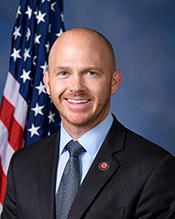
William R. Timmons IV
RRepublicanSC-4 · Representative
53
/ 100
Average
Attendance98
Avg: 96
Independence3
Avg: 4
Bipartisan Tone24
Avg: 15
Ethics Record100
Avg: 99
Transparency18
Avg: 53
Accountability Score — composite of attendance, independence, bipartisan tone, ethics record & transparency.
Methodology10
Bills Sponsored
0
Enacted into Law
3
Passed a Chamber
7
In Committee
All Sponsored Bills
HR10219In Committee
SNAP Fraud Accountability Act
HJRES199In Committee
Proposing an amendment to the Constitution of the United States to temporarily fill vacancies in the House of Representatives to further the continuity of Congress.
This proposed constitutional amendment would allow states to temporarily fill vacant House seats with appointed representatives instead of waiting for special elections, ensuring Congress can continue operating during emergencies or unexpected vacancies. The temporary appointees would serve only until a special election could be held to fill the seat permanently. This change would affect how quickly Congress can respond to member deaths, resignations, or other situations that leave districts without representation.
HR4437Passed House
SMART Act of 2025
Supervisory Modifications for Appropriate Risk-based Testing Act of 2025 or the SMART Act of 2025 This bill limits the scope of certain examinations and combines oversight procedures for certain small depository institutions and credit unions. Specifically, depository institutions and credit unions that are considered well-capitalized and well-managed (per their most recent examination) with assets of $6 billion or less must receive a limited-scope examination, as determined by the appropriate federal regulator, in the year following a full-scope examination. In addition, upon request by the depository institution or credit union, the regulator must combine separate compliance examinations (e.g., safety and soundness examinations and information technology examinations) and perform them at the same time. The bill provides exceptions for recently acquired depository institutions and for depository institutions and credit unions subject to certain formal enforcement proceedings or orders.
HR1755In Committee
Timely and Accurate Benefits Act
The legislation would require federal agencies to process and deliver benefits to eligible recipients more quickly and accurately, with specific timelines and quality standards for programs like Social Security, veterans' benefits, and unemployment insurance. It aims to reduce delays that leave people waiting months for payments they're entitled to receive and would hold agencies accountable if they miss deadlines or make errors. Workers, veterans, retirees, and other benefit recipients would see faster access to the money they depend on.
HR6544In Committee
REVIEW Act of 2025
Regulatory Efficiency, Verification, Itemization, and Enhanced Workflow Act of 2025 or the REVIEW Act of 2025 This bill increases the frequency and expands the scope of regulatory reviews conducted by federal financial agencies. Currently, these regulatory reviews must occur every 10 years to identify outdated or unnecessary regulations imposed on insured depository institutions. The bill increases this frequency to every 7 years. Additionally, the bill expands these reviews to include an internal review of the cumulative impacts of regulations, including an assessment regarding (1) access to financial products and services, (2) credit availability and market liquidity, and (3) costs and benefits of regulations with respect to financial safety and soundness and overall economic activity. The bill also codifies the National Credit Union Administration’s inclusion in this review process.
HR7274In Committee
Federal Acquisition Security Council Improvement Act of 2026
The bill would strengthen the Federal Acquisition Security Council, the government body that reviews and blocks purchases of equipment or software that pose national security risks, by giving it clearer authority and better tools to evaluate threats from foreign companies and supply chains. This affects federal agencies that buy technology and equipment, as well as companies selling to the government, by potentially making it harder to win contracts if there are concerns about foreign control or espionage risks. The council would have more resources and clearer rules to protect sensitive government operations from security vulnerabilities.
HR5810Passed House
Federal Supervisor Education Act
Federal Supervisor Education Act of 2025 This bill expands the training requirements for federal government supervisors. Specifically, the head of each agency, in consultation with the Office of Personnel Management (OPM), must establish programs (1) for supervisors to have individual development plans that include training on how to foster performance goals and objectives for employees, (2) to train supervisors on employee rights and prohibited personnel practices, and (3) to provide guidance and advice to new or underperforming supervisors. Supervisors must complete the training under this bill not later than one year after the individual is appointed to the position of supervisor and every three years thereafter. The OPM must issue (1) regulations to implement these training requirements, and (2) guidance to agencies about the competencies supervisors are expected to meet to effectively manage the performance of employees. Agencies must assess supervisors in accordance with this guidance.
HR4431Passed House
Improving Capital Allocation for Newcomers Act of 2025
Improving Capital Allocation for Newcomers Act of 2025 This bill expands qualification requirements for venture capital funds to include investment firms with more owners and capital contributions. Venture capital funds are exempt from certain regulations applicable to other investment firms, including those related to filings, audits, and restricted communications with investors. Currently, an investment firm qualifies as a venture capital fund if, among other requirements (1) the fund's securities are owned by 250 persons or less, and (2) the fund has $10 million or less in aggregate capital contributions and uncalled committed capital. The bill increases these amounts to 2,000 persons and $150 million, respectively.
HR5163In Committee
Clean and Managed Public Spaces Act
This bill prohibits camping outdoors on public property in the District of Columbia. The penalty for a violation of the prohibition is a fine of up to $500, imprisonment for up to 30 days, or both.
HR465In Committee
Old Glory Only Act
Old Glory Only Act This bill prohibits the flying of any flag other than the U.S. flag over U.S. diplomatic and consular posts.