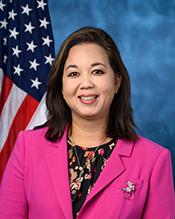
Jill N. Tokuda
DDemocratHI-2 · Representative
59
/ 100
Average
Attendance100
Avg: 96
Independence1
Avg: 4
Bipartisan Tone19
Avg: 15
Ethics Record100
Avg: 99
Transparency65
Avg: 53
Accountability Score — composite of attendance, independence, bipartisan tone, ethics record & transparency.
Methodology28
Bills Sponsored
0
Enacted into Law
1
Passed a Chamber
26
In Committee
All Sponsored Bills
HRES1590In Committee
Expressing support for the designation of September 2026 as "Hawaiian History Month" to recognize the history, culture, and contributions of Native Hawaiians and reaffirm the United States Federal trust responsibility to the Native Hawaiian Community to support their well-being.
HR10293In Committee
Rural Emergency Hospital Designation Improvement Act
HR8945Reported
To designate the facility of the United States Postal Service located at 86-014 Farrington Highway in Wai'anae, Hawai'i, as the "U.S. Representative Colleen Hanabusa Post Office Building".
This bill designates the facility of the United States Postal Service located at 86-014 Farrington Highway in Wai'anae, Hawai'i, as the "U.S Representative Colleen Hanabusa Post Office Building".
HRES1307In Committee
Commemorating the 70th anniversary of the United States Forest Service Institute of Pacific Islands Forestry.
This commemorative measure recognizes the 70th anniversary of a specialized research facility within the U.S. Forest Service that focuses on forestry practices and conservation in Pacific Island territories. The resolution honors the institute's work in studying and managing forests across Pacific regions, which affects local communities, environmental conservation efforts, and forest management policies in those areas. No new programs or funding changes are created by this measure—it simply marks an important milestone for the organization.
HR9306In Committee
Hands Off Elections Act of 2026
Federal employees would be banned from getting involved in election administration activities, such as counting votes, managing polling places, or overseeing voter registration. The law would apply to all federal workers across government agencies and would prevent them from taking on these election duties even if they volunteer or are temporarily assigned to help. This affects federal employees and could impact how elections are staffed, particularly in areas that rely on federal workers to assist with voting operations.
HRES1330In Committee
Recognizing the 120th anniversary of the immigration of Filipinos to Hawai'i.
This resolution honors the 120-year history of Filipino immigration to Hawaii, recognizing the significant contributions Filipino immigrants and their descendants have made to the islands' culture, economy, and communities. The measure acknowledges this important milestone in Hawaiian history and celebrates the Filipino-American experience in the state. No new laws or programs are created; this is a ceremonial recognition of a historical anniversary.
HR9005In Committee
Rural Hospital Revitalization Act of 2026
The federal government would provide interest-free loans to help rural communities build new hospitals or fix up existing ones through an agriculture department program. Rural hospitals in areas with limited access to healthcare would be able to borrow money at zero percent interest, making it cheaper for them to expand or modernize their facilities. This would primarily benefit rural communities and patients who currently struggle to access hospital services nearby.
HRES1298In Committee
Supporting the goals and ideals of "National Charter Schools Week", to be observed from May 10 through May 16, 2026.
This resolution designates May 10-16, 2026 as National Charter Schools Week to recognize and promote charter schools across the country. The measure celebrates the role charter schools play in education and encourages communities to acknowledge their contributions to student learning and school choice options.
HRES1278In Committee
Reaffirming congressional support for the Taiwan Relations Act and longstanding bipartisan Taiwan policy.
Congress would formally reaffirm its support for the Taiwan Relations Act, a decades-old law that guides U.S. relations with Taiwan and commits the U.S. to providing defensive military equipment to the island. The measure expresses Congress's backing for the longstanding bipartisan approach to Taiwan policy, which has been supported by both Republican and Democratic administrations. This affects U.S. foreign policy toward Taiwan and China, as well as defense contractors and military suppliers involved in arms sales to Taiwan.
HR8531In Committee
Farmland for Farmers Act of 2026
The proposal would help young and beginning farmers purchase agricultural land by providing grants, loans, and other financial assistance to make farmland more affordable. It aims to address the challenge of rising land prices that make it difficult for new farmers to start operations or expand existing farms. The legislation would primarily benefit beginning farmers, agricultural workers, and rural communities looking to keep farming viable for the next generation.
HR7455In Committee
To amend the Emergency Food Assistance Act of 1983 to allow certain States to directly purchase commodities, and for other purposes.
This bill allows a state to receive cash funds under The Emergency Food Assistance Program (TEFAP) to directly purchase agricultural commodities through the private commercial marketplace. TEFAP is a federal program that helps supplement the diets of people with low income by providing them with emergency food assistance at no cost. Through TEFAP, the Department of Agriculture (USDA) purchases a variety of commodities and makes those food products (e.g., canned, frozen, dried, and fresh fruits and vegetables, eggs, meat, dairy, and whole-grain and enriched grain products) available to state distributing agencies. Specifically, the bill allows an eligible state agency to elect to receive as cash the dollar amount used by USDA to purchase the commodities to distribute to the state.
HR7518In Committee
To amend the Food, Agriculture, Conservation, and Trade Act of 1990 to ensure adequate staffing and resources for the Institute of Tropical Forestry and the Institute of Pacific Islands Forestry.
The bill would increase funding and staffing for two government research centers that study forests in tropical and Pacific Island regions. These institutes conduct research on forest management, conservation, and sustainability in these specific environments, and the bill aims to give them the resources they need to do their work more effectively. This would affect scientists, forestry professionals, and communities that depend on tropical and Pacific Island forests.
HRES1089In Committee
Expressing support for the designation of February 2026 as "Hawaiian Language Month" or "'Olelo Hawai'i Month".
This resolution supports the designation of Hawaiian Language Month or 'Ōlelo Hawai'i Month.
HR7716In Committee
Tariff Free Farming Act
This bill would eliminate or reduce tariffs on agricultural imports to make farm products cheaper for American consumers and food manufacturers. It would affect farmers, grocery stores, and food companies by changing how much they pay for imported crops and livestock products. The goal appears to be lowering food costs by removing trade barriers on agricultural goods.
HR7563In Committee
Rare Earth Magnet Market Revitalization Act
This bill aims to strengthen the U.S. rare earth magnet industry, which is currently dominated by foreign suppliers, by likely using trade policies and domestic support to reduce American dependence on imports and boost domestic production. The legislation would affect manufacturers who use these magnets in products like electric vehicles and wind turbines, as well as companies in the rare earth mining and processing sectors. By revitalizing domestic rare earth magnet production, the bill seeks to improve national security and economic competitiveness in clean energy and advanced manufacturing.
HR6601In Committee
CARE for First Responders Act
This bill would provide health benefits and support services to first responders—including firefighters, police officers, and emergency medical personnel—who suffer from job-related illnesses or injuries. The legislation likely aims to improve access to medical care, mental health services, and financial assistance for these workers and their families who face unique health risks from their work. The bill is currently being reviewed by a congressional subcommittee to determine its scope and feasibility.
HR5241In Committee
RTCP Revitalization Act
RTCP Revitalization Act This bill amends the Department of Agriculture (USDA) Reimbursement Transportation Cost Payment Program (RTCP) to provide specified funds for the RTCP through FY2031 and each fiscal year thereafter. The RTCP provides reimbursement payments for geographically disadvantaged farmers and ranchers (e.g., those in Hawaii and Alaska) for a portion of the cost to transport agricultural commodities or inputs used to produce an agricultural commodity. The bill also removes a $15 million payment cap for any given fiscal year. Further, USDA may not impose a limitation on the amount of producer payments for any fiscal year that the program funds are equal to or exceed demand.
HR6343In Committee
Parity for Alaska Native and Native Hawaiian Students in Agriculture Act
The legislation would ensure that Alaska Native and Native Hawaiian students receive the same federal agricultural education and training opportunities as other students across the country. Currently, these groups may face barriers to accessing USDA programs and resources, so the bill aims to remove those obstacles and expand their participation in agriculture-related fields. This would help increase economic opportunities and agricultural knowledge within Alaska Native and Native Hawaiian communities.
HR6368In Committee
Feeding Rural Families Act of 2025
Feeding Rural Families Act of 2025 This bill provides for separate food cost calculations for urban and rural parts of Hawaii for the purposes of determining Supplemental Nutrition Assistance Program (SNAP) maximum monthly benefit allotments. Specifically, the bill requires separate food cost adjustments in the Thrifty Food Plan (TFP) for urban and rural parts of Hawaii. SNAP maximum monthly benefit allotments are tied to the cost of purchasing a nutritionally adequate low-cost diet, as measured by the Department of Agriculture-created and -calculated TFP. Maximum allotments are set at the monthly cost of the TFP for a four-person family, adjusted for family size. Under current law, maximum allotments are higher (to reflect the cost of food) in Hawaii, Guam, and the U.S. Virgin Islands, as well as in urban and rural parts of Alaska.
HR5164In Committee
Promoting American Competition in Aquaculture Research Act
The federal government would invest in research and development programs to help American fish farming companies compete with international aquaculture producers and improve farming techniques. This funding would support universities, research institutions, and private companies working to make fish farming more efficient, sustainable, and profitable in the United States. The goal is to strengthen the domestic seafood industry and reduce American dependence on imported farmed fish.
HR6769In Committee
Restoring Trust in Public Safety Act
The proposal would establish new standards and oversight measures for law enforcement agencies to improve accountability and rebuild public confidence in policing. It would likely affect police departments, officers, and communities by potentially requiring changes to training, use-of-force policies, or complaint procedures. The bill is currently under review by the House Judiciary Committee.
HR5562In Committee
Tropical Plant Health Initiative Act
Tropical Plant Health Initiative Act This bill establishes a Tropical Plant Health Initiative as a Department of Agriculture (USDA) high-priority research and extension area and reauthorizes other USDA research and extension initiatives. Under the bill, tropical plants include coffee plants, macadamia trees, cacao trees, plantains and bananas, mangos, floriculture and nursery crops, and vanilla plants. Specifically, the bill allows research and extension grants for developing and disseminating science-based tools and treatments to combat plant pests and noxious weeds that impact tropical plants; establishing an integrated pest management program in areas where tropical plants are affected by plant pests or noxious weeds; and conducting related data collection, research, and investigations regarding the production, health, immune systems, biology, ecology, and genomics of the tropical plants. Further, the bill reauthorizes USDA grants to support competitive specialized research and extension activities, including high-priority areas, through FY2030.
HRES784In Committee
Recognizing the value of coffee to the United States and expressing support for September 29, 2025, to be designated as "National Coffee Day".
This resolution supports the designation of National Coffee Day. Among other things, the resolution also supports efforts to strengthen domestic and global coffee supply chains and encourages continued scientific research into the health effects of drinking coffee.
HR5217In Committee
Rural Behavioral Health Improvement Act of 2025
This bill aims to improve mental health and substance abuse treatment services in rural areas, where such care is often scarce and hard to access. It would likely expand funding, training, and support for behavioral health providers in rural communities and may make it easier for rural residents to receive care through telehealth or other remote options. The changes would primarily affect rural patients seeking mental health treatment, rural healthcare providers, and potentially insurance companies that cover these services.
HR4968In Committee
Protecting and Preserving Social Security Act
Protecting and Preserving Social Security Act This bill eliminates the cap on income subject to Social Security taxes and revises methods for calculating various aspects of Social Security benefits. Under current law, Social Security has a taxable maximum , which refers to the maximum amount of a worker's earnings that are subject to Social Security payroll taxes (set at $176,100 in 2025). The taxable maximum also serves as the maximum amount of earnings used to calculate a worker's Social Security benefits. This bill phases out the taxable maximum so as to apply payroll taxes to all earnings after 2031, and revises the method used to calculate a worker’s Social Security benefits to account for earnings in excess of the taxable maximum. The bill also revises the method of calculating cost-of-living adjustments to Social Security benefits to reflect the spending habits of individuals over the age of 62. An increase in Social Security benefits resulting from this change may not be treated as income for purposes of determining eligibility for, or the amount of assistance provided under, the Medicaid or Supplemental Security Income programs.
HRES136In Committee
Expressing support for the designation of February 2025 as "Hawaiian Language Month" or "'Ōlelo Hawai'i Month".
This resolution supports the designation of Hawaiian Language Month or 'Ōlelo Hawai'i Month.
HR375Passed House
Continued Rapid Ohia Death Response Act of 2025
Continued Rapid Ohia Death Response Act of 2025 This bill establishes requirements to research and control Rapid Ohia Death, which is the disease caused by the fungal pathogen known as Ceratocystis fimbriata that affects the tree of the species Metrosideros polymorpha . Specifically, the Department of the Interior must partner with the Department of Agriculture (USDA) and Hawaii to control and address Rapid Ohia Death. In addition, the U.S. Geological Survey and the Forest Service Institute of Pacific Islands Forestry must continue to research Rapid Ohia Death vectors and transmission. The U.S. Fish and Wildlife Service must continue to partner with USDA, Hawaii, and local stakeholders to manage ungulates (e.g., certain mammals such as deer) in Rapid Ohia Death control areas on federal, state, and private land, with the consent of private landowners. Finally, the Forest Service must provide (1) financial assistance to prevent the spread of the fungus and to restore the native forests of Hawaii, and (2) staff and necessary infrastructure funding to the Institute of Pacific Islands Forestry to research the fungus.
HRES29In Committee
Recognizing the 125th anniversary of organized Okinawan immigration to the United States.
This resolution recognizes the historic contributions of Okinawan Americans to the United States and urges the people of the United States to honor the 125th anniversary of Okinawan immigration to the United States.