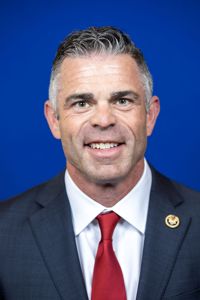
Tony Wied
RRepublicanWI-8 · Representative
52
/ 100
Average
Attendance99
Avg: 96
Independence4
Avg: 4
Bipartisan Tone18
Avg: 15
Ethics Record100
Avg: 99
Transparency19
Avg: 53
Accountability Score — composite of attendance, independence, bipartisan tone, ethics record & transparency.
Methodology19
Bills Sponsored
0
Enacted into Law
3
Passed a Chamber
16
In Committee
All Sponsored Bills
HR10238In Committee
Cybersecurity for Small Businesses Act of 2026
HR9718In Committee
Reshoring American Manufacturing Act of 2026
The Small Business Administration would be required to create and maintain a website to help small manufacturers find information and resources about moving their production operations back to the United States. This resource would serve as a central hub for small business owners interested in onshoring—bringing manufacturing jobs and facilities back from overseas—by providing them with relevant guidance and support options. The measure aims to make it easier for small manufacturers to access government assistance and information related to domestic production.
HR5831Passed House
To designate the facility of the United States Postal Service located at 306 South Main Street in Waupaca, Wisconsin, as the "Master Sergeant Melvin O. Handrich Post Office Building".
This bill designates the facility of the United States Postal Service located at 306 South Main Street in Waupaca, Wisconsin, as the "Master Sergeant Melvin O. Handrich Post Office Building".
HRES1477In Committee
Honoring the contributions of small manufacturers of firearms to the economy, culture, and recreational heritage of the United States and supporting the designation of August 2026 as "National Shooting Sports Month".
This measure would recognize August 2026 as "National Shooting Sports Month" to honor small firearm manufacturers and their role in the U.S. economy and recreational traditions. The designation would celebrate the shooting sports industry's contributions to American culture and heritage without creating new laws or regulations. The proposal is currently being reviewed by the House Committee on Small Business.
HR9822In Committee
SERVE Act
This proposal would ban former members of Congress from becoming lobbyists who try to influence current members of Congress, their staff, or other congressional employees. The restriction would apply to ex-lawmakers regardless of how long ago they left office, preventing them from using their insider connections and relationships to advocate for special interests on Capitol Hill. The change aims to reduce conflicts of interest and the revolving door between government service and lobbying.
HR9387In Committee
REAL Butter Act
The proposal would require lab-created butter products to be clearly labeled so consumers know they weren't made from traditional dairy sources, helping people make informed choices at the grocery store. The measure amends food labeling rules to ensure these synthetic butter alternatives are honestly identified on packaging. This affects food manufacturers who produce lab-created butter and consumers who want to know what they're buying.
HR8157In Committee
Risk-based Oversight for Integrity Act
This bill would change how the government inspects and oversees food safety by focusing inspections more heavily on farms and food companies that pose higher risks to public health, rather than inspecting all operations equally. The approach aims to make food safety oversight more efficient by directing resources toward the biggest potential problems while reducing unnecessary inspections of low-risk producers. Farmers, food manufacturers, and consumers would all be affected by how these new inspection priorities are carried out.
HR7719In Committee
SOS Act of 2026
The bill aims to address crime and law enforcement issues, though the specific policy details are not provided in the available information. Based on its referral to the House Judiciary Committee, it likely proposes changes to federal criminal law, law enforcement procedures, or related policies that would affect police agencies, prosecutors, courts, and potentially criminal defendants. Without access to the bill's full text, the exact nature of these changes cannot be determined.
HR4305Passed House
DUMP Red Tape Act
Destroying Unnecessary, Misaligned, and Prohibitive Red Tape Act or the DUMP Red Tape Act This bill establishes a requirement for the Office of Advocacy of the Small Business Administration (SBA) to continue to operate and maintain the Red Tape Hotline, which receives notifications from small entities about the burden of complying with applicable rules, guidance, policy statements, or other activities of a federal agency. The office must report annually to the SBA and Congress information about the notifications received through the hotline.
HR6018In Committee
Bringing Assistance for Rural Needs During Shutdowns Act
Bringing Assistance for Rural Needs During Shutdowns Act This bill requires Farm Service Agency (FSA) officers and employees to continue to work during a government shutdown. As background, under an exception in the Antideficiency Act, an employee whose duties involve the safety of human life or the protection of property may be required to work during a government shutdown (i.e., lapse in appropriations). Under this bill, any services by an FSA officer or employee are deemed to be for an emergency involving the safety of human life or the protection of property. Thus, if a lapse in FSA appropriations occurs, FSA officers and employees may be required to continue working.
HR5791In Committee
BLOOD Centers Act
This bill would establish new federal standards and support for blood donation centers across the country, likely including requirements for blood collection, testing, and storage to ensure safety and quality. It would affect blood banks, hospitals, and the millions of Americans who donate blood or receive transfusions by setting clearer rules for how blood products are handled and distributed. The legislation aims to strengthen the nation's blood supply system and protect both donors and patients who depend on blood transfusions for medical treatment.
HR3423Passed House
Facility for Runway Operations and Safe Transportation Act
Facility for Runway Operations and Safe Transportation Act or the FROST Act This bill allows airport sponsors to use funds from Airport Improvement Program (AIP) grants for storage facilities for aircraft deicing equipment and fluids. Under current law, airports may use AIP funds for structures and equipment that are used to deice aircraft, but not for the associated storage facilities.
HR5165In Committee
Go Pack Go Act of 2025
Go Pack Go Act of 2025 This bill requires cable and satellite television providers to make Wisconsin-based television programming available to subscribers in counties assigned to out-of-state television markets. U.S. counties are assigned to geographic television markets, and television providers are generally required to provide subscribers with programming local to their assigned market. Counties on state borders are sometimes assigned to out-of-state markets; subscribers in those counties often receive out-of-state programming (e.g., out-of-state news and sports). Under the bill, a cable or satellite television provider must offer subscribers in specified Wisconsin counties with the choice of (1) programming local to the subscriber's assigned market that the provider is currently required to retransmit, (2) Wisconsin-based adjacent-market programming, or (3) both. The bill also establishes that the provision of Wisconsin-based programming to subscribers who have elected it fulfills certain statutory coverage obligations applicable to providers.
HRES622In Committee
Honoring the contributions of small manufacturers of firearms to the economy, culture, and recreational heritage of the United States and supporting the designation of August 2025 as "National Shooting Sports Month".
This resolution recognizes small firearm manufacturers' role in the U.S. economy and culture, and designates August 2025 as "National Shooting Sports Month" to celebrate recreational shooting and hunting traditions. The measure is largely symbolic and doesn't create new laws or regulations, but rather acknowledges the shooting sports industry and encourages public awareness of its economic and cultural significance.
HR4622In Committee
To provide for eligibility for veterans of Operation End Sweep for the Vietnam Service Medal.
This bill provides eligibility for the Vietnam Service Medal to veterans who participated in Operation End Sweep and submit an application. (Operation End Sweep was a mission to clear mines from Haiphong harbor and surrounding areas after the Vietnam war concluded.)
HR4546In Committee
FIRE Act
Without access to the full bill text, the FIRE Act likely addresses crime prevention or law enforcement procedures, though the specific policy changes cannot be determined from the title alone. Based on its referral to the House Judiciary Committee, it probably affects how police operate, how crimes are prosecuted, or how the criminal justice system functions. To understand exactly what it would do—whether it expands police powers, changes sentencing rules, or modifies criminal procedures—you would need to review the actual bill language.
HR3894In Committee
SAFE Cities Act
The bill aims to address crime and public safety in cities through law enforcement measures, though the specific provisions are not yet detailed in available summaries. Once the Judiciary and Oversight committees review it, they will determine what changes to federal crime laws, police practices, or city safety programs the legislation would implement. The bill would likely affect urban residents, law enforcement agencies, and potentially federal funding for local police departments.
HR2166In Committee
Safe Routes Act of 2025
Safe Routes Act of 2025 This bill directs the Department of Transportation to waive vehicle weight limits for covered logging vehicles, thus allowing logging vehicles to travel on interstate highways in certain circumstances. The term covered logging vehicle means a vehicle that (1) is transporting raw or unfinished forest products, including logs, pulpwood, biomass, or wood chips; (2) is traveling a distance not greater than 150 air miles on interstate highways from origin to a storage or processing facility; and (3) meets state legal weight tolerances and vehicle configurations for transporting raw or unfinished forest products within the state boundaries in which the vehicle is operating.
HR1513In Committee
Unplug the Electric Vehicle Charging Stations Program Act
Unplug the Electric Vehicle Charging Stations Program Act This bill repeals grant programs that provide funding for electric vehicle charging infrastructure and alternative fueling infrastructure. Specifically, the bill repeals the Charging and Fueling Infrastructure Grant Program under which the Department of Transportation provides grants for acquiring and installing publicly accessible electric vehicle charging infrastructure, hydrogen fueling infrastructure, propane fueling infrastructure, or natural gas fueling infrastructure that is directly related to the charging or fueling of a vehicle. It also repeals the National Electric Vehicle Infrastructure Formula Program under which the Federal Highway Administration (FHWA) provides grants for deploying electric vehicle charging infrastructure and establishing a network to facilitate data collection, access, and reliability. In addition, the bill rescinds unobligated funds that were provided to the FHWA for the program and prohibits funds from being used to carry out the program.