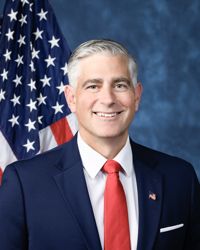
Michael Baumgartner
RRepublicanWA-5 · Representative
58
/ 100
Average
Attendance97
Avg: 96
Independence1
Avg: 4
Bipartisan Tone15
Avg: 15
Ethics Record100
Avg: 99
Transparency72
Avg: 53
Accountability Score — composite of attendance, independence, bipartisan tone, ethics record & transparency.
Methodology16
Bills Sponsored
0
Enacted into Law
3
Passed a Chamber
11
In Committee
All Sponsored Bills
HR9834In Committee
No Racketeers on our Shores Act
The proposal would make it possible to deny entry to the United States or deport foreign nationals who are found to have engaged in economic discrimination against American citizens or residents. This could apply to individuals or representatives of foreign companies accused of unfair business practices targeting Americans. The bill has been sent to the House Judiciary Committee for review.
HR9621In Committee
Northwest Endangered Salmon Predation Prevention Act of 2026
This bill would allow fishermen and wildlife managers to kill sea lions and seals in the Columbia River and Washington state waters to protect salmon populations that are endangered or threatened. Currently, federal law strictly protects these marine mammals, but this change would let authorities remove them when they're eating too many salmon that scientists are trying to save. The bill affects fishing communities, environmental groups, and wildlife managers who deal with the conflict between protecting marine mammals and restoring fish populations.
HR4584Passed House
To make technical amendments to update statutory references to certain provisions which were formerly classified to chapters 14 and 19 of title 25, United States Code, and to correct related technical errors.
This bill updates references in the U.S. Code to certain provisions in Title 25 (Indians). In 2016, Congress transferred certain provisions in Chapter 14 (Miscellaneous) and Chapter 19 (Indian Land Claims Settlements) of Title 25 to new chapters at the end of the title as part of an effort to reclassify the code. To reflect the reclassification of the code, this bill updates references to Title 25.
HR10109In Committee
Wildfire Event Contract Prohibition Act
HR9602In Committee
Less Bureaucracy, Better International Foreign Gift Transparency Act
Less Bureaucracy, Better International Foreign Gift Transparency Act This bill transfers specified functions relating to disclosure of foreign gifts and contracts from the Department of Education (ED) to the Department of State. Specifically, the bill transfers to the State Department all the functions and authorities exercised by ED before the bill's effective date related to disclosure of foreign gifts and contracts. (Institutions of higher education must disclose to ED a gift from or contract with a foreign source that is valued at $250,000 or more, considered alone or in combination with all other gifts from or contracts with that foreign source. On February 23, 2026, ED announced an interagency agreement with the State Department for the State Department to provide support for managing the reporting portal, while ED must maintain its statutory responsibilities and program oversight.) Additionally, the bill transfers to the State Department all personnel and appropriations related to the functions that are transferred under this bill. The bill outlines the authority of the Office of Management and Budget (OMB) related to the functions that are transferred under this bill, including that OMB must ensure that this bill does not create a net increase in full-time equivalent employees at the State Department or ED. Further, OMB must certify compliance with the bill to specified congressional committees. The transfer of these functions does not affect any suits, proceedings, or applications for benefits, services, licenses, permits, certificates, or financial assistance that are pending on the date of this bill's effective date.
HR9419In Committee
Power and Water for Families Act of 2026
This bill aims to set rules for building data centers and similar large power-consuming facilities while making sure regular electricity and water customers don't have to pay extra costs caused by these new industrial operations. It would encourage data centers to reuse water instead of drawing heavily on local water supplies, and it would likely establish cost-sharing requirements so that companies building these facilities help pay for the infrastructure upgrades needed to support them. The goal is to balance economic development with protecting existing residents and businesses from unexpected rate increases.
HR9137In Committee
Protect College Sports Act of 2026
Protect College Sports Act of 2026 This bill establishes requirements for name, image, or likeness (NIL) agreements for college student athletes and provides a limited antitrust exemption for schools and conferences to pool and sell certain college sports media rights. The requirements address elements of the court-approved agreement to settle In re College Athlete NIL Litigation (i.e., House settlement ). First, the bill statutorily prohibits institutions, conferences, or interstate intercollegiate athletic associations (e.g., the National Collegiate Athletic Association [NCAA]) from restricting student athletes from entering NIL agreements (subject to specified limitations). Students must report to their institution NIL compensation greater than $600. The bill requires agents to register with a state and caps agent endorsement contract fees at 5%. The bill also provides student athletes with one transfer without losing athletic eligibility and restricts football personnel from becoming the head football coach at a different institution during the same season. Further, the bill prohibits institutions, conferences, or specified entities acting for the benefit of an institution from providing athletes with compensation that circumvents the limit on sharing revenue with student athletes established under the House settlement. The bill also makes the limit permanent and provides for an annual inflation adjustment. Additionally, the bill establishes (subject to specified conditions) a limited antitrust exemption for institutions or conferences that form joint agreements to transfer their sports telecasting rights to a third party. Such an agreement requires participation from at least 75% of the institutions in the Football Bowl Subdivision.
HR8649In Committee
Expanding the Defense Industrial Base Sales Act
The federal government would be allowed to use foreign military financing—money given to other countries to buy military equipment—to help those countries purchase weapons and military goods directly from American defense companies instead of only through government-to-government sales. This change would streamline the process for allied nations to acquire U.S. military equipment and could expand business opportunities for American defense contractors. The proposal is currently under review by the House Committee on Foreign Affairs.
HR8170In Committee
MATCH Act
I don't have enough information to write an accurate summary. The bill's subjects aren't listed, and "MATCH Act" is too vague without knowing what those letters stand for or what policy area it addresses. To provide a meaningful explanation of what this bill would actually do and who it affects, I would need additional details about its content or purpose.
HR8196In Committee
Workforce Data Quality Initiative Act of 2026
This bill would improve how the government collects and uses information about workers and jobs to help policymakers make better decisions about employment programs and training. It likely aims to make workforce data more accurate and consistent across different agencies so that schools, employers, and government programs can better understand labor market trends and prepare people for available jobs. The changes would primarily affect workers seeking job training, employers hiring workers, and government agencies that run employment and education programs.
HR7058Reported
Foreign Adversary AI Risk Assessment and Diplomacy Act
This bill would require the U.S. government to assess and monitor artificial intelligence development by foreign adversaries like China and Russia, and to develop diplomatic strategies for managing the risks posed by their AI capabilities. It aims to help policymakers understand how competing nations are advancing AI technology and to coordinate international efforts to prevent misuse of AI for military, espionage, or other harmful purposes. The bill affects government agencies responsible for national security and foreign policy, as well as international relations with other countries.
HR8037In Committee
Protect American AI Act of 2026
The bill would establish legal rules and oversight for artificial intelligence development and use in the United States, likely aiming to protect American interests in AI technology while setting standards for how AI systems are created and deployed. It affects AI companies, technology developers, and potentially consumers who use AI products, and would give federal agencies authority to enforce these new AI regulations. The bill has been sent to two committees in Congress for review before any vote can take place.
HR5388In Committee
American Artificial Intelligence Leadership and Uniformity Act
The proposal would establish federal standards and oversight for artificial intelligence development and use across the United States, aiming to ensure consistent rules rather than having different states create conflicting regulations. It would affect tech companies building AI systems, government agencies using AI for decision-making, and potentially workers and consumers who interact with AI applications. The bill seeks to position the U.S. as a leader in AI innovation while maintaining safety and fairness standards.
HR4215Passed House
International Traffic in Arms Regulations Licensing Reform Act
International Traffic in Arms Regulations Licensing Reform Act This bill requires the Department of State to establish deadlines for the review of applications to export defense articles or services. Specifically, the State Department must develop and maintain a list of countries and end users with respect to which expedited decision-making on applications to export defense articles and services is vital to U.S. national security. The State Department must submit this list to Congress annually. Following publication of the list, the State Department, in coordination with the Department of Defense, must initiate a rulemaking process to establish timelines for decision-making with respect to (1) applications to export defense articles and services to countries or end users identified in the list, and (2) all other applications to export defense articles and services. To the maximum extent practicable, applications for export to listed countries or end users must be acted on within 45 days of submission, and applications for export to other countries or end users must be acted on within 60 days of submission. These deadlines may be suspended under specified circumstances. Finally, the State Department must submit a semiannual report to Congress identifying each application to export defense articles or services during the preceding 180 days that was not acted upon by the applicable deadline.
HR2619Reported
No Paydays for Hostage-Takers Act
The legislation would prevent the U.S. government from providing foreign aid or financial assistance to countries or groups that take hostages or fail to cooperate in securing the release of American citizens held captive. This measure aims to pressure hostile nations and terrorist organizations to free hostages by cutting off their access to U.S. funding and support. The bill affects international relations and could influence how the government responds to hostage situations involving Americans abroad.
HR1048Passed House
DETERRENT Act
Defending Education Transparency and Ending Rogue Regimes Engaging in Nefarious Transactions Act or the DETERRENT Act This bill expands oversight and disclosure requirements related to foreign sources and institutions of higher education (IHEs). Specifically, the bill requires an IHE to annually disclose to the Department of Education (ED) any year in which the IHE receives a gift from a foreign country of concern (e.g., China or Russia) or foreign entity of concern of any dollar amount; receives a gift or contract from a foreign source (other than a foreign country of concern or foreign entity of concern) that is valued at $50,000 or more, considered alone or in combination with all other gifts or contracts within a calendar year (current disclosure threshold is $250,000 or more), or which has an undetermined monetary value; enters into a contract with a foreign country of concern or foreign entity of concern after receiving a waiver for such contract; or is substantially controlled by a foreign source. Additionally, the bill prohibits IHEs from entering into contracts with a foreign country of concern or with a foreign entity of concern without obtaining a waiver, requires certain IHEs to disclose gifts or contracts between covered individuals (e.g., researchers) and foreign sources, and requires private IHEs with specified assets or investments to file annual investment disclosure reports. The bill requires ED to investigate possible violations of this bill and outlines the various penalties for each violation. Penalties may include losing eligibility for federal student financial aid.