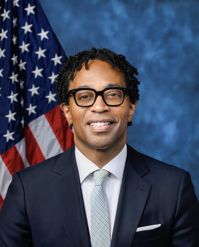
Wesley Bell
DDemocratMO-1 · Representative
53
/ 100
Average
Attendance97
Avg: 96
Independence2
Avg: 4
Bipartisan Tone11
Avg: 15
Ethics Record100
Avg: 99
Transparency38
Avg: 53
Accountability Score — composite of attendance, independence, bipartisan tone, ethics record & transparency.
Methodology27
Bills Sponsored
0
Enacted into Law
1
Passed a Chamber
25
In Committee
All Sponsored Bills
HR5254Passed House
Gateway Partnership Act
Gateway Partnership Act This bill authorizes the National Park Service (NPS) to enter into a one-time agreement with the Gateway Arch Park Foundation to host private events at the Gateway Arch National Park and its buildings for a period of up to five years. The NPS manages the park, located in St. Louis, Missouri, and its buildings, such as the Arch Visitor Center and the Old Courthouse. The bill outlines the terms and conditions that must be included in the agreement. The bill also requires private events hosted at the park or its buildings to be consistent with the park's purposes and compatible with NPS programs. Such events may not (1) degrade the integrity, appearance, or purposes of the park; or (2) take place during times or in locations that prevent or disrupt public use or access to the park or its buildings. The NPS must charge a fee to cover the cost of wear and tear resulting from the private events. The NPS may recover all costs incurred as a result of the private events, including maintenance, utilities, administrative expenses, security, and personnel costs. The bill terminates the NPS's authority to enter and carry out an agreement with the foundation seven years after the enactment of this bill.
HR10486In Committee
Relief Without Delay Act
HRES1522In Committee
Recognizing the 30th anniversary of the Missouri-Panama State Partnership Program and celebrating the enduring partnership between the State of Missouri and the Republic of Panama.
HRES1514In Committee
Recognizing suicide as a serious public health problem, expressing support for the designation of September 8, 2026, as "988 Day" and the role of the 988 Suicide and Crisis Lifeline, and for other purposes.
HRES1487In Committee
Recognizing the 1960 University of Missouri Tigers Football Team for its undefeated regular season, Orange Bowl victory, and claim to the 1960 National Championship.
HR9180In Committee
CDBG–DR Automated Assessment Act
The federal government would be required to regularly assess what community development needs are not being met in areas affected by disasters, such as housing repairs, infrastructure rebuilding, and economic recovery support. This ongoing evaluation would help identify gaps in disaster relief efforts and guide where federal resources should be directed to help communities rebuild more effectively. The measure affects disaster-affected communities, local governments, and federal housing agencies responsible for coordinating recovery efforts.
HR9011In Committee
Vacancy to Value Act of 2026
The federal government would sell or give away unused government buildings and land to qualified organizations that promise to redevelop them for economic growth, with the General Services Administration and Department of Housing and Urban Development running pilot and grant programs to make these transfers happen. This would help communities repurpose vacant federal properties into new businesses, housing, or other productive uses rather than letting them sit empty. Local governments, nonprofits, and private developers could potentially benefit from access to these properties at reduced costs.
HR8846In Committee
Tornado Preparedness Act
The proposal would strengthen the nation's ability to detect, forecast, and warn people about tornadoes while helping communities better prepare for and recover from tornado damage. It would likely improve weather monitoring technology, enhance alert systems to reach more people faster, and provide resources to help towns and cities build stronger defenses and emergency response plans. The bill affects weather forecasters, emergency management officials, and communities in tornado-prone areas across the country.
HR8599In Committee
St. Louis Postal Accountability and Reform Act
The Postal Service would be required to prepare and submit a detailed report to Congress about how well it's delivering mail and packages in the St. Louis area, including information about delivery times and service quality. This would help lawmakers understand whether residents and businesses in that region are receiving reliable postal service or experiencing problems with their mail delivery.
HR5543Reported
Baltic Security Assessment Act of 2025
This bill would require the federal government to assess the military and security situation in the Baltic countries (Lithuania, Latvia, and Estonia) and report back to Congress on their defense needs and vulnerabilities. The assessment would help lawmakers understand whether these NATO allies need additional U.S. military support or assistance to defend against potential threats from Russia. The report would inform decisions about future military aid, troop deployments, and security cooperation with these countries.
HRES1167In Committee
Expressing support for the designation of the month of April 2026 as "Parkinson's Awareness Month".
This resolution would officially recognize April 2026 as "Parkinson's Awareness Month" to help increase public understanding of Parkinson's disease, a neurological condition that affects movement and causes symptoms like tremors and stiffness. The designation aims to encourage awareness campaigns, educational efforts, and fundraising activities related to the disease during that month. This is a symbolic measure that doesn't create new programs or funding but shows congressional support for raising awareness about Parkinson's among patients, families, and the general public.
HRES1138In Committee
Recognizing the critical missions of the Federal Emergency Management Agency (FEMA), the Cybersecurity and Infrastructure Security Agency (CISA), and the Transportation Security Administration (TSA) and expressing concern that the systematic reduction of its career workforce has undermined those missions and endangered the safety and security of United States citizens.
This resolution expresses concern that FEMA, CISA, and TSA have lost too many career employees through workforce reductions, which the resolution argues has weakened their ability to protect Americans from disasters, cyberattacks, and terrorism threats. The resolution does not propose specific legislation but rather calls attention to the problem and asks Congress to consider whether staffing levels at these three agencies are adequate for their critical national security and emergency response missions.
HR7998In Committee
BRIDGE Act
The BRIDGE Act would likely create temporary tax relief or incentives to help businesses or individuals transition during a specific period, though the exact provisions depend on the bill's full text. Based on its referral to the House Ways and Means Committee, it probably addresses tax policy changes that could affect workers, employers, or specific industries. Without more details about which taxpayers or sectors it targets, the bill appears designed to provide a "bridge" of financial support during an economic transition or policy change.
HR7814In Committee
EPSTEIN Act
This bill would create a new independent commission in Congress to oversee the Department of Justice's operations and review how federal authorities handled cases and evidence related to Jeffrey Epstein, with a focus on ensuring transparency and accountability. The commission would have the power to investigate DOJ decisions and practices to determine whether proper procedures were followed and whether the public has access to relevant information about these cases. This would affect the Department of Justice, Congress, and potentially victims and the public seeking answers about how these high-profile cases were managed.
HR7746In Committee
To designate the facility of the United States Postal Service located at 8390 North Broadway in St. Louis, Missouri, as the "Chuck Stone Post Office".
This bill designates the facility of the United States Postal Service located at 8390 North Broadway in St. Louis, Missouri, as the "Chuck Stone Post Office".
HR7570In Committee
Reinvest in Public Schools Act of 2026
This bill would likely change tax policies to direct more federal money toward public schools, possibly by adjusting tax rates or closing tax loopholes to fund education. The changes would affect both individual taxpayers and potentially businesses, with the goal of increasing resources available to schools for teachers, facilities, and programs. Students, teachers, and school districts would be the primary beneficiaries of increased education funding.
HR7461In Committee
FEMA Accountability Act
This bill would establish new oversight and accountability measures for the Federal Emergency Management Agency (FEMA) to ensure the agency properly manages disaster relief funds and responds effectively to emergencies. The legislation likely aims to improve how FEMA tracks spending, prevents fraud, and handles disaster recovery operations that affect millions of Americans during hurricanes, floods, wildfires, and other major disasters. The bill is currently under review by the House committee responsible for infrastructure and emergency management issues.
HR7395In Committee
NO ICE ADs Act
The bill would restrict Immigration and Customs Enforcement (ICE) from using advertising to recruit informants or conduct undercover operations in immigrant communities. The measure aims to limit ICE's surveillance and intelligence-gathering activities that could target vulnerable populations, affecting both immigrants and civil liberties advocates who worry about government overreach.
HR7197In Committee
Home Energy Relief Act
This bill would likely provide financial assistance or tax breaks to help homeowners reduce their energy costs and improve their home's energy efficiency. It could include programs for weatherization, upgrades to heating and cooling systems, or rebates for installing solar panels and other renewable energy equipment. The legislation would affect homeowners and potentially energy companies involved in efficiency upgrades.
HR6252In Committee
Food Assurance and Security Act
The bill would establish or strengthen food safety and security measures across the agricultural and food production system to protect consumers from contaminated or unsafe food products. It likely addresses how food is inspected, tracked, and handled from farms through stores, and may give federal agencies more tools to respond to food safety problems. The proposal affects farmers, food manufacturers, distributors, retailers, and ultimately anyone who buys groceries.
HR5794In Committee
FEMA Operations Continuity Act of 2025
FEMA Operations Continuity Act of 2025 This bill authorizes the Federal Emergency Management Agency (FEMA) to continue certain disaster relief, recovery, and mitigation operations during a lapse in appropriations (i.e., government shutdown). Specifically, the bill authorizes FEMA to continue all disaster relief, recovery, and mitigation operations funded through the Disaster Relief Fund (DRF); obligate and disburse DRF balances for all existing and future disaster declarations, including individual and public assistance under the Robert T. Stafford Disaster Relief and Emergency Assistance Act; and maintain personnel and contract support necessary to ensure uninterrupted processing of claims and payments. The bill also (1) requires all unobligated balances in the DRF to remain available to FEMA for expenditure during a lapse in appropriations; and (2) prohibits the funds from being withheld, sequestered, or reprogrammed during a lapse in appropriations, except as necessary to comply with the Antideficiency Act. Finally, the bill specifies that, for the purposes of the Antideficiency Act, the FEMA operations authorized by this bill must be considered essential to protect human life and property and are exempt from government shutdown restrictions.
HR6172In Committee
Ending Forced Arbitration of Race Discrimination Act of 2025
This bill would prevent employers from forcing workers to settle race discrimination complaints through private arbitration instead of going to court, allowing employees to pursue discrimination cases in the public legal system. The change would apply to new employment contracts and give workers more options when they believe they've faced racial discrimination on the job. This affects both private sector employees and employers, shifting how workplace discrimination disputes are resolved.
HRES680In Committee
Recognizing suicide as a serious public health problem, expressing support for the designation of September 8, 2025, as ''988 Day'' and the role of 988 Suicide and Crisis Lifeline, and for other purposes.
HR4631In Committee
St. Louis RECA Readjustment Act
Workers who were exposed to radiation while employed at a uranium processing facility in St. Louis would become eligible for compensation and health benefits under this proposal, similar to programs that already exist for nuclear weapons plant workers in other locations. The bill would recognize these employees' occupational health risks and provide them with financial support and medical care related to their radiation exposure. This would primarily affect former and current workers at the St. Louis site and their families.
HRES345In Committee
Expressing support for designation of the month of April 2025 as "Parkinsons Awareness Month".
This resolution supports the designation of Parkinson's Awareness Month.
HR2669In Committee
Community First Act
Community First Pretrial Reform Act or the Community First Act This bill requires the Bureau of Justice Assistance within the Department of Justice to award grants to partnerships of tribal, territorial, and local governments and nonprofit organizations to reduce the number of individuals in local jails and the duration of their incarceration.
HR2816In Committee
Shell Company Abuse Act
Shell Company Abuse Act This bill makes it unlawful to establish or use a corporation, company, or other entity with the intent to conceal an election contribution or donation by a foreign national. A violator is subject to criminal penalties—a fine, a prison term of up to five years, or both.