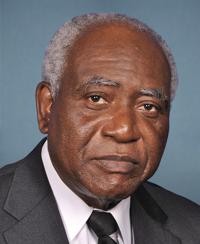
Danny K. Davis
DDemocratIL-7 · Representative
54
/ 100
Average
Attendance96
Avg: 96
Independence2
Avg: 4
Bipartisan Tone20
Avg: 15
Ethics Record100
Avg: 99
Transparency39
Avg: 53
Accountability Score — composite of attendance, independence, bipartisan tone, ethics record & transparency.
Methodology19
Bills Sponsored
0
Enacted into Law
0
Passed a Chamber
19
In Committee
All Sponsored Bills
HRES1577In Committee
Expressing support for the designation of September 2026 as "Sickle Cell Disease Awareness Month" in order to educate communities across the United States about sickle cell disease and the need for research, early detection methods, effective treatments, and preventative care programs with respect to complications from sickle cell disease and conditions related to sickle cell disease.
HR10429In Committee
To designate the facility of the United States Postal Service located at 901 Lake Street in Oak Park, Illinois, as the "Detective Allan Reddins Post Office Building".
This bill designates the facility of the United States Postal Service located at 901 Lake Street in Oak Park, Illinois, as the "Detective Allan Reddins Post Office Building".
HRES1432In Committee
Of inquiry requesting the President and directing the Secretary of Health and Human Services to transmit, respectively, certain documents to the House of Representatives relating to the freeze on State-based Temporary Assistance for Needy Families, Child Care and Development Fund, and Social Services Block Grant payments for California, Colorado, Illinois, Minnesota, and New York.
Congress is asking the President and the Secretary of Health and Human Services to provide documents explaining why federal payments for welfare assistance, child care support, and social services were frozen for California, Colorado, Illinois, Minnesota, and New York. The request seeks to understand the reasons behind this freeze and what impact it had on these states' ability to help low-income families and children. This would help lawmakers determine whether the freeze was justified and what steps should be taken next.
HRES1371In Committee
Expressing support for a "World Sickle Cell Awareness Day" in order to increase public awareness across the United States and global community about sickle cell disease and the continued need for empirical research, early detection screenings, novel effective treatments leading to a cure, and preventative care programs with respect to complications from sickle cell anemia and conditions relating to sickle cell disease.
This resolution calls for the United States to officially recognize and support a "World Sickle Cell Awareness Day" to help educate the public about sickle cell disease and the importance of research, early screening, and treatment options. The measure aims to increase attention to sickle cell disease both in America and worldwide, with a focus on finding better treatments and preventing complications from the condition. It affects patients with sickle cell disease, researchers, healthcare providers, and public health organizations working to combat this inherited blood disorder.
HR8887In Committee
Julius Rosenwald and Rosenwald Schools National Historical Park Act
The proposal would create a new national historical park dedicated to Julius Rosenwald and the schools he funded, preserving the legacy of a major philanthropist who helped build thousands of schools for African American students in the early 1900s. This would protect and interpret important sites related to Rosenwald's charitable work and the educational institutions that served Black communities across the South during a time of severe racial segregation. The park would allow visitors to learn about this significant but often overlooked chapter of American history and education.
HR7529In Committee
Fresh Starts for Foster Youth Act
This bill would provide financial assistance and support services to young people aging out of the foster care system to help them transition to independent living. The legislation aims to reduce homelessness and improve outcomes for foster youth by offering resources like housing assistance, education support, and job training as they leave government care and enter adulthood.
HR7690In Committee
Dr. William W. Sullivan TRIO Upward Bound Student Stipend Support Act
This bill would provide additional financial support to students participating in the TRIO Upward Bound program, which helps low-income and first-generation students prepare for and succeed in college. The extra stipends would help cover living expenses and other costs for participating students, making it easier for them to focus on their studies without financial hardship. The funding would benefit students from disadvantaged backgrounds who are working toward higher education.
HR7689In Committee
Earl N. Williams, Sr., First Chance Act
The bill would create or expand educational and job training programs aimed at giving people with criminal records a second chance to rebuild their lives through education and employment opportunities. It likely focuses on removing barriers that formerly incarcerated individuals face when trying to access schools, vocational training, or jobs after their release. The legislation would affect both the individuals seeking to reintegrate into society and employers or educational institutions that participate in these second-chance programs.
HR7639In Committee
For the relief of Roberto Carlos Lopez.
This bill seeks to provide special relief to an individual named Roberto Carlos Lopez, likely addressing a specific legal or immigration matter that requires congressional action outside of normal procedures. Without additional details about the subjects or nature of the relief being requested, the bill appears to be a private relief measure designed to help this particular person resolve a unique situation that cannot be addressed through standard legal channels. Such bills typically involve immigration cases, citizenship issues, or other individual circumstances requiring legislative intervention.
HR6625In Committee
RISE from Trauma Act
Resilience Investment, Support, and Expansion from Trauma Act or the RISE from Trauma Act This bill reauthorizes, establishes, and expands programs to support youth and families who have experienced, or may experience, trauma. The bill reauthorizes the National Child Traumatic Stress Network through FY2030, school-based grants to increase access to trauma-support and mental health services through FY2030, public health data collection about adverse childhood experiences through FY2030, and a task force on trauma-informed care through FY2031. It also establishes grants for multi-sector demonstration projects to mitigate trauma and toxic stress; improving outcomes for hospital patients who experience drug overdoses, suicide attempts, or violent injury; and clinical training in infant and early childhood mental health. Additionally, the bill authorizes (1) federal agencies to use specified discretionary funds for pilot projects to address traumatic exposures among children, and (2) Department of Justice (DOJ) grants to prevent trauma in children by reducing their exposure to violence and trauma. Further, the Department of Health and Human Services must provide resources for training frontline service providers and certain community members about trauma, toxic stress, and resilience. In addition, DOJ must establish a national center to disseminate resources to law enforcement agencies to improve interactions with youth and families who are exposed to violence and trauma. The bill also incorporates trauma-informed practices in programs for health care professional education, health care access, and educators.
HR6181In Committee
John Lewis Every Child Deserves a Family Act
This bill would expand federal support and resources for children in foster care and those waiting to be adopted, with the goal of helping more kids find permanent families. It likely includes changes to tax benefits, healthcare coverage, or funding for adoption and foster care services to make it easier and more affordable for families to adopt children from the foster care system. The bill affects foster children, adoptive families, and social service agencies that work with vulnerable youth.
HR5370In Committee
To provide low-income individuals with opportunities to enter and follow a career pathway in the health professions, and for other purposes.
The legislation would create programs and financial support to help low-income people get training and education needed for jobs in healthcare, such as nursing, medical assistance, and other health professions. It aims to remove barriers like cost and lack of information that prevent people from lower-income backgrounds from entering these careers. The bill would affect both individuals seeking healthcare careers and healthcare employers looking to expand their workforce.
HR5356In Committee
National Infrastructure Bank Act of 2025
The bill would create a new federal bank designed to provide loans and financial support for large infrastructure projects like roads, bridges, airports, and utilities that might otherwise struggle to get private funding. This bank would help states, cities, and private companies finance major construction and modernization efforts by offering long-term, low-interest loans and other financial tools. The goal is to speed up infrastructure development across the country by making it easier and cheaper for communities to pay for critical projects.
HRES524In Committee
Expressing support for the designation of June 19, 2025, as "World Sickle Cell Awareness Day" in order to increase public awareness across the United States and global community about sickle cell disease and the continued need for empirical research, early detection screenings, novel effective treatments leading to a cure, and preventative care programs with respect to complications from sickle cell anemia and conditions relating to sickle cell disease.
This resolution designates June 19, 2025, as "World Sickle Cell Awareness Day" to help educate Americans and people worldwide about sickle cell disease, a serious inherited blood disorder that primarily affects Black communities. The measure aims to highlight the importance of research, early screening programs, new treatments, and preventative care to help patients avoid complications from the disease. While this is a symbolic designation rather than a law creating new programs, it signals congressional support for raising awareness and funding priorities around sickle cell disease.
HR2994In Committee
Child and Dependent Care Tax Credit Enhancement Act of 2025
The legislation would increase the tax credit that working families can claim for child care and dependent care expenses, making it easier for parents and caregivers to afford these services. Families would receive a larger reduction in their taxes based on what they spend on childcare, daycare, or care for elderly or disabled relatives, putting more money back in their pockets. This change would primarily benefit middle and lower-income working families who struggle with the high costs of care.
HR2833In Committee
Adoption Tax Credit Refundability Act of 2025
Adoption Tax Credit Refundability Act of 2025 This bill makes the federal adoption tax credit refundable. The bill also requires the Internal Revenue Service to provide for a standardized third-party affidavit for purposes of verifying a legal adoption. As background, individuals may claim a tax credit for qualified expenses to adopt a child. The maximum amount of the tax credit is $17,280 per child for 2025, which is adjusted annually for inflation. Income limitations apply. Under current law, the adoption tax credit is not refundable but may be carried forward for up to five subsequent tax years to reduce taxable income in those years.
HR2595In Committee
Building Child Care for a Better Future Act
The proposal would expand federal funding and support for child care services to help make care more affordable and accessible for families with young children. It aims to increase the number of available child care slots, improve the quality of care facilities, and provide financial assistance to parents who struggle with child care costs. Working families, child care providers, and early childhood educators would be the primary beneficiaries of these expanded programs and resources.
HR2540In Committee
SSI Savings Penalty Elimination Act
This bill would remove the strict limits on how much money people receiving Supplemental Security Income (SSI) benefits can save without losing their assistance. Currently, SSI recipients can only keep about $2,000 in savings before their benefits are reduced or cut off, which discourages them from building financial security. The change would help low-income disabled people, elderly individuals, and blind people who rely on SSI to accumulate emergency savings without penalty.
HR2108In Committee
TANF State Expenditure Integrity Act of 2025
This bill would require states to provide more detailed reporting on how they spend federal Temporary Assistance for Needy Families (TANF) money, with stricter oversight to ensure funds go toward helping low-income families rather than other purposes. The measure would affect state welfare agencies and the families who receive or could receive cash assistance, by potentially making the program more transparent and accountable for its spending.