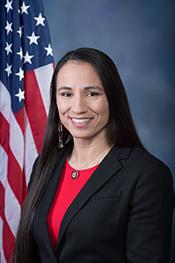
Sharice Davids
DDemocratKS-3 · Representative
53
/ 100
Average
Attendance99
Avg: 96
Independence6
Avg: 4
Bipartisan Tone25
Avg: 15
Ethics Record100
Avg: 99
Transparency14
Avg: 53
Accountability Score — composite of attendance, independence, bipartisan tone, ethics record & transparency.
Methodology32
Bills Sponsored
0
Enacted into Law
2
Passed a Chamber
30
In Committee
All Sponsored Bills
HR10727In Committee
Access to Community Care Act of 2026
HR10731In Committee
Rural Surgery Sustainability Act of 2026
HR10728In Committee
Maternity Care for Rural Communities Act of 2026
HR10726In Committee
Early-Onset Alzheimer’s Coverage Act of 2026
HR10725In Committee
GAP Act
HR10730In Committee
Healthy Communities Act of 2026
HR10729In Committee
Long-Term Rural Health Investment Act of 2026
HR10658In Committee
Critical Biomanufacturing Input Assessment Act
HRES1576In Committee
Recognizing the week of September 27 through October 3, 2026, as "National Orange Shirt Week" or "National Week of Remembrance", which aims to honor those who were forced to attend Indian boarding schools, and to recognize the experience of Indian boarding school victims and survivors.
HR10490In Committee
Born to Invest Act of 2026
HR10428In Committee
Survivor Benefits Application Modernization Act
HR10205In Committee
REACH Our Tribes Act
HR9425In Committee
Increasing Tribal Input on Nutrition Act of 2026
The proposal would require the federal government to consult with Native American tribes before making decisions about food distribution programs that serve people on Indian reservations, and would give tribes a greater say in how these programs operate. This affects Native American communities that rely on federal food assistance, as well as the tribes themselves who would have more input into what foods are available and how the programs are run. The bill is currently being reviewed by the House Committee on Agriculture.
HR7396Passed House
Native American Entrepreneurial Opportunity Act
Native American Entrepreneurial Opportunity Act This bill provides statutory authority for the establishment of the Office of Native American Affairs within the Small Business Administration (SBA). The office must establish a working relationship with Indian tribes and Native Hawaiian organizations by targeting SBA programs relating to entrepreneurial development, contracting, and capital access to (1) establish or expand small businesses owned and controlled by individuals who are members of Indian tribes or Native Hawaiian organizations, and (2) promote economic development in Indian country.
HR9346In Committee
USDA Field Office Stability Act
The proposal would prevent the U.S. Department of Agriculture from closing or moving certain offices without approval from Congress. This would affect USDA employees in those offices and farmers or rural communities that rely on local USDA services for programs like crop support, conservation assistance, and rural development loans. The bill is currently being reviewed by the House Agriculture Committee.
HR8742In Committee
Respect Tribal IDs Act
The Department of Homeland Security would be required to train its officers and employees on tribal sovereignty, history, and culture to improve their interactions with Native American tribes. This training would help DHS personnel better understand tribal governments and their unique legal status when enforcing laws and policies that affect tribal lands and communities. The requirement aims to strengthen relationships between federal law enforcement and tribal nations.
HR8539In Committee
Truth in National Parks Act
The proposal would require the National Park Service to ensure that exhibits and educational materials at national parks, monuments, and historic sites present historically accurate information. This would affect how parks tell their stories to the millions of visitors who come each year, potentially requiring updates to existing displays and educational programs to reflect accurate historical facts and scholarship.
HR8404In Committee
21st Century Entrepreneurship Act
I don't have enough information to write an accurate summary. The bill's subjects are listed as "None," and the title alone doesn't provide specific details about what policies the bill would actually implement. To write a factual summary for a general audience, I would need to know the bill's actual provisions—such as whether it addresses funding for startups, changes to business licensing, tax incentives, education programs, or other specific policies.
HR8298In Committee
SSI Savings and Efficiency Act of 2026
This bill would change how the Supplemental Security Income program counts what disabled, blind, and elderly people receive, by not counting food, shelter, or other basic items given to them as "income" when determining their benefits. Currently, when someone receives free housing or meals from family or friends, it can reduce their SSI payments, but this bill would stop that from happening. The change would allow low-income disabled and elderly people to keep more of their SSI benefits even when they receive help with basic needs from others.
HR8080In Committee
Data to Save Moms Act
This bill would require the federal government to collect and analyze data on maternal health outcomes, particularly focusing on pregnancy-related deaths and complications among different groups of women. The goal is to identify patterns and disparities in maternal health care so that policymakers and health providers can better understand and address why some women face higher risks during pregnancy and childbirth. The data gathered would help inform efforts to improve maternal health care quality and safety across the country.
HR7589In Committee
Resilient Food Supply Chain and Affordability Act
This bill aims to strengthen America's food system by making it more resistant to disruptions and keeping food prices affordable for consumers. It likely includes measures to support farmers, reduce supply chain bottlenecks, and help grocery stores and food producers operate more efficiently. The changes would affect farmers, food companies, grocery retailers, and shoppers across the country.
HRES1033In Committee
Expressing support for the designation of the week beginning February 2, 2026, as "National Tribal Colleges and Universities Week".
This resolution expresses support for the designation of National Tribal Colleges and Universities Week.
HR6432In Committee
Brownfields Reauthorization Act of 2025
The proposal would extend and update the federal government's program that helps clean up and redevelop abandoned or underused industrial and commercial properties contaminated with hazardous substances. This affects property owners, developers, and communities looking to revitalize polluted sites by providing funding, liability protections, and technical assistance to make cleanup more affordable and feasible. The program aims to turn these neglected properties into productive uses like housing, businesses, or parks while protecting public health and the environment.
HR7093In Committee
Afterschool ACCESS Act
The proposal would create tax incentives for businesses and organizations that provide or support afterschool programs for children, making it more affordable for families to access these services. By offering tax credits or deductions, the bill aims to encourage employers and nonprofits to invest in afterschool care, which helps working parents while giving kids safe places to learn and develop skills outside of regular school hours.
HR6518In Committee
SAF Act
The SAF Act appears to address taxation policy, though the specific details are unclear from the title alone. Based on its referral to the House Ways and Means Committee, it likely proposes changes to how certain income, businesses, or transactions are taxed. Without more information about what "SAF" stands for or the bill's specific provisions, it's difficult to determine exactly which taxpayers or industries would be affected.
HRES794In Committee
Recognizing the week of September 30th as "National Orange Shirt Week" or "National Week of Remembrance", which aims to honor those who were forced to attend Indian boarding schools, and to recognize the experience of Indian boarding school victims and survivors.
This resolution recognizes National Orange Shirt Week or National Week of Remembrance, which aims to honor those who were forced to attend Indian boarding schools. The resolution also recognizes the experience of Indian boarding school victims and survivors.
HR4644In Committee
ABLE Employment Flexibility Act
This bill would expand tax benefits for people with disabilities who work by allowing them to earn more income before losing eligibility for federal benefits like Supplemental Security Income and Medicaid. Currently, strict income limits discourage disabled workers from taking jobs or earning more because they risk losing their benefits, so this change would make it financially possible for more disabled people to work without penalty. The bill affects disabled individuals, employers who hire them, and the federal programs that provide support to people with disabilities.
HR3757In Committee
Pride In Mental Health Act of 2025
This bill would require health insurance plans to cover mental health services and treatments for LGBTQ+ individuals without discrimination, ensuring they have equal access to care. It aims to address gaps in mental health support for this community by setting standards for insurance coverage and potentially requiring healthcare providers to offer culturally competent mental health services. The legislation would affect health insurance companies, mental health providers, and LGBTQ+ patients seeking mental health treatment.
HR2762In Committee
Expanding Access to Family Planning Act
Expanding Access to Family Planning Act This bill provides, subject to specified conditions, funding through FY2035 for federally funded family planning services and clinics. In particular, the funds must be used for (1) grants and contracts that support the provision of family planning services, and (2) clinic infrastructure (e.g., construction and renovation of clinics). Clinics that receive funding to provide family planning services must offer each patient with a positive pregnancy test the opportunity for nondirective counseling on (1) prenatal care and delivery; (2) infant care, foster care, and adoption; and (3) pregnancy termination. This counseling must include referrals if requested by a patient. Additionally, if a funding recipient makes subawards for the provision of family planning services, the recipient may not prohibit an entity from participating in a subaward program for reasons other than the entity's inability to provide family planning services.
HR828Passed House
SERV Act
Successful Entrepreneurship for Reservists and Veterans Act or the SERV Act This bill requires (1) the Small Business Administration to report on the veterans interagency task force; and (2) the Government Accountability Office to report on access to credit for small businesses owned and controlled by veterans, Reservists, or their spouses.
HR1408In Committee
Affordable Child Care Act
HRES97In Committee
Expressing support for the designation of the week beginning February 3, 2025, as "National Tribal Colleges and Universities Week".
This resolution supports the designation of National Tribal Colleges and Universities Week.