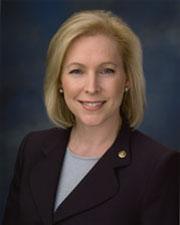
Kirsten E. Gillibrand
DDemocratNY · Senator
63
/ 100
Average
Attendance98
Avg: 97
Independence18
Avg: 23
Bipartisan Tone11
Avg: 14
Ethics Record100
Avg: 100
Transparency83
Avg: 47
Accountability Score — composite of attendance, independence, bipartisan tone, ethics record & transparency.
Methodology63
Bills Sponsored
0
Enacted into Law
2
Passed a Chamber
56
In Committee
All Sponsored Bills
S5594In Committee
A bill to establish the Data Protection Agency, protect the privacy of individuals, and for other purposes.
S5483In Committee
Seneca Nation Law Enforcement Efficiency Act
S1288Reported
Finger Lakes National Heritage Area Act
This bill would establish the Finger Lakes region in New York as a National Heritage Area, which means the federal government would help protect and promote the area's natural, cultural, and historical resources through funding and coordination with local communities. The designation would support tourism, preservation of historic sites, and environmental conservation in the region while allowing local landowners and communities to maintain control over their own property and decisions. The program would benefit visitors, local businesses, and residents interested in preserving the area's unique character and heritage.
SRES859Introduced
A resolution recognizing the 25th anniversary of the terrorist attacks of September 11, 2001, honoring the memory of the victims, recognizing the courage and sacrifice of the heroes who answered the call to serve, acknowledging the charitable organizations that continue to support survivors and victims' families, and reaffirming the enduring commitment of the United States to never forget.
S5397In Committee
BAD DEAL Act
S5385In Committee
A bill to require the Administrator of the Federal Emergency Management Agency to reimburse public employee retirement systems for accidental disability retirements and accidental deaths resulting from the September 11, 2001 attacks on the World Trade Center.
S5394In Committee
Hands Off Our Great Lakes Act
S5386In Committee
Don’t STEAL Act
S5393In Committee
FABRIC Act
S3897Passed Senate
Officer John Barnes and Chief Michael Ansbro Public Safety Officers' Benefit Program Expansion Act of 2026
Officer John Barnes and Chief Michael Ansbro Public Safety Officers' Benefit Program Expansion Act of 2026 This bill establishes processing timelines and expands claims assistance, outreach, and reporting requirements pertaining to claims for benefits under the Public Safety Officers' Benefits (PSOB) program. The PSOB program provides death, disability, and education benefits to public safety officers who are killed or injured in the line of duty and their survivors. This bill requires the Department of Justice's Bureau of Justice Assistance (BJA) to notify a claimant of any missing information required to process a claim within 90 days of receiving the claim and generally requires the BJA to determine eligibility within 270 days of a completed claim. In addition, the bill requires the BJA to use its subpoena authority to obtain information or documentation that is necessary to adjudicate a claim if a public agency fails to provide it 30 days after a request. Under the bill, the BJA must conduct ongoing outreach to promote awareness of the PSOB program. The BJA must also report on whether a delay in processing a claim was due to the inaction of the claimant or the public agency from which information is required. The bill requires the BJA to implement the recommendations of the Government Accountability Office (GAO) in the 2024 report, Public Safety Officers' Benefits Program: Transparency, Claims Assistance, and Program Management Improvements Needed . Finally, the GAO must conduct an annual audit of PSOB claims that have been pending for more than one year.
S5351In Committee
Clean Elections Act
SJRES181In Committee
A joint resolution to direct the removal of United States Armed Forces from hostilities within or against the Islamic Republic of Iran that have not been authorized by Congress.
This joint resolution directs the President to remove U.S. Armed Forces from hostilities within or against Iran unless a declaration of war or authorization to use military force for such purpose has been enacted. The resolution specifies that it shall not be construed to prevent the United States from defending against an attack on the United States or its personnel or facilities in other nations.
S1518Reported
Strengthening America’s Turning Point Act
Strengthening America’s Turning Point Act This bill renames the Saratoga National Historical Park, located in Stillwater, New York, as Saratoga National Battlefield Park.
S5094In Committee
Real Courts, Rule of Law Act of 2026
The proposal would create a new federal court system specifically designed to handle immigration cases, giving these courts official status as regular courts rather than administrative tribunals. This would affect immigrants facing deportation, asylum seekers, and immigration officials by potentially changing how cases are heard and decided. The change could make immigration proceedings more formal and give judges greater independence in ruling on immigration matters.
S5093In Committee
PROKID Act
The bill would create a new government office dedicated to helping immigrant children who are being held in custody by immigration authorities. This ombudsperson would investigate complaints, monitor conditions, and advocate for the welfare and rights of these children. The office would serve as an independent voice to ensure children in immigration custody are treated fairly and their concerns are heard.
S4928In Committee
COVID–19 Commuter Benefits Distribution Act
Workers who have set aside pre-tax money in transportation benefit accounts (used for parking, transit passes, or vanpools) would be allowed to withdraw that money one time without penalty or tax consequences. This would give employees more flexibility to access funds they've already contributed to these accounts, which are typically restricted to transportation-related expenses only. The change would primarily benefit workers who use public transportation or employer-sponsored commuting programs.
S3475In Committee
A bill to authorize, ratify, and confirm the Agreement of Settlement and Compromise to Resolve the Akwesasne Mohawk Land Claim in the State of New York, and for other purposes.
This bill recognizes and settles the Akwesasne land claim in northern New York. (Akwesasne is a Mohawk territory that extends into the United States and Canada, specifically New York, Ontario, and Quebec.) The bill authorizes, ratifies, and confirms a specified settlement agreement entered into by the Saint Regis Mohawk Tribe (SRMT), the Mohawk Council of Akwesasne, the State of New York, Franklin and Saint Lawrence Counties in New York, the towns of Fort Covington and Bombay in New York, and the New York Power Authority. (Among its provisions, the settlement agreement restores land rights and provides access to land to SRMT, provides tuition assistance for tribal members to certain postsecondary institutions, and requires the New York Power Authority to make annual payments to SRMT.) Additionally, the bill authorizes, ratifies, and confirms any transfer of land, right-of-way, or easement that is the subject of claims in specified court cases. The bill also recognizes as Indian country any land owned or subsequently acquired by SRMT within the settlement acquisition areas. (The term Indian country , for purposes of criminal jurisdiction, generally refers to all lands within a tribal reservation, dependent Indian communities, and tribal allotments.)
S4656In Committee
Secure and Accountable Military AI Act of 2026
The Department of Defense would be required to establish safeguards and oversight procedures for how it develops and uses artificial intelligence systems, ensuring these tools are tested for safety and bias before deployment. The bill would create accountability measures so military leaders can track how AI is being used in decision-making and operations, protecting both national security and the rights of people affected by these automated systems.
S4598In Committee
Hate Crimes Commission Act of 2026
The proposal would create a new federal commission to research hate crimes, understand what causes them, and suggest ways to prevent them from happening. The commission would study trends in hate crimes across the country and provide recommendations to Congress and law enforcement agencies on how to better address this problem. This would affect law enforcement officials, community organizations, and policymakers working on public safety and civil rights issues.
S4574In Committee
MARCH for Military Servicemembers Act
The bill would restrict the Department of Defense from using its money and facilities to provide abortion services to military members and their families, even in cases where abortion is legal under state law. This would affect active-duty service members, retirees, and dependents who currently have access to abortion care through military hospitals and clinics. The proposal has been sent to the Armed Services Committee for review.
S4554In Committee
Renewing our PACT Act of 2026
Federal employees who were exposed to toxic burn pits while working overseas would gain easier access to workers' compensation benefits and medical care under this proposal. The bill recognizes that burn pit exposure can cause serious health problems and aims to help affected civilian government workers get the support they need without having to prove their illness was directly caused by the burn pits. This would primarily benefit federal employees who served in military-related roles in countries where burn pits were used to dispose of waste.
S4552In Committee
Moms Matter Act
The bill would expand mental health and addiction treatment services for pregnant women and new mothers, including improving access to screening, counseling, and medication-assisted treatment. It aims to help healthcare providers better identify and treat conditions like postpartum depression and anxiety, as well as substance use disorders during pregnancy and after childbirth. The legislation would affect pregnant women, new mothers, healthcare providers, and hospitals that serve these populations.
S4553In Committee
Aaron Salter, Jr., Responsible Body Armor Possession Act
The proposal would make it illegal for regular civilians to buy, own, or have advanced protective body armor, though it would still allow law enforcement and military personnel to use it. Currently, civilians can purchase most types of body armor, but this bill would change that by restricting access to enhanced versions that provide higher levels of protection. The restriction would affect anyone outside of official government and law enforcement roles who wants to possess this type of protective equipment.
S4497In Committee
Tax Relief for First Responder Beneficiaries Act
The bill would modify tax rules to provide financial relief for families of public safety officers, such as police officers and firefighters, who die in the line of duty by adjusting how death benefits are taxed. This would help surviving spouses, children, and other dependents keep more of the money they receive after losing a loved one who was protecting their community. The measure is currently under review by the Senate Finance Committee.
S4313In Committee
HUMBLE Presidents Act
This bill would prevent the federal government from putting a sitting president's name, image, likeness, or signature on federal buildings, monuments, currency, or other government property while they are still in office. The restriction would apply only to current presidents, not to former presidents or other government officials. The goal appears to be maintaining a separation between a president's personal identity and federal assets during their time in power.
S4286In Committee
Senior Hunger Prevention Act of 2026
Senior Hunger Prevention Act of 2026 This bill expands and modifies nutrition programs for older adults and adults with disabilities, including the Supplemental Nutrition Assistance Program (SNAP) and the Commodity Supplemental Food Program (CSFP). Under the bill, a household's eligibility for SNAP benefits may be certified for 36 months if all adult household members are elderly or disabled, an increase from 24 months. The bill also expands the SNAP medical expense deduction and increases the minimum allotment for households with one and two persons. The Department of Agriculture (USDA) must establish an elderly simplified application program that allows a state to implement a streamlined SNAP application and certification process for households where all adult household members are elderly or disabled and have no earned income. The bill also directs USDA to authorize public-private partnerships between USDA, retail food stores participating in SNAP, and community-based organizations to provide free or low-cost food delivery under SNAP, including through the use of private funds. Further, the bill reauthorizes CSFP, provides additional funding for the program, and expands eligibility to include low-income adults with disabilities. CSFP benefits may also be certified for 36 months. Currently, benefits may be certified for not less than one year, but not more than three years. The bill also expands eligibility for the Seniors Farmers Market Nutrition Program (SFMNP) to include adults with disabilities, provide a 36-month certification period, and include minimum and maximum benefit amounts. Under the bill, USDA must also establish various related grant programs.
SJRES160In Committee
A joint resolution providing for congressional disapproval under chapter 8 of title 5, United States Code, of the rule submitted by the Bureau of Consumer Financial Protection relating to the withdrawal of the rule relating to "Consumer Financial Protection Circular 2023-01: Unlawful Negative Option Marketing Practices".
Congress is voting on whether to reject a Consumer Financial Protection Bureau rule that would have withdrawn protections against deceptive "negative option" marketing—the practice where companies automatically charge customers for subscriptions or services after a free trial without clear consent. If approved, this resolution would block the agency from removing those consumer protections, keeping rules in place that require companies to make cancellation easy and get explicit permission before charging customers. This affects anyone who uses free trials or subscription services online.
S4203In Committee
Voter Empowerment Act of 2026
Voter Empowerment Act of 2026 This bill expands voter registration and voting access. Specifically, the bill expands voter registration by requiring states to (1) make available online voter registration, (2) establish automatic voter registration systems, (3) permit same-day voter registration, and (4) accept voter registration applications from individuals under age 18. Further, the bill limits removing voters from voter rolls and prohibits interference with voter registration or voting. Next, the bill requires states to allow individuals with disabilities to use absentee registration procedures and to vote by absentee ballot in federal elections. The bill also prohibits voter caging (the practice of sending mail to addresses on voter rolls, compiling a list of the undeliverable mail, and using the list to remove registered voters from voter rolls). Next, the bill expands voting access by requiring states to allow early voting and voting by mail without additional conditions. It also requires states to provide secured drop boxes at which individuals may drop off their completed absentee ballots. In addition, the bill declares that the right of a U.S. citizen to vote in any federal election shall not be denied or abridged because that individual has been convicted of a criminal offense unless, at the time of the election, such individual is serving a felony sentence. Finally, the bill permanently reauthorizes the Election Assistance Commission (EAC). It also directs the EAC to make grants to states for specified activities, including to implement automatic voter registration systems.
S4163In Committee
Advancing Regional Quantum Hubs Act of 2026
The bill would establish regional centers across the country focused on developing and commercializing quantum computing technology, which could revolutionize fields like medicine, finance, and national security. These hubs would bring together universities, private companies, and government researchers to collaborate on quantum projects and train workers in this emerging field. The initiative aims to help the United States compete globally in quantum technology while creating high-skilled jobs in participating regions.
S3958In Committee
Puerto Rico Nutrition Assistance Fairness Act
This bill would increase federal nutrition assistance benefits for Puerto Rico residents to match the levels provided to people in the 50 states, addressing a long-standing disparity where Puerto Rico receives lower funding for food assistance programs. The change would help low-income Puerto Rican families afford more groceries and food, bringing their federal support in line with what mainland Americans receive for the same programs.
SCONRES25Passed Senate
A concurrent resolution recognizing the 15th anniversary of the January 8, 2011, Tucson, Arizona, shooting and honoring the survivors and victims, including former Congresswoman Gabby Giffords, a gun violence survivor and one of the most influential voices of courage in the United States in the fight to end gun violence.
This resolution commemorates the 15th anniversary of the 2011 shooting in Tucson, Arizona, that killed six people and wounded thirteen others, including then-Congresswoman Gabby Giffords. It honors the survivors and victims of the attack and recognizes Giffords' advocacy work on gun violence prevention since the incident. As a concurrent resolution, it expresses the sentiment of Congress but does not create new laws or policies.
S3883In Committee
Language Access to Gun Violence Prevention Strategies Act of 2026
This bill would require gun violence prevention programs and resources to be made available in multiple languages so that non-English speakers can fully understand and access information about firearm safety, violence prevention services, and related support programs. The measure aims to ensure that language barriers don't prevent immigrant communities, non-English speakers, and other groups from benefiting from crime prevention and public safety initiatives. It would affect law enforcement agencies, community organizations, and other entities involved in delivering gun violence prevention services.
S3882In Committee
Fair Legal Access Grants Act
This bill would provide federal grants to help pay for legal services for people who cannot afford lawyers in criminal cases. The funding would support public defenders' offices and legal aid organizations that represent low-income defendants, crime victims, and others involved in the criminal justice system. The goal is to ensure that people without money can still get quality legal representation when facing criminal charges.
S3775In Committee
Stop Underrides Act 2.0
This bill would require trucks to have better safety guards on their rear, sides, and front to prevent smaller vehicles from sliding underneath them during crashes. The measure aims to reduce deaths and injuries from underride accidents, which occur when cars get trapped under large trucks, and would apply safety standards to manufacturers of heavy trucks and trailers across the country.
S3666In Committee
A bill to reauthorize the West Valley demonstration project.
The bill would continue funding and operations for the West Valley demonstration project, a nuclear waste cleanup and research facility in New York that has been working to safely manage radioactive materials left over from nuclear fuel reprocessing. This reauthorization would allow the project to keep operating and receiving federal support for its environmental remediation and technology development work. The bill affects nuclear energy workers, nearby communities, and the Department of Energy's long-term plans for managing the nation's nuclear waste.
S3457In Committee
Clean Water Standards for PFAS Act of 2025
S3460In Committee
PFAS Accountability Act of 2025
S730In Committee
African Burial Ground International Memorial Museum and Educational Center Study Act
The federal government would study the feasibility of creating an international museum and educational center dedicated to the African Burial Ground, a historic site in New York City where thousands of enslaved and free African Americans were buried in the 1600s and 1700s. The study would examine how to develop this facility to educate visitors about this important but often overlooked part of American history and its global significance. The project would affect historians, educators, tourists, and communities interested in preserving African American heritage and ensuring this burial ground receives appropriate recognition and remembrance.
S3355In Committee
National Strategy for Combating Scams Act of 2025
S3279In Committee
John Lewis Every Child Deserves a Family Act
S2990In Committee
Campus Accountability and Safety Act
This bill would require colleges and universities to improve how they handle reports of sexual assault and harassment on campus, likely by strengthening investigation procedures, support services for victims, and transparency requirements. The legislation aims to hold schools more accountable for addressing these incidents and protecting students from misconduct. Schools would need to meet new standards or face potential consequences, affecting how administrators, students, and campus safety personnel handle these serious matters.
S2877In Committee
No Stock Act
This bill would prohibit members of Congress and their staff from buying or selling stocks based on non-public information they learn through their government work, and would require them to disclose their stock trades publicly. The law aims to prevent lawmakers from profiting unfairly off insider knowledge while serving in office, addressing concerns that politicians have an unfair advantage in the stock market compared to ordinary investors.
S2823In Committee
FAMILY Act
S2734In Committee
9/11 Memorial and Museum Act
9/11 Memorial and Museum Act This bill directs the Department of Homeland Security to award to the nonprofit organization that operates the National September 11 Memorial & Museum in New York, New York, a one-time grant to be used solely for the purposes of the operation, security, and maintenance of the memorial and museum. As a condition of receiving the grant, the organization must provide for free admission to all facilities and museums associated with the memorial and museum for active and retired members of the Armed Forces, individuals who were registered first responders to the terrorist attacks of September 11, 2001, and family members of victims of such attacks; provide for dedicated free admission hours for the general public at least once a week; and allow for annual federal audits of its financial statements.
S2703In Committee
Protecting Older Americans Act of 2025
Protecting Older Americans Act of 2025 This bill prohibits a predispute arbitration agreement or predispute joint-action waiver from being valid or enforceable with respect to a case relating to an age discrimination dispute at the election of the person alleging the discrimination.
S2512In Committee
EATS Act of 2025
The EATS Act would likely address regulations or policies affecting agriculture and food production, though the specific provisions aren't yet clear from the title alone. Based on its referral to the agriculture committee, it probably aims to either streamline food safety rules, support farmers, modify nutrition standards, or adjust how the government oversees the food supply. The bill would affect farmers, food producers, consumers, and possibly retailers depending on which agricultural or food policies it targets.
S389Reported
Setting Consumer Standards for Lithium-Ion Batteries Act
Setting Consumer Standards for Lithium-Ion Batteries Act This bill requires the Consumer Product Safety Commission to issue a final consumer product safety rule for rechargeable lithium-ion batteries used in micromobility devices, such as electric bikes and electric scooters. Specifically, the rule must require manufacturers and distributors of such products to comply with the applicable safety standards jointly established by the American National Standards Institute, the Standards Council of Canada, and UL Solutions Inc.
S2337In Committee
Providing Child Care for Police Officers Act of 2025
This bill would help police officers afford child care by providing federal funding or support for child care services specifically for law enforcement families. The goal is to make it easier for police officers to work without worrying about finding or paying for reliable child care, which could help with officer recruitment and retention in police departments across the country.
S2255In Committee
Trafficking Survivors Relief Act of 2025
Trafficking Survivors Relief Act of 2025 This bill establishes a process to vacate convictions and expunge arrest records for certain criminal offenses committed by victims of human trafficking that directly result from or relate to having been a trafficking victim. It defines the offenses eligible to be vacated or expunged and sets forth procedures for filing a motion. The Government Accountability Office must assess the impact of this process, including the number of human trafficking survivors who file motions to vacate convictions or expunge records. The bill permits certain grants for legal representation to be used to seek post-conviction relief. Finally, the bill allows a defendant to establish that the offenses were committed under duress by demonstrating that he or she was a victim of human trafficking at the time of the offense.
S1789In Committee
Training and Nutrition Stability Act of 2025
Training and Nutrition Stability Act of 2025 This bill excludes specific employment and training program allowances, earnings, and payments from income when determining eligibility for the Supplemental Nutrition Assistance Program (SNAP). (Under SNAP, a household must have an income below a certain level to qualify for program benefits.) Examples of programs excluded from income include Workforce Innovation and Opportunity Act (WIOA) programs, vocational rehabilitation programs, and refugee employment programs. This bill also removes the requirement that earnings from on-the-job training be considered earned income for purposes of determining SNAP eligibility.
S1289In Committee
25th Anniversary of 9/11 Commemorative Coin Act
The government would create and sell special commemorative coins to mark the 25th anniversary of the September 11 attacks, with proceeds typically going toward related memorials or charitable causes. These coins would be produced by the U.S. Mint and made available to the public and collectors who want to honor the anniversary.
S1256In Committee
Fire Island AIDS Memorial Establishment Act
This bill would establish a national memorial on Fire Island in New York to honor people who died from AIDS, particularly recognizing the island's historical significance to the LGBTQ+ community during the AIDS crisis. The memorial would be created on federal land and managed as part of the National Park System, allowing visitors to learn about and pay respects to those lost to the disease. The bill affects the National Park Service and would create a permanent public space dedicated to remembering this important chapter of American history.
S1050In Committee
Forest Conservation Easement Program Act of 2025
This bill would create a program allowing private landowners to voluntarily place conservation easements on their forest properties, which means they agree to keep the land forested and undeveloped in exchange for tax benefits or payments. The program aims to protect forests from being cleared for development while letting landowners maintain ownership and use of their property. Landowners, conservation groups, and the timber industry would be the main groups affected by this new option.
S781In Committee
Long Island Sound Restoration and Stewardship Reauthorization Act of 2025
Long Island Sound Restoration and Stewardship Reauthorization Act of 2025 This bill reauthorizes the Environmental Protection Agency's Long Island Sound programs through FY2029. The programs, which include a stewardship grant program, focus on conserving and restoring the estuary off the coast of New York and Connecticut.
S728In Committee
African Burial Ground International Memorial Museum and Educational Center Act
This bill would establish a new museum and educational center dedicated to the African Burial Ground, a historic site in New York City where thousands of enslaved and free African Americans were buried in the 1600s and 1700s. The facility would serve as both a memorial to those buried there and a place where visitors can learn about this important but often overlooked part of American history. The project would help preserve the site's historical significance and make its story more accessible to the public.
S581In Committee
Fair Milk Pricing for Farmers Act
This bill would establish new rules for how much dairy farmers are paid for their milk, likely aiming to ensure farmers receive fairer prices that better reflect their production costs. The legislation would affect dairy farmers and potentially milk processors and consumers by changing the pricing mechanisms currently used in the milk industry. The bill is still in early stages and has been sent to the agriculture committee for review.
S463In Committee
Protect Our Letter Carriers Act of 2025
Protect Our Letter Carriers Act of 2025 This bill requires or authorizes certain actions related to the U.S. Postal Service (USPS). The bill requires the Department of Justice to appoint an assistant U.S. attorney in each judicial district to coordinate and supervise the investigation and prosecution of various crimes related to postal services (for example, assault on a postal service employee, breaking into a post office, or obstruction of mails). The bill also requires the U.S. Sentencing Commission to amend sentencing guidelines to provide that the assault or robbery of a postal employee shall be treated the same as the assault of a law enforcement officer. Additionally, the bill authorizes appropriations for the USPS to install high security collection boxes and replace older versions of the universal mailbox key with electronic versions.
S432In Committee
Fort Ontario Holocaust Refugee Shelter National Historical Park Establishment Act
This bill would designate Fort Ontario in New York as a national historical park to preserve the history of the shelter that housed Jewish refugees fleeing the Holocaust during World War II. The park would commemorate the experiences of the approximately 982 refugees who found safety there and educate visitors about this important chapter of American history. The designation would protect the site and likely provide federal funding for its preservation and interpretation.
S2900Reported
Gas Turbine Efficiency Act of 2009
(This measure has not been amended since it was introduced. The summary has been expanded because action occurred on the measure.) Gas Turbine Efficiency Act of 2009 - Directs the Secretary of Energy to carry out a research, development, and technology demonstration program to improve the efficiency of gas turbines used in power generation systems and to identify the technologies that will lead to gas turbine combined cycle efficiency of 65% or simple cycle efficiency of 50%. Requires the program to: (1) support first-of-a-kind engineering and detailed gas turbine design for megawatt-scale and utility-scale electric power generation; (2) include technology demonstration through component testing, subscale testing, and full scale testing in existing fleets; (3) include field demonstrations of the developed technology elements to demonstrate technical and economic feasibility; and (4) assess overall combined cycle and simple cycle system performance. Delineates as the goals of the program: (1) in phase I, to develop the conceptual design of, and to develop and demonstrate the technology required for, advanced high efficiency gas turbines that can achieve at least 62% combined cycle efficiency or 47% simple cycle efficiency on a lower heating value basis; and (2) in phase II, to develop the conceptual design for advanced high efficiency gas turbines that can achieve at least 65% combined cycle efficiency or 50% simple cycle efficiency on a lower heating value basis. Directs the Secretary, in selecting program proposals, to emphasize the extent to which the proposal will: (1) stimulate the creation or increased retention of jobs in the United States; and (2) promote and enhance U.S. technology leadership. Requires awards of financial assistance to be made on a competitive basis with an emphasis on technical merit. Authorizes appropriations for FY2011-FY2014.
S3810In Committee
Gulf Security and Iran Sanctions Enforcement Act
Gulf Security and Iran Sanctions Enforcement Act - Requires the Secretary of the Interior to include in each lease issued after enactment of this Act that authorizes oil and gas drilling on the Outer Continental Shelf a provision that requires: (1) the lessee to certify annually to the Secretary that it does not engage in any activity for which sanctions may be imposed under the Iran Sanctions Act of 1996; and (2) the Secretary to cancel the lease if the lessee fails to make such a certification or makes a false one. Requires such a lease also to require the lessee to disclose to the Secretary any participation in any energy-related joint venture, investment, or partnership located outside Iran that involves: (1) any person whose property and property interests are blocked pursuant to Executive Orders 13224 (for transacting business with persons who commit, threaten to commit, or support terrorism) or 13382 (because they are weapons of mass destruction proliferators or their supporters); or (2) any entity on a specified list relating to Iranian Transactions Regulations. Requires cancellation of any lease whose lessee has failed to make such a disclosure or makes a false disclosure. Allows a national interest waiver of these requirements.
S3392In Committee
A bill to direct the Secretary of the Interior to conduct a special resource study to evaluate the significance of the Newtown Battlefield located in Chemung County, New York, and the suitability and feasibility of its inclusion in the National Park System, and for other purposes.
Directs the Secretary of the Interior to conduct a special resource study to evaluate the significance of the Newtown Battlefield in Chemung County, New York (where the Battle of Newtown was fought on August 29, 1779, during the Revolutionary War), as well as the suitability and feasibility of the Battlefield's inclusion in the National Park System.
S3131In Committee
Hudson River Valley Special Resource Study Act
Hudson River Valley Special Resource Study Act - Directs the Secretary of the Interior to complete a study of the Hudson River Valley in the state of New York to evaluate: (1) the national significance of the part of the Hudson River that flows from Rodgers Island at Fort Edward to the southern-most boundary of Westchester County, New York, including any relevant sites and landscapes within counties in New York that abut that part of the River (the study area); and (2) the suitability and feasibility of designating the study area as a unit of the National Park System.
S1590In Committee
A bill to establish a clean energy technology business competition grant program.
Authorizes the Secretary of Energy to provide grants to organizations to conduct business competitions that provide incentives, training, and mentorship to entrepreneurs and early stage startup companies throughout the United States to meet high priority economic, environmental, and energy security goals in areas including energy efficiency, renewable energy, air quality, water quality and conservation, transportation, smart grid, green buildings, and waste management. Grants priority to such competitions that: (1) are led by the private sector; (2) encourage regional and interregional cooperation; and (3) can demonstrate the creation of cost-effective green jobs through an annual publication of competition activities and directory of companies. Requires an organization, to be eligible for such a grant, to be a tax-exempt, charitable organization, or any sponsored entity of such organization that is operated as a nonprofit entity. Directs the Secretary to give priority to organizations that can demonstrate broad funding support from private and other non-federal funding sources to leverage federal investment.