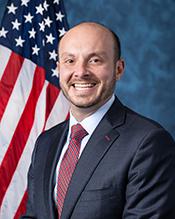
Andrew R. Garbarino
RRepublicanNY-2 · Representative
54
/ 100
Average
Attendance97
Avg: 96
Independence5
Avg: 4
Bipartisan Tone18
Avg: 15
Ethics Record100
Avg: 99
Transparency34
Avg: 53
Accountability Score — composite of attendance, independence, bipartisan tone, ethics record & transparency.
Methodology33
Bills Sponsored
0
Enacted into Law
2
Passed a Chamber
30
In Committee
All Sponsored Bills
HR10779In Committee
To designate the facility of the United States Postal Service located at 1905 Route 112 in Medford, New York, as the "Gunnery Sergeant Ruben Santos Post Office Building".
This bill designates the facility of the United States Postal Service located at 1905 Route 112 in Medford, New York, as the "Gunnery Sergeant Ruben Santos Post Office Building".
HR10553In Committee
Margin Eligibility Modernization Act
HR10361In Committee
To require the Administrator of the Federal Emergency Management Agency to reimburse public employee retirement systems for accidental disability retirements and accidental deaths resulting from the September 11, 2001 attacks on the World Trade Center.
HRES1511In Committee
Recognizing the 25th anniversary of the terrorist attacks of September 11, 2001, honoring the memory of the victims, recognizing the courage and sacrifice of the heroes who answered the call to serve, acknowledging the charitable organizations that continue to support survivors and victims' families, and reaffirming the enduring commitment of the United States to never forget.
HR9391Passed House
Reimbursable Screening Services Program Extension Act of 2026
Reimbursable Screening Services Program Extension Act of 2026 This bill extends the Transportation Security Administration (TSA) Reimbursable Screening Services Program through FY2031. The bill also allows TSA to expand the pilot program to up to 14 locations, from the current limit of not more than 8 locations. The Reimbursable Screening Services Program is a pilot program that allows TSA to be reimbursed for establishing and providing screening services outside an airport terminal’s existing primary screening area for passengers.
HR9217In Committee
Natural Climate Solutions Research and Extension Act of 2026
The proposal would create grants and funding for farmers, ranchers, and agricultural researchers to study and implement farming practices that help fight climate change, such as soil conservation and sustainable land management. These grants would support both research into new climate-friendly agricultural methods and educational programs to help farmers adopt them. The funding would help agricultural communities reduce greenhouse gas emissions while potentially improving soil health and farm productivity.
HRES1341In Committee
Expressing support for the recognition of June 7, 2026, as "Tourette Syndrome Awareness Day".
The resolution asks Congress to officially recognize June 7, 2026, as "Tourette Syndrome Awareness Day" to help raise public understanding of this neurological condition that causes involuntary movements and sounds. This symbolic recognition would encourage people to learn more about Tourette syndrome and support those living with the condition. The measure has been sent to the House Committee on Oversight and Government Reform for consideration.
HR9056In Committee
Community Flood Resilience Act
This bill would let communities that receive federal flood prevention grants use that money to pay for special flood insurance policies that pay out quickly based on the severity of a flood, rather than waiting for damage assessments. The change would help towns and cities protect themselves from flooding by giving them more flexibility in how they spend federal disaster prevention funds. Communities affected by flooding would benefit from faster insurance payouts when floods occur.
HR8789In Committee
Volunteer First Responder Housing Act
The proposal would make it easier for volunteer firefighters, emergency medical technicians, and other volunteer first responders to qualify for federal housing assistance programs by expanding who is considered eligible. Currently, many housing programs prioritize paid professionals, so this change would help volunteer responders—who often work without pay to protect their communities—access loans, grants, or other housing support. The measure recognizes that volunteer first responders frequently struggle financially because they don't receive regular paychecks, making homeownership or stable housing harder to achieve.
HR4171Reported
SEED Act of 2025
Small Entrepreneurs' Empowerment and Development Act of 2025 or the SEED Act of 2025 This bill creates an exemption to securities registration requirements for a micro-offering of securities. In general, the Securities and Exchange Commission (SEC) prohibits the offering or selling of securities unless the offering is registered with the SEC or the offering qualifies for an exemption from registration requirements. The bill defines a micro-offering as an aggregate amount of securities offered or sold by an issuer that does not exceed $500,000 in a 12-month period. This exemption does not apply to issuers who are convicted of specified financial crimes or are subject to specified professional disciplinary actions.
HRES1110In Committee
Expressing the disapproval of the House of Representatives regarding the slaughter of dogs and cats for human consumption and encouraging Japan to enact a nationwide ban on such practices.
This resolution expresses the House's official disapproval of killing dogs and cats for food and calls on Japan to pass a nationwide law banning the practice. The measure is a statement of the House's position on animal welfare rather than a law that would directly regulate U.S. businesses or citizens, and it aims to encourage a foreign government to adopt stricter animal protection standards.
HR4130In Committee
Small Business Relief Act
Small Business Relief Act This bill allows issuers of securities to have institutional investors and buyers in a class of securities without needing to comply with certain Securities and Exchange Commission (SEC) registration requirements. Currently, issuers of securities must register with and periodically report to the SEC when, among other requirements, the number of investors in a class of securities exceeds a specific cap. Under the bill, qualified institutional buyers and institutional accredited investors do not count towards this cap.
HR6858In Committee
Veteran Suicide Prevention Act
Veteran Suicide Prevention Act This bill requires the Department of Veterans Affairs (VA) to complete a review of the deaths of all covered veterans who died by suicide during the five-year period preceding the enactment of this bill. Covered veterans are those who received VA hospital care or medical services during the five-year period preceding the death of the veteran. The VA shall report on the results of the review and make such report publicly available.
HR5577In Committee
NFIP Extension Act of 2026
The National Flood Insurance Program (NFIP), which provides affordable flood insurance to property owners who can't get coverage from private insurers, would be extended beyond its current expiration date. This affects millions of homeowners and businesses in flood-prone areas across the country who rely on this federal program to protect their properties and mortgages.
HR6961In Committee
USMMA Athletics Act of 2026
This bill would make changes to how the U.S. Merchant Marine Academy handles its athletics programs and operations. The legislation likely aims to improve funding, facilities, or competitive opportunities for the academy's student-athletes while ensuring the school can continue training future merchant marine officers effectively.
HR4663In Committee
Saving Vet Halls Act of 2025
The proposal would protect and preserve historic military buildings and facilities that serve veterans, ensuring these structures are maintained for current and future use by veterans' organizations and the Department of Veterans Affairs. It addresses concerns about deteriorating veteran-related facilities by establishing requirements for their upkeep and preventing unnecessary closures or demolition. Veterans, their families, and communities that rely on these facilities would benefit from improved maintenance and continued access to these important spaces.
HRES831In Committee
Expressing support for the designation of October 2025 as "National Down Syndrome Awareness Month".
This resolution expresses support for the designation of National Down Syndrome Awareness Month.
HRES737In Committee
Supporting the designation of September 22 as "National Veterans Suicide Awareness and Remembrance Day" and recognizing the Suicide Awareness and Remembrance Flag.
This resolution officially recognizes the Suicide Awareness and Remembrance flag and designates the flag as the symbol of awareness of military and veteran suicide and the commitment to resolve military and veteran suicide. The resolution also remembers and honors the servicemembers and veterans who have died by suicide and commits to posting the flag above all federal buildings wherever there is an American flag and POW/MIA flag. Further, the resolution supports the designation of a National Veterans Suicide Awareness and Remembrance Day.
HR5061In Committee
Counter-UAS Authority Security, Safety, and Reauthorization Act
This bill would give federal agencies and airport operators legal authority to detect, track, and disable unmanned drones (like commercial drones or those flown by hobbyists) that pose security or safety risks near airports and other sensitive facilities. The law would establish clear rules about when and how these counter-drone systems can be used while protecting people's privacy and preventing interference with legitimate drone operations. The measure affects airport security personnel, federal agencies, drone manufacturers, and the general public by clarifying what's allowed to keep airspace safe from potentially dangerous or unauthorized aircraft.
HR4129In Committee
Tailoring for Main Street’s Investors Act
The legislation would make it easier for small businesses and regular investors to raise money by relaxing some federal securities rules that currently apply mainly to large corporations. This would allow smaller companies to sell stock or bonds to everyday investors without going through as many expensive regulatory requirements, potentially lowering costs for startups and small enterprises while giving individual investors more opportunities to fund local businesses. The changes would primarily affect small business owners, entrepreneurs, and retail investors looking to participate in early-stage company funding.
HR3538In Committee
Wildlife Confiscations Network Act of 2025
The proposal would establish a coordinated system for federal agencies to track and share information about illegally taken wildlife and confiscated animals across public lands. This network would help law enforcement officials work together more effectively to combat poaching and illegal wildlife trafficking, ultimately protecting endangered species and natural resources. The measure affects hunters, wildlife agencies, park rangers, and anyone involved in enforcing wildlife protection laws.
HR2096Passed House
Protecting Our Nation’s Capital Emergency Act
Protecting Our Nation's Capital Emergency Act of 2025 This bill rescinds certain changes that were made in 2023 to District of Columbia (DC) law governing discipline of Metropolitan Police Department (MPD) officers. First, the bill reinstates a 90-day statute of limitations (i.e., time limit) for initiating a corrective or adverse action against any MPD officer or civilian employee. The bill also allows officer disciplinary matters to be negotiated as part of a collective bargaining agreement. Next, the bill eliminates the MPD police chief's authority to increase the police trial board's recommended penalty for officer misconduct. Finally, the bill eliminates a requirement that MPD publish a schedule online of disciplinary hearings for which the proposed action is termination, including the date, time, and underlying allegations.
HR3226In Committee
Law Enforcement Officers Equity Act
This bill would extend federal retirement and survivor benefits to law enforcement officers who were hired before certain eligibility dates and were previously excluded from these programs. It aims to ensure that police officers, federal agents, and similar law enforcement employees receive the same pension and survivor protections as other federal workers, addressing what supporters view as unfair treatment of officers hired during specific periods.
HRES395In Committee
Establishing a "Bill of Rights" to support United States law enforcement personnel nationwide in their work to protect our communities.
This resolution recognizes law enforcement agencies and officers for their tireless work to protect us and make our communities safer. It also condemns calls to defund, disband, dismantle, or abolish the police.
HR3206In Committee
Protecting America's Property Rights Act
Protecting America's Property Rights Act This bill directs the government-sponsored enterprises—Fannie Mae and Freddie Mac—to establish standards for the use of products such as title insurance. (The enterprises facilitate liquidity in the mortgage market by purchasing mortgages and issuing mortgage-backed securities.) Specifically, the enterprises must establish regulations or guidelines for risk management related to loss or damage from liens upon, encumbrances on, or defects in the title to property, or the invalidity or unenforceability of any liens or encumbrances on property by using third party products subject to state regulation. Further, the enterprises must hold an additional 1% of the unpaid principal of any mortgage that does not meet the above regulations or guidelines as part of each enterprise’s minimum capital levels.
HR2257In Committee
National Fallen Firefighters Memorial Coin Act
The government would create and sell special commemorative coins to honor firefighters who have died in the line of duty, with proceeds going toward the National Fallen Firefighters Memorial. These coins would be produced by the U.S. Mint and sold to the public, allowing Americans to support a tribute to fallen firefighters while collecting a piece of commemorative currency. The program would help fund the memorial's operations and maintenance.
HR2095In Committee
Postal Police Reform Act of 2025
This bill would reform how the U.S. Postal Inspection Service operates as a law enforcement agency, likely addressing issues like officer training, oversight, accountability, or the scope of their investigative powers. The changes would affect postal inspectors who investigate crimes involving the mail system and potentially impact how they interact with the public and other law enforcement agencies. The bill is currently being reviewed by two House committees to determine what specific reforms should be included.
HR2048In Committee
Metastatic Breast Cancer Access to Care Act
Metastatic Breast Cancer Access to Care Act This bill expedites payment of Social Security Disability Insurance (SSDI) benefits and eligibility for Medicare coverage for those with metastatic breast cancer (i.e., breast cancer that has spread to other sites in the body). Specifically, the bill eliminates the 5-month waiting period for SSDI benefits and the subsequent 24-month waiting period for Medicare coverage for individuals with metastatic breast cancer. Under current law, individuals generally must wait 5 months after the onset of disability to begin receiving SSDI benefits and an additional 24 months to become eligible for Medicare.
HR1922In Committee
Ensuring Access to Essential Drugs Act
This bill would address drug availability and affordability by establishing requirements to ensure Americans can access essential medications without excessive delays or costs. The legislation likely includes measures to prevent drug shortages, regulate pricing practices, or expand insurance coverage for critical medicines that treat serious health conditions. It would affect patients needing medications, pharmaceutical companies, insurance companies, and healthcare providers.
HR1410In Committee
9/11 Responder and Survivor Health Funding Correction Act of 2025
9/11 Responder and Survivor Health Funding Correction Act of 2025 This bill modifies the World Trade Center Health Program (WTCHP), including by updating the formula for determining the program’s annual funding amounts and authorizing mental health providers to provide certain evaluations under the program. The WTCHP is a federal health care program (terminating in FY2090) providing responders and survivors with monitoring and treatment of certified medical conditions related to the terrorist attacks that occurred on September 11, 2001. Under current law, the program’s annual federal funding is determined based on the amount specifically appropriated in the previous fiscal year, adjusted for inflation. The bill establishes a new federal funding formula for FY2026-FY2090 that is generally based on annual changes in the number of enrollees. The bill also increases the amounts the program may spend annually on medical research and activities relating to data collection. The bill requires the National Institute for Occupational Safety and Health (NIOSH), which administers the program, to submit a report to Congress on the program’s projected budgetary needs and expenditures. In addition, the bill authorizes licensed mental health providers to perform initial health evaluations with respect to mental health conditions for purposes of determining eligibility under the WTCHP. NIOSH must issue regulations specifying the categories of mental health providers that may perform these activities.
HR935In Committee
Health Care Workforce Innovation Act of 2025
Health Care Workforce Innovation Act of 2025 This bill establishes the Health Care Workforce Innovation Program within the Health Resources and Services Administration to provide grants to federally qualified health centers, rural health clinics, and post-secondary vocational programs for developing education and training for allied health professionals (e.g., professionals providing clinical or non-clinical support services, community health workers, and health education specialists). Specifically, grant recipients must use the funds to carry out innovative, community-based programs to train allied health professionals, with a focus on supporting rural and underserved areas. Grant recipients may use the funds to launch or expand health care professional partnerships (e.g., between a grant recipient and a school), establish apprenticeship or other career programs, or invest in training equipment, among other activities.
HR430In Committee
SALT Deductibility Act
Securing Access to Lower Taxes by ensuring Deductibility Act or the SALT Deductibility Act This bill repeals the limitation on the federal tax deduction for state and local taxes (commonly known as the SALT deduction cap). Under current law, a SALT deduction cap of $10,000 ($5,000 for married individuals filing separate federal income tax returns) applies for tax years 2018 through 2025 and expires beginning in 2026.
HR31In Committee
POLICE Act of 2025
Protect Our Law enforcement with Immigration Control and Enforcement Act of 2025 or the POLICE Act of 2025 This bill makes assaulting a law enforcement officer, firefighter, or other first responder a deportable offense. Specifically, the bill makes deportable any non-U.S. national ( alien under federal law) who has been convicted of (or admits to have committed) any act that constitutes the essential elements of any offense involving assault of a law enforcement officer, firefighter, or other first responder. The Department of Homeland Security must publish annually on its website a report on the number of individuals deported in the previous year pursuant to this bill.