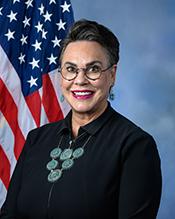
Harriet M. Hageman
RRepublicanWY · Representative
58
/ 100
Average
Attendance100
Avg: 96
Independence7
Avg: 4
Bipartisan Tone9
Avg: 15
Ethics Record100
Avg: 99
Transparency66
Avg: 53
Accountability Score — composite of attendance, independence, bipartisan tone, ethics record & transparency.
Methodology36
Bills Sponsored
1
Enacted into Law
3
Passed a Chamber
31
In Committee
All Sponsored Bills
HR10673In Committee
Battery Safety Placarding Act
HR677Passed House
EARA
Expedited Appeals Review Act or the EARA This bill authorizes a party that files an appeal of a Department of the Interior decision with the Interior Board of Land Appeals to submit a written request for expedited review of the appeal. (The mission of the board is to provide an impartial forum within Interior for the resolution of disputes involving public lands and natural resources under Interior's jurisdiction.) If a party submits such a request, the board must issue a final decision on the appeal not later than six months after the date on which the request for expedited review was received. However, the deadline may not be earlier than 18 months after the date on which the appeal was initially filed with the board. If the deadline for expedited review is not met, Interior's decision is deemed a final agency action and is subject to de novo judicial review (i.e., without deference to the agency's decision). This bill applies to appeals pending as of the date of enactment of this bill and appeals filed after the date of enactment.
HR10558In Committee
CLEAR Act
HRES1535In Committee
Supporting the designation of the week of September 13 through September 19, 2026, as "National Truck Driver Appreciation Week".
HR10123In Committee
STOP Improper Licensing Act
HR1693Reported
To redesignate the National Historic Trails Interpretive Center in Casper, Wyoming, as the "Barbara L. Cubin National Historic Trails Interpretive Center".
This bill renames the National Historic Trails Interpretive Center located in Casper, Wyoming, as the Barbara L. Cubin National Historic Trails Interpretive Center.
HR10090In Committee
To amend the Internal Revenue Code of 1986 to impose an excise tax on certain institutions of higher education that allow male participation in female intercollegiate athletic programs or events.
HJRES202In Committee
Providing congressional disapproval under chapter 8 of title 5, United States Code, of the rule submitted by the Environmental Protection Agency relating to "California State Motor Vehicle Pollution Control Standards; Notice of Decision Granting a Waiver of Clean Air Act Preemption for California's 2009 and Subsequent Model Year Greenhouse Gas Emission Standards for New Motor Vehicles".
Congress would reject an Environmental Protection Agency decision that allowed California to set its own stricter greenhouse gas emission standards for cars instead of following federal standards. This would prevent California from enforcing pollution rules that are tougher than what the federal government requires for new vehicles. The measure affects automakers and California residents by determining whether the state can independently regulate vehicle emissions.
HR5880In Committee
Fight Illicit Pill Presses Act
Fight Illicit Pill Presses Act This bill broadens the scope of pill machines that are subject to regulation under the Controlled Substances Act (CSA). The bill also requires regulated machines to have serial numbers and imposes criminal penalties for conduct involving the removal of serial numbers or the transportation of regulated machines knowing the serial numbers have been removed. Currently, the CSA requires persons who manufacture, distribute, import, export, or purchase certain regulated machines to keep records of and report on transactions involving the machines. Currently, the term regulated machines includes tableting machines and encapsulating machines. This bill requires persons who sell or deliver regulated machines to comply with the CSA's recordkeeping and reporting requirements, in addition to persons who manufacture, distribute, import, export, or purchase them. The bill also expands regulated machines , for which transactions must be recorded and reported, to include critical parts of tableting and encapsulating machines such as dies used to mold pills and punches used to imprint markings and logos onto pills. The bill requires serial numbers to be permanently affixed to encapsulating machines, tableting machines, and critical parts of tableting and encapsulating machines. Finally, the bill prohibits, subject to criminal penalties, the (1) removal, alteration, or obliteration of any serial number affixed to a tableting machine, encapsulating machine, or a critical part; or (2) transportation, shipment, receipt, possession, distribution, delivery, sale, import, or export of any tableting machine, encapsulating machine, or critical part knowing the serial number has been removed, altered, or obliterated.
HRES1374In Committee
Expressing the sense of the House of Representatives that parents should be provided clear, accurate, and useful information about the content of video programming so they can make informed decisions for their children.
The House is expressing its view that parents need better, clearer information about what's in TV shows and video content so they can decide what their children should watch. This is a non-binding statement of support rather than a law that would require specific changes, but it signals that Congress believes the entertainment industry should provide more transparent and useful content descriptions to families.
HR9277In Committee
To amend title 5, United States Code, to provide that judicial review under the Administrative Procedure Act does not include any evidence that the court determines is not the product of reliable scientific principles and methods.
This bill would change how federal courts review government agency decisions by allowing judges to exclude scientific evidence they believe doesn't come from reliable scientific methods. The change would affect anyone challenging government actions in court, including businesses, environmental groups, and individuals, by potentially making it harder to use certain studies or data to support their legal arguments. Courts would have more power to decide which scientific evidence is trustworthy enough to consider when reviewing whether an agency followed proper procedures.
HR9278In Committee
To amend title 5, United States Code, to provide that judicial review under the Administrative Procedure Act requires de novo trial of the facts when agency action seeks a sanction.
When federal agencies punish someone with a sanction (like a fine or license revocation), this proposal would require courts to completely re-examine all the facts from scratch rather than just checking whether the agency followed proper procedures. Currently, courts typically give agencies significant deference and only review whether they acted reasonably, but this change would let people challenge agency punishments by having a judge conduct a full new trial on the facts. This would affect workers, businesses, and individuals facing federal agency penalties across areas like labor, environmental, and financial regulation.
HR9279In Committee
Preventing AI Censorship Act
Federal employees could be sued by individuals who believe their First Amendment rights were violated through the government's use or development of artificial intelligence systems. The bill would create a legal pathway for people to take action against the federal government if they claim AI tools were used to restrict their speech, religious practice, or other First Amendment protections. This would apply to situations where federal agencies deploy or create AI systems that allegedly infringe on these constitutional rights.
HR7695In Committee
To provide that the final rule titled "Special Areas; Roadless Area Conservation" and issued on January 12, 2001 (66 Fed. Reg. 3244) shall have no force or effect and require the Secretary of Agriculture to construct certain roads on National Forest System lands, and for other purposes.
This bill would overturn a 2001 rule that protected large areas of national forests from road construction and would require the U.S. Forest Service to build roads on certain federal forest lands. The change would affect logging companies, outdoor recreation groups, and environmental organizations that have different interests in how national forests are managed. The bill is currently being reviewed by congressional committees that handle agriculture and natural resources.
HR3766In Committee
To prohibit the District of Columbia from requiring tribunals in court or administrative proceedings in the District of Columbia to defer to the Mayor of the District of Columbia's interpretation of statutes and regulations, and for other purposes.
The proposal would prevent Washington, D.C. courts and administrative agencies from automatically accepting the Mayor's interpretation of local laws and regulations as correct. Instead of deferring to the Mayor's reading of statutes, judges and administrative officials would make their own independent decisions about what the laws mean. This change affects anyone involved in legal disputes in D.C., including residents, businesses, and government agencies.
HR8330In Committee
Stop Climate Shakedowns Act of 2026
This bill would shield energy companies and workers in the mining, oil, gas, and power industries from lawsuits seeking damages or court orders related to their products' use—meaning people harmed by pollution, climate impacts, or other effects of energy production could not sue these companies for compensation. The protection would apply across the entire energy supply chain, from extraction and refinement through sales to consumers. This would significantly limit the legal recourse available to individuals, communities, and governments seeking to hold energy producers accountable for environmental or health-related harms.
HR7872In Committee
To amend the Mineral Leasing Act to provide for the payment of bonus payments of certain coal leases issued under that Act.
This bill would change how the federal government collects upfront payments from companies that lease public land to mine coal, likely adjusting the bonus amounts that coal companies must pay when they win the right to extract coal from federal property. The changes would affect coal mining companies and potentially alter how much money the government receives from these leases. The bill is currently being reviewed in a subcommittee to determine whether these payment adjustments are appropriate.
HR7458In Committee
Domestic ORE Act
This bill would likely aim to increase domestic production of minerals and materials needed for energy generation and storage, such as those used in batteries, solar panels, and wind turbines. By reducing reliance on foreign sources for these critical materials, the legislation could help American energy companies and manufacturers become more independent while potentially creating mining and processing jobs in the U.S. The bill is currently being reviewed in subcommittee hearings to determine its specific requirements and impacts.
HR7997In Committee
Research and Oversight of AI in Courts Act of 2026
This bill would require courts and the federal government to study how artificial intelligence is being used in the legal system and establish rules to oversee its use. It aims to ensure that AI tools used in courtrooms—such as those that predict sentences, evaluate evidence, or assist judges—are accurate, fair, and don't discriminate against defendants or other people involved in cases. The legislation would affect judges, lawyers, defendants, and anyone going through the court system.
HR5910Passed House
To authorize leases of up to 99 years for land held in trust for federally recognized Indian Tribes.
This bill authorizes any federally recognized Indian tribe to lease their land held in trust for a term of up to 99 years.
HR7539In Committee
SAFE Act
The SAFE Act addresses transportation and public works policy, though the specific details are not provided in the available information. Based on its referral to the House Committee on Transportation and Infrastructure, it likely aims to improve safety, efficiency, or funding related to roads, bridges, transit systems, or other public infrastructure projects. To understand exactly what changes the bill would make and who it affects, you would need to review the full bill text.
HR6300In Committee
Grasslands Grazing Act of 2025
This bill would modify how ranchers can use federal grasslands for livestock grazing, likely making it easier or cheaper for them to graze cattle and sheep on public lands managed by the government. The changes would affect both ranching operations that depend on federal grazing permits and the management of these public grasslands, potentially influencing which conservation practices are required and how grazing fees are set.
HR6642In Committee
ROUTE Act
The ROUTE Act likely addresses highway infrastructure, transit systems, or how transportation projects are planned and funded across the country. Based on its referral to the highways and transit subcommittee, it probably aims to improve road conditions, expand public transportation options, or streamline the process for building new transportation projects. The bill would affect drivers, public transit riders, construction workers, and communities that depend on roads and buses to get around.
HR7286In Committee
To amend the Internal Revenue Code of 1986 to revoke the tax-exempt status of organizations that provide, or provide funding for, abortion.
This bill would remove the tax-exempt status from nonprofit organizations that perform abortions or financially support abortion services, meaning these organizations would have to pay federal income taxes like regular businesses. The change would affect hospitals, clinics, and charitable groups that currently don't pay taxes because they serve the public good, potentially reducing their funding and ability to operate. Religious organizations, foundations, and other nonprofits that fund abortion-related activities would also lose their tax benefits under this proposal.
HJRES130Enacted
Providing for congressional disapproval under chapter 8 of title 5, United States Code, of the rule submitted by the Bureau of Land Management relating to Buffalo Field Office Record of Decision and Approved Resource Management Plan Amendment.
This joint resolution nullifies the rule submitted by the Bureau of Land Management (BLM) on November 20, 2024, which amended the 2015 resource management plan (RMP) for the Buffalo Field Office in Wyoming to make no federal coal available for future leasing. Thus, the joint resolution requires the BLM to follow the 2015 RMP as it was before it was amended in 2024 and make coal available for leasing. By way of background, the BLM developed the amendment to the plan in response to Western Organization of Resource Councils v. Bureau of Land Management. In that case, the court held that the BLM must evaluate the climate impacts of federal coal leasing in the Buffalo Field Office and include alternatives to limit or stop coal leasing in the evaluation in order to comply with the National Environmental Policy Act. After conducting the evaluation, the BLM amended the RMP and made BLM-managed coal resources in the Buffalo Field Office planning area unavailable for future leasing.
HR5818In Committee
Country of Origin Labeling Enforcement Act of 2025
Country of Origin Labeling Enforcement Act of 2025 This bill requires retailers to notify their customers of the country of origin of beef. In general, under the Department of Agriculture's (USDA's) mandatory Country of Origin Labeling (COOL) requirements, retailers (such as grocery stores, supermarkets, and club warehouses) must provide certain information to consumers regarding the origin of specific foods (e.g., lamb, chicken, fish, and perishable agriculture products). This bill expands these requirements to include mandatory COOL for beef (including ground beef). In order to designate beef as exclusively having a country of origin of the United States, the product must generally be derived from an animal that was exclusively born, raised, and slaughtered in the United States. A retailer (or a supplier for the retailer) who willfully violates the COOL requirements for beef may be subject to a USDA fine of $5,000 for each pound of beef that is not in compliance. Under current law, the USDA fine may not exceed $1,000 for each COOL violation. The bill specifies that no ruling by the World Trade Organization (or by any other international organization of which the United States is a member) may be construed to limit, alter, or affect USDA's authority to implement COOL under this bill.
HR5315In Committee
FAIR Act
I don't have enough specific information about this particular FAIR Act to write an accurate summary, as there are multiple bills with that acronym (Federal Acquisition Improvement and Reform Act, Financial Accountability and Integrity Reform Act, etc.). To provide you with a factual, nonpartisan summary of what this bill would actually do and who it affects, I would need additional details about its specific provisions or the bill number.
HR4926In Committee
Highway Funding Transferability Improvement Act
Highway Funding Transferability Improvement Act This bill increases the amount of federal highway program funds that a state may reallocate annually between designated programs. Specifically, for the following programs, the bill allows a state to reallocate up to 75% (currently, 50%) of the annual funding for each program to any of the other programs: National Highway Performance Program; Surface Transportation Block Grant Program; Highway Safety Improvement Program; Congestion Mitigation and Air Quality Improvement Program; National Highway Freight Program; Carbon Reduction Program; and Promoting Resilient Operations for Transformative, Efficient, and Cost-Saving Transportation Formula Program (also known as the PROTECT Formula Program).
HR4670In Committee
To subject emergency legislation enacted by the District of Columbia Council to expedited congressional disapproval procedures.
This bill would allow Congress to quickly block emergency laws passed by the Washington D.C. city council, giving lawmakers a faster way to reject local emergency measures they disagree with. Currently, Congress has limited tools to override D.C.'s emergency decisions, so this would create a streamlined process for federal lawmakers to disapprove of them. The change would affect D.C. residents and the local government's ability to respond quickly to crises without federal interference.
HJRES109In Committee
Disapproving the action of the District of Columbia Council in approving the Open Meetings Clarification Temporary Amendment Act of 2025.
Congress is considering blocking a new Washington D.C. law that would change how the city council conducts its meetings and handles public access to government proceedings. If approved, this action would overturn the D.C. Council's decision to implement these changes to their meeting rules. The measure affects how transparent D.C. government operations are to residents and the public.
HR4328In Committee
Wyoming Education Trust Modernization Act
Wyoming Education Trust Modernization Act This bill provides Wyoming with more flexibility to invest the principal of its permanent school fund by allowing the state to use earnings generated from investment of the fund rather than only interest. By way of background, Congress created the fund when Wyoming became a state by granting certain federal lands to be held in a trust for the state. Proceeds from school trust land sales, exchanges, or disposals are deposited into the fund to support public schools.
HR1001Passed House
To provide for a memorandum of understanding to address the impacts of a certain record of decision on the Upper Colorado River Basin Fund.
This bill directs the Bureau of Reclamation and the Western Area Power Administration, in consultation with the Glen Canyon Dam Adaptive Management Work Group, to enter into a memorandum of understanding to explore and address the impact that the 2024 record of decision entitled Supplement to the 2016 Glen Canyon Dam Long-Term Experimental and Management Plan Record of Decision has on the Upper Colorado River Basin Fund. The memorandum of understanding must include a plan to (1) address the effects that the decision may have on the fund's obligations, (2) address the impact that the decision has on hydropower production at Glen Canyon Dam, and (3) identify impacts that the decision has had on species listed as threatened or endangered species. By way of background, Reclamation published a Final Supplemental Environmental Impact Statement (SEIS) under the National Environmental Policy Act of 1969 for the Glen Canyon Dam Long-Term Experimental and Management Plan (LTEMP) in 2024. The SEIS revises the 2016 LTEMP Record of Decision to address two issues: (1) responding to the threat of the invasive smallmouth bass below Glen Canyon Dam, and (2) incorporating the latest sediment science to assess when high-flow experiments should be conducted in order to protect the endangered humpback chub.
HR3237In Committee
No Student Visas for Sanctuary Cities Act of 2025
This bill would prevent foreign students from obtaining visas to study at colleges and universities located in cities that have adopted sanctuary policies (which limit cooperation with federal immigration enforcement). The measure would effectively punish sanctuary cities by restricting their access to international students, who contribute tuition revenue and diversity to campuses. It targets local governments that the bill's supporters view as obstructing immigration enforcement.
HR773In Committee
To amend the Food Security Act of 1985 to repeal certain provisions relating to the acceptance and use of contributions for public-private partnerships, and for other purposes.
This bill would remove rules that allow the federal government to accept money and donations from private companies to support agricultural and conservation programs through public-private partnerships. The change would limit how the Department of Agriculture can work with businesses to fund projects related to farming, conservation, and food security.
HR1416In Committee
Parental Oversight and Educational Transparency Act
This bill would likely give parents greater access to information about what their children are learning in school and more say in school decisions, though the specific details would depend on the final legislation. It could require schools to share curriculum materials, test scores, and other educational records more readily with families. The bill appears aimed at increasing parental involvement in K-12 education by making school operations more transparent.
HR432In Committee
Seventh Amendment Restoration Act
The proposal would protect people's right to have their civil lawsuits decided by a jury rather than a judge alone, and would limit the ability of companies to force customers and employees into private arbitration instead of court. This affects everyday Americans involved in disputes over contracts, workplace issues, or consumer complaints who would gain the option to have their case heard publicly by a jury of their peers.