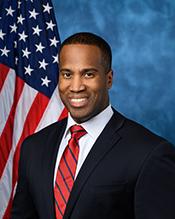
John James
RRepublicanMI-10 · Representative
50
/ 100
Average
Attendance90
Avg: 96
Independence3
Avg: 4
Bipartisan Tone17
Avg: 15
Ethics Record100
Avg: 99
Transparency25
Avg: 53
Accountability Score — composite of attendance, independence, bipartisan tone, ethics record & transparency.
Methodology18
Bills Sponsored
1
Enacted into Law
2
Passed a Chamber
15
In Committee
All Sponsored Bills
HR10759In Committee
Tariff Relief for American Development and Employment Act of 2026
HR10560In Committee
Skilled JOBS Act
HR9783In Committee
CANADA FIRE Act
This bill would allow the U.S. government to impose economic sanctions and other penalties against Canada if wildfire smoke from Canadian forests continues to affect air quality in the United States. The sanctions could include trade restrictions, financial penalties, and other measures targeting the Canadian government. The bill has been referred to multiple congressional committees to review its legal, financial, and trade implications.
HRES1347In Committee
Recognizing the roles and contributions of automotive workers in the United States, with particular recognition of their impact in Michigan, and expressing support for the designation of September 2026 as "American Automotive Worker Recognition Month".
Congress would officially recognize September 2026 as "American Automotive Worker Recognition Month" to honor the contributions of people who work in the car manufacturing industry, with special attention to Michigan's role as a major automotive hub. The resolution celebrates the skills and economic importance of automotive workers across the country without creating any new laws or programs. This is largely a symbolic gesture to acknowledge the industry's significance to American workers and the economy.
HR9149In Committee
National Diabetes Project Act
The proposal would create a national program to improve diabetes prevention, treatment, and research across the United States. It would coordinate efforts among federal agencies, healthcare providers, and researchers to better understand the disease and help the millions of Americans living with or at risk for diabetes. The program aims to reduce the burden of diabetes on patients, families, and the healthcare system.
HRES1321In Committee
Calling on the Government of Nigeria to ensure that all legal proceedings involving Mazi Nnamdi Kanu are conducted in full accordance with Nigeria's constitutional obligations and international human rights commitments.
This resolution calls on the Nigerian government to ensure all legal proceedings involving Mazi Nnamdi Kanu are conducted in full accordance with Nigeria’s constitutional obligations and international human rights commitments.
HR8614In Committee
Safe Water in Schools Act of 2026
The legislation would require schools to test their drinking water for lead contamination and fix any problems found, protecting students and staff from exposure to this harmful metal. Schools would need to follow new safety standards and report their testing results, with federal funding potentially available to help pay for necessary repairs and upgrades to water systems.
HR8140In Committee
Money Where Our Mouths Are Act
This bill would require members of Congress to use the same healthcare system and follow the same laws that apply to ordinary Americans, rather than having access to special congressional benefits. The measure aims to make lawmakers more accountable by having them experience firsthand the healthcare and regulatory requirements they impose on the general public. It affects Congress members and could influence how they write legislation affecting healthcare and other areas where they currently receive different treatment than constituents.
HR7904In Committee
Protecting America’s Working Dogs Act of 2026
The bill would establish protections and standards for military and law enforcement working dogs, likely ensuring they receive proper care, medical treatment, and retirement benefits after their service ends. It affects the Department of Defense, law enforcement agencies, and the dogs themselves—many of which are trained for combat, bomb detection, or other critical security missions. The legislation has been sent to multiple committees to review different aspects, including military policy, legal authority, and veterans' benefits.
HR3617Passed House
Securing America’s Critical Minerals Supply Act
Securing America's Critical Minerals Supply Act This bill requires the Department of Energy (DOE) to secure the supply of critical energy resources that are essential to the energy security of the United States. A critical energy resource means an energy resource (1) that is essential to the energy sector and energy systems of the United States, and (2) the supply chain of which is vulnerable to disruption. As part of its duties, DOE must conduct ongoing assessments of energy resource criticality, the U.S. supply chain of critical energy resources and its vulnerabilities, the diversity of domestic critical energy resource supply chains, capacity constraints on the domestic production of critical energy resources, federal regulations affecting the domestic production or importation of critical energy resources, how energy security is affected by reliance on imports of critical energy resources, and how adversarial nations seek to exploit critical energy resource markets to undermine investment in the United States. DOE must also facilitate the development of strategies to strengthen critical energy resource supply chains, develop substitutes and alternatives to critical energy resources, and improve technology that reuses and recycles critical energy resources.
HR6932In Committee
IDEAL Act
The IDEAL Act would provide federal funding and support for education initiatives, though the specific programs or reforms it targets are not clear from the title alone. Based on its referral to the Appropriations Committee, the bill likely aims to allocate money toward improving schools, student services, or educational opportunities for American students and families. The exact details of how schools would use these funds and which students would benefit would depend on the bill's specific provisions.
HR3149In Committee
App Store Accountability Act
This bill would require large app stores like Apple's App Store and Google Play to follow new rules about how they treat app developers, such as allowing alternative payment methods and preventing unfair removal of apps. The legislation aims to reduce the control that major tech companies have over which apps can be sold and how much they can charge users, giving smaller developers more flexibility and potentially lowering costs for consumers. The changes would mainly affect app developers, tech companies that operate app stores, and people who download apps on their phones.
HR6396In Committee
Kid PROOF Act of 2025
The bill aims to protect children's health and safety, likely by establishing new standards or regulations related to products, substances, or practices that could harm kids. The measure has been sent to two congressional committees—one focused on energy and commerce issues and another on education and workforce matters—suggesting it may address multiple areas affecting children, such as consumer products, environmental hazards, or school-related health concerns.
HR5582In Committee
Patients Deserve Price Tags Act
Healthcare providers would be required to publicly display prices for common medical services and procedures so patients can see costs upfront before receiving care. This would let patients compare prices between different hospitals and clinics, similar to how you can compare prices when shopping for other services. The rule would apply to doctors' offices, hospitals, and other healthcare facilities across the country.
HJRES87Enacted
Providing congressional disapproval under chapter 8 of title 5, United States Code, of the rule submitted by the Environmental Protection Agency relating to "California State Motor Vehicle and Engine Pollution Control Standards; Heavy-Duty Vehicle and Engine Emission Warranty and Maintenance Provisions; Advanced Clean Trucks; Zero Emission Airport Shuttle; Zero-Emission Power Train Certification; Waiver of Preemption; Notice of Decision".
This joint resolution revokes waivers granted to the California Air Resources Board regarding several of its regulations, including the Heavy-Duty Vehicle and Engine Emission Warranty Regulations and Maintenance Provisions. (Under the Clean Air Act, California may seek waivers of the preemption prohibiting states from enacting certain emission standards.) Specifically, the joint resolution nullifies the Environmental Protection Agency notice titled California State Motor Vehicle and Engine Pollution Control Standards; Heavy-Duty Vehicle and Engine Emission Warranty and Maintenance Provisions; Advanced Clean Trucks; Zero Emission Airport Shuttle; Zero-Emission Power Train Certification; Waiver of Preemption; Notice of Decision .
HR2444Passed House
Promoting Resilient Supply Chains Act of 2025
Promoting Resilient Supply Chains Act of 2025 This bill requires the Industry and Analysis office of the International Trade Administration of the Department of Commerce to monitor and respond to disruptions in critical industries and supply chains. Specifically, the office must (1) establish the Supply Chain Resilience Working Group; (2) assess, map, and model critical supply chains; (3) identify high-priority supply chain gaps and vulnerabilities in critical industries; (4) identify and evaluate the effect of potential supply chain disruptions on market stability; and (5) collaborate with other governmental bodies and key international partners to identify opportunities to reduce supply chain gaps and vulnerabilities. Additionally, the office, in consultation with the working group and specified nongovernmental entities, must make recommendations and implement a strategy to improve the security and resiliency of manufacturing capacity and supply chains for critical industries (including critical industries for emerging technologies). The bill includes various reporting requirements.
HR1999In Committee
Disclose GIFT Act
Disclose Getting Involved in Foreign Transactions Act or the Disclose GIFT Act This bill requires certain institutions of higher education (IHEs) to disclose gifts or contracts between covered individuals (e.g., researchers) and foreign sources. This bill applies to an IHE that (1) is an eligible institution for purposes of federal student aid programs, and (2) has received more than $50 million in federal funds in any of the previous five calendar years (with at least part to support research and development) or that receives certain other federal funds. Specifically, the bill requires an IHE to maintain a policy requiring covered individuals employed at the IHE to annually disclose gifts received from, or contracts entered into with, a foreign source; a publicly available and searchable database with the disclosed information, excluding personally identifiable information; and a plan to identify and manage potential information gathering by foreign sources through espionage targeting covered individuals that may arise from such gifts or contracts. The bill requires the Department of Education (ED) to investigate possible violations of this bill and outlines the various penalties for each violation. Additionally, ED must maintain a single point of contact to, among other duties, receive and respond to inquiries and requests for technical assistance from IHEs regarding compliance with the requirements of the bill. IHEs must also establish policies and designate compliance officers. The Government Accountability Office must study and report on ways to improve intergovernmental agency coordination for implementing and enforcing disclosure reporting requirements.
HRES194In Committee
Expressing support for the designation of March 6, 2025, as "Great Lakes Day".