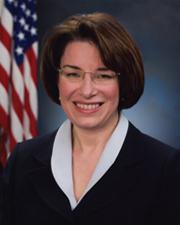
Amy Klobuchar
DDemocratMN · Senator
62
/ 100
Average
Attendance99
Avg: 97
Independence18
Avg: 23
Bipartisan Tone35
Avg: 14
Ethics Record100
Avg: 100
Transparency47
Avg: 47
Accountability Score — composite of attendance, independence, bipartisan tone, ethics record & transparency.
Methodology73
Bills Sponsored
0
Enacted into Law
5
Passed a Chamber
59
In Committee
All Sponsored Bills
S2339Passed Senate
EARLY Act Reauthorization of 2025
EARLY Act Reauthorization of 2025 This bill reauthorizes through FY2031 programs relating to young women’s awareness of breast health and breast cancer, which are administered by the Centers for Disease Control and Prevention. These programs include campaigns to educate young women and health care professionals, research on preventing breast cancer in younger women, and grants for resources and services to young women diagnosed with breast cancer and precancerous conditions.
SRES908In Committee
A resolution supporting the designation of the week of September 21 through September 25, 2026, as "National Hazing Awareness Week".
SRES858In Committee
A resolution honoring the life and legacy of the late Constance Benjamin Clery.
S3467In Committee
Virginia Graeme Baker Pool and Spa Safety Reauthorization Act
S5285In Committee
Visitable Inclusive Tax credits for Accessible Living (VITAL) Act
S5241In Committee
A bill to designate the facility of the United States Postal Service located at 200 1st Avenue Southeast in Austin, Minnesota, as the "John Madden Memorial Post Office".
This bill designates the facility of the United States Postal Service located at 200 1st Avenue Southeast in Austin, Minnesota, as the "John Madden Memorial Post Office".
S5052In Committee
Lainie Jones Comprehensive Cancer Survivorship Act of 2026
The bill would establish standards and programs to help cancer survivors manage their health after treatment ends, addressing issues like physical recovery, mental health, and long-term medical care. It would apply to all cancer survivors regardless of their type of cancer or background, and would work to improve their quality of life and health outcomes during the recovery period and beyond. The legislation aims to create consistent care guidelines so survivors receive the support they need throughout their entire journey from diagnosis through recovery.
S5007In Committee
SEARCH Act of 2026
This legislation would limit the power of major tech companies that dominate online search and advertising by preventing them from using their market position to unfairly block competitors or favor their own services. The rules would apply to large digital platforms and aim to make it easier for smaller companies and startups to compete in these markets. Consumers could potentially benefit from more choices and innovation in search engines and online advertising services.
S4896In Committee
Child Care Innovation Advancement Act of 2026
The bill would create a pilot program to test new ways of providing nutritious meals to children in child care settings, with the goal of improving their access to healthy food. The program would likely involve grants or funding to child care facilities to help them serve better meals and potentially experiment with different nutrition approaches. This would affect child care providers, the children they serve, and families looking for quality nutrition options for their kids.
S4897In Committee
Credit for Prior Learning Act
This bill would require colleges to include the cost of testing that evaluates skills students already have (from work experience, military service, or self-study) as part of their official cost of attendance calculations. This change would make it easier for students to get financial aid to pay for these assessment tests, which can help them earn college credits without taking the actual courses. The bill primarily affects college students seeking to demonstrate prior knowledge and the financial aid they receive.
SRES761In Committee
A resolution designating June 23, 2026, as "Social Media Harms Victim Remembrance Day".
This resolution designates June 23, 2026, as Social Media Harms Victim Remembrance Day and encourages government, industry, and community stakeholders to take action to prevent social media-related harm.
S4647In Committee
AGE Act of 2026
The proposal would allow older adults and their families to claim a tax credit for money spent on eldercare services like adult day care, assisted living, or in-home care assistance. This tax break would reduce the amount of federal income tax owed by eligible people who pay for these services, making it more affordable for families to access care for aging relatives. The bill is currently under review by the Senate Finance Committee.
SRES668In Committee
A resolution designating April 2026 as "Second Chance Month".
This resolution would officially recognize April 2026 as "Second Chance Month" to raise awareness about criminal justice reform and support for people who have been incarcerated or have criminal records. The designation aims to highlight programs and initiatives that help formerly incarcerated individuals reintegrate into society through job training, education, and other rehabilitation efforts. It's a symbolic measure meant to encourage public recognition of redemption and rehabilitation in the criminal justice system.
SRES648In Committee
A resolution honoring the memory, service, and sacrifice of Master Sergeant Nicole M. Amor, United States Army Reserve.
This resolution honors Master Sergeant Nicole M. Amor of the Army Reserve for her military service and sacrifice. The Senate unanimously approved the resolution to recognize her memory and contributions to the armed forces.
S4148In Committee
Homegrown Fertilizer Act
This bill would likely encourage or support the production of fertilizer within the United States rather than relying on imports, potentially through incentives, regulations, or infrastructure investments. The measure would affect farmers, fertilizer manufacturers, and agricultural producers who depend on fertilizer supplies for crops. By boosting domestic fertilizer production, the bill aims to reduce costs and supply chain vulnerabilities for American agriculture.
S4107In Committee
Antitrust Accountability and Transparency Act
This bill would require large technology and online companies to be more transparent about their business practices and give the government stronger tools to investigate whether they're unfairly crushing competition. It aims to prevent dominant companies from using their market power to block smaller competitors or favor their own products, affecting how platforms like social media sites and online marketplaces operate. The legislation would make it easier for regulators to challenge anticompetitive behavior in court and impose penalties on companies that violate antitrust laws.
S2074Passed Senate
Servicemembers’ Credit Monitoring Enhancement Act
Servicemembers' Credit Monitoring Enhancement Act This bill makes available to all members of the Armed Forces free electronic credit monitoring, regardless of their duty status. (This service is currently available only to those on active duty.)
S4062In Committee
Next Generation 9–1–1 Act
Next Generation 9–1–1 Act This bill establishes a grant program to support implementation of next generation 9-1-1 (NG9-1-1) systems by state, territorial, and tribal governments and requires other related activities. NG9-1-1 means a secure, interoperable, Internet Protocol-based (IP-based) system for receiving 9-1-1 requests for emergency assistance. (IP-based 9-1-1 systems have capabilities that legacy telephone systems do not, including enhanced location-finding and the ability to receive text and multimedia messages.) Under the bill, the National Telecommunications and Information Administration (NTIA) must provide grants to state, territorial, and tribal governments (and entities established by those governments) to support the implementation and maintenance of NG9-1-1 systems. Grant funds may also be used for public outreach on NG9-1-1, implementation of cybersecurity measures, and, subject to certain limits, training and administrative costs. Entities applying for grants must submit a plan for NG9-1-1 coordination and implementation that ensures interoperability and reliability, incorporates cybersecurity tools, and meets other requirements related to technology and procurement. Applicants must also certify that they have established, or will establish within a specified time frame, a sustainable funding mechanism to support NG9-1-1 and effective cybersecurity resources. The NTIA must advise applicants on the preparation of implementation plans and provide technical assistance to grant recipients. Further, the NTIA must establish (1) an advisory board to provide recommendations with respect to the grant program and other topics related to NG9-1-1; and (2) a cybersecurity center to coordinate with state, local, and regional governments on the sharing of cybersecurity information related to NG9-1-1.
S4020In Committee
Housing Supply and Affordability Act
This bill aims to increase the availability of affordable housing and make it easier for people to buy or rent homes by likely addressing barriers to housing construction, expanding funding for affordable housing programs, or reforming regulations that drive up housing costs. The legislation would affect renters and homebuyers struggling with high housing costs, construction companies, and local governments responsible for housing policy. By removing obstacles to building more homes and supporting affordable housing development, the bill seeks to address the nationwide shortage of affordable places to live.
SRES602In Committee
A resolution supporting the United States Olympic and Paralympic Teams in the 2026 Olympic and Paralympic Winter Games.
The Senate passed a resolution expressing official support for American athletes competing in the 2026 Winter Olympics and Paralympics. The resolution is a symbolic show of backing for the U.S. Olympic and Paralympic teams as they prepare for and compete in the international winter sports competition.
SRES586In Committee
A resolution raising awareness and encouraging the prevention of stalking by designating January 2026 as "National Stalking Awareness Month".
This resolution designates January 2026 as National Stalking Awareness Month.
S3686In Committee
Hemp Planting Predictability Act
Hemp Planting Predictability Act This bill extends by two years the implementation of changes to the regulation of hemp products, which reimpose certain federal controls over some hemp products. Specifically, Congress enacted the FY2026 agriculture appropriations act (P.L. 119-37) on November 12, 2025. Effective November 12, 2026, the act modifies the statutory definition of hemp products that are considered to be lawful. This bill extends the effective date to November 12, 2028. As background, the 2018 farm bill excluded hemp from the Controlled Substances Act definition of marijuana and defined hemp . As a result, hemp and hemp-derived products at or below the 0.3% delta-9 tetrahydrocannabinol (THC, the psychoactive component of marijuana) concentration threshold were no longer regulated as Schedule I controlled substances and registration with the Drug Enforcement Administration was no longer required to cultivate or handle hemp and hemp-derived products. However, hemp remained subject to Department of Agriculture and Food and Drug Administration regulation. The 2025 changes to the definition of hemp, include changing the limit to a total THC concentration of not more than 0.3% on a dry weight basis rather than only delta-9 THC, explicitly including industrial hemp, excluding seeds from a cannabis plant that exceed a certain THC concentration, and excluding various types of hemp-derived cannabinoid products. Cannabinoids refer to unique chemical compounds that are found in hemp and marijuana (e.g., THC) and are known to exhibit a range of psychological and physiological effects.
S3495In Committee
Artificial Intelligence Scam Prevention Act
S3285In Committee
ADOPT Act of 2025
S3155In Committee
COACH Act
The bill would establish new support programs and resources to help small business owners and entrepreneurs access coaching, mentoring, and training services to improve their operations and growth prospects. It aims to connect business owners with experienced advisors who can provide guidance on management, finances, marketing, and other key areas of running a successful company. The measure would affect small business owners and the organizations that provide coaching and mentoring services to them.
S3040In Committee
Edith Nourse Rogers STEM Scholarship Opportunity Act of 2025
Edith Nourse Rogers STEM Scholarship Opportunity Act of 2025 This bill expands eligibility for and modifies administration of the Edith Nourse Rogers STEM Scholarship. The scholarship allows individuals who are entitled to Post-9/11 GI Bill educational assistance and are pursuing eligible degrees in science, technology, engineering, mathematics, or health care to receive up to nine additional months of benefits (capped at $30,000). The bill eliminates the requirement that an individual must have less than 180 days of remaining educational assistance entitlement (or no entitlement remaining) to be eligible for the scholarship. Additionally, the bill reduces by 25% the number of credits an individual must have completed in order to be eligible for the scholarship. In situations where there are insufficient funds available in a fiscal year, the bill authorizes the Department of Veterans Affairs to give priority to individuals who have used the most months of their educational assistance entitlement and those who are using their entitlement to pursue a program of post-secondary education in specified fields (e.g., engineering). The bill specifies that individuals who receive the scholarship benefit may only use the benefit after they have used all of their educational assistance entitlement under the Post-9/11 GI Bill.
S2144Passed Senate
A bill to improve the safety and security of Members of Congress, immediate family members of Members of Congress, and congressional staff.
This bill would provide enhanced security protections and resources for members of Congress, their families, and congressional staff, including measures like threat assessment programs and security improvements. The legislation aims to address safety concerns following recent incidents of violence and harassment targeting lawmakers and their households. It has passed the Senate and is currently awaiting action in the House.
S2662In Committee
504 Modernization and Small Manufacturer Enhancement Act of 2025
S2822In Committee
Register America to Vote Act of 2025
Register America to Vote Act of 2025 This bill provides for the automatic registration of eligible voters. Specifically, the bill directs each state that has a voter registration requirement for federal elections to automatically register eligible individuals when they turn 18 years of age. The bill also provides for the automatic registration of individuals through state motor vehicle authorities. Individuals must be provided with an opportunity to opt out of automatic voter registration. The Election Assistance Commission must make grants to states to implement these automatic voter registration programs.
S725Passed Senate
Enhancing First Response Act
Enhancing First Response Act This bill requires the Federal Communications Commission (FCC) to report on certain activations of the Disaster Information Reporting System (DIRS). DIRS is a reporting system that is activated during severe weather and other events impacting communications service and enables communications providers to report outages and other degradations to service. If the system was activated for at least seven days, the FCC must issue a preliminary report that includes information about the number, duration, and nature of all associated outages. The FCC must also hold at least one public field hearing in the area affected by the event, and it must issue a final report that includes recommendations for improving the resiliency of affected networks or recovery efforts. Separately, the FCC must publish a general report on (1) the volume and nature of 9-1-1 outages that are not required to be reported under current outage notification rules, and (2) the value to public safety agencies of the inclusion of visual information in outage notifications from communications providers. The bill also requires the Office of Management and Budget, by 30 days after the bill's enactment, to categorize public safety telecommunicators as a protective service occupation under the Standard Occupational Classification System. Finally, the Office of the Inspector General of the FCC is directed to publish a report on the implementation of Kari’s Law, which requires multiline telephone systems to be preconfigured to allow users to dial 9-1-1 directly from any phone without dialing any additional code or prefix.
SRES371In Committee
A resolution honoring the victims and survivors of the mass shooting at the Annunciation Catholic Church and School in Minneapolis, Minnesota.
This resolution honors the victims and survivors of a mass shooting that occurred at Annunciation Catholic Church and School in Minneapolis, Minnesota. The measure expresses the Senate's sympathy and support for those affected by the tragedy and recognizes the impact of gun violence on the community.
S2725In Committee
STOP Act 2.0
STOP Act 2.0 This bill revises requirements related to advance electronic data (AED) on international mail shipments. (The STOP Act of 2018 requires international mail shipments coming into the United States to have AED to address the threat of synthetic opioids and other dangerous items.) Specifically, the bill establishes a new criminal penalty for knowingly misrepresenting the country of origin of an international mail shipment in order to avoid AED requirements. Additionally, five years after enactment, the bill terminates U.S. Customs and Border Protection's (CBP's) authority to exclude countries from AED requirements. The bill establishes additional reporting requirements related to AED, including a requirement for the Department of Homeland Security (DHS) to report the results of randomized tests of packages entering the United States. Further, the bill authorizes DHS, the Department of Justice, and the U.S. Postal Service to enter into partnerships with private parcel services or other private information technology entities to develop technology and processes for identifying the origin of fentanyl, other synthetic opioids, and other narcotics and psychoactive substances. The bill also authorizes DHS to share with and receive information from foreign governments regarding (1) shippers with a history of transporting illegal substances, and (2) best practices for detecting the substances. CBP must train its officers in detecting illicit fentanyl and other synthetic opioids. Finally, the bill directs the Government Accountability Office to evaluate the implementation of the STOP Act of 2018.
S2723In Committee
Treatment Court, Rehabilitation, and Recovery Act of 2025
S2724In Committee
Safe at Home Act
S2679In Committee
Fulfilling Promises to Afghan Allies Act
S2576In Committee
Election Mail Act
Election Mail Act This bill addresses the delivery and processing of election mail for federal elections, including by establishing certain standards for mail-in ballots. Specifically, the bill requires the U.S. Postal Service (USPS) to ensure (to the maximum extent practicable) same-day processing of mail-in ballots, postmark each ballot, carry election mail (e.g., voter registration applications and mail-in ballots) as first-class mail that is free of postage, appoint an election mail coordinator at each area office and district office, and consult annually with Indian tribes regarding barriers to voting for eligible voters living on Indian lands. The bill prohibits the USPS, within 120 days of a federal election, from making any operational change that would restrict the prompt and reliable delivery of election mail. Each state and jurisdiction must provide with each mail-in ballot a return envelope with an intelligent mail barcode. This requirement does not apply to a state or jurisdiction that uses an alternative system that enables voters to track the ballot through the mail. The bill requires election officials to count mail-in ballots that are postmarked by election day and arrive within seven days after the election.
S2639In Committee
Military Spouse Entrepreneurship Act of 2025
S1703Reported
Rural Small Business Resilience Act
This bill would provide financial support and resources to help small businesses in rural areas survive economic challenges and grow their operations. It likely includes measures such as easier access to loans, grants, or technical assistance programs designed specifically for rural entrepreneurs who often face higher costs and fewer resources than businesses in cities. The goal is to strengthen rural economies by helping small business owners stay competitive and create jobs in their communities.
S2459In Committee
ABLE Employment Flexibility Act
The legislation would allow people with disabilities who participate in ABLE accounts (special savings accounts designed for disabled individuals) to work and earn income without losing their benefits or facing penalties on the money they save. Currently, strict limits on earnings and savings can discourage disabled workers from taking jobs because they risk losing government assistance, so this change would make it easier for them to balance employment with maintaining their benefits. The change primarily affects disabled individuals, their families, and the government programs that support them.
S2456In Committee
Promoting Rural Exports Act of 2025
Promoting Rural Exports Act of 2025 This bill provides statutory authority for the U.S. and Foreign Commercial Service to establish the National Rural Export Center and up to nine regional rural export centers to assist rural businesses seeking to export their products. Specifically, the National Rural Export Center and regional rural export centers must (1) provide in-depth, customized, and actionable market research services for rural businesses; and (2) conduct strategic planning and export support services for those businesses as needed. The centers must also collect specified data to measure their effectiveness in assisting businesses and maintain websites that include this data. Each center's website must also include (1) best practices for rural businesses beginning to evaluate export opportunities, and (2) contact information for staff at the center.
SRES330Introduced
A resolution designating June 23, 2025, as "Social Media Harms Victim Remembrance Day".
This resolution designates June 23, 2025, as Social Media Harms Victim Remembrance Day and encourages government, industry, and community stakeholders to take action to prevent social media-related harm.
S2345In Committee
Short on Competition Act
Short on Competition Act This bill requires the Food and Drug Administration (FDA) to provide temporary authorization to import certain prescription drugs facing shortages or in a marginally competitive drug market. Specifically, the FDA must authorize importation of an eligible drug that is lifesaving, life-sustaining, or intended to treat or prevent a debilitating condition. To be eligible, a drug must (1) be facing a shortage, (2) require a prescription, (3) have received market authorization in certain foreign countries, and (4) have the same active ingredient as the drug for which there is a shortage in the United States. The drug's manufacturer must also seek approval for the drug as a generic drug. The authority to import a drug terminates after three years or when the shortage no longer applies, whichever occurs first. Importation must begin within 60 days of the FDA receiving an application that meets all of the applicable requirements. The FDA may deny importation of a drug for reasons related to safety or effectiveness. Drugs in marginally competitive markets must be treated as being in shortage for the purposes of this bill and may be treated as such for the purposes of expediting inspections and reviewing applications. A drug is in a marginally competitive market if (1) there are fewer than five holders of approved applications for commercially available brand-name or generic versions of the drug, (2) the drug has been approved for at least 10 years, and (3) the patents on the drug's active ingredients have expired.
S2291In Committee
Flex Fuel Fairness Act of 2025
S2238In Committee
PART Act
The legislation would establish new requirements and standards for public transportation systems and infrastructure projects across the country. It aims to improve how transit agencies plan, fund, and maintain buses, trains, and related facilities that millions of Americans rely on for daily commuting. The bill would affect transportation workers, commuters, local governments, and transit agencies that operate public transportation services.
S2196In Committee
Strengthening Protections for Domestic Violence and Stalking Survivors Act of 2025
Strengthening Protections for Domestic Violence and Stalking Survivors Act of 2025 This bill extends federal restrictions on the receipt, possession, shipment, and transportation of firearms and ammunition to new types of stalking and domestic violence offenders. Specifically, the bill extends federal firearms-related restrictions to individuals who are convicted of a misdemeanor crime of stalking. The term misdemeanor crime of stalking means a federal, state, tribal, or local offense involving harassment, intimidation, or surveillance that (1) causes emotional distress; or (2) places a person in reasonable fear of harm to themselves, an immediate family member, a current or former cohabitant, an intimate partner, or a pet. Additionally, the bill extends federal firearms-related restrictions to individuals who are subject to a domestic violence protection order that restrains them from harassing, stalking, or threatening a current or former dating partner (regardless of when the relationship occurred) or an individual similarly situated to a spouse. Currently, the restrictions only apply if the domestic violence protection order restrains the individual from harassing, stalking, or threatening a co-parent, a current or former spouse, or a current or former cohabitant. Finally, the bill extends federal firearms-related restrictions to individuals who commit a misdemeanor crime of domestic violence against the child of a current or recent former dating partner. Currently, the restrictions only apply if the offense is committed against a current or recent former dating partner.
SRES301In Committee
A resolution condemning the attacks on Minnesota lawmakers in Brooklyn Park and Champlin, Minnesota and calling for unity and the rejection of political violence in Minnesota and across the United States.
This resolution condemns the June 14, 2025, attacks on Minnesota state legislators and calls on the people of the United States to reaffirm our commitment to a safe, civil, and peaceful democracy. The resolution also honors (1) the lives of Speaker Emerita Melissa Hortman and her husband Mark Hortman who were killed, (2) Senator John Hoffman and his wife Yvette Hoffman who were critically injured, and (3) the law enforcement officers who rapidly responded to the attacks and apprehended the suspected perpetrator.
S2124In Committee
Election Worker Protection Act of 2025
Election Worker Protection Act of 2025 This bill establishes certain protections for election workers. Specifically, the bill makes it a crime to intimidate, threaten, coerce, or harass an election worker with the intent to interfere with the official duties of, or retaliate against, the worker. The bill extends (1) the prohibition on certain types of intimidation in federal elections to also prohibit intimidation for processing ballots or tabulating, canvassing, or certifying votes; and (2) the prohibition on public disclosure of restricted personal information to also prohibit the disclosure of information about election officials, poll workers, or election volunteers in connection with a federal election. The bill also authorizes election officials to remove poll observers who are interfering with or attempting to disrupt the administration of an election. Additionally, the bill directs the Election Assistance Commission to award grants to states (or local governments under specified circumstances) for (1) recruiting and training individuals to serve as poll workers and election volunteers on dates of elections for public office, and (2) physical security services and social media threat monitoring for election workers. The bill directs the Department of Justice to (1) provide training to law enforcement and federal attorneys on addressing threats to election workers, and (2) establish a grant program to support programs to prevent the disclosure of personally identifiable information of election workers.
S1836In Committee
SMART Prices Act
The legislation would require pharmaceutical companies to justify and potentially negotiate drug prices with Medicare, aiming to make prescription medications more affordable for seniors and other patients. It would give the federal government more authority to review whether drug prices are reasonable compared to their actual development costs and effectiveness. This could lower out-of-pocket costs for people taking expensive medications, though it might also affect how quickly new drugs reach the market.
S1563Reported
Retired Law Enforcement Officers Continuing Service Act
Retired Law Enforcement Officers Continuing Service Act This bill authorizes the Department of Justice to award grants for state, local, tribal, and territorial law enforcement agencies to hire retired law enforcement personnel to perform civilian law enforcement tasks on behalf of the agency and to train civilian employees in the performance of such tasks. Under the bill, the term civilian law enforcement task includes assisting with certain investigations, reviewing camera footage, conducting crime scene analysis, and conducting forensic analysis.
S237Reported
Honoring Our Fallen Heroes Act of 2025
Honoring Our Fallen Heroes Act of 2025 This bill extends death and disability benefits under the Public Safety Officers' Benefits Program (PSOB) to certain public safety officers who suffer from exposure-related cancer while on duty and their survivors. The PSOB program provides death, disability, and education benefits to public safety officers who are killed or injured in the line of duty and their survivors. The bill specifies that exposure to a carcinogen shall be presumed to constitute a personal injury in the line of duty if the exposure occurred while the officer was in the line of duty; the officer began serving as an officer not fewer than 5 years before the date of the diagnosis of an exposure-related cancer and the diagnosis occurred not more than 15 years after the last date of active service; and the exposure-related cancer directly and proximately resulted in the death or permanent and total disability of the officer. The Department of Justice's Bureau of Justice Assistance must periodically review the definition of exposure-related cance r and update the definition if appropriate based on medical evidence and in accordance with the requirements of a petition process.
S1796In Committee
HART Act
S314Reported
Hotel Fees Transparency Act of 2025
Hotel Fees Transparency Act of 2025 This bill requires providers of short-term lodging (e.g., hotels, short-term rentals, and third-party online sellers) to include certain price information when displaying, advertising, or marketing reservations for lodging. Specifically, such providers must (1) display the total services price, including the base price and any service fees, if a price is displayed in an advertisement. marketing material, or a price list; (2) disclose the total services price at the time the services are first displayed to an individual seeking to purchase such services and anytime thereafter during the purchasing process; and (3) disclose, prior to the final purchase, any tax, fee, or assessment imposed by any government entity (or quasi-government entity) on the sale of such services. The bill provides for enforcement by the Federal Trade Commission and state attorneys general (or other authorized state officials).
S1704In Committee
National Taxpayer Advocate Enhancement Act of 2025
National Taxpayer Advocate Enhancement Act of 2025 This bill authorizes the National Taxpayer Advocate to appoint legal counsel within the Taxpayer Advocate Service (TAS) to report directly to the National Taxpayer Advocate. The bill also expands the authority of the National Taxpayer Advocate to take personnel actions with respect to local taxpayer advocates (located in each state) to include actions with respect to any employee of TAS. Currently, pursuant to a Department of the Treasury order, all legal counsel whose duties include providing legal advice to any official in any office or bureau of Treasury are part of the Legal Division within Treasury and under the supervision of the General Counsel, with limited exceptions. TAS assists taxpayers in matters involving the Internal Revenue Service (IRS) and is part of the IRS, within Treasury.
SRES149In Committee
A resolution designating April 2025 as "Second Chance Month".
This resolution designates April 2025 as Second Chance Month to promote awareness of unnecessary legal and social barriers that prevent individuals with criminal records from becoming productive members of society.
S1095Reported
Stop STALLING Act
Stop Significant and Time-wasting Abuse Limiting Legitimate Innovation of New Generics Act or the Stop STALLING Act This bill makes it an unfair method of competition to submit an objectively baseless petition to the Food and Drug Administration (FDA) in an attempt to interfere with a competitor's application for market approval of a drug. The bill authorizes the Federal Trade Commission to sue an individual or entity that submits such a petition to the FDA. A party found liable in such a lawsuit is subject to civil penalties, such as a fine of up to $50,000 for each day that the FDA spent reviewing the baseless petition.
S1096Reported
Preserve Access to Affordable Generics and Biosimilars Act
Preserve Access to Affordable Generics and Biosimilars Act This bill prohibits parties from entering into any agreement that resolves or settles a patent claim related to the sale of a drug or biological product and that has anticompetitive effects. Such an agreement is presumed to have anticompetitive effects if the filer of a generic drug or biosimilar application receives anything of value and agrees to limit or forego research, development, manufacturing, marketing, or sales of the generic drug or biosimilar. An agreement is exempt if the only consideration granted to the generic manufacturer is (1) the right to market and secure final approval for its product prior to the expiration of any statutory exclusivity, (2) a payment for reasonable litigation expenses, or (3) a covenant not to sue on any claim that the generic drug or biosimilar infringes a U.S. patent. An agreement is also exempt if the agreement's pro-competitive benefits outweigh the anticompetitive effects. The bill provides for enforcement by the Federal Trade Commission (FTC). Violators are subject to penalties including the forfeiture of the 180-day marketing exclusivity period for a generic drug. Additionally, when a generic or biosimilar drug manufacturer enters into an agreement with another drug manufacturer related to the manufacturing, marketing, or sale of a drug, the manufacturers must certify that the material they have given the FTC and the Department of Justice concerning the agreement contains the complete agreement and any related agreements, including descriptions of any oral agreements or representations.
S1410In Committee
Find It Early Act
This bill would likely establish or expand early detection and screening programs for diseases, helping doctors identify health problems in their earliest stages when treatment is often more effective and less expensive. The legislation would probably affect patients, healthcare providers, and possibly insurance companies by requiring or incentivizing screening initiatives for conditions like cancer, heart disease, or other major illnesses. By catching diseases earlier, the bill aims to improve health outcomes and potentially reduce overall healthcare costs.
SRES164In Committee
A resolution supporting the goals and ideals of National Public Safety Telecommunicators Week.
This resolution supports the goals and ideals of National Public Safety Telecommunicators Week and honors and recognizes the contributions of public safety telecommunications professionals.
S1076In Committee
Preventing Illegal Weapons Trafficking Act of 2025
Preventing Illegal Weapons Trafficking Act of 2025 This bill requires the Departments of Justice, Homeland Security, and the Treasury to develop and implement a strategy to prevent or intercept the importation or trafficking of machinegun conversion devices. The term machinegun conversion device means parts or combinations of parts designed and intended for use in converting a weapon into a machinegun. The bill also specifies that proceeds derived from the illegal trafficking of a machinegun are subject to seizure and forfeiture.
S1087In Committee
Rebuild America’s Health Care Schools Act of 2025
Rebuild America’s Health Care Schools Act of 2025 This bill allows hospitals to receive reimbursement under Medicare for certain costs associated with training nursing and allied health students in settings other than the hospital itself. Currently, hospitals may receive reimbursement under Medicare for the reasonable costs associated with training nursing and allied health students if certain conditions are met; the criteria vary depending on whether the students are enrolled in an educational program that is operated by the hospital or another entity. If the students are part of a program that is operated by another entity, the training must occur at the hospital itself or in areas immediately surrounding the hospital in order to qualify for reimbursement (among other requirements). The bill allows hospitals to receive reimbursement for these costs if the training is conducted at an entity that is related to the hospital (i.e., common ownership or control). The bill requires the Centers for Medicare & Medicaid Services (CMS) to update regulations to reflect these changes. Additionally, the CMS may not recoup or reduce payments to hospitals with respect to costs that are allowed under the bill and must refund any such recoupments or reductions that occurred during the six-year period prior to the bill's enactment.
S983In Committee
Hearing Device Coverage Clarification Act
This bill would clarify how health insurance plans must cover hearing aids and related devices, ensuring that people with hearing loss have consistent access to these treatments across different insurance types. The legislation aims to remove confusion about what hearing devices insurers are required to pay for, which would help patients and doctors understand their coverage options without having to navigate conflicting rules.
S811In Committee
RTP Full Funding Act of 2025
This bill would ensure that the Land and Water Conservation Fund receives its maximum authorized annual funding of $900 million, which is used to buy and protect public lands, parks, and wildlife areas across the country. Currently, Congress often appropriates less money than allowed, so this would guarantee full funding for conservation projects that benefit outdoor recreation, wildlife habitat, and public access to natural spaces. The change would affect federal land agencies, state and local governments that partner on conservation projects, and Americans who use public parks and outdoor areas.
S758In Committee
Apprenticeships to College Act
A pprenticeships to College Act This bill requires the Department of Labor to enter into an interagency agreement with the Department of Education to promote and support integration and alignment of programs under the national apprenticeship system with secondary, two- and four-year postsecondary, and adult education.
S709In Committee
Conrad State 30 and Physician Access Reauthorization Act
Conrad State 30 and Physician Access Reauthorization Act This bill modifies the Conrad 30 Waiver program, which incentivizes qualified foreign physicians to serve in underserved communities. It also extends statutory authority for the program for three years from this bill's enactment. Individuals coming to the United States under a J-1 nonimmigrant visa to receive medical training typically must leave the country and reside for two years abroad before being eligible to apply for an immigrant visa or permanent residence. The Conrad program waives this requirement for individuals who meet certain qualifications, including serving for a number of years at a health care facility in an underserved area. The bill increases the number of waivers that a state may obtain each fiscal year from 30 to 35 if a certain number of waivers were used the previous year, and provides for further adjustments depending on demand. A physician may be employed at an academic medical center to meet the Conrad program's employment requirements if the physician's work is in the public interest, even if the medical center is not in an underserved area. Employment contracts for physicians under the Conrad program shall contain certain information, such as the maximum number of on-call hours per week the physician shall have to work. Certain physicians (along with the physician's spouse and children) shall be exempt from the direct annual numerical limits on immigration, including those physicians that have met certain requirements related to visas for physicians to serve in underserved areas.
S600In Committee
Supporting Adopted Children and Families Act
This bill would provide financial support and tax benefits to families who adopt children, making adoption more affordable by reducing the out-of-pocket costs parents face. The legislation likely includes measures such as tax credits, subsidies, or grants to help cover adoption expenses like legal fees, agency costs, and home studies. Families looking to adopt would benefit from these incentives, which aim to encourage more people to pursue adoption.
S516In Committee
SHIELD Act of 2023
Stopping Harmful Image Exploitation and Limiting Distribution Act of 2025 or the SHIELD Act of 2023 [ sic ] This bill establishes new federal criminal offenses related to the distribution of sexual exploitative content. First, the bill makes it a crime to knowingly mail or distribute (or intentionally threaten to mail or distribute) an intimate visual depiction of a recognizable adult engaged in sexual conduct. To constitute a crime, certain elements must be met, including that the distribution must be nonconsensual; the depiction is not a matter of public concern; and the distribution must be intended to cause harm or cause harm. A violator is subject to a fine, a prison term of up to two years, or both; mandatory restitution; and the forfeiture of material involved in the offense, property constituting or derived from the proceeds from the offense, and property used to commit or facilitate the offense. Second, the bill makes it a crime to knowingly mail or distribute (or intentionally threaten to mail or distribute) a visual depiction of a nude minor with intent to abuse, humiliate, harass, or degrade the minor, or to arouse or gratify the sexual desire of any person. A violator is subject to a fine, a prison term of up to three years, or both; mandatory restitution; and the forfeiture of material involved in the offense, property constituting or derived from the proceeds from the offense, and property used to commit or facilitate the offense.
S531In Committee
American Apprenticeship Act
This bill would likely expand and strengthen apprenticeship programs in the United States, making it easier for workers to learn skilled trades while earning money on the job instead of only attending traditional four-year colleges. The legislation probably aims to increase funding, create new apprenticeships in various industries, and remove barriers that prevent employers and workers from participating in these training programs. Workers seeking career paths in fields like construction, manufacturing, and healthcare would be the primary beneficiaries.
SRES46Introduced
A resolution raising awareness and encouraging the prevention of stalking by designating January 2025 as "National Stalking Awareness Month".
This resolution designates January 2025 as National Stalking Awareness Month.
S232In Committee
Preventing Algorithmic Collusion Act of 2025
S130In Committee
Competition and Antitrust Law Enforcement Reform Act of 2025
Competition and Antitrust Law Enforcement Reform Act of 2025 This bill revises antitrust laws applicable to mergers and anticompetitive conduct. Specifically, the bill applies a stricter standard for permissible mergers by prohibiting mergers that (1) create an appreciable risk of materially lessening competition, or (2) create a monopsony (i.e., where a single buyer or employer has sufficient market power to lower the price of goods or wages due to a lack of competition) Additionally, for some large mergers or mergers that concentrate markets beyond a certain threshold, the bill shifts the burden of proof to the merging parties to prove that the merger does not violate the law. The bill also prohibits exclusionary conduct that presents an appreciable risk of harming competition. No predispute arbitration agreements or predispute joint-action waivers are valid or enforceable with respect to an antitrust dispute. The bill also establishes monetary penalties for violations, requires annual reporting for certain mergers and acquisitions, establishes within the Federal Trade Commission (FTC) the Office of the Competition Advocate, and sets forth whistleblower protections. The Government Accountability Office must report on (1) the success of merger remedies required by the Department of Justice or the FTC in recent consent decrees; and (2) the impact of mergers and acquisitions on wages, employment, innovation, and new business formation.
SCONRES3Passed Senate
A concurrent resolution authorizing the use of the rotunda of the Capitol for the lying in state of the remains of the late James Earl Carter, Jr., 39th President of the United States.
This concurrent resolution authorizes the Capitol rotunda to be used for the lying in state of the remains of Jimmy Carter, the 39th President of the United States. The lying in state shall take place from January 7, 2025, until January 9, 2025.
S553Reported
North Country National Scenic Trail Route Adjustment Act of 2010
North Country National Scenic Trail Route Adjustment Act of 2010 - Amends the National Trails System Act to add certain existing hiking trails along Lake Superior's north shore and in Superior National Forest and Chippewa National Forest to the North Country National Scenic Trail in northeastern Minnesota.
S2779In Committee
Upper Mississippi River Basin Protection Act
Upper Mississippi River Basin Protection Act - Directs the Secretary of the Interior, acting through the United States Geological Survey (USGS), to establish a nutrient and sediment monitoring network for the Upper Mississippi River Basin. Directs the Secretary to: (1) establish guidelines for related data collection and storage activities; (2) inventory the sediment and monitoring efforts of governmental and nongovernmental entities for the purpose of creating a baseline understanding of overlap, data gaps, and redundancies; and (3) collaborate with other public and private monitoring efforts in establishing the monitoring program. Directs the National Research Council of the National Academy of Sciences to conduct a water resources assessment of the Basin. Requires the Director of the USGS to establish: (1) a computer modeling program of nutrient and sediment sources in the Basin; and (2) an Internet-based system to distribute information about nutrient and sediment loss reduction projects and nutrient and sediment levels in the Upper Mississippi River and its tributaries.