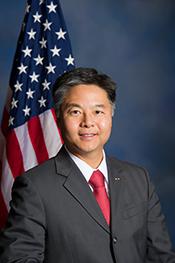
Ted Lieu
DDemocratCA-36 · Representative
48
/ 100
Below Average
Attendance98
Avg: 96
Independence2
Avg: 4
Bipartisan Tone0
Avg: 15
Ethics Record100
Avg: 99
Transparency21
Avg: 53
Accountability Score — composite of attendance, independence, bipartisan tone, ethics record & transparency.
Methodology33
Bills Sponsored
0
Enacted into Law
3
Passed a Chamber
30
In Committee
All Sponsored Bills
HRES1544Passed House
Electing a Member to a certain standing committee of the House of Representatives.
HR2004Passed House
Tyler’s Law
Tyler’s Law This bill requires the Department of Health and Human Services (HHS) to complete, within one year after the bill’s enactment, a study on how frequently Medicare-participating hospital emergency departments test for fentanyl in patients experiencing an overdose, the costs associated with such testing, and how such testing may impact patients. Within six months after the study’s completion and based on its results, HHS must issue guidance regarding (1) whether hospital emergency departments should implement fentanyl testing as a routine procedure for patients experiencing an overdose, (2) how to ensure clinicians know which substances they are testing for in routine drug tests, and (3) how fentanyl testing may affect the future risk of overdose and other health outcomes.
HR10055In Committee
Congressional Authorization for Federal Building Names Act
HR9917In Committee
AI Kill Switch Act
The proposal would require certain technology companies and organizations to maintain the technical ability to shut down or disable their systems if ordered to do so by the Department of Homeland Security, potentially in response to security threats or emergencies. This would affect technology providers, telecommunications companies, and other entities that operate critical infrastructure or widely-used platforms. The measure is currently under review by the House Committee on Homeland Security.
HR9558In Committee
21st Century Federal Writers’ Project Act
The National Endowment for the Arts would receive funding to create a new grant program that helps artists, historians, and documentarians record and preserve stories about American life and culture. These grants would support projects that capture the experiences of everyday people across different communities, regions, and time periods. The program would help ensure that diverse perspectives on American history and culture are documented for future generations.
HRES1375In Committee
Reaffirming the importance of the United States promoting the safety, health, and well-being of refugees and displaced persons in the United States and around the world.
This resolution reaffirms the U.S. commitment to protect the safety, health, and well-being of refugees and asylum seekers. The resolution calls upon the Department of State, the Department of Homeland Security, the Department of Health and Human Services, and the U.S. Mission to the United Nations to partner with the international community to solve existing conflicts, prevent new conflicts from emerging, and tackle the root causes of involuntary migration.
HR9319In Committee
Keeping Pets and Families Together Act
The federal government would work with animal shelters and similar facilities to help pay for microchipping dogs and cats, making it easier to reunite lost pets with their owners. This would involve the Department of Agriculture entering into agreements with shelters to support the costs of implanting these tracking devices. The change would primarily affect animal shelters, rescue organizations, and pet owners who use these facilities.
HRES1352Passed House
Electing Members to certain standing committees of the House of Representatives.
The House of Representatives voted to fill vacant positions on several of its standing committees, which are the permanent groups that handle specific areas like taxes, defense, healthcare, and other policy matters. These committees are where most legislative work happens before bills go to a full House vote, so having all seats filled helps Congress function more efficiently. The motion to reconsider was rejected, meaning the election results are final.
HR8819In Committee
Federal Artificial Intelligence Risk Management Act of 2026
Federal agencies would be required to follow a set of guidelines created by the National Institute of Standards and Technology when they develop or use artificial intelligence systems in their operations. These guidelines are designed to help identify and manage risks that AI systems might pose, such as errors, bias, or security problems. The requirement would apply to all federal agencies and help ensure they use AI responsibly and safely.
HR8696In Committee
Russia is a State Sponsor of Terrorism Act
The proposal would officially label Russia as a state sponsor of terrorism, a designation that triggers automatic economic sanctions and restrictions on U.S. military aid and exports to that country. This classification would affect American businesses seeking to trade with Russia, international relations between the U.S. and Russia, and could impact Americans traveling to or doing business in Russia. The designation reflects concerns about Russian government support for groups or activities the U.S. considers terrorist in nature.
HRES1242In Committee
Supporting the first Friday of May as "National Space Day" in recognition of the significant positive impact the aerospace community has and will continue to have on the United States of America.
The proposal would officially recognize the first Friday in May as "National Space Day" to celebrate the aerospace industry's contributions to the United States. This symbolic designation would honor the work of companies, scientists, and engineers involved in space exploration and related technologies. The measure has been sent to congressional committees for review but does not create any new laws or funding programs.
HR8516In Committee
American Leadership in AI Act
The bill would establish new rules and standards for how artificial intelligence systems are developed and used across the United States, affecting tech companies, government agencies, and potentially workers in industries that use AI. The proposal has been sent to multiple congressional committees to review different aspects, including how AI impacts jobs, consumer protection, agriculture, and taxes. The specific improvements and requirements would be determined as the committees examine the bill's details.
HR8451In Committee
Prevent the Misuse of Federal Law Enforcement Act
The bill would establish new rules and oversight mechanisms to prevent federal law enforcement agencies from misusing their powers, likely including restrictions on how agencies like the FBI and DEA can conduct investigations and use surveillance tools. It aims to protect citizens from potential abuses while maintaining law enforcement's ability to investigate crimes, and would affect both federal agents and the general public. The proposal is currently being reviewed by multiple congressional committees to determine which parts fall under their specific areas of responsibility.
HR8178In Committee
Protecting Americans from Unauthorized Surveillance Act
This bill would restrict government agencies' ability to conduct surveillance on Americans without proper legal authorization, likely by requiring warrants or court approval before monitoring communications or activities. The legislation aims to protect citizens' privacy rights by limiting what federal agencies like the FBI and NSA can do when investigating potential threats or crimes. The bill has been sent to two congressional committees for review and debate before any vote can take place.
HR7738In Committee
Government Surveillance Transparency Act of 2026
This bill would require federal law enforcement agencies to publicly report how often they conduct surveillance activities like wiretaps, searches, and data collection, along with details about what types of crimes they're investigating. The transparency requirements would let Congress, courts, and the public better understand the scope of government surveillance and potentially identify any patterns of overreach. The measure affects federal agencies like the FBI and DEA, as well as people concerned about privacy rights and government accountability.
HR7434In Committee
AI Grand Challenges Act of 2026
This bill would establish major research goals and funding programs to advance artificial intelligence development in areas like healthcare, climate change, and national security. The government would invest in AI research projects aimed at solving significant national challenges while supporting universities, private companies, and research institutions working on these problems. The bill affects scientists, tech companies, and federal research agencies that would compete for and conduct this AI research.
HR6149In Committee
FAIR Act
Without access to the specific bill text, the FAIR Act likely addresses immigration policy, though the exact provisions depend on which version is being considered. Based on the title and subject matter, it probably aims to modify how immigration is enforced, processed, or regulated in some way that supporters view as more equitable or efficient. The bill is currently under review by the House Judiciary Committee, which handles immigration matters.
HR6098In Committee
Climate Solutions Act of 2025
Climate Solutions Act of 2025 This bill establishes renewable energy standards, energy saving targets, and greenhouse gas emission reduction targets. Specifically, the Department of Energy (DOE) must promulgate regulations to increase the percentage of electricity sold in the United States that is generated from renewable sources. By 2035, 100% of electricity must be generated from renewable sources. DOE must also promulgate regulations that set end-user electricity savings targets for retail electric energy suppliers and natural gas saving targets for retail natural gas suppliers through 2032 as specified by the bill. Each year's savings must be in addition to the previous years' savings. DOE must allow suppliers to achieve the targets through a market-based trading system. The Environmental Protection Agency (EPA) must promulgate annual net emission reduction targets for 2030 through 2050 to ensure that U.S. greenhouse gas emissions (1) in 2035 are at least 52% below those in 2005, and (2) in 2050 are zero. The EPA must promulgate final regulations to implement those targets within seven years and review them at least every five years thereafter.
HR4811In Committee
Cell-Site Simulator Warrant Act of 2025
Cell-Site Simulator Warrant Act of 2025 This bill establishes a federal statutory framework to regulate the use of cell-site simulators. Cell-site simulators (commonly known as Stingrays) are devices that function as or simulate a cell-phone tower to identify, locate, or intercept transmissions from a cell phone for purposes other than providing ordinary commercial mobile services or private mobile services. The framework generally prohibits the knowing use of a cell-site simulator domestically by an individual or entity or the use of a cell-site simulator by an element of the intelligence community outside the United States to conduct surveillance of a U.S. person. It imposes a civil fine on an individual or entity that violates the prohibition and restricts the use of unlawfully acquired information as evidence in a legal proceeding or official proceeding. The framework contains exceptions to permit the use of a cell-site simulator in certain circumstances, such as by a law enforcement agency pursuant to a warrant or by an element of the intelligence community to conduct surveillance under the Foreign Intelligence Surveillance Act of 1978. Finally, an individual who is the subject of unlawful use of a cell-site simulator may bring a private right of action.
HR4695In Committee
Facial Recognition Act of 2025
The bill would establish rules for how law enforcement agencies can use facial recognition technology to identify suspects and solve crimes. It likely addresses concerns about accuracy, privacy, and potential misuse by setting standards for when and how police can deploy this technology, and may require oversight or warrants before using it in certain situations. The proposal affects both police departments and the public, since it determines what surveillance tools officers can use and what protections citizens have against being identified without their knowledge.
HR4599In Committee
Protections and Transparency in the Workplace Act
The legislation would require financial services companies to disclose their workplace practices and policies related to employee compensation, benefits, and working conditions to regulators and the public. Workers in the finance industry would gain access to clearer information about how their employers handle pay equity, harassment prevention, and other workplace protections. The bill aims to increase transparency so employees and investors can better understand and evaluate companies' treatment of their workforce.
HR4339In Committee
Renewable Energy for U.S. Territories Act
Renewable Energy for U.S. Territories Act This bill directs the Department of Agriculture (USDA) to establish a grant program under which USDA may award grants to eligible nonprofit organizations for renewable energy systems, energy efficiency activities, energy storage, smart grids, or microgrids in U.S. territories. In addition, USDA may award grants to train residents of U.S. territories to develop, construct, maintain, or operate renewable energy systems. The Department of Energy must ensure that its national laboratories offer to provide technical assistance to grant recipients. The Government Accountability Office must study and report on renewable energy and energy efficiency in U.S. territories.
HR4187In Committee
Stop Hate Crimes Act of 2025
Stop Hate Crimes Act of 2025 This bill lowers the standard for establishing that a defendant's conduct constitutes a federal hate crime offense. Currently, federal law prohibits willfully causing bodily injury or using a dangerous weapon to attempt to do so because of the actual or perceived protected characteristic (e.g., race or religion) of any person. In a prosecution for a hate crime offense, the government must establish that the defendant committed prohibited conduct because of a specific protected characteristic. The phrase because of is not defined. However, since 2014, courts have generally held that because of relates to causation and requires the government to establish but-for causation. For example, the U.S. Court of Appeals for the Sixth Circuit held in United States v. Miller that in a prosecution for a hate crime offense, the phrase because of required the government to establish that but for the religion of the victims, the defendants would not have committed the assaults. This bill replaces the because of standard, which relates to causation, with a new standard related to motive. Under the new standard, willfully causing bodily injury or using a dangerous weapon to attempt to do so is a hate crime offense if the actual or perceived protected characteristic of any person is a contributory motivating factor in the offense.
HRES533In Committee
Reaffirming the importance of the United States promoting the safety, health, and well-being of refugees and displaced persons in the United States and around the world.
The measure expresses Congress's support for the United States to prioritize protecting the safety, health, and well-being of refugees and displaced people both within America and globally. It affirms a commitment to humanitarian efforts for vulnerable populations fleeing conflict, persecution, or disaster, though it does not create new laws or programs. The proposal has been sent to the Foreign Affairs and Judiciary committees for review.
HR3243In Committee
Therapeutic Fraud Prevention Act of 2025
This bill would establish new federal rules to prevent fraudulent claims about health treatments and therapies, likely giving the government stronger authority to investigate and punish companies that make false or misleading promises about what their products can cure or treat. The measure would affect manufacturers, sellers, and marketers of health products and therapies, as well as consumers who rely on accurate information when making healthcare decisions. It aims to protect people from wasting money on treatments that don't actually work as advertised.
HR3218In Committee
Reproductive Data Privacy and Protection Act
The legislation would protect people's personal information related to reproductive health and decisions by restricting how law enforcement and government agencies can access, collect, and use data about reproductive services, medications, and choices. It would prevent authorities from using medical records, location data, search histories, and other information to investigate or prosecute people for reproductive-related activities. The law would apply to patients, healthcare providers, and technology companies that handle sensitive reproductive information.
HRES370In Committee
Supporting May 2 as "National Space Day" in recognition of the significant positive impact the aerospace community has and will continue to have on the United States of America.
The proposal would officially designate May 2 as "National Space Day" to honor the aerospace industry's contributions to the United States. This recognition day would celebrate the work of companies, scientists, and engineers involved in space exploration and related technologies. The measure is currently being reviewed by congressional committees that oversee science and military affairs.
HR3071In Committee
Increasing Penalties for Offshore Polluters Act
The proposal would increase financial penalties and criminal punishments for companies that illegally dump pollution into ocean waters or violate environmental laws at sea. This would affect shipping companies, oil and gas operations, and other industries that operate offshore, making violations more costly and creating stronger incentives to follow environmental rules. The stricter penalties aim to reduce ocean pollution and protect marine ecosystems and coastal communities.
HR2945In Committee
Housing for All Act of 2025
The bill aims to expand affordable housing options and address homelessness through federal programs and funding. It would likely affect renters, low-income families, homeless individuals, housing developers, and local governments by providing resources and incentives to build more affordable homes and support housing assistance programs. The proposal is currently being reviewed by multiple congressional committees to determine which parts fall under their specific areas of responsibility.
HR2787In Committee
Warrant for Metadata Act
Warrant for Metadata Act This bill addresses the disclosure of customer electronic communications or records, including by requiring a governmental entity to obtain a warrant before requesting that a provider of electronic communication service or remote computing service disclose a customer's metadata.
HR2508In Committee
ENCRYPT Act of 2025
Ensuring National Constitutional Rights for Your Private Telecommunications Act of 2025 or the ENCRYPT Act of 2025 This bill prohibits a state from requiring a manufacturer, developer, seller, or provider of a technology product or service to (1) alter the security functions of its product or service to allow a government agency to conduct a physical search or user surveillance, or (2) use its product or service to decrypt encrypted information. A technology product or service includes a commercial computer product, electronic device, or online service that is publicly available. Additionally, it bars a state from prohibiting the manufacture, sale or lease, or provision of a technology product or service because it uses encryption or similar security functions.
HR2447In Committee
New Collar Jobs Act of 2025
New Collar Jobs Act of 2025 This bill provides incentives for cybersecurity education. Specifically, the bill establishes an employee cybersecurity education tax credit for an employer who incurs costs for an employee who earns a certain cybersecurity certificate or degree. If a business claims such a credit, then federal agencies must award a score increase to each competitive proposal submitted by the business for a federal contract valued at more than $5 million. In addition, the Department of Education must cancel eligible student loans for borrowers who have (1) made 36 consecutive monthly payments, and (2) held a cybersecurity job in an economically distressed area during at least 12 months of payments. Finally, the bill makes cybersecurity course instructors eligible for awards under the CyberCorps Scholarship for Service program.
HR669In Committee
Restricting First Use of Nuclear Weapons Act of 2025
Restricting First Use of Nuclear Weapons Act of 2025 This bill prohibits using federal funds to conduct a first-use nuclear strike unless Congress expressly authorizes such a strike pursuant to a declaration of war. A first-use nuclear strike is an attack using nuclear weapons against an enemy without confirming that there has been a nuclear strike against the United States, its territories, or its allies.