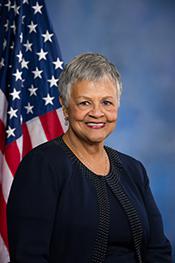
Bonnie Watson Coleman
DDemocratNJ-12 · Representative
57
/ 100
Average
Attendance99
Avg: 96
Independence2
Avg: 4
Bipartisan Tone10
Avg: 15
Ethics Record100
Avg: 99
Transparency67
Avg: 53
Accountability Score — composite of attendance, independence, bipartisan tone, ethics record & transparency.
Methodology38
Bills Sponsored
0
Enacted into Law
1
Passed a Chamber
37
In Committee
All Sponsored Bills
HRES1450In Committee
Condemning all forms of hate.
This resolution condemns all forms of discrimination and expresses support for policies to prevent and respond to hate crimes, including education and training on prevention and response.
HR9208In Committee
HEAR Act of 2026
The proposal would establish federal regulations for firearm silencers and mufflers, which are devices that reduce the noise produced by guns. Gun owners, manufacturers, and dealers would need to comply with new rules governing how these devices are made, sold, and used. The regulations would affect anyone who owns, manufactures, or sells firearms and sound-suppression equipment.
HR9114In Committee
Gig Is Up Act
Large businesses would be required to withhold payroll taxes directly from payments made to independent contractors, similar to how they currently withhold taxes from employee paychecks. This change would affect gig workers, freelancers, and other self-employed people who work with major companies, potentially reducing their tax filing burden but also changing how they receive and manage their income. The goal is to ensure consistent tax collection and reduce tax evasion among independent contractor arrangements.
HR9044In Committee
Minority Fellowship Program Reauthorization Act of 2026
The proposal would continue funding for a federal program that provides fellowships and training to minority students pursuing careers in public health, medicine, and related fields. By reauthorizing this program, the government would maintain financial support and educational opportunities designed to increase diversity among health professionals and help address health disparities in underserved communities. The measure would affect minority students, educational institutions, and healthcare organizations that participate in the fellowship program.
HR9021In Committee
Stay Cool Act
The legislation would strengthen how the federal government prepares for and responds to dangerous heat waves and extreme heat events that threaten public health and safety. It would likely establish new programs, funding, and coordination mechanisms across multiple agencies to help communities, workers, and vulnerable populations better prepare for and survive extreme heat conditions. The bill affects everyday Americans, outdoor workers, elderly people, low-income families, and communities most at risk from heat-related illness and death.
HR9008In Committee
Worker Rights and Support Act
The proposal would require employers to give workers paid time for meal breaks, rest periods, bathroom breaks, and medical appointments during the workday. Currently, federal law doesn't guarantee these breaks, so this change would establish a minimum standard that applies across most industries and affects millions of American workers and their employers.
HR3087In Committee
Civil Rights Cold Case Records Collection Reauthorization Act
This bill would extend and reauthorize a federal program that collects and preserves records related to unsolved civil rights murders and crimes from the civil rights era, helping investigators and researchers access historical documents that may shed light on these cases. The measure aims to ensure that government agencies continue funding efforts to locate, organize, and make available evidence and records that could assist in solving decades-old crimes against African Americans and other minorities. Families of victims and civil rights advocates would benefit from improved access to information about these historical injustices.
HR8869In Committee
Traumatic Births Research Act of 2026
The bill would fund and authorize research to study how traumatic experiences during childbirth and post-traumatic stress disorder affect mothers, newborns, and their families. This research would help doctors and mental health professionals better understand and treat birth-related trauma and its long-term effects on both parents and children. The legislation affects pregnant women, new mothers, infants, and healthcare providers who care for them.
HRES1292In Committee
To acknowledge the Black Women Best framework to empower and improve life for all through guaranteed income, expanding child and income tax credit, increasing access to equitable health care and government assistance, prohibiting policing in schools, and prioritizing restorative justice.
This resolution supports the need for and use of certain policy frameworks to incorporate the experiences of Black women into public policies.
HR8645In Committee
New Pathways Act
New Pathways Act This bill revises existing requirements for the Bureau of Prisons (BOP) to help prisoners obtain identification documents prior to their release. With respect to U.S. citizens, the BOP must obtain and provide a Social Security card, a proof of U.S. citizenship document, and a photo identification card. With respect to noncitizens, the BOP must help obtain proof of lawful status and, if applicable, an employment authorization document.
HR8360In Committee
Commission on Advancing Restorative Justice in Elementary and Secondary Education Act of 2026
The bill would create a new advisory commission made up of officials from the Education and Health and Human Services departments to study and recommend ways schools can use restorative justice practices—approaches that focus on repairing harm and rebuilding relationships rather than traditional punishment—in elementary and secondary schools. The commission would work to advance these practices across the country's public school system. This would primarily affect students, teachers, school administrators, and families looking for alternatives to suspensions and expulsions.
HR8130In Committee
Filer Voter Act
Tax Filer Voter Registration Act or the Filer Voter Act This bill treats certain tax return preparers as voter registration agencies. Specifically, the bill requires tax return preparers who prepare at least 100 individual tax returns in a taxable year to provide voter registration application forms to their customers. The form must be made available by (1) displaying copies of the form in the preparer's office for customers who receive in-person services, and (2) providing a hyperlink to the form for customers who receive online services. The bill also outlines the responsibilities of the Department of the Treasury to enable certified volunteer tax preparers to meet the requirements of the bill.
HRES1114In Committee
Recognizing Girl Scouts of the United States of America on its 114th birthday and celebrating its legacy of providing girls with a secure and inclusive space where they can explore their world, build meaningful relationships, and have access to experiences that prepare them for a life of leadership.
This is a ceremonial resolution honoring Girl Scouts of the United States of America on its 114th anniversary and recognizing the organization's role in providing girls with leadership development, community building, and educational opportunities. The resolution celebrates Girl Scouts' mission to create a supportive environment where girls can develop skills and confidence for their futures. It has no direct policy impact but serves as an official congressional acknowledgment of the organization's contributions to American youth.
HR7933In Committee
To amend title 10, United States Code, to expand the authority to provide a wig and treat traction alopecia under the TRICARE program, and for other purposes.
This bill would expand TRICARE (the military health insurance program) to cover wigs and medical treatment for traction alopecia, a condition where hair loss is caused by repeated pulling or tension on the hair, affecting military members and their families. Currently, TRICARE's coverage for these treatments is limited, so this change would make it easier for service members and their dependents to access these services as part of their military health benefits.
HR7858In Committee
Data Center Community Impact Act
This bill would likely require large data centers to assess and report on their impact to local communities, particularly regarding energy use, water consumption, and other environmental effects. The measure aims to give communities and regulators better information about how data centers affect their areas, potentially leading to stricter rules or mitigation requirements for companies operating these facilities. Data center operators, tech companies, and local governments would be the main groups affected by increased transparency and possible new regulations.
HR7859In Committee
Welcoming International Success Act
The bill would make it easier for foreign-born entrepreneurs and investors to start or expand businesses in the United States by streamlining visa and immigration processes for them. It aims to attract international business talent and capital by reducing bureaucratic barriers that currently make it difficult for successful foreign business owners to relocate to America. The changes would primarily benefit immigrant entrepreneurs, their employees, and the U.S. economy through job creation and business investment.
HR7566In Committee
Federal Jobs Guarantee Development Act of 2026
The bill would direct the federal government to develop and test a program guaranteeing job opportunities to Americans who want to work, likely through direct government employment or subsidized positions with private employers. This would affect workers seeking employment, federal agencies responsible for job placement, and potentially taxpayers funding the program. The proposal aims to address unemployment and underemployment by ensuring job availability rather than relying solely on traditional unemployment benefits.
HR7479In Committee
WORK to Save Lives Act
The bill aims to address workplace safety and health issues that could prevent worker deaths and injuries, though the specific measures aren't yet detailed in its current referred status. Once the House Committee on Education and Workforce reviews it, the legislation would likely establish new requirements or protections for employees across various industries. Workers, employers, and occupational safety agencies would be the primary groups affected by whatever workplace standards or enforcement mechanisms the bill ultimately proposes.
HR7456In Committee
Fundamental Immigration Fairness Act
The bill addresses immigration policy, though its specific provisions are not detailed in the available information. Based on the title's emphasis on "fairness," it likely proposes changes to how the immigration system operates, potentially affecting immigrants, employers who hire foreign workers, or the immigration court process. The bill has been sent to the House Judiciary Committee for review and consideration.
HR7385In Committee
PrEP Assistance Program Act
This bill would create a federal assistance program to help uninsured and underinsured people afford PrEP (pre-exposure prophylaxis), a medication that prevents HIV infection. The program would likely cover the cost of the drug and related medical care for eligible individuals who cannot otherwise afford it. This would expand access to HIV prevention for people at higher risk, regardless of their ability to pay.
HR7166In Committee
Stop Online Ammunition Sales Act of 2026
This bill would require ammunition sellers to verify buyers' identities and backgrounds before shipping ammunition orders online, similar to how licensed gun dealers currently operate in stores. The measure aims to prevent criminals and people prohibited from owning firearms from purchasing ammunition through internet sales, which currently have fewer restrictions than in-person purchases. It would affect online retailers, ammunition manufacturers, and anyone who buys ammunition through the internet.
HR7005In Committee
Customer Non-Discrimination Act
This bill would prohibit businesses from discriminating against customers based on protected characteristics like race, color, religion, sex, or national origin when providing goods and services. It would give customers who face discrimination the right to sue businesses and seek damages, similar to existing civil rights protections in employment and housing. The law would apply to most private businesses open to the public, though it may include certain exemptions for religious organizations or other specific categories.
HR6831In Committee
Stop Padding Presidential Pockets Act
This bill would restrict how much money a sitting president can earn from their personal business interests while in office, aiming to prevent presidents from profiting off their position. The proposal would likely require presidents to divest from or place their businesses in a blind trust, and would establish rules about what income sources are acceptable during their term. The bill affects presidents and their families, as well as taxpayers concerned about potential conflicts of interest.
HR6418In Committee
Employee Profit-Sharing Encouragement Act of 2025
The legislation would provide tax incentives to encourage companies to share profits with their employees through special retirement accounts or cash bonuses. Workers who receive these profit-sharing payments would get tax breaks on the money, while employers would receive tax deductions for setting up or contributing to profit-sharing plans. The goal is to help employees build wealth and retirement savings while giving businesses a financial reason to involve workers in company profits.
HR6243In Committee
Semiquincentennial Congressional Time Capsule Act
This bill would authorize Congress to create a time capsule to commemorate the 250th anniversary of American independence, allowing lawmakers to preserve documents, artifacts, and other items representing modern American life for future generations to discover. The time capsule would likely be stored in a congressional building or similar federal location and opened at a designated future date to give people centuries from now a snapshot of what Congress and the country were like today.
HR5671In Committee
Colorectal Cancer Payment Fairness Act
Colorectal Cancer Payment Fairness Act This bill eliminates Medicare coinsurance requirements with respect to colorectal cancer screening tests, regardless of the code billed for a resulting diagnosis or procedure.
HR4359In Committee
Public Housing Fire Safety Act
HR4212In Committee
SHADE Act
The proposal would establish new requirements for how housing developers and financial institutions handle shade and tree coverage in residential communities. It aims to protect existing trees and require shade planning in new housing developments, which could affect both homebuilders and residents seeking cooler, more livable neighborhoods. The measure is currently under review by the House Committee on Financial Services to determine its financial and regulatory implications.
HR3376In Committee
Water Affordability, Transparency, Equity, and Reliability Act of 2025
This bill aims to make drinking water more affordable and reliable for households while requiring water utilities to be more transparent about their operations and costs. It would likely establish programs to help low-income families pay their water bills, set standards for water quality and service, and ensure that water systems are maintained and upgraded properly. The legislation affects water companies, local governments, and millions of Americans who depend on public water systems.
HR3128In Committee
Improving Diaper Affordability Act of 2025
The proposal would make diapers more affordable for families by adjusting how they're taxed or treated under the tax code. Currently, diapers are subject to sales tax in most states, and this bill would likely reduce or eliminate that tax burden on parents and caregivers purchasing diapers for infants and young children. The change would primarily benefit lower and middle-income families who spend a significant portion of their budget on this essential childcare product.
HR2904In Committee
Pursuing Equity in Mental Health Act
The legislation aims to improve access to mental health services for underserved communities by requiring insurance companies to cover mental health treatments at the same rate as physical health treatments and directing federal funding toward mental health providers in low-income and rural areas. The bill would affect patients seeking mental health care, insurance companies, healthcare providers, and communities that currently have limited access to mental health services. It addresses disparities in mental health treatment by ensuring that insurance doesn't discriminate between mental and physical health coverage.
HR2587In Committee
Youth Mental Health Research Act
This bill would fund and support research into mental health conditions that affect young people, helping scientists better understand and treat issues like depression, anxiety, and other psychiatric disorders in children and teenagers. The funding would likely go to universities, medical centers, and research institutions to conduct studies that could lead to improved treatments and prevention strategies for youth mental health. This would primarily benefit young people struggling with mental health challenges and the doctors and therapists who treat them.
HR2479In Committee
Homes for Young Adults Act of 2025
This bill would likely create new programs or financial incentives to help young adults afford housing, such as down payment assistance, lower-interest loans, or tax breaks for first-time homebuyers. The legislation aims to address the challenge many young people face in saving enough money to buy their first home or secure affordable rental housing. It would primarily benefit young adults struggling with housing costs while potentially involving government agencies, lenders, and housing developers in implementing these support programs.
HRES239In Committee
Raising awareness of the racial disparities in the impact of colorectal cancer on the Black community.
This resolution recognizes the deadly impact colorectal cancer; acknowledges racial disparities in the impact of colorectal cancer, particularly in the Black community; and encourages actions to address colorectal cancer and those disparities.
HR469Passed House
Semiquincentennial Congressional Time Capsule Act
Semiquincentennial Congressional Time Capsule Act This bill requires the Architect of the Capitol to create a congressional time capsule in honor of the 250 th anniversary of the Declaration of Independence to be buried on the west lawn of the Capitol on or before July 4, 2026. Congressional leadership will determine the contents of the time capsule, and the time capsule shall be sealed until July 4, 2276.
HRES116In Committee
Condemning the pardons for individuals who were found guilty of assaulting Capitol Police Officers.
This resolution disapproves of pardons for individuals who were found guilty of assaulting U.S. Capitol Police officers.
HR905In Committee
EITC Modernization Act
EITC Modernization Act This bill expands eligibility for the earned income tax credit (EITC), provides a minimum EITC amount of $1,200 (subject to limitations), and allows an individual to receive the EITC as monthly payments. The bill also establishes a grant program for tax return preparation assistance for low-income individuals. Under the bill, EITC eligibility is expanded to include a student who meets certain requirements and an individual with a qualifying dependent, which includes a qualifying child, dependent who attains the age of 65 within the tax year and for whom the individual may claim a tax deduction for a personal exemption, and dependent or spouse who is physically or mentally incapable of caring for themselves and meets certain residency requirements. Further, for an individual who does not have a qualifying dependent, the bill lowers the EITC eligibility age to 18 years (from 25 years) and eliminates the maximum age limit. The bill allows an individual who meets certain requirements to receive the EITC in monthly payments and provides for a one-time increase in the first monthly payment. The bill also provides a new parent (through birth or adoption) an increase in their monthly EITC payments (subject to limitations). Finally, the bill establishes a grant program, which is similar to the existing Volunteer Income Tax Assistance program and provides funding for tax return preparation assistance for low-income taxpayers and members of underserved populations.
HRES52In Committee
Recognizing and honoring the work of community organizations and individuals who create and maintain services and educational programs for marginalized groups ensuring the resilience and prosperity of members of the LGBTQIA+ community.
This resolution recognizes the necessity and work of those who create LGBTQIA+ community spaces with the goals of equality and commends those who foster community partnerships between marginalized groups and local resources.