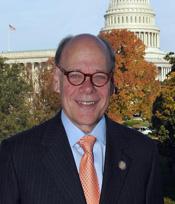
Steve Cohen
DDemocratTN-9 · Representative
57
/ 100
Average
Attendance95
Avg: 96
Independence2
Avg: 4
Bipartisan Tone3
Avg: 15
Ethics Record100
Avg: 99
Transparency79
Avg: 53
Accountability Score — composite of attendance, independence, bipartisan tone, ethics record & transparency.
Methodology41
Bills Sponsored
0
Enacted into Law
1
Passed a Chamber
39
In Committee
All Sponsored Bills
HR10653In Committee
Police Training and Independent Review Act of 2026
HJRES218In Committee
Proposing an amendment to the Constitution of the United States to abolish the electoral college and to provide for the direct election of the President and Vice President of the United States.
HRES1575In Committee
Impeaching Donald J. Trump, President of the United States, for high crimes and misdemeanors.
HR10516In Committee
FAIR Fees Act of 2026
HR10517In Committee
Fair Fees Act
HR9670In Committee
Medical Bankruptcy Fairness Act of 2026
This proposal would change bankruptcy laws to give special protections to people who have gone into serious debt because of medical bills or health crises. The changes would make it easier for people struggling with medical debt to get relief through bankruptcy without losing as much of their property or facing as many restrictions as they currently do.
HR9401In Committee
Latonya Reeves Freedom Act of 2026
The bill would prevent discrimination against people with disabilities who require long-term care services and supports, ensuring they have equal access to these services regardless of their disability status. It would protect individuals from being denied or treated unfairly when seeking assistance with daily living activities, medical care, or other support services they need to live independently or in community settings. The legislation affects people with disabilities, healthcare providers, insurance companies, and long-term care facilities that provide these essential services.
HR9186In Committee
Controlled Substances Act Clarification in Sciences Act of 2026
The proposal would update the federal law that regulates drugs like opioids and stimulants to better match current medical understanding and how doctors actually practice medicine today. The changes would affect how the government classifies controlled substances, how doctors can prescribe them, and how the medical and pharmaceutical industries operate under these rules. The bill is currently being reviewed by two congressional committees to determine which parts each should handle.
HRES1309In Committee
Impeaching John Glover Roberts, Jr., Chief Justice of the United States for high crimes and misdemeanors.
This resolution would formally charge Chief Justice John Roberts with high crimes and misdemeanors, which is the first step in the impeachment process that could potentially remove him from office. If approved by the House, the charges would move to the Senate for a trial where a two-thirds majority would be needed to convict and remove him. The resolution has been sent to the House Judiciary Committee for review.
HR8215In Committee
Volume II Transparency Act of 2026
This bill would require law enforcement agencies to publicly report detailed information about their use of force incidents, arrests, and other enforcement activities, making crime and policing data more transparent to the public. The legislation aims to help citizens, researchers, and policymakers better understand how police operate in their communities by standardizing what information gets collected and shared. It would affect police departments, sheriffs' offices, and other law enforcement agencies across the country.
HRES1065In Committee
Condemning and censuring President Donald Trump.
This resolution would formally express the House's disapproval of President Trump's actions and conduct, which is a symbolic statement of censure rather than a legal punishment. While a censure doesn't remove a president from office or carry legal consequences, it serves as an official congressional rebuke recorded in the historical record. The resolution has been sent to the Judiciary Committee for review and debate.
HR7354In Committee
Stop Underrides Act 2.0
This bill would require trucks to have better safety guards on their rear and sides to prevent smaller vehicles from sliding underneath them in crashes, which can be fatal. The measure aims to reduce underride accidents—where cars get trapped beneath large trucks—by setting stricter safety standards that truck manufacturers and owners would need to follow. The changes would primarily affect trucking companies and vehicle manufacturers while potentially saving lives among passenger vehicle drivers.
HR7310In Committee
Deadly Force Independent Review Act of 2026
This bill would require independent investigations and reviews whenever police officers use deadly force, rather than allowing police departments to investigate themselves. The goal is to ensure impartial oversight of officer-involved shootings and other fatal encounters to increase public trust and accountability in law enforcement.
HR5223In Committee
RESTORE Act of 2025
Re-Entry Support Through Opportunities for Resources and Essentials Act of 2025 or the RESTORE Act of 2025 This bill repeals a prohibition barring an individual with certain felony drug convictions from participating in the Supplemental Nutrition Assistance Program (SNAP). Under current law, a state may opt out of enforcing the ban on participation. The bill also allows an individual who is incarcerated to apply for SNAP benefits before their release date. Specifically, the bill amends the definition of household to include incarcerated individuals who are scheduled to be released from an institution within 30 days. Currently, a state agency may apply to the Food and Nutrition Service for an administrative waiver in order to allow individuals to apply for SNAP benefits up to 30 days prior to release.
HR6179In Committee
Clean Cloud Act of 2025
Clean Cloud Act of 2025 This bill establishes an emissions standard and fee system regarding the electricity used by data centers or cryptomining facilities that exceed a specified size. Additionally, the bill appropriates collected fees for various purposes, including to fund zero-carbon electricity generation, long-duration energy storage, and grants to lower residential electricity consumer costs. The bill requires the Environmental Protection Agency (EPA) and the Energy Information Administration to annually determine the greenhouse gas emission intensity of the total annual electricity consumed by (1) covered facilities from the electric grid, and (2) covered facilities from electricity generation assets located behind the power meter of the facilities. The EPA must determine and publish the greenhouse gas emissions intensities of the electric grid of each region to establish a baseline for the assessment of fees. Each calendar year from 2027 through 2034, the baseline for each region is reduced by 11% of the original baseline. For 2035 and after, the baseline is set to zero emissions. The EPA must assess a fee on (1) owners of any electric utility providing power to a covered facility that exceeds the baseline emissions in that region for that year, and (2) covered facilities with respect to the greenhouse gas emissions from electricity generation assets located behind the power meter of the facility above the baseline of the region for that year. The electric utilities may not recoup the cost of the fee by raising rates or assessing fees on customers that are not covered facilities.
HR1669Reported
To amend the Public Health Service Act to reauthorize the Stop, Observe, Ask, and Respond to Health and Wellness Training Program.
This bill reauthorizes through FY2030 the Stop, Observe, Ask, and Respond (SOAR) to Health and Wellness Training Program, which is administered by the National Human Trafficking Training and Technical Assistance Center in the Department of Health and Human Services. The program provides training for health care and social service providers on how to identify and support those who have experienced or are at risk of experiencing human trafficking.
HRES843In Committee
Supporting the designation of October 30 as the "International Day of Political Prisoners".
The proposal would officially recognize October 30 as an international day dedicated to raising awareness about people imprisoned for their political beliefs and activities. This designation aims to draw global attention to political prisoners and advocate for their rights, though it does not create any new laws or enforcement mechanisms. The measure has been sent to the House Committee on Foreign Affairs for consideration.
HR5727In Committee
ERRPA
End Racial and Religious Profiling Act of 2025 or ERRPA This bill establishes a framework to eliminate racial profiling by law enforcement agencies at the federal, state, and local levels. Specifically, it requires federal law enforcement agencies to maintain policies and procedures to eliminate racial profiling, including training, data collection, and complaint procedures. State, local, and tribal law enforcement agencies must maintain similar policies and procedures as a condition of receiving funds under the Edward Byrne Memorial Justice Assistance Grant program and the Community Oriented Policing Services program. To enforce violations, the bill authorizes civil suits by the Department of Justice and affected individuals.
HR5452In Committee
Safe Streets for All Reauthorization and Improvement Act
This bill would reauthorize and update federal funding and programs aimed at reducing traffic deaths and injuries on American roads, likely including grants to states and cities for safety improvements like better road design, traffic enforcement, and pedestrian protections. The legislation would affect transportation agencies, local governments, and the general public by directing resources toward making streets safer for drivers, pedestrians, and cyclists. The bill is currently being reviewed by lawmakers who focus on highway and transit issues.
HR5426In Committee
John Tanner and Jim Cooper Fairness and Independence in Redistricting Act
John Tanner and Jim Cooper Fairness and Independence in Redistricting Act This bill establishes requirements regarding congressional redistricting, including that redistricting plans must be developed by an independent redistricting commission. A state that has been redistricted after an apportionment of Representatives may not be redistricted again until after the next apportionment, unless the state is ordered by a court to conduct a subsequent redistricting in order to comply with the Constitution or enforce the Voting Rights Act of 1965. Each state must establish an independent redistricting commission to develop redistricting plans that meet specified criteria. If such a plan is not enacted into law, a state's highest court may select a plan developed by the state's commission. If the state court does not select a plan, a U.S. district court must develop a plan. The Election Assistance Commission must make payments to states to carry out redistricting.
HR5427In Committee
Billionaires Income Tax Act
This proposal would create a new annual tax on the wealth of Americans worth over $50 million, requiring them to pay taxes on the increased value of their assets each year rather than only when they sell them. The tax would apply to a small number of ultra-wealthy individuals and is designed to raise federal revenue, though it would represent a significant change to how the U.S. currently taxes investment gains. Supporters argue it would reduce wealth inequality, while opponents contend it could be difficult to implement and might discourage investment.
HR4587In Committee
Independent Acting IGs Act of 2025
This bill would allow inspectors general—officials who investigate fraud and misconduct within federal agencies—to continue serving in a temporary "acting" capacity without needing Senate confirmation, rather than requiring a permanent replacement to be appointed and approved. The change would affect how federal agencies maintain oversight and accountability, potentially allowing investigations to proceed more quickly but also reducing congressional input on who leads these watchdog positions. Government workers and the public would be impacted by how effectively these temporary leaders can investigate agency problems.
HR4026In Committee
POST Act of 2025
Protecting Our Students and Taxpayers Act of 2025 or the POST Act of 2025 This bill requires proprietary (i.e., for-profit) institutions of higher education (IHEs) to derive a larger portion of their revenues from nonfederal sources by replacing the existing 90/10 rule with an 85/15 rule. Specifically, the bill requires a proprietary IHE to derive at least 15% of its revenue from sources other than federal education assistance funds. (Currently, a proprietary IHE must derive at least 10% of its revenue from sources other than federal education assistance funds.) Additionally, the bill specifies how revenue must be calculated for purposes of the 85/15 rule. (Currently, the Higher Education Act of 1965 and accompanying regulatory provisions specify how revenue must be calculated for purposes of the 90/10 rule.) Finally, the bill makes a proprietary IHE that fails to meet the 85/15 rule's requirements for a fiscal year ineligible to participate in federal student aid programs for at least two institutional fiscal years. However, the proprietary IHE may regain eligibility if it complies with all eligibility and certification requirements for at least two institutional fiscal years. (Currently, if a proprietary IHE fails to meet the 90/10 rule's requirement in a single year, then its certification to participate in federal student aid programs becomes provisional for two institutional fiscal years. Further, if a proprietary IHE fails to meet the rule's requirements in two consecutive years, then it loses its eligibility to participate in these programs for at least two institutional fiscal years.)
HR3908In Committee
National Emergencies Reform Act of 2025
National Emergencies Reform Act of 2025 This bill requires congressional approval for national emergencies, termination of national emergencies after five years, and related reporting by the President. It also repeals the exemption of funds for overseas contingency operations/global war on terrorism from sequestration, which is a process of automatic, usually across-the-board spending reductions under which budgetary resources are permanently cancelled to enforce specific budget policy goals. The bill requires that the President’s declaration of a national emergency and specified emergency powers terminate after 20 Senate session days and 20 House legislative days unless Congress passes a joint resolution approving the declaration and emergency powers. Congress must similarly approve the President’s annual renewal of emergencies. The bill also establishes new procedures for expedited congressional review of national emergencies and removes the existing requirement for a congressional termination review every six months. Emergencies automatically terminate after five years. The bill continues to apply existing law to national emergencies for which the President proposes exercising certain international emergency powers. Additionally, the bill requires the President to provide to Congress a report on relevant circumstances when transmitting a declaration and status reports every three months during the emergency. Also, the President’s budget must include a report on the expenditure of funds pursuant to national emergencies and presidential emergency action documents must be submitted to Congress.
HR3712In Committee
Complete Streets Act of 2025
Complete Streets Act of 2025 This bill supports the development of safe and accessible roads through complete streets design and construction grants, policies, and design standards. Under the bill, a complete street means a public road that provides safe and accessible travel options for multiple travel modes (e.g., walking, cycling, transit, mobility devices, automobiles, and freight) for people of all ages, abilities, and disabilities. In general, each state must establish a competitive grant program that provides a portion of its federal highway funds to eligible entities for complete streets grants and technical assistance. Eligible entities include local and tribal governments, local agencies, metropolitan planning organizations (MPOs), and nonprofit organizations. An eligible entity must develop a complete streets policy and a prioritization plan. The state or an MPO must approve the policy and plan. The Department of Transportation (DOT) must develop complete streets benchmarks and guidance for states and eligible entities. In addition, DOT and the Department of Justice must update and adopt certain accessibility standards (e.g., by including provisions for cognitive ability and language access). Further, DOT must require each state and MPO to adopt and implement design standards for the safe and adequate accommodation of all surface transportation network users. DOT must also establish complete streets design standards for federal projects and phase in their adoption, with exemptions for certain roadways, facilities, and projects. The standards must include (1) dedicated, protected bike lanes; (2) requirements for sidewalks and crosswalks; and (3) guidelines for lighting and signalization to promote safety.
HR3623In Committee
Horse Transportation Safety Act of 2025
HR2621In Committee
REAL AMERICA Act
Reward Each American’s Labor And Make Every Rich Individual Contribute Again Act or the REAL AMERICA Act This bill establishes new federal tax deductions for cash tips and qualified overtime compensation, excludes Social Security and Tier I railroad retirement benefits from gross income for federal tax purposes, and modifies the taxation of carried interest. The bill allows individuals with a modified adjusted gross income (MAGI) of $450,000 or less ($900,000 or less for joint filers) to claim a federal tax deduction for (1) cash tips, and (2) qualified overtime compensation. The bill excludes all Social Security and Tier I railroad retirement benefits from gross income. (Currently, a portion of such benefits is included in gross income, depending on the beneficiary’s MAGI.) Under the bill, net capital gain and loss attributable to carried interest is recharacterized as ordinary and, thus, taxed at ordinary income tax rates. (Carried interest is currently taxed at capital gains tax rates, which may be lower than applicable ordinary income tax rates. Carried interest is the share of profits received by the general partner in a private equity firm or hedge fund from the assets managed by that general partner.) The bill also treats as ordinary the money (or fair market value of property) received by a partner in a sale or exchange of carried interest, requires distributions of carried interest by a partnership in exchange for interest in other partnership property to be recognized ordinary gain, and imposes self-employment taxes on carried interest income.
HR2178In Committee
Cerebral Palsy Research Program Authorization Act of 2025
Cerebral Palsy Research Program Authorization Act of 2025 This bill requires the Centers for Disease Control and Prevention to carry out a research program that addresses diagnosis and treatment, public health surveillance, and other aspects of cerebral palsy (a group of disorders caused by abnormal brain development or brain damage that affects an individual's ability to move and maintain balance and posture).
HR2040In Committee
NEWBORN Act
The NEWBORN Act would establish new federal requirements or programs related to newborn health care, screening, or services. Based on the health focus and newborn-specific subject matter, the bill likely aims to improve outcomes for infants and new mothers by expanding access to medical care, screening tests, or support services during the critical early months of life. The legislation would affect hospitals, healthcare providers, parents, and potentially insurance companies involved in newborn care.
HR1828In Committee
School Bus Safety Act of 2025
School Bus Safety Act of 2025 This bill directs the Department of Transportation (DOT) to issue rules requiring school buses to have certain safety features. DOT must also establish a grant program to assist in the implementation of the requirements. Specifically, DOT must issue rules requiring school buses to include three-point safety belts for all seats, a fire suppression system which addresses engine fires, a firewall between the engine and passenger compartment that prevents hazardous quantities of gas or flames from passing through the firewall, increased performance standards for interior flammability and smoke emissions, an automatic emergency braking system, an event data recorder, and an electronic stability control system. DOT must also require at least eight hours of behind-the-wheel training for school bus operators that meets specified requirements. Further, the Federal Motor Carrier Safety Administration and the National Highway Traffic Safety Administration (NHTSA) must issue rules on the evaluation of safety sensitive personnel for moderate-to-severe obstructive sleep apnea. NHTSA must also study the benefits of requiring school buses manufactured in, or imported into, the United States to be equipped with a motion-activated detection system that is capable of detecting road users (e.g., pedestrians and bicyclists) and alerting the bus operator of their presence. NHTSA must issue rules implementing such a requirement. Finally, DOT must establish a grant program to assist local educational agencies in (1) purchasing school buses equipped with three-point safety belts or any of the other safety features required under this bill, and (2) modifying existing school buses.
HR1240In Committee
National Statistics on Deadly Force Transparency Act of 2025
National Statistics on Deadly Force Transparency Act of 2025 This bill establishes a framework to require law enforcement agencies to collect data on the use of deadly force by law enforcement officers. Specifically, it requires federal, state, and local law enforcement agencies to collect, compile, and submit to the Department of Justice's (DOJ's) Bureau of Justice Statistics data on the use of deadly force by law enforcement officers. DOJ must reduce by 10% the allocation of funds under the Edward Byrne Memorial Justice Assistance Grant Program for a state or local government that fails to substantially comply.
HR1188In Committee
Police CAMERA Act of 2025
Police Creating Accountability by Making Effective Recording Available Act of 2025 or the Police CAMERA Act of 2025 This bill authorizes the Bureau of Justice Assistance within the Department of Justice to make grants for states, local governments, and Indian tribes to purchase or lease body-worn cameras for use by law enforcement officers and to implement body-worn camera programs.
HR1056In Committee
To include the Czech Republic in the list of foreign states whose nationals are eligible for admission into the United States as E1 nonimmigrants if United States nationals are treated similarly by the Government of the Czech Republic.
This bill allows a national of the Czech Republic to qualify for E-1 nonimmigrant status if the Czech Republic provides similar nonimmigrant status to U.S. nationals. E-1 classification allows nationals of certain countries (i.e., those with a treaty of commerce and navigation with the United States, those under a qualifying international agreement, or those deemed to qualify through statute) to be admitted solely to engage in international trade, along with their families and employees.
HRES81In Committee
Commending efforts to eradicate the wild poliovirus.
This resolution supports the goals of the Global Polio Eradication Initiative.
HR144Passed House
Tennessee Valley Authority Salary Transparency Act
Tennessee Valley Authority Salary Transparency Act This bill expands reporting requirements for the Tennessee Valley Authority (TVA). TVA is a government corporation that provides electricity in Tennessee and in portions of several surrounding states. It also provides flood control, navigation, and land management services for the Tennessee River system. The bill reinstates the requirement for TVA to file an annual financial statement and report with Congress in March. (The requirement was terminated by the Federal Reports Elimination and Sunset Act of 1995.) The bill also modifies the requirement that the report include the names, salaries, and duties of employees earning more than $1,500 a year. Under the bill, this information is only required for employees earning more than the maximum rate of basic pay for grade GS-13 of the General Schedule.
HR423In Committee
Private Student Loan Bankruptcy Fairness Act of 2025
Private Student Loan Bankruptcy Fairness Act of 2025 This bill modifies the treatment of certain student loans in bankruptcy. Specifically, it allows private student loans to be discharged in bankruptcy regardless of whether a debtor demonstrates undue hardship. Under current law, student loans may be discharged in bankruptcy only if the loans impose an undue hardship on the debtor.
HR385In Committee
Combating Global Corruption Act of 2025
Combating Global Corruption Act of 2025 This bill requires the Department of State to address corruption in foreign governments. The State Department must annually publish a ranking of foreign countries based on their government's efforts to eliminate corruption. Corruption, for the purposes of the bill, is the unlawful exercise of entrusted public power for private gain, including by bribery, nepotism, fraud, or embezzlement. The bill outlines the minimum standards that the State Department must consider when creating the ranking. These considerations include, for example, whether a country has criminalized corruption, adopted measures to prevent corruption, and complied with the United Nations Convention against Corruption and other relevant international agreements. Tier one countries meet the standards; tier two countries make some efforts to meet the standards; tier three countries make de minimis or no efforts to meet the standards. If a country is ranked in the second or third tier, the State Department must designate an anti-corruption contact at the U.S. diplomatic post in that country to promote good governance and combat corruption. The State Department must also evaluate whether there are foreign persons (individuals or entities) engaged in significant corruption in all third-tier countries for the purpose of potential imposition of sanctions under the Global Magnitsky Human Rights Accountability Act. The State Department must annually provide Congress with a list of those persons that the President has sanctioned pursuant to this evaluation, the dates sanctions were imposed, and the reasons for imposing sanctions.
HR264In Committee
Train EATS Act
Train Establishment of Appetizing Table Service Act or the Train EATS Act This bill requires Amtrak to provide a range of dining services to passengers on overnight routes. Specifically, Amtrak must make available (1) traditional dining (i.e., table service), to the extent practicable; and (2) an alternative food and beverage service that is more affordable than traditional dining. On each overnight route, Amtrak must offer any traditional dining capacity not otherwise used by first-class or business-class passengers to passengers in coach class for a fee. In addition, Amtrak must ensure that traditional dining on overnight routes includes (1) a healthy meal option, and (2) the option for passengers to preorder meals that satisfy their dietary restrictions. The Department of Transportation must issue any necessary regulations.
HR265In Committee
Train FOOD Act
Train Furtherance of Outstanding Onboard Dining Act or the Train FOOD Act This bill directs Amtrak to establish an advisory committee to provide internal review for Amtrak's implementation of the Amtrak Food and Beverage Working Group (FBWG) recommendations to improve onboard food and beverage service. The Amtrak advisory committee must submit an annual report to Congress on the status of Amtrak's implementation of each of the FBWG recommendations. The advisory committee's annual reports must be publicly available on an Amtrak website. In addition, the Government Accountability Office must submit a report to Congress describing Amtrak's progress in implementing each FBWG report recommendation.
HRES16In Committee
Recognizing Russian actions in Ukraine as a genocide.
This resolution condemns Russia for committing acts of genocide against the Ukrainian people. It also calls on the United States, in cooperation with North Atlantic Treaty Organization and European Union allies, to undertake measures to support the Ukrainian government to prevent further acts of Russian genocide against the Ukrainian people.
HR4740In Committee
Jobs for Urban Sustainability in America Act
Jobs for Urban Sustainability in America Act - Directs the Secretary of Commerce to make additional grants from unobligated Troubled Asset Relief Program (TARP) funds under the Emergency Economic Stabilization Act of 2008 (EESA) to: (1) cities with high unemployment (with a population of at least 600,000 and an unemployment rate of 10% or more) for public works, training, and economic development projects; and (2) firms adversely affected by import competition which are assisted under the Trade Adjustment Assistance for Firms Program. Directs the Secretary of Labor to make grants from such funds to carry out adult and dislocated worker employment and training activities under the Workforce Investment Act of 1998 in cities with high unemployment.