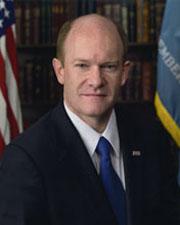
Christopher A. Coons
DDemocratDE · Senator
54
/ 100
Average
Attendance94
Avg: 97
Independence19
Avg: 23
Bipartisan Tone10
Avg: 14
Ethics Record100
Avg: 100
Transparency33
Avg: 47
Accountability Score — composite of attendance, independence, bipartisan tone, ethics record & transparency.
Methodology53
Bills Sponsored
1
Enacted into Law
1
Passed a Chamber
43
In Committee
Bills That Became Law
All Sponsored Bills
S5637In Committee
STRATA Act of 2026
S5676In Committee
Strengthening Civics Education Act
S5476In Committee
A bill to impose sanctions with respect to foreign persons that have facilitated Israeli settlement construction in the E1 area of the West Bank.
S5471In Committee
AI Systems Transparency Act
S5308In Committee
Afghanistan TPS Act of 2026
S5307In Committee
Artificial Intelligence and Innovation Talent Act
S5313In Committee
Quantum-GUARD Act of 2026
S5186In Committee
ASSET Act
The bill would remove restrictions on how much money and property people can have while still qualifying for federal assistance programs like food stamps and housing aid. Currently, these programs limit eligibility based on assets, meaning people lose benefits if they save too much money or own certain property; this change would let people keep more savings without losing assistance. The change would primarily affect low-income individuals and families who rely on these federal support programs.
S5170In Committee
Carbon Dioxide Removal Leadership Act of 2026
The federal government would be required to develop and deploy technology that captures carbon dioxide directly from the air or ocean to help reduce greenhouse gases in the atmosphere. This would involve the Department of Energy researching, building, and operating facilities that remove CO2 through direct air capture or similar methods, affecting energy policy and potentially creating new jobs in clean technology sectors. The goal is to address climate change by removing carbon that's already in the environment rather than just preventing new emissions.
S4392Reported
Energy Security Pacts Act
The legislation aims to strengthen America's and its allies' ability to access reliable energy sources and critical minerals needed for manufacturing, technology, and national defense. It would likely involve strategies to reduce dependence on potentially hostile countries for these resources and support domestic production or partnerships with friendly nations. This affects businesses in energy and manufacturing sectors, consumers who depend on affordable energy and products, and policymakers focused on national security.
S2546Reported
A bill to provide for an extension of the legislative authority of the National Emergency Medical Services Memorial Foundation to establish a commemorative work in the District of Columbia and its environs.
This bill extends the authority of the National Emergency Medical Services Memorial Foundation to establish a commemorative work in the District of Columbia that honors the commitment and service of emergency medical services.
S5035In Committee
National Coordination on Resilience for Security Act of 2026
The federal government would be required to develop a comprehensive national resilience strategy to help the country prepare for and recover from major disruptions like natural disasters, pandemics, or attacks. This strategy would coordinate efforts across different government agencies to strengthen critical infrastructure, supply chains, and communities so they can better withstand and bounce back from crises. The plan would affect how federal agencies work together and could influence policies that impact businesses, emergency responders, and the general public.
S5010In Committee
NO BOSS Act
States would gain more flexibility in how they run self-employment assistance programs, which help unemployed workers start their own businesses by providing training, counseling, and sometimes cash support while they transition from traditional jobs. The changes would modify tax rules that currently govern these state-run programs, potentially making it easier for states to design and manage them according to their own needs. This affects unemployed workers seeking to become entrepreneurs and the state agencies that administer these job training programs.
S4591Reported
NO FAKES Act of 2026
Nurture Originals, Foster Art, and Keep Entertainment Safe Act of 2026 or the NO FAKES Act of 2026 This bill creates a federal intellectual property right to protect individuals from unauthorized digital replicas (e.g., digital content made using generative artificial intelligence) of their voice and visual likeness. Specifically, the bill gives each individual or right holder the right to authorize (1) the use of a digital replica embodying the individual's voice or visual likeness, or (2) the use of the individual's voice or visual likeness for a product or service requiring authorization to avoid liability under the bill. This property right is not assignable during the individual’s lifetime but is licensable and does not expire upon the death of the individual. Generally, any individual or entity that engages in specified prohibited activities (e.g., distributing a digital replica without authorization) shall be liable in a civil action and subject to related penalties. The bill exempts specified uses from liability, such as categories of conduct likely to involve protected speech under the First Amendment (e.g., news reporting, sports broadcasts, and satire). The bill establishes (1) a notice-and-takedown process for unauthorized digital replicas; and (2) a counter-notification process, which allows an individual to contest the removal of a digital replica. The bill establishes penalties related to false or deceptive notice or counter-notice. The bill expressly preempts state laws related to digital replicas except for causes of action under state statutes or common law in existence as of January 2, 2025.
S4707In Committee
Responsible Artificial Intelligence Defense Act of 2026
The Department of Defense would establish official policies and procedures for developing and using autonomous weapons and artificial intelligence systems in military operations, including requirements to review and verify that these systems work safely and as intended before deployment. This would affect military personnel, defense contractors, and potentially civilians in conflict zones where these technologies might be used. The bill aims to ensure the Pentagon has clear guidelines for how much decision-making power to give to machines versus keeping humans in control of weapons systems.
SRES751In Committee
A resolution designating May 2026 as "ALS Awareness Month".
Congress would officially recognize May 2026 as a month dedicated to raising awareness about ALS (amyotrophic lateral sclerosis), a serious disease that affects nerve cells and causes progressive muscle weakness. This designation would encourage Americans, organizations, and government agencies to educate the public about the disease, support patients and their families, and promote research efforts to find treatments and a cure. The resolution is largely symbolic but helps bring national attention to a condition that currently has no cure and affects thousands of people in the United States.
S4664In Committee
Safer Choice Program Authorization Act of 2026
The Environmental Protection Agency's Safer Choice Program would be formally authorized to help businesses identify and use safer chemical alternatives in their products and manufacturing processes. This program affects companies across industries, consumers who use these products, and workers who handle chemicals, by promoting the development and adoption of less toxic substances. The bill would give the EPA official backing to continue and expand this voluntary partnership program that encourages safer innovation.
SJRES191In Committee
A joint resolution to direct removal of United States Armed Forces from hostilities within or against the Islamic Republic of Iran that have not been authorized by Congress.
This joint resolution directs the President to remove U.S. Armed Forces from hostilities within or against Iran unless a declaration of war or authorization to use military force for such purpose has been enacted. The resolution specifies that it shall not be construed to prevent the United States from defending against an attack on the United States or its personnel or facilities in other nations.
SRES716In Committee
A resolution expressing the sense of the Senate regarding critical elements of the United States policy towards the People's Republic of China.
The Senate is expressing its official position on how the United States should approach its relationship with China, covering important policy areas like trade, security, and diplomacy. This resolution doesn't create new laws or require specific actions, but instead signals what the Senate believes should guide American foreign policy decisions toward China. The measure is currently being reviewed by the Senate Foreign Relations Committee.
SRES702Introduced
A resolution commending the American Chemical Society on the occasion of its 150th anniversary and recognizing its many years of service to the United States.
This resolution honors the American Chemical Society for 150 years of work in chemistry research, education, and scientific advancement in the United States. The resolution recognizes the organization's contributions to developing new materials, medicines, and technologies that have benefited American industry and society. The Senate unanimously approved this commendation.
S4362In Committee
Railroad Retirement Fairness Act of 2026
Railroad workers and their families would receive changes to how their retirement benefits are calculated and paid under this proposal. The bill aims to address fairness concerns in the railroad retirement system, which operates separately from Social Security and covers employees of freight and passenger rail companies. The measure has been sent to the Senate committee responsible for labor and pension issues for review.
S4144In Committee
ESCRA Act
The bill addresses financial sector regulations, though the specific details would depend on what ESCRA stands for and what provisions it contains. Based on its referral to the Banking Committee, it likely aims to modify rules affecting banks, lending practices, or financial institutions in some way. Without more information about the bill's actual provisions, the exact impact on consumers, businesses, or the financial system cannot be determined.
S4145In Committee
Pro Codes Act of 2026
The bill would establish legal protections and standards for professional licensing codes used in construction and building trades, likely making it easier for workers to move between states without having to retake exams or get new licenses. This could help skilled tradespeople like electricians, plumbers, and contractors work across state lines more freely while ensuring they still meet safety and quality standards. The measure affects both workers seeking greater mobility and construction companies that operate in multiple states.
S2328In Committee
Military Learning for Credit Act of 2025
This bill would allow military service members and veterans to earn college credits for training and education they complete while serving in the armed forces, making it easier for them to finish college degrees after leaving the military. The change would help servicemembers transition to civilian careers more quickly and reduce the time and cost of getting a college degree by recognizing the skills and knowledge they've already gained through military training.
S4089In Committee
Supporting Blue Envelope Programs Act
This bill would support "Blue Envelope" programs, which help law enforcement officers and their families cope with trauma, mental health challenges, and financial hardship resulting from their work. The legislation likely provides funding or establishes guidelines for these peer-support and assistance programs that serve police officers, sheriffs, and other first responders dealing with job-related stress and crisis situations.
S4011In Committee
Tropical Forest and Coral Reef Conservation Reauthorization Act of 2026
This bill would renew and update federal funding and programs that help protect tropical forests and coral reefs around the world, likely through grants and partnerships with other countries. The legislation aims to preserve these ecosystems, which support wildlife and provide benefits like carbon storage and protection from storms, while also supporting conservation efforts in developing nations. The bill would affect environmental organizations, international partners, and potentially U.S. taxpayers who fund these conservation programs.
S3891In Committee
ICE Accountability Act
This bill would establish new oversight and accountability measures for Immigration and Customs Enforcement (ICE), likely including requirements for reporting on enforcement actions, detention practices, and civil rights complaints. The legislation would affect ICE operations, immigration detainees, and potentially immigrants and their families by creating stronger mechanisms to monitor how the agency conducts its work. The bill aims to increase transparency and ensure ICE follows proper procedures in its immigration enforcement activities.
S3424Enacted
Bankruptcy Administration Improvement Act of 2025
Bankruptcy Administration Improvement Act of 2025 This act makes several changes to the administration of bankruptcy cases, particularly by increasing amounts received by certain trustees, extending the sunset date of various fees, and extending the term of specified bankruptcy judgeships. (Sec. 3) The act increases the amounts paid out of fees to the trustee in Chapter 7 (liquidation) cases. (Sec. 4) The act extends for an additional five years the fees paid quarterly to the U.S. trustee in Chapter 11 (reorganization) cases. The act also increases the fee percentage for cases with large disbursements, subject to limitations. (Sec. 5) Finally, temporary bankruptcy judgeships in various districts are extended for an additional five years.
S3663In Committee
NDO Fairness Act of 2026
NDO Fairness Act of 2026 This bill increases the requirements the government must meet to obtain a nondisclosure order (NDO) under the Stored Communications Act (SCA). The SCA generally prohibits providers of remote computing services or electronic communication services (providers) from disclosing stored electronic communications or records (e.g., emails) or information pertaining to customers or subscribers. However, the SCA authorizes the government seek a warrant, order, or subpoena to compel providers to disclose electronic communications or records or information pertaining to customers or subscribers during an investigation. Providers may notify customers and subscribers of the warrant, order, or subpoena unless the government obtains a court order—an NDO—that delays the notification. This bill raises the standard the government must meet to obtain (or extend) an NDO. The bill also requires the court, before issuing an NDO, to issue a written determination that the standard was met based on specific and articulable facts, and to review the underlying warrant, order, or subpoena. The bill requires NDOs to be narrowly tailored. It also limits their duration to 90 days for most investigations, though it permits a duration of up to one year for investigations pertaining to an offense involving child pornography or sexual exploitation of children. Finally, the bill requires the Department of Justice to report annually on NDO-related data, including the number of customers or subscribers targeted; applications for orders; orders granted, extended, or denied; and orders targeting members of the media or conduct related to certain protected activities.
S3577In Committee
Auto Theft Prevention Act
Auto Theft Prevention Act This bill establishes a grant program to combat auto theft and stolen automobile trafficking. Specifically, the bill directs the Office of Community Oriented Policing Services within the Department of Justice to award grants for state and local law enforcement agencies to combat auto theft and stolen vehicle trafficking. The bill also allows funds under the Community Oriented Policing Services grant program to be used to combat auto thefts and stolen automobile trafficking.
S3438In Committee
HIRRE Prosecutors Act of 2025
The bill would likely authorize the federal government to hire additional prosecutors to handle criminal cases in federal courts. This would expand the workforce at the Department of Justice to help process more cases and potentially reduce backlogs in the federal criminal justice system, affecting how quickly federal crimes are prosecuted.
SRES540In Committee
A resolution recognizing Human Rights Day on December 10, 2025, and commemorating the 77th anniversary of the Universal Declaration of Human Rights and the Celebration of "Human Rights Day".
S3379In Committee
EARLY Benefits for Workers Act
The bill would allow workers to receive Social Security benefits earlier than the current minimum age, likely giving people access to retirement payments before they reach the standard eligibility age. This would affect millions of American workers nearing retirement and could provide financial relief to those who need income sooner, though it might result in lower monthly benefit amounts since payments would be spread over a longer period.
S3292In Committee
Platform Accountability and Transparency Act
SRES509Introduced
A resolution designating October 16, 2025, and October 16, 2026, as "World Food Day".
This resolution designates October 16, 2025, and October 16, 2026, as World Food Day. It also reaffirms the commitment of the United States to combating global food insecurity and malnutrition through humanitarian support and investment in resilient agriculture to improve long-term food security.
S3188In Committee
Biomanufacturing Excellence Act of 2025
This bill aims to strengthen the U.S. biomanufacturing industry—the production of medicines, vaccines, and biological products—by investing in research, workforce training, and manufacturing facilities. It would help American companies compete globally in biotechnology while reducing dependence on other countries for critical medicines and vaccines. The legislation affects pharmaceutical companies, research institutions, workers entering the biotech field, and patients who depend on these medicines.
SRES498Introduced
A resolution honoring Dr. Jane Goodall and her legacy as an ethologist, conservationist, and activist.
This resolution proclaims April 3, 2025, and April 3, 2026, as Jane Goodall Day and expresses gratitude for her dedication to the well-being of animals, conservation, and the planet as a whole.
SRES449In Committee
A resolution designating the week beginning on October 12, 2025, as "National Wildlife Refuge Week".
This resolution designates the week beginning on October 12, 2025, as National Wildlife Refuge Week. The resolution acknowledges the importance of national wildlife refuges for their recreational opportunities and contribution to local economies. Finally, the resolution reaffirms the support of the Senate for wildlife conservation and the National Wildlife Refuge System.
S1659Passed Senate
Bankruptcy Administration Improvement Act of 2025
Bankruptcy Administration Improvement Act of 2025 This bill makes several changes to the administration of bankruptcy cases, particularly by increasing certain fees, extending the sunset date of various fees, and extending the term of specified bankruptcy judgeships. The bill increases the fees paid to the trustee in Chapter 7 (liquidation) cases. The bill extends for an additional five years the fees paid quarterly to the U.S. trustee in Chapter 11 (reorganization) cases. The bill also increases the fee percentage for cases with large disbursements, subject to limitations. Finally, temporary bankruptcy judgeships in various districts are extended for an additional five years.
S2570In Committee
Energy Savings and Weatherization Reauthorization Act of 2025
This bill would reauthorize federal programs that help low-income households and buildings reduce energy costs by improving insulation, fixing air leaks, and upgrading heating and cooling systems. The legislation would provide funding and set new rules for weatherization assistance that helps families lower their utility bills while also reducing energy waste. The bill affects low-income households, building owners, and the contractors who perform these energy-saving upgrades.
S1883Reported
DISRUPT Act
The DISRUPT Act aims to counter foreign interference and destabilization efforts by authorizing new tools and strategies for the U.S. government to identify, prevent, and respond to activities by hostile nations and non-state actors that threaten American interests abroad. The legislation likely gives federal agencies expanded authority to take diplomatic, economic, or intelligence actions against countries or groups engaged in disinformation campaigns, election interference, or other disruptive operations targeting the United States or its allies. This would affect how the State Department, intelligence agencies, and other federal bodies coordinate their response to foreign threats.
S1463Reported
Finding ORE Act
Finding Opportunities for Resource Exploration Act or the Finding ORE Act This bill allows the U.S. Geological Survey (USGS) to enter into a memorandum of understanding (MOU) to partner with a foreign country in mapping the country's reserves of critical minerals and rare earth elements. A critical mineral is any mineral, element, substance, or material designated as critical by USGS because it is essential to U.S. economic and national security, has a vulnerable supply chain, and serves an essential function in manufacturing a product. Rare earth elements have catalytic, magnetic, electrical, and luminescent properties vital for civilian and defense purposes. In negotiating a MOU, USGS must seek to increase the security and resilience of international supply chains for critical minerals and rare earth elements by committing to assisting the partner foreign country through cooperative activities that help it map reserves; ensuring that private companies headquartered in the United States or an allied foreign country are offered the right of first refusal in the further development of critical minerals and rare earth elements in the partner foreign country; facilitating private-sector investment in the exploration and development of critical minerals and rare earth elements; and ensuring that the mapping data is protected against unauthorized access by, or disclosure to, governmental or private entities based in non-allied countries. USGS must obtain the concurrence of the Department of State in prioritizing and selecting partner foreign countries, negotiating or implementing a MOU, and notifying and reporting to Congress about issues related to a MOU.
S1974In Committee
ABC-ED Act of 2025
Based on the vague title and health subject matter, this bill likely addresses some combination of health policy, education, or workforce training related to health professions, though the specific details are unclear from the title alone. The bill has just been introduced and sent to the Senate committee responsible for health and education matters for initial review and discussion. Without access to the bill's actual text, the precise impact on patients, healthcare workers, or the health system cannot be determined.
S1660In Committee
Research Advancing to Market Production for Innovators Act
S1553In Committee
PREVAIL Act
Promoting and Respecting Economically Vital American Innovation Leadership Act or the PREVAIL Act This bill addresses various issues relating to the U.S. Patent and Trademark Office (USPTO), including by imposing additional requirements on administrative patent validity challenges (proceedings to review and potentially cancel issued patents) at the USPTO. The bill modifies provisions relating to inter partes reviews (IPRs) and other administrative patent validity proceedings, including by prohibiting an administrative patent judge who participated in deciding whether to institute an IPR (i.e., whether to allow the IPR to proceed based on the initial petition) from also participating in deciding the final outcome of the same IPR; prohibiting a person (individual or entity) from petitioning for an IPR against a patent unless the person meets certain standing requirements (currently, any person may petition for an IPR); prohibiting a person who has challenged a patent's validity in an IPR from raising the same challenges against the patent in other proceedings (e.g., district court) if the IPR has been instituted; and raising the burden that the petitioner in an IPR must meet to invalidate a previously issued patent claim. The bill also makes institutions of higher education (IHEs) and nonprofit entities that hold patents on behalf of IHEs eligible for reduced patent-related fees, including filing fees. (Currently, employees of IHEs are eligible for reduced fees but not the IHEs themselves.) The bill also makes fees collected by the USPTO available for the USPTO's use without further appropriations from Congress.
S1395In Committee
NO TIME TO Waste Act);
New Opportunities for Technological Innovation, Mitigation, and Education To Overcome Waste Act or the NO TIME TO Waste Act This bill directs the Department of Agriculture (USDA) to reduce U.S. food loss and waste (FLW) through federal coordination, grants, and education. Under the bill, food loss means the food that does not reach a consumer as a result of an issue in the production, storage, processing, or distribution phase. Food waste means that food intended for human consumption is unconsumed for any reason at the retail or consumption phase. The bill requires USDA to collaborate with the Food and Drug Administration and the Environmental Protection Agency to carry out a December, 17, 2020, agreement to coordinate federal efforts to cut FLW. Further, USDA must establish an Office of Food Loss and Waste to support the existing role of the Food Loss and Waste Liaison. The office must also, among other things, establish a grant program to support collecting data on existing state and local FLW policies (and the office must use the data to establish model policies for state and local governments); a block grant program for states and Indian tribes to develop and support food recovery infrastructure and innovative food distribution models; and a grant program to incentivize state, municipal, local, and tribal governments to establish public-private partnerships that commit to reducing FLW by 50% by 2030. The Office of Food Loss and Waste must also initiate a national FLW education and public awareness campaign.
S1367In Committee
NO FAKES Act of 2025
Nurture Originals, Foster Art, and Keep Entertainment Safe Act of 2025 or the NO FAKES Act of 2025 This bill creates a federal intellectual property right to protect individuals from unauthorized digital replicas (e.g., digital content made using generative artificial intelligence) of their voice and visual likeness. Specifically, the bill gives each individual or right holder the right to authorize the use of the individual's voice or visual likeness (1) in a digital replica, or (2) for a product or service requiring authorization to avoid liability under the bill. This property right is not assignable during the individual’s lifetime but is licensable and does not expire upon the death of the individual. Generally, any individual or entity that engages in specified prohibited activities (e.g., distributing a digital replica without authorization) shall be liable in a civil action and subject to related penalties. The bill exempts specified uses from liability, such as categories of conduct likely to involve protected speech under the First Amendment (e.g., news reporting, sports broadcasts, and satire). The bill establishes a notice-and-takedown process for unauthorized digital replicas. The bill establishes penalties related to false or deceptive notice. The bill expressly preempts state laws related to digital replicas except for causes of action under state statutes or common law in existence as of January 2, 2025.
S1235In Committee
Expanding Partnerships for Innovation and Competitiveness Act
Expanding Partnerships for Innovation and Competitiveness Act This bill establishes a nonprofit corporation, to be known as the Foundation for Standards and Metrology, to support the mission and activities of the National Institute of Standards and Technology (NIST). Among other activities, the foundation may support metrology and the development of benchmarks and technical standards infrastructure across NIST’s mission areas; advance collaboration between NIST and researchers, industry, nonprofit organizations, academia, and other specified entities; and offer direct support to NIST associates, including through the provision of grants, housing, training, and other appropriate expenditures. ( NIST associates are guest researchers, volunteers, and other nonemployees who conduct research or otherwise engage with NIST.) The foundation must not be an agency or instrumentality of the federal government. No officer or employee of the foundation may exercise administrative control over a federal employee. The foundation may solicit, accept, and use funds and gifts to support its activities, and it may transfer funds and property to NIST. The foundation must submit a strategic plan to Congress, including short- and long-term objectives and a plan for the foundation to become financially self-sustaining. The foundation must also publish periodic reports describing its activities, financial condition, and a description of all support provided to the foundation. The Government Accountability Office must report to Congress with an evaluation of the foundation’s operations and any recommendations for improvement.
S1067In Committee
Concrete and Asphalt Innovation Act of 2025
This bill would likely support research and development into more environmentally friendly ways to make and use concrete and asphalt, which are widely used in roads, buildings, and infrastructure projects. The legislation probably aims to reduce the pollution and carbon emissions that come from producing these materials, which are major contributors to climate change. Construction companies, road builders, and environmental groups would be the main stakeholders affected by any new standards or incentives the bill might create.
S708In Committee
RESTORE Patent Rights Act of 2025
Realizing Engineering, Science, and Technology Opportunities by Restoring Exclusive Patent Rights Act of 2025 or the RESTORE Patent Rights Act of 2025 This bill establishes a rebuttable presumption for injunctive relief in patent infringement cases. Specifically, if a court enters a final judgment finding infringement of a right secured by patent, the patent owner shall be entitled to a rebuttable presumption that the court should grant a permanent injunction with respect to that infringing conduct. (In 2006, the U.S. Supreme Court held in eBay v. MercExchange that patent holders do not have an automatic right to a permanent injunction in a patent infringement case.)
S655In Committee
Stop Tax Penalties on American Hostages Act of 2025
Stop Tax Penalties on American Hostages Act of 2025 This bill extends certain federal tax deadlines for U.S. nationals who are unlawfully or wrongfully detained abroad or held hostage abroad and their spouses. The bill also allows for an abatement and refund of additional taxes, interest, and penalties assessed to such individuals for failing to meet a federal tax deadline during a period of detention. Specifically, under the bill, the time period during which a U.S. national is unlawfully or wrongfully detained abroad or held hostage abroad is disregarded in determining certain federal tax deadlines, including deadlines for filing a return for and paying federal income, estate, gift, employment, or excise taxes; a tax credit or refund claim; and the determination, assessment, and collection of additional taxes, interest, or penalties. The bill requires the Department of State and the Department of Justice to annually provide the Internal Revenue Service (IRS) with lists to identify U.S. nationals who qualify for an extension. The bill also requires the IRS to (1) abate and refund additional taxes, interest, and penalties assessed for any tax year ending during a period of detention for which an extension of a federal tax deadline is permitted; and (2) establish a program allowing U.S. nationals unlawfully or wrongfully detained abroad or taken hostage abroad (or their spouse or dependent) to claim a refund of additional taxes, interest, and penalties assessed for any tax year ending during a period of detention from 2021 to the bill’s enactment date.
S656In Committee
Fair Credit for American Hostages Act of 2025
Fair Credit for American Hostages Act of 2025 This bill prohibits a consumer reporting agency from including adverse credit information on a consumer's credit report from an event that occurred during a time when that consumer was held hostage or wrongfully detained abroad.
S398In Committee
NO BAN Act
National Origin-Based Antidiscrimination for Nonimmigrants Act or the NO BAN Act This bill imposes limitations on the President's authority to suspend or restrict aliens from entering the United States. It also prohibits religious discrimination in various immigration-related decisions, such as whether to issue an immigrant or nonimmigrant visa, unless there is a statutory basis for such discrimination. The President may temporarily restrict the entry of any aliens or class of aliens after the Department of State determines that the restriction would address specific and credible facts that threaten U.S. interests such as public safety. The bill also imposes limitations on such restrictions, such as requiring the President, State Department, and the Department of Homeland Security (DHS) to (1) only issue a restriction when required to address a compelling government interest, and (2) narrowly tailor the suspension to use the least restrictive means to achieve such an interest. Before imposing a restriction, the State Department and DHS shall consult with Congress. The State Department and DHS shall report to Congress about the restriction within 48 hours of the restriction's imposition. If such a report is not made, the restriction shall immediately terminate. Individuals or entities present in the United States and unlawfully harmed by such a restriction may sue in federal court. The bill transfers the authority to suspend the entry of aliens traveling to the United States on a commercial airline that failed to comply with regulations related to detecting fraudulent travel documents from the Department of Justice to DHS.