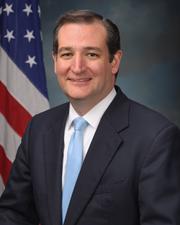
Ted Cruz
RRepublicanTX · Senator
57
/ 100
Average
Attendance95
Avg: 97
Independence24
Avg: 23
Bipartisan Tone13
Avg: 14
Ethics Record100
Avg: 100
Transparency36
Avg: 47
Accountability Score — composite of attendance, independence, bipartisan tone, ethics record & transparency.
Methodology98
Bills Sponsored
4
Enacted into Law
11
Passed a Chamber
71
In Committee
All Sponsored Bills
S283Enacted
Illegal Red Snapper and Tuna Enforcement Act
Illegal Red Snapper and Tuna Enforcement Act This bill directs the National Oceanic and Atmospheric Administration (NOAA) and the National Institute of Standards and Technology (NIST) to jointly develop a standard methodology for identifying the country of origin of seafood to support enforcement against illegal, unreported, and unregulated fishing (IUU fishing). It also authorizes technical assistance to other countries to help combat IUU fishing and transnational organized crime. NOAA and NIST must consult with U.S. Customs and Border Protection and the Coast Guard in developing the methodology, which must use chemical analysis to identify the country of origin of seafood. The methodology must be consistent with the needs of federal and state law enforcement agencies in combating IUU fishing. The methodology must also include a portable field kit and, to the extent practicable, be appropriate for testing prepared food (including raw preparations of seafood such as sushi). The agencies must conduct pilot studies of the methodology on red snapper and tuna. Within two years after the bill's enactment, NIST must report to Congress regarding the methodology and a plan for operationalizing it. The report must explain any aspects of its methodology that are impracticable, whether additional research would make the methodology practicable, and whether an alternate approach might be practicable. The bill also authorizes the Department of Defense to use operation and maintenance funds to provide technical assistance to maritime forces of other countries to help combat IUU fishing and transnational organized crime (e.g., by providing observers or data analysis).
S3798Passed Senate
Safe Access to Cash Act of 2026
This bill would require banks and financial institutions to maintain adequate access to cash for customers, making it illegal for them to eliminate in-person teller services or ATMs in ways that deny people reasonable access to their own money. The law aims to protect consumers—especially elderly people, rural residents, and those without reliable internet access—from being forced into digital-only banking when they prefer or need to use physical cash. It addresses concerns that some banks have been closing branches and removing ATMs, which can make it difficult for certain groups to withdraw and deposit money safely.
S4009Passed Senate
Falun Gong and Victims of Forced Organ Harvesting Protection Act
This bill would impose sanctions and restrictions on Chinese officials and entities believed to be involved in forced organ harvesting, particularly targeting the persecution of Falun Gong practitioners and other religious minorities. The legislation aims to pressure the Chinese government to stop these practices by limiting their access to U.S. markets, freezing assets, and denying visas to those responsible. It affects U.S. foreign policy toward China and could impact American companies doing business with sanctioned Chinese entities.
S4668Passed Senate
Protect College Sports Act of 2026
Protect College Sports Act of 2026 This bill establishes requirements for name, image, or likeness (NIL) agreements for college student athletes and provides a limited antitrust exemption for schools and conferences to pool and sell certain college sports media rights. The requirements address elements of the court-approved agreement to settle In re College Athlete NIL Litigation (i.e., House settlement ). First, the bill statutorily prohibits institutions, conferences, or interstate intercollegiate athletic associations (e.g., the National Collegiate Athletic Association [NCAA]) from restricting student athletes from entering NIL agreements (subject to specified limitations). Students must report to their institution NIL compensation greater than $600. The bill requires agents to register with a state and caps agent endorsement contract fees at 5%. The bill also provides student athletes with one transfer without losing athletic eligibility and restricts football personnel from becoming the head football coach at a different institution during the same season. Further, the bill prohibits institutions, conferences, or specified entities acting for the benefit of an institution from providing athletes with compensation that circumvents the limit on sharing revenue with student athletes established under the House settlement. The bill also makes the limit permanent and provides for an annual inflation adjustment. The bill generally prohibits Division I conferences from reducing the number of varsity or Olympic sports teams that a member institution must sponsor. Specifically, large institutions ($80 million or more in annual athletics revenue) must offer and maintain at least as many grant-in-aid opportunities and roster spots for sports that do not generate positive net revenue as the institution provided during academic year 2024-25. The bill provides for a waiver of this requirement under certain circumstances of financial hardship and the requirements expire nine years after the enactment of the bill. Additionally, the bill establishes (subject to specified conditions) a limited antitrust exemption for institutions or conferences that form joint agreements to transfer their sports telecasting rights to a third party. Such an agreement requires participation from at least 75% of the institutions in the Football Bowl Subdivision.
S3923Reported
Weather Research and Forecasting Innovation Reauthorization Act of 2026
This bill would renew federal funding and authority for weather research and forecasting programs that help predict storms, hurricanes, and other dangerous weather conditions. The legislation supports the scientists and technology that meteorologists use to issue warnings that protect people's lives and help transportation systems, airlines, and emergency responders prepare for severe weather. By reauthorizing these programs, the bill ensures the government can continue improving weather prediction accuracy and investing in the tools communities rely on to stay safe.
S759Enacted
Modernizing Access to Our Public Oceans Act
Modernizing Access to Our Public Oceans Act This act directs the National Oceanic and Atmospheric Administration (NOAA) to standardize and publish geospatial data related to public recreational use of federal waterways (e.g., boating and fishing). Under the act, NOAA must consult with relevant stakeholders (including state and local governments, Indian tribes, and Native Hawaiian organizations) to develop and adopt standards for the coordination and dissemination of geospatial data relating to fishing restrictions and recreational vessels' use of federal waterways, including the exclusive economic zone of the United States (EEZ). (The EEZ generally includes waters between 3 and 200 miles seaward from the U.S. coastline.) Within four years after the act is enacted, NOAA must provide geographic information system data on a public website that identifies and describes the locations where and conditions under which certain recreational activities are restricted in federal waterways. Specifically, the website must identify (1) locations where fishing restrictions are imposed, (2) areas in the EEZ with restrictions on specified recreational vessel types, and (3) federally protected areas (e.g., National Marine Sanctuaries). NOAA must also continue to provide digitized navigation information related to the EEZ and make the information available on the website to the extent practicable. The act allows NOAA to coordinate and partner with nonfederal entities to carry out this act. It also directs NOAA to work with other federal agencies to ensure compatibility and interoperability among federal databases with respect to collecting and disseminating geospatial data related to the public outdoor recreational use of the EEZ.
S5514In Committee
Responsible Cormorant Management and Control Act of 2026
S5550In Committee
529 Retirement Enhancement Act of 2026
S2887Reported
Route 66 National Historic Trail Designation Act
This bill would officially designate Route 66 as a National Historic Trail, giving it the same federal protection and recognition as other historic trails across the country. The designation would help preserve the historic highway's cultural significance, support tourism and local economies along the route, and make it easier for the federal government to coordinate preservation efforts with states and communities that the road passes through.
S4749In Committee
JAWBONE Act
The bill would allow people and companies to sue the federal government if they believe government officials improperly pressured them to censor or remove speech from their platforms or publications. It aims to protect free speech by making it illegal for government agencies to use threats or coercion to influence what private companies decide to publish or take down, affecting social media platforms, news outlets, and other media companies.
S32Enacted
LACA
Local Access to Courts Act or LACA This act adds College Station to the list of places where court must be held in the Galveston Division of the Southern District of Texas. Additionally, the act adds El Centro to the list of places where court must be held in the Southern District of California.
S5188In Committee
Muhammad Ali American Boxing Revival Act of 2026
The legislation would strengthen safety rules for professional boxers by requiring major boxing organizations to follow consistent standards for fighter health and protection. It aims to improve conditions for boxers through enhanced medical requirements, safety protocols, and oversight of the organizations that sanction fights. The bill would affect professional boxers, boxing promoters, and the major boxing organizations that currently operate with varying rules.
S58Reported
A bill to designate the facility of the United States Postal Service located at 107 North Hoyne Avenue in Fritch, Texas, as the "Chief Zeb Smith Post Office".
This bill designates the facility of the United States Postal Service located at 107 North Hoyne Avenue in Fritch, Texas, as the Chief Zeb Smith Post Office.
S2394Reported
A bill to designate the facility of the United States Postal Service located at 505 East 9th Avenue in Amarillo, Texas, as the "Mayor Jerry H. Hodge Post Office Building".
This bill designates the facility of the United States Postal Service located at 505 East 9th Avenue in Amarillo, Texas, as the "Mayor Jerry H. Hodge Post Office Building".
S5369In Committee
Restoring Electoral Fairness and Opposition Rights through Mandates for Accountability Act of 2026
S5289In Committee
Right to Worship Act
S4407In Committee
CHATBOT Act
This bill would require AI chatbot companies to set up special family accounts for children and get verifiable permission from parents before teens can use their services. The law aims to give parents more control over what AI tools their kids interact with and what information those tools collect about them. It would apply to companies that offer AI chatbots to young users.
SRES829In Committee
A resolution reaffirming the policy of the United States to support a peaceful democratic transition in Venezuela through free and fair elections.
S5158In Committee
Federal Insurance Office Abolishment Act of 2026
The proposal would eliminate the Federal Insurance Office, a Treasury Department agency that monitors the insurance industry and advises Congress on insurance-related issues. This would affect insurance companies, regulators, and consumers by removing a federal body that tracks insurance market trends and potential risks. The bill is currently under review by the Senate Banking Committee.
S3018Reported
A bill to permit visiting dignitaries and service members from Taiwan to display the flag of the Republic of China.
This bill would allow Taiwanese government officials and military personnel visiting the United States to display Taiwan's flag in public. Currently, diplomatic protocols restrict such displays, so this change would give Taiwan's representatives the same flag-flying privileges that other countries' visitors enjoy. The change primarily affects how Taiwan is treated in official U.S. settings and symbolizes a shift in how America recognizes Taiwan's status.
S5130In Committee
Human Dignity and Emerging Technologies Act
The proposal would create a new federal commission focused on protecting human dignity in areas like technology, medicine, and scientific research. The commission would study how emerging technologies and policies affect people's rights and well-being, and make recommendations to Congress on protecting individuals from potential harms. This would affect technology companies, researchers, healthcare providers, and the general public by establishing oversight of how new innovations are developed and used.
S5110In Committee
Improving America's Literacy Act
The bill would establish new requirements for reading and literacy programs in elementary and secondary schools that receive federal funding under existing education law. Schools would need to follow specific guidelines when implementing these literacy activities, likely affecting how teachers instruct reading and how schools allocate resources for language arts programs. The changes would impact students, teachers, and school administrators across the country.
S4894In Committee
FUSE Act
The federal government would create a test program to study how to safely make and use special materials that can be 3D-printed to create energetic devices (like explosives or propellants). This pilot program would establish safety standards and qualification requirements for these printable materials, helping manufacturers and the military understand best practices before widespread use. The program would affect defense contractors, manufacturers working with advanced 3D printing technology, and military agencies that might use these materials.
S4902In Committee
PROTECT Act
The government would prevent private companies and individuals from trademarking symbols, logos, or names that the military already uses for official awards and honors. This protects military decorations like the Medal of Honor and Purple Heart from being commercialized or misused by businesses trying to profit off them. The change affects trademark applicants and companies that might otherwise try to register these protected military symbols as their own brands.
S4863In Committee
Save Our Shrimpers Act
Save Our Shrimpers Act This bill requires the Department of the Treasury to instruct U.S. leadership of international financial institutions (e.g., the International Monetary Fund and the World Bank) to oppose providing financial assistance for any project to support shrimp farming, shrimp processing, or the export of shrimp in a borrowing country. Treasury may waive this requirement with respect to a project upon notifying Congress that the waiver is in the national interest of the United States. The requirement expires seven years after the enactment of this bill.
S4783In Committee
COMPASS Act
The proposal would change federal law to give military members and their families special protections and support when they homeschool their children, recognizing the unique challenges that come with frequent moves and deployments. Currently, the Servicemembers Civil Relief Act provides various legal protections for active-duty service members, but this bill would expand those protections to specifically address homeschooling situations. The changes would help military families avoid penalties or legal issues related to homeschooling requirements that might conflict with military service obligations.
S4693In Committee
NEW HORIZON Act
The Department of Defense would test whether it can use commercial companies' data centers and cloud computing services located in space to support military operations and national security missions. This pilot program would evaluate whether these space-based services could help the military process information and run systems more effectively than current methods. The test would determine if this approach is practical and beneficial before the military decides whether to use it more widely.
S4677In Committee
SUSTAIN Act
The military would be prohibited from reducing the number of MQ-9 Reaper drone aircraft units below current levels, protecting jobs at defense contractors and maintaining surveillance and strike capabilities for the armed forces. This affects military personnel, defense workers, and the defense industry that manufactures and maintains these unmanned aircraft. The bill is currently under review by the Armed Services Committee.
S3966Passed Senate
TREY'S Law
Terminating Restrictive Enforcement of Youth Settlements Law or TREY'S Law This bill limits the enforceability of nondisclosure clauses that prohibit the disclosure of sexual abuse against a minor. Specifically, the bill makes a nondisclosure clause in a contract void and unenforceable to the extent that it prohibits (1) a victim or alleged victim of sexual abuse against a minor from disclosing the sexual abuse or facts related to it, or (2) any other person from disclosing facts related to the sexual abuse of a minor. These changes apply to any nondisclosure clause in a contract entered into before, on, or after this bill's date of enactment. Further, the changes made by this bill supersede any state law to the extent the state law permits enforcement of a nondisclosure clause that prohibits the disclosure of sexual abuse against a minor.
S4521In Committee
Army Organic Industrial Base Mineral Partnerships Act of 2026
The Army would be allowed to partner with private companies to extract minerals from land at military industrial facilities, potentially generating revenue while maintaining military operations on those sites. These partnerships would let the Army lease or contract with mining companies to access valuable minerals like rare earth elements or metals found on Army property. The arrangement could benefit both the military's budget and domestic mineral supply chains, though it would require oversight to ensure mining activities don't interfere with military readiness or environmental protection.
S2975Passed Senate
PIPELINE Safety Act of 2025
This bill would strengthen safety requirements for natural gas and hazardous liquid pipelines, likely including new inspection standards, leak detection systems, and emergency response procedures to protect communities near pipeline infrastructure. The rules would apply to pipeline companies and operators, with oversight from federal regulators to reduce the risk of accidents, explosions, and environmental damage. Workers in the pipeline industry and residents living near pipeline routes would be the primary groups affected by these new safety measures.
S4412In Committee
No FED in West Texas Act
No Federal Expansion Designation in West Texas Act or the No FED in West Texas Act This bill prohibits the Department of the Interior from finalizing, implementing, administering, or enforcing its 2023 final land protection plan and environmental assessment for the Muleshoe National Wildlife Refuge in Texas. The plan allows Interior to expand the refuge and purchase lands or acquire conservation easements on up to 700,000 acres of land in the Southern High Plains region along the Texas-New Mexico border.
SRES695Introduced
A resolution commemorating April 6, 2026, as the day the Artemis II crew surpassed the record for the farthest distance traveled by astronauts into deep space and celebrating the success of the Artemis II mission.
This resolution officially recognizes April 6, 2026, as the date when the Artemis II astronauts traveled farther into space than any human crew before them, breaking the previous distance record. The resolution celebrates this achievement in space exploration and honors the astronauts and teams involved in the successful mission. The Senate has already approved this resolution unanimously.
S4340In Committee
Stop Climate Shakedowns Act of 2026
This bill would shield energy companies and workers in the mining, oil, gas, and power industries from lawsuits seeking damages or court orders to stop their operations, even if their products cause harm. The protection would apply across the entire energy supply chain, from extraction and refinement to sale to consumers. The measure would significantly limit the ability of individuals, communities, and governments to sue energy producers for environmental damage, health problems, or other injuries allegedly caused by fossil fuels and energy products.
S2351Reported
Space Exploration Research Act
Space Exploration Research Act This bill explicitly authorizes the National Aeronautics and Space Administration (NASA) to lease its properties to states and localities, universities, and nonprofit organizations to conduct space research and training. (Under current law, NASA is authorized to lease property to individuals and entities subject to specified conditions.) Under the bill, NASA may use existing authorities to lease property under its jurisdiction to (1) the state in which the property is located or a subdivision thereof, (2) a nonprofit organization founded for educational or scientific purposes, or (3) an institution of higher education. NASA may also enter into agreements to lease back such property. Construction and operations on leased property must serve a space-related purpose relevant to NASA’s mission. NASA may provide administrative, instructional, and other appropriate support to lessees. NASA must report annually to Congress on the relevance, value, and other quantifiable benefits of the lease agreements.
S4063In Committee
Polisario Front Terrorist Designation Act of 2026
This bill would officially designate the Polisario Front, a militant group involved in the Western Sahara conflict, as a terrorist organization under U.S. law. The designation would restrict the group's ability to operate in the United States, freeze any assets they hold here, and make it illegal for Americans to provide support or resources to them. The change would affect U.S. foreign policy toward the Western Sahara dispute and could impact diplomatic relations with countries that support or oppose the Polisario Front.
S933In Committee
NASA Transition Authorization Act of 2025
NASA Transition Authorization Act of 2025 This bill reauthorizes through FY2025 the programs and activities of the National Aeronautics and Space Administration (NASA). The bill also revises certain existing NASA programs and establishes new programs related to space exploration, research, and technology. For example, the bill directs NASA to continue its efforts to support crewed lunar landings and Mars explorations, including through partnerships with the private sector (i.e., the Moon to Mars and Artemis programs). The bill also requires NASA to maintain the capability for a continuous human presence in low-Earth orbit until and beyond the retirement of the International Space Station (ISS). NASA may solicit proposals for the development of a commercial space station in low-Earth orbit. When such a station is ready, NASA must initiate an orderly transition of operations from the ISS to the commercial station. NASA must also develop a de-orbit vehicle for the eventual retirement of the ISS. ( Low-Earth orbit encompasses orbits at an altitude of 1,200 miles or less.) In addition, NASA is authorized to develop an architecture for lunar communications and navigation, and must develop a strategy to implement a standardized lunar time to support operations and infrastructure on and around the moon. NASA must also continue to conduct research relating to advanced air mobility, unmanned aircraft systems (i.e., drones), and hypersonic technologies. Finally, the bill requires the Government Accountability Office to report on fire and emergency services at NASA launch and reentry facilities.
S3972In Committee
Highway Formula Fairness Act
This bill would change how the federal government distributes highway funding to states, likely shifting money away from some states and toward others based on a new formula for calculating each state's share. The changes would affect state transportation departments and local governments that rely on federal highway dollars to build and repair roads. The specific details of the new formula would determine which states benefit and which lose funding under this approach.
S3942In Committee
SPONSOR Act
The SPONSOR Act appears to address tax policy, though the specific provisions are not detailed in the available information. Based on its referral to the Senate Finance Committee, it likely proposes changes to how certain entities or individuals are taxed, though without more details about the bill's contents, the exact impact on workers, businesses, or taxpayers cannot be determined.
S2503Passed Senate
ROTOR Act
Rotorcraft Operations Transparency and Oversight Reform Act or the ROTOR Act This bill addresses aviation safety by increasing requirements for aircraft tracking and communication using Automatic Dependent Surveillance-Broadcast (ADS-B) technology and expanding oversight. As background, ADS-B for broadcasting (Out) and receiving (In) transmits information (e.g., location and weather information) between aircraft and air traffic control. Under the bill, aircraft must generally operate with ADS-B In equipment to provide the aircraft with location information of other aircraft and traffic advisories. Current law does not require this equipment. Current Federal Aviation Administration (FAA) regulations allow aircraft performing a sensitive government mission to be excepted from requirements for using ADS-B Out equipment. This bill limits which flights may be considered sensitive government missions (e.g., not training flights) and requires additional reporting and notifications for the exception. The Government Accountability Office must review the use of the ADS-B Out exception and the Office of the Inspector General (OIG) of the Department of Transportation must annually audit FAA oversight of operations that use the exception. Further, the bill repeals a 2025 law that exempts certain military helicopters from the ADS-B Out requirements for the Washington, DC, metropolitan area. The bill also requires the OIG of the Army to audit the Army’s coordination with the FAA, the FAA to establish an office to coordinate airspace usage of military aircraft and review the safety of flight operations and routes around airports, and the FAA to enter into memoranda of understanding with military agencies for safety information sharing.
S3639In Committee
SAT Streamlining Act
This bill would streamline and modernize how the federal government handles science, technology, and communications regulations and programs. The changes would likely reduce bureaucratic delays and make it easier for companies and researchers to work with federal agencies in these fields. The bill has advanced through the Senate Commerce Committee and is moving toward a full Senate vote.
S3862In Committee
Payment Integrity Act
This bill would likely establish or strengthen measures to prevent fraud and improper payments in federal benefit programs that serve families, such as child tax credits, welfare assistance, or childcare subsidies. The legislation aims to ensure that government money reaches eligible recipients while catching cases where people receive benefits they shouldn't qualify for. It would affect families receiving federal assistance as well as the agencies responsible for distributing these benefits.
S3849In Committee
Community Bank Relief Act
This bill would likely ease financial regulations and compliance requirements for smaller community banks, making it cheaper and easier for them to operate. The changes would probably help community banks compete with larger national banks and continue lending to local businesses and homeowners. Community banks, their customers, and small business owners in rural and underserved areas would be the main beneficiaries.
S1510Passed Senate
Civil Rights Cold Case Records Collection Reauthorization Act
The government would continue funding efforts to collect, preserve, and make public records related to unsolved civil rights murders and crimes from decades past, helping families, researchers, and the public understand historical injustices. This reauthorization extends a program that works to locate documents held by federal agencies about these cold cases and ensures they remain accessible for investigation and historical documentation. The measure affects civil rights advocates, descendants of victims, historians, and law enforcement agencies involved in reviewing these historical cases.
S3418In Committee
COMPETE Act
I don't have enough specific information about this particular COMPETE Act bill to write an accurate summary, as the title and subject area alone don't clarify what health policy changes it would make. To provide you with a meaningful explanation of what this bill would actually do and who it affects, I would need additional details about its specific provisions or legislative language.
S3263In Committee
Stop TSP ESG Act
Stop TSP ESG Act This bill prohibits a qualified professional asset manager from exercising voting rights associated with the ownership of securities by the Thrift Savings Fund. Under current law, the term qualified professional asset manager includes certain banks, savings and loan associations, insurance companies, and investment advisers.
SRES463In Committee
A resolution expressing condemnation of the Chinese Communist Party's persecution of religious minority groups, including Christians, Muslims, and Buddhists and the detention of Pastor "Ezra" Jin Mingri and leaders of the Zion Church, and reaffirming the United States' global commitment to promote religious freedom and tolerance.
The Senate passed a resolution condemning China's government for persecuting religious groups including Christians, Muslims, and Buddhists, and specifically calling out the detention of Pastor Jin Mingri and other leaders of the Zion Church. The resolution reaffirms the United States' commitment to promoting religious freedom and tolerance worldwide. While this is a symbolic statement rather than a law that changes policy, it expresses Congress's official position on religious persecution in China.
S3120In Committee
Ensuring Predictable and Reliable Water Deliveries Act of 2025
This bill likely addresses water-sharing agreements or disputes between the United States and other countries, possibly involving shared rivers or water resources. It probably aims to establish more stable and dependable water supplies for American communities, farmers, or businesses that rely on international water sources. The bill has been sent to the Foreign Relations Committee, suggesting it involves negotiating or managing water agreements with neighboring nations like Mexico or Canada.
S3113In Committee
Deporting Fraudsters Act of 2025
S3081In Committee
Reciprocity Ensures Streamlined Use of Lifesaving Treatments Act of 2025
Reciprocity Ensures Streamlined Use of Lifesaving Treatments Act of 2025 This bill establishes a reciprocal marketing approval process that allows for the sale of a drug, biological product, or medical device that has not been approved by the Food and Drug Administration (FDA) if the product is approved for sale in another country and there is an unmet need for the product. Specifically, in order to receive reciprocal approval, the bill requires the product's sponsor to demonstrate, among other things, that (1) the product has been approved in one of the countries specified in the bill, (2) neither the FDA nor any of the specified countries have withdrawn approval for the product because of safety or effectiveness concerns, and (3) there is a public health or unmet medical need for the product. The FDA may decline approval if it determines that the product is not safe or effective. The FDA may condition reciprocal approval on the conduct of postmarket studies. The FDA must issue a decision on whether to grant a request for reciprocal marketing approval within 30 days of receiving the request. Congress may pass a joint resolution to grant reciprocal marketing approval of a product that the FDA declines to approve through the reciprocal process.
S582Reported
Astronaut Ground Travel Support Act
Astronaut Ground Travel Support Act This bill permits the National Aeronautics and Space Administration (NASA) to use government-owned passenger vehicles to transport astronauts and other space flight participants to and from post-mission medical research and treatment activities. (After returning to earth, astronauts generally undergo a post-mission medical recovery program and may be prohibited from driving motor vehicles for varying periods of time.) Under the bill, transportation may be provided to necessary post-mission activities including medical research and the monitoring, diagnosis, and treatment of an astronaut or space flight participant before they receive post-mission clearance to operate a motor vehicle. Only astronauts employed by the U.S. government, certain international partner astronauts, and other individuals carried in launch or reentry vehicles are eligible for transportation. The bill also permits NASA to maintain, operate, and repair one or more passenger vehicles, including motor vehicles, aircraft, and other means of transportation, for the purpose of providing such post-mission transportation. The cost of transporting international partner astronauts and space flight participants not employed by the U.S. government must be reimbursed to the Department of the Treasury.
S3035In Committee
Natural Gas Export Expansion Act
This bill would make it easier for U.S. companies to export natural gas to other countries by streamlining the approval process and reducing regulatory barriers. The change would allow energy companies to sell more American natural gas abroad, potentially lowering costs for international buyers while increasing profits and jobs in the U.S. energy sector, though it could also affect domestic natural gas prices and environmental concerns.
S3031Introduced
Keep America Flying Act of 2026
Keep America Flying Act of 2026 This bill provides continuing appropriations to pay air traffic controllers, other essential Federal Aviation Administration (FAA) employees, and certain Transportation Security Administration (TSA) employees during the period in which interim or full-year appropriations for FY2026 are not in effect (i.e., the government shutdown). Specifically, the bill provides FY2026 continuing appropriations to pay and provide benefits to air traffic controllers and other FAA essential operational personnel whose services are required for the safe and orderly operation of the national airspace system; and TSA employees engaged in screening operations, aviation security duties, or related mission-support functions necessary to carry out security screening. The bill also provides appropriations for payments to FAA and TSA contractors who are providing support to these employees. The bill provides the continuing appropriations until the earlier of (1) the enactment into law of specified appropriations legislation, or (2) September 30, 2026. The bill must take effect as if it had been enacted on September 30, 2025.
S1278Reported
Fog Observations and Geographic Forecasting Act
Fog Observations and Geographic Forecasting Act This bill directs the National Oceanic and Atmospheric Administration (NOAA) to develop and implement a project to improve coastal marine fog modeling and forecasting. The project goal is to enhance vessel safety and reduce the economic impact of coastal marine fog events. Specifically, the project must increase the number of marine-based observations through additional federal platforms and commercially acquired observations in locations where impacts from marine fog have major safety and economic impacts; advance geographic coverage, resolution, skill, and accuracy of marine fog modeling; improve NOAA's communication of marine fog advisories; communicate risks posed by hazardous marine fog events in a way that maximizes informed decision-making by the public; and provide decision support services based on environmental information that is actionable to the recipient of a marine fog advisory. Within one year following the bill's enactment, NOAA must develop a project plan detailing the specific research, development, technology transfer activities, resources, and timelines necessary to achieve the goal. The bill directs NOAA to meet with Indian tribes and public and private stakeholders regarding planning, development, and implementation of the project.
S3016In Committee
Advancing Research in Nuclear Fuel Recycling Act of 2025
This bill would support research and development programs aimed at recycling nuclear fuel to reduce nuclear waste and improve the efficiency of nuclear power plants. The legislation would likely fund studies and projects that help scientists develop better ways to reprocess spent nuclear fuel, which could lower disposal costs and environmental concerns for utilities and the nuclear energy industry. The bill targets the energy sector's need for cleaner, more sustainable fuel solutions.
S2893In Committee
SEVER Act of 2025
The SEVER Act would likely establish new restrictions or procedures related to international agreements, diplomatic relations, or cross-border activities, though the specific policy details are unclear from the title alone. Based on its referral to the Judiciary Committee, it probably involves legal mechanisms for withdrawing from or modifying international commitments or dealing with foreign entities. The bill would affect how the U.S. government manages its international relationships and obligations.
S2750In Committee
SANDBOX Act
S1081Reported
Comprehensive NASA Reporting Act of 2025
Comprehensive NASA Reporting Act of 2025 This bill sets forth general requirements for the submission of reports and notices to Congress by the National Aeronautics and Space Administration (NASA). The bill also requires NASA to provide Congress with a copy of any international agreement or nonbinding instrument entered into by the United States that concerns NASA’s activities in space.
S2687In Committee
CLEAN DC Act
Common-Sense Law Enforcement and Accountability Now in DC Act or the CLEAN DC Act This bill repeals the Comprehensive Policing and Justice Reform Amendment Act of 2022, enacted by the Council of the District of Columbia. Any provision of law amended or repealed by that act is restored or revived as if it had not been enacted. (The act sets forth a variety of measures that focus on policing, including measures prohibiting the use of certain neck restraints by law enforcement officers, requiring additional procedures related to body-worn cameras, and expanding access to police disciplinary records.)
S2583In Committee
NOAA Weather Radio Modernization Act
S2547In Committee
Kate's Law
This bill would increase criminal penalties for immigrants who re-enter the United States after being deported, making it a felony with mandatory minimum prison sentences for repeat offenders. It would affect both undocumented immigrants who attempt to return and the federal agencies responsible for enforcing immigration law, potentially increasing prosecutions and incarceration for immigration-related crimes.
S2509In Committee
Transparency in Reporting of Adversarial Contributions to Education Act
Transparency in Reporting of Adversarial Contributions to Education Act This bill requires each local educational agency (LEA), as a condition of receiving federal elementary and secondary education funds, to ensure that each elementary and secondary school served by the LEA notifies parents of their rights to request and receive information regarding foreign influence (e.g., influence by China) in schools. These rights include the right to review (and make copies of at no cost) any curricular or professional development material used at the school that was obtained using funds received from a foreign government or a foreign entity of concern; know, by written response, how many school personnel are compensated using funds received from a foreign government or a foreign entity of concern; and know, by written response, information about funding from or agreements (e.g., contracts) with a foreign country or a foreign entity of concern. Parents must submit a written request for this information. Each school must post on a publicly accessible website (or otherwise widely disseminate to the public) a summary notice of parental rights under the bill. The bill requires the Department of Education to notify state educational agencies (SEAs) about the bill's requirements. Each SEA must, as a condition of receiving federal elementary and secondary education funds, notify LEAs about the bill's requirements.
S2506In Committee
SkyFoundry Act of 2025
The proposal would establish new requirements and authorities related to military operations and national security infrastructure. The specific details of what changes it would make are not yet publicly available since the bill is still in its early stages of review by the Armed Services Committee. Once the committee examines the bill, more information about how it would affect military personnel, defense contractors, or national security operations should become clearer.
S2376In Committee
A bill to amend title 18, United States Code, to include rioting in the definition of racketeering activity.
The bill would expand federal racketeering laws to treat rioting as a criminal enterprise activity, allowing prosecutors to bring more serious charges against people involved in riots that are part of an organized pattern. This could result in harsher penalties for rioters and make it easier for law enforcement to prosecute multiple people involved in the same riot as members of a criminal organization. The change would affect anyone charged with participating in riots, potentially including protesters and demonstrators.
S2293In Committee
Muslim Brotherhood Terrorist Designation Act of 2025
The legislation would officially designate the Muslim Brotherhood as a terrorist organization under U.S. law, which would restrict financial transactions, freeze assets, and impose criminal penalties on individuals or groups providing material support to the organization. This designation would affect U.S. foreign policy toward countries where the Muslim Brotherhood operates, potentially impact diplomatic relationships, and could influence how the U.S. government interacts with organizations or individuals connected to the group. The change would give law enforcement and intelligence agencies additional tools to investigate and prosecute activities they determine are linked to the organization.
S2010In Committee
TERMS Act
SJRES56In Committee
Life Month Resolution
This resolution designates a month to raise awareness about life issues and encourage Americans to reflect on the value of life. It aims to promote public education and discussion around life-related topics through official recognition and observance. The resolution does not create new laws or programs but rather calls attention to these issues through a symbolic designation.
S129Passed Senate
No Tax on Tips Act
No Tax on Tips Act This bill establishes a new tax deduction of up to $25,000 for tips, subject to limitations. The bill also expands the business tax credit for the portion of payroll taxes an employer pays on certain tips to include payroll taxes paid on tips received in connection with certain beauty services. Under the bill, the new tax deduction for tips is limited to cash tips (1) received by an employee during the course of employment in an occupation that customarily receives tips, and (2) reported by the employee to the employer for purposes of withholding payroll taxes. (Under current law, an employee is required to report tips exceeding $20 per month to their employer.) Further, an employee with compensation exceeding a specified threshold ($160,000 in 2025 and adjusted annually for inflation) in the prior tax year may not claim the new tax deduction for tips. Finally, the bill expands the business tax credit for the portion of payroll taxes that an employer pays on certain tips to include payroll taxes paid on tips received in connection with barbering and hair care, nail care, esthetics, and body and spa treatments. (Under current law, an employer is allowed a business tax credit for the amount of payroll taxes paid on certain tips received by an employee in connection with providing, delivering, or serving food or beverages.)
S1901In Committee
Protect LNG Act of 2025
The legislation would streamline the federal approval process for liquefied natural gas (LNG) export terminals and facilities, making it faster and easier for companies to build and operate plants that convert natural gas into liquid form for international shipment. This would affect energy companies, workers in the natural gas and export industries, and potentially consumers by influencing natural gas prices and availability. Environmental groups and communities near proposed facilities would also be impacted, as the bill could reduce the time available for environmental review and public input on these projects.
S214In Committee
MEDAL Act of 2025
Monetary Enhancement for Distinguished Active Legends Act of 2025 or the MEDAL Act of 2025 This bill increases the monthly special pension for living Medal of Honor recipients from $1,406.73 to $8,333.33 and establishes a rate of $1,406.73 for the monthly special pension for surviving spouses of Medal of Honor recipients. Both amounts must be adjusted annually for inflation.
S1852In Committee
IBEM Act of 2025
S146Enacted
TAKE IT DOWN Act
Tools to Address Known Exploitation by Immobilizing Technological Deepfakes on Websites and Networks Act or the TAKE IT DOWN Act This act generally prohibits the nonconsensual online publication of intimate visual depictions of individuals, both authentic and computer-generated, and requires certain online platforms (e.g., social media platforms) to promptly remove such depictions upon receiving notice of their existence. Specifically, the act prohibits the online publication of intimate visual depictions of an adult subject where publication is intended to cause or does cause harm to the subject, and where the depiction was published without the subject’s consent or, in the case of an authentic depiction, was created or obtained under circumstances where the adult had a reasonable expectation of privacy; or a minor subject where publication is intended to abuse or harass the minor or to arouse or gratify the sexual desire of any person. Violators are subject to mandatory restitution and criminal penalties, including prison, a fine, or both. Threats to publish intimate visual depictions of a subject are similarly prohibited and subject to criminal penalties. Separately, covered platforms must establish a process through which subjects of intimate visual depictions may notify the platform of the existence of, and request removal of, an intimate visual depiction including the subject that was published without the subject’s consent. Covered platforms must remove such depictions within 48 hours of notification. Under the act, covered platforms are defined as public websites, online services, or applications that primarily provide a forum for user-generated content.
SJRES7Passed Senate
A joint resolution providing for congressional disapproval under chapter 8 of title 5, United States Code, of the rule submitted by the Federal Communications Commission relating to "Addressing the Homework Gap Through the E-Rate Program".
This joint resolution nullifies the final rule issued by the Federal Communications Commission titled Addressing the Homework Gap Through the E-Rate Program and published on August 20, 2024. The rule permits schools and libraries participating in the Schools and Libraries Universal Service Support program (E-Rate) to purchase discounted Wi-Fi hotspots and associated mobile connectivity service for off-premises use by students, school staff, and library patrons. Under the rule, E-Rate participants must implement acceptable use policies that require hotspots to be used primarily for educational purposes.
S1614In Committee
AVIATE Act of 2025
Authorizing Vocational and Instructional Aviation Training for Eligible Veterans Act of 2025 or the AVIATE Act of 2025 This bill authorizes the Department of Veterans Affairs (VA) to approve nondegree flight training courses for certain veterans with service-connected disabilities as part of the VA’s vocational rehabilitation programs under the Veteran Readiness and Employment (VR&E) program. Generally, the VR&E program provides job training and other employment-related services to veterans with service-connected disabilities, including long-term employment training courses.
S1581In Committee
Universal Savings Account Act of 2025
Universal Savings Account Act of 2025 This bill establishes Universal Savings Accounts, which are tax-advantaged savings accounts that allow contributions up to a certain amount, exempt earnings and distributions from federal income taxes, and allow distributions to be used for any purpose. (Conditions and exceptions apply.) Specifically, the bill allows cash contributions to a Universal Savings Account of up to $10,000 in 2025 (maximum base contribution), excluding qualified amounts rolled over from another tax-advantaged account (e.g., individual retirement account). The maximum base contribution amount is increased by $500 each year beginning in 2026 and adjusted annually for inflation, up to a total maximum contribution of $25,000 (also adjusted annually for inflation beginning in 2026). Under the bill, earnings and distributions from a Universal Savings Account are excluded from gross income for federal tax purposes and, thus, are not subject to federal income taxes (similar to the federal tax treatment of distributions from a Roth individual retirement account). (Some exceptions apply.) Further, distributions from such accounts are not restricted and may be used for any purpose (unlike other types of tax-advantaged accounts currently available). The bill also imposes a federal excise tax on contributions to a Universal Savings Account in excess of the applicable contribution limit, a federal excise tax on certain transactions involving a Universal Savings Account and disqualified persons, certain reporting requirements on Universal Savings Account trustees, and a federal excise tax for failing to meet such reporting requirements.
S28Reported
Informing Consumers about Smart Devices Act
Informing Consumers about Smart Devices Act This bill requires manufacturers of internet-connected devices (e.g., smart appliances) that are equipped with a camera or microphone to disclose to consumers prior to purchase that a camera or microphone is part of the device. The bill does not apply to mobile phones, laptops, or other devices that a consumer would reasonably expect to include a camera or microphone.
S1487In Committee
LIABLE Act
S1244In Committee
Education Savings Accounts for Military Families Act of 2025
Education Savings Accounts for Military Families Act of 2025 This bill directs the Department of Education (ED) to establish a program to provide children with parents on active duty in the uniformed services with funds to pay educational expenses. Specifically, ED must establish a tax-exempt Military Education Savings Account for dependent children of parents in the uniformed services for the payment of the children's educational expenses. Funds in the savings account may be used for specified purposes, including the cost of attendance at a private elementary or private secondary school or institution of higher education, private tutoring, or costs associated with an apprenticeship or other vocational training program.
S1124In Committee
Anti-CBDC Surveillance State Act
Anti-CBDC Surveillance State Act This bill prohibits a Federal Reserve bank from offering products or services directly to an individual, maintaining an account on behalf of an individual, or issuing a central bank digital currency (i.e., a digital dollar). Further, the Board of Governors of the Federal Reserve System is prohibited from using a central bank digital currency to implement monetary policy or from testing, studying, creating, or implementing a central bank digital currency, with exceptions as provided by the bill.
SJRES3Passed Senate
A joint resolution providing for congressional disapproval under chapter 8 of title 5, United States Code, of the rule submitted by the Internal Revenue Service relating to "Gross Proceeds Reporting by Brokers That Regularly Provide Services Effectuating Digital Asset Sales".
This joint resolution nullifies the rule titled Gross Proceeds Reporting by Brokers That Regularly Provide Services Effectuating Digital Asset Sales and issued by the Internal Revenue Service (IRS) on December 30, 2024. The rule generally requires persons effectuating decentralized financial (DeFi) transactions to report certain information regarding digital asset sales to the IRS.
S524Passed Senate
Coast Guard Authorization Act of 2025
This bill authorizes funding and sets policies for the Coast Guard's operations, including personnel, equipment, and facilities for the next fiscal year. It affects Coast Guard members, maritime workers, and communities that depend on the Coast Guard for search and rescue, coastal security, and law enforcement on waterways. The bill has passed the Senate and is awaiting action in the House.
S817In Committee
Falun Gong Protection Act
This bill would direct the U.S. government to take steps to protect members of Falun Gong, a spiritual practice that faces persecution in China, including through diplomatic pressure and potential sanctions against Chinese officials involved in that persecution. The legislation aims to support Falun Gong practitioners both in China and internationally who face discrimination or violence because of their beliefs. It affects U.S. foreign policy toward China and could influence how the government responds to human rights concerns involving this religious group.
S798In Committee
Capital Gains Inflation Relief Act of 2025
The proposal would allow people and businesses to adjust the original purchase price of investments upward based on inflation before calculating taxes owed when those investments are sold, potentially reducing the capital gains taxes they pay. This would mainly benefit wealthy investors and business owners who hold stocks, real estate, and other assets for long periods, since they could exclude inflation-driven price increases from their taxable gains. The change would reduce federal tax revenue but could make investment returns feel less heavily taxed in inflationary environments.
S718In Committee
Eric’s Law
Eric's Law This bill modifies procedures with respect to capital sentencing hearings. If a jury at a capital sentencing hearing does not reach a unanimous recommendation on the defendant's sentence and there is a motion by the attorney for the government, the court must order a new special sentencing hearing and impanel a new jury. If the new jury at the special sentencing hearing does not reach a unanimous recommendation on the defendant's sentence, then the court is prohibited from imposing a death sentence.
S685In Committee
Stop Dangerous Sanctuary Cities Act
SRES82In Committee
An original resolution authorizing expenditures by the Committee on Commerce, Science, and Transportation.
S571In Committee
Officer John Barnes Act
The proposal honors a fallen law enforcement officer by establishing new measures to support police departments and improve officer safety and training standards. It would affect police agencies, officers, and communities by potentially providing resources for better equipment, mental health support, and professional development programs for law enforcement personnel.
SJRES4In Committee
A joint resolution providing for congressional disapproval under chapter 8 of title 5, United States Code, of the rule submitted by the Department of Energy relating to "Energy Conservation Program: Energy Conservation Standards for Consumer Gas-fired Instantaneous Water Heaters".
This joint resolution nullifies the rule titled Energy Conservation Program: Energy Conservation Standards for Consumer Gas-fired Instantaneous Water Heaters and submitted by the Department of Energy (DOE) on December 26, 2024. Under the rule, DOE adopted amended energy conservation standards for gas-fired instantaneous water heaters to achieve the maximum improvement in energy efficiency that DOE determined was technologically feasible and economically justified.
S512In Committee
Agent Raul Gonzalez Officer Safety Act
Agent Raul Gonzalez Officer Safety Act This bill establishes new federal criminal offenses for operating a motor vehicle within 100 miles of the U.S. border while fleeing from a U.S. Border Patrol agent or a federal, state, or local law enforcement officer who is actively assisting or under the command of the U.S. Border Patrol. The bill establishes criminal penalties for an offense, including a mandatory minimum prison term for an offense resulting in death or serious bodily injury. Additionally, a non-U.S. national who is convicted of or admits to committing an offense is inadmissible, deportable, and ineligible for immigration relief (including asylum).
SJRES16In Committee
A joint resolution proposing an amendment to the Constitution of the United States to require that the Supreme Court of the United States be composed of nine justices.
This joint resolution proposes a constitutional amendment requiring the Supreme Court to consist of nine Justices.
S430In Committee
TICKET Act
S271In Committee
Stop Illegal Reentry Act
Stop Illegal Reentry Act This bill increases criminal penalties for certain non-U.S. nationals ( aliens under federal law) who illegally reenter the United States after removal or exclusion. Generally, an individual who had been denied entry into or removed from the United States and who later enters or attempts to enter the United States without prior approval from the Department of Homeland Security shall be fined, imprisoned for up to five years, or both. Current law requires a fine, imprisonment for up to two years, or both, for such an individual. An individual who had been denied entry or removed three or more times and who later enters or attempts to enter the United States shall be fined, imprisoned for up to 10 years, or both. An individual who was convicted of an aggravated felony or convicted at least two times before removal or departure and who subsequently enters or tries to enter the United States shall be imprisoned at least 5 years and for up to 20 years and may also be fined. Currently, there is no minimum term of imprisonment for an individual who reenters after a conviction for an aggravated felony, and there are no criminal penalties for a reentering individual who had been convicted at least two times (other than the penalties for illegal reentry generally).
S115In Committee
GATE CRASHERS Act
Guarding and Administering Trespass Enforcement, Controlling Restricted Areas, and Stopping High-risk Encroachment Recidivism and Sabotage Act or the GATE CRASHERS Act This bill establishes a new federal criminal offense for going onto Department of Defense property that is closed or restricted without authorization.
S143In Committee
Natural Gas Tax Repeal Act
Natural Gas Tax Repeal Act This bill eliminates a program administered by the Environmental Protection Agency that provides support for reducing methane emissions from the oil and gas sector. It also repeals a charge on methane emissions from facilities that contain petroleum and natural gas systems and emit 25,000 metric tons or more of greenhouse gases per year.
S104In Committee
Overturn Biden’s Offshore Energy Ban Act
Overturn Biden’s Offshore Energy Ban Act This bill nullifies two presidential memoranda that were published on January 6, 2025, including (1) the Memorandum on the Withdrawal of Certain Areas of the United States Outer Continental Shelf from Oil or Natural Gas Leasing, relating to the Gulf of Mexico, Atlantic, and Pacific areas of the Outer Continental Shelf (OCS); and (2) the Memorandum on the Withdrawal of Certain Areas of the United States Outer Continental Shelf from Oil or Natural Gas Leasing, relating to the Bering Sea areas of the OCS. The memoranda prohibited the Bureau of Ocean Energy Management (BOEM) from issuing offshore leases for the exploration, development, or production (i.e., offshore drilling) of oil or natural gas in those areas. This bill reverses the withdrawal to allow BOEM to issue leases in those areas.
S83In Committee
Thin Blue Line Act
Thin Blue Line Act This bill expands the list of statutory aggravating factors in death penalty determinations to also include killing or targeting a law enforcement officer, firefighter, or other first responder.
S72In Committee
Justice for Jocelyn Act
Justice for Jocelyn Act This bill limits Immigration and Customs Enforcement’s (ICE’s) Alternatives to Detention program, which supervises non-U.S. nationals ( aliens under federal law) subject to removal who are released from the custody of the Department of Homeland Security (DHS). Specifically, releases under this program are prohibited unless all detention beds are filled and DHS found no alternatives after exercising and exhausting all reasonable options. The bill requires all individuals on ICE’s nondetained docket to be enrolled in the program and be subject to continuous GPS monitoring and curfew. Further, the bill requires a non-U.S. national who was arrested and released to be removed in absentia if an immigration officer submits an affidavit to an immigration judge stating that the individual failed to comply with a condition of release.
SJRES1In Committee
A joint resolution proposing an amendment to the Constitution of the United States relative to limiting the number of terms that a Member of Congress may serve.
This joint resolution proposes an amendment to the Constitution establishing term limits for individuals serving in the Senate and the House of Representatives. The proposed amendment makes an individual who has served two terms in the Senate ineligible for appointment or election to the Senate and an individual who has served three terms as a Member of the House of Representatives ineligible for election to the House of Representatives. The joint resolution provides that the amendment shall be valid when ratified by the legislatures of three-fourths of the states within seven years after the date of its submission for ratification. Under Article V of the Constitution, both chambers of Congress may propose an amendment by a vote of two-thirds of all Members present for such vote. A proposed amendment must be ratified by the states as prescribed in Article V and as specified by Congress.