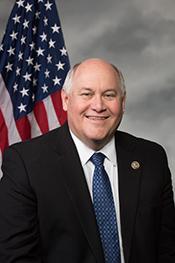
Ron Estes
RRepublicanKS-4 · Representative
55
/ 100
Average
Attendance99
Avg: 96
Independence3
Avg: 4
Bipartisan Tone21
Avg: 15
Ethics Record100
Avg: 99
Transparency37
Avg: 53
Accountability Score — composite of attendance, independence, bipartisan tone, ethics record & transparency.
Methodology14
Bills Sponsored
0
Enacted into Law
1
Passed a Chamber
13
In Committee
All Sponsored Bills
HR10334In Committee
EFIN Verification Act of 2026
EFIN Verification Act of 2026 This bill requires the Internal Revenue Service (IRS) or a specified validator (e.g., software provider or state agency) to validate that an electronic filing identification number (EFIN) is authorized and active before a federal tax return or other document may be electronically filed with the IRS. (As background, an EFIN is assigned by the IRS to an individual or entity who is authorized to file federal tax returns and other documents on behalf of other taxpayers.) Specifically, the bill requires (1) the IRS to develop a program to validate the status of an EFIN in real time, and (2) EFINs to be validated prior to the initial use and at intervals determined by the IRS.
HR10431In Committee
U.S. Innovation and Global Competitiveness Act of 2026
HRES1340In Committee
Expressing strong opposition to the imposition of digital services taxes and other relevant similar measures by other countries that unfairly discriminate against United States companies.
This resolution calls on (1) all other countries to cease and desist from implementing any digital services tax (DST) or similar measure, repeal existing DSTs, and immediately stop unfairly targeting U.S. companies; and (2) U.S. government agencies to use all available methods and resources to protect U.S. companies from the discriminatory effects of DSTs. It also supports appropriate tax and trade tools, including Section 301 investigations into the implementation or proposal of DSTs by any nation. (Section 301 of the Trade Act of 1974 authorizes the Office of the U.S. Trade Representative to investigate and take action to enforce U.S. rights under trade agreements and respond to certain foreign trade practices.)
HRES1152In Committee
Expressing appreciation and recognition for the contributions of the American cowboy and historic cattle trails in advancing American history in celebration of the Nation's 250th anniversary.
This resolution honors the cultural and historical significance of American cowboys and cattle trails in shaping the nation's development, particularly as part of celebrating the country's 250th anniversary. The measure is largely symbolic, expressing Congress's appreciation for how these figures and routes contributed to American history and westward expansion. It does not create new laws or programs, but rather recognizes the cowboy heritage as an important part of the nation's story.
HR8101In Committee
Ensuring Better Interest Treatment and Deductibility Act (EBITDA)
This bill would change how businesses calculate their taxable income by adjusting rules around interest deductions and earnings before interest, taxes, depreciation, and amortization (EBITDA). The changes would likely affect how much tax large corporations and businesses owe by allowing them to deduct more interest expenses or calculate their profits differently. The specific impact on individual taxpayers and businesses would depend on the detailed provisions once the bill moves through Congress.
HCONRES76In Committee
Recognizing the visionary leadership of Chief Richard LaMunyon and the profound global impact of the Law Enforcement Torch Run for Special Olympics.
This resolution honors Chief Richard LaMunyon's leadership and recognizes the Law Enforcement Torch Run for Special Olympics, a program where police officers and law enforcement agencies help raise money and awareness for Special Olympics athletes around the world. The measure celebrates the contributions of law enforcement to supporting people with intellectual disabilities through this charitable initiative. It does not create new laws or programs, but rather formally acknowledges the work of these organizations and individuals.
HR7520In Committee
Efficiency Adjustment Delay Act
The bill would delay certain efficiency adjustments in health care payments, likely postponing scheduled changes to how Medicare or other health programs reimburse doctors and hospitals for their services. This delay would affect healthcare providers and potentially patients by giving medical facilities more time before facing payment reductions or changes tied to efficiency measures. The bill is currently being reviewed by two congressional committees to determine which parts fall under their respective areas of responsibility.
HR7096In Committee
Ensuring Seniors’ Access to Quality Care Act
The bill aims to improve healthcare quality and access for people on Medicare and other seniors by potentially adjusting how Medicare pays doctors and hospitals and what services are covered. It would affect seniors receiving healthcare, doctors and hospitals that treat Medicare patients, and possibly insurance companies involved in senior care. The proposal is currently being reviewed by congressional committees to determine what specific changes would be made to senior healthcare programs.
HR6569In Committee
Executive Action Cost Transparency Act
HR5036In Committee
To remove the limitation imposed as a result of receiving funding under the Land and Water Conservation Fund on the conversion of Northeast Sedgwick County Park in Sedgwick County, Kansas, to a use other than public outdoor recreation.
This bill would allow Sedgwick County, Kansas to change how it uses Northeast Sedgwick County Park, even though the county received federal funding through the Land and Water Conservation Fund that normally requires parks to remain available for public recreation. The change would free the county from restrictions that currently prevent converting the park to other uses, giving local officials more flexibility in deciding the park's future.
HR4792In Committee
Protecting Air Ambulance Services for Americans Act of 2025
Protecting Air Ambulance Services for Americans Act of 2025 This bill authorizes payment changes under Medicare for air ambulance services based on certain collected data and requires additional reporting from providers of these services. Current law requires providers of air ambulance services to report certain information regarding general costs and utilization to the Department of Health and Human Services; private health insurers are also required to report information relating to coverage of these services. The bill authorizes the Centers for Medicare & Medicaid Services to revise payment rates under Medicare for air ambulance services based on this data, and it requires providers of air ambulance services to specifically report information relating to costs and utilization under Medicare. The bill also requires the Government Accountability Office to report on the data that is collected under current law requirements and to recommend changes to Medicare payment rates accordingly.
HR2251In Committee
Protecting Individuals with Down Syndrome Act
Protecting Individuals with Down Syndrome Act This bill creates new federal crimes related to the performance of an abortion on an unborn child who has Down syndrome. It subjects a violator to criminal penalties—a fine, a prison term of up to five years, or both. It also authorizes civil remedies, including damages and injunctive relief. A woman who undergoes such an abortion may not be prosecuted or held civilly liable.
HRES153Passed House
Expressing condolences to the families, friends, and loved ones of the victims of the crash of American Eagle Flight 5342 and PAT 25, and for other purposes.
This resolution expresses condolences to the families, friends, and loved ones of the victims of the crash of American Eagle Flight 5342 and the U.S. Army helicopter flying under the call sign PAT 25 near Ronald Reagan Washington National Airport on January 29, 2025. The resolution also commends the heroic actions of the first responders, emergency services personnel, and all those who aided in the recovery efforts.
HR858In Committee
REVIVE VI Act
Restore Economic Vitality and Investment in the Virgin Islands Act or the REVIVE VI Act This bill allows certain U.S. shareholders of a controlled foreign corporation to exclude qualified Virgin Islands service income from the calculation of global intangible low-taxed income (GILTI) for federal tax purposes. It also requires the Internal Revenue Service (IRS) to issue guidance on the exclusion. (Some limitations apply.) Under current law, U.S. shareholders that own 10% or more of a controlled foreign corporation are required to include in gross income the GILTI of the controlled foreign corporation. The calculation of GILTI is based, in part, on the controlled foreign corporation’s tested income (the controlled foreign corporation’s gross income excluding certain types of income and dividends). Under the bill, specified U.S. shareholders (individuals, trusts, estates, and certain closely-held C corporations) may exclude qualified Virgin Islands service income from a controlled foreign corporation’s gross income for purposes of calculating the controlled foreign corporation’s tested income. The bill defines qualified Virgin Islands service income as gross income that is compensation for labor or personal services performed in the Virgin Islands by a corporation formed under Virgin Islands laws, attributable to services performed in the Virgin Islands by individuals for the benefit of such corporation, and effectively connected with the conduct of a trade or business in the Virgin Islands. Finally, the bill requires the IRS to issue guidance on the exclusion of qualified Virgin Island service income from the GILTI calculation.