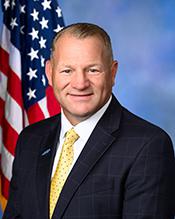
Troy E. Nehls
RRepublicanTX-22 · Representative
48
/ 100
Below Average
Attendance93
Avg: 96
Independence4
Avg: 4
Bipartisan Tone33
Avg: 15
Ethics Record80
Avg: 99
Transparency10
Avg: 53
Accountability Score — composite of attendance, independence, bipartisan tone, ethics record & transparency.
Methodology26
Bills Sponsored
1
Enacted into Law
3
Passed a Chamber
22
In Committee
Bills That Became Law
All Sponsored Bills
HR7553In Committee
Aviation Innovation and Global Competitiveness Act
This bill aims to boost the U.S. aviation industry's ability to compete globally by likely supporting research, development, and modernization of aircraft technology and airport infrastructure. It would probably affect airlines, aircraft manufacturers, airport operators, and workers in the aviation sector by providing funding or regulatory changes to help them stay competitive with international competitors. The specific details would determine whether it focuses on new technology development, workforce training, environmental improvements, or infrastructure upgrades.
HR309Passed House
National Law Enforcement Officers Remembrance, Support, and Community Outreach Act
National Law Enforcement Officers Remembrance, Support and Community Outreach Act. [ sic ] This bill temporarily directs the Department of the Interior to award a grant to the National Law Enforcement Officers Memorial Fund for the expenses associated with operating and enhancing the community outreach, public education, and officer safety and wellness programs of the National Law Enforcement Museum.
HR9071In Committee
Preventing Trafficking of Minors Act of 2026
The proposal would strengthen federal laws against child sexual exploitation by making it explicitly illegal to pay for or seek out sex acts with minors, closing potential legal loopholes that currently exist. It would apply to anyone who patronizes or solicits a minor for commercial sexual activity, giving law enforcement clearer tools to prosecute those who create demand for child sex trafficking. The change affects potential offenders and aims to protect children from sexual abuse and exploitation.
HR9037In Committee
To direct the Administrator of the Federal Aviation Administration to improve and expand electronic filing capabilities for Federal Aviation Administration Form 337, and for other purposes.
The Federal Aviation Administration would be required to improve and expand its online filing system for Form 337, which aircraft owners and mechanics use to report major repairs and modifications to their planes. This change would make it easier and faster for people in the aviation industry to submit required paperwork electronically instead of dealing with paper forms, potentially reducing delays and errors in the aircraft maintenance documentation process.
HR2071Passed House
Save Our Shrimpers Act
Save Our Shrimpers Act This bill prohibits federal funds from being made available to international financial institutions (e.g., the International Monetary Fund) for financing activities related to foreign shrimp farms. The bill also requires an annual report on compliance by U.S. leadership of international financial institutions with policies to oppose financing for certain commodities or minerals. Specifically, the bill requires the Department of the Treasury to condition any provision of federal funds to an international financial institution on the requirement that the funds not be used to finance any activity related to shrimp farming, shrimp processing, or the export of shrimp in any foreign country. Under current law, Treasury must instruct U.S. leadership of international financial institutions to oppose providing financial assistance for the production or extraction of any commodity or mineral for export if (1) the commodity or mineral is in surplus on world markets, and (2) the export of such commodity or mineral will cause substantial injury to U.S. producers of a competing commodity or mineral (or of the same or a similar commodity or mineral). This bill requires the Government Accountability Office to investigate and annually report to Congress on the extent to which U.S. leadership at these institutions have carried out Treasury's instructions.
HR3410Passed House
Supersonic Aviation Modernization Act
Supersonic Aviation Modernization Act This bill directs the Federal Aviation Administration (FAA) to allow civil aircraft to operate at speeds above Mach 1 (i.e., supersonic) over land in the United States under certain conditions. Specifically, the FAA must issue or revise regulations to allow for the operation of civil aircraft at speeds greater than Mach 1 in the national airspace system without a special authorization, so long as no sonic boom reaches the ground in the United States. The FAA must also issue a final rule to establish noise standards that prohibit civil aircraft operating at speeds greater than Mach 1 from exceeding takeoff and landing noise levels required for subsonic aircraft (i.e., aircraft that operate at speeds that do not exceed Mach 1). As part of the rule, the FAA must specify a process to periodically review and update the noise standards to reflect future advances in aircraft noise reduction technology and regulatory changes. Current regulations prohibit civil aircraft from operating above Mach 1 speeds over land in the United States without a special flight authorization issued by the FAA.
HR7916In Committee
CODIS Access Modernization Act
This bill would update how law enforcement agencies access the national DNA database (CODIS) used to match crime scene evidence with criminal records, likely making it easier or faster for police to search for suspects. The changes would modernize the system's technology and procedures to help investigators solve crimes more efficiently while potentially addressing privacy or accuracy concerns with how the database currently operates. The bill affects police departments, crime labs, and potentially people whose DNA profiles are in the system.
HR7662In Committee
Railroad Safety Enhancement Act of 2026
The bill would strengthen safety requirements and standards for railroad operations across the United States, likely including measures to improve track maintenance, train inspection procedures, and accident prevention systems. It would affect railroad companies, workers, and passengers by potentially requiring new equipment upgrades, training standards, or operational changes to reduce derailments and other rail accidents. The proposal is currently under review by two congressional committees to determine which parts each committee should handle.
HR7510In Committee
Preventing Research Ownership Transfer to External Competitive Threats (PROTECT) Act of 2026
This bill would restrict universities and research institutions from transferring ownership of research projects or intellectual property to foreign companies or countries that are considered competitive threats to the United States. The law aims to protect American research investments and prevent sensitive discoveries in areas like technology and science from being controlled by foreign entities. It would likely affect university researchers, technology companies, and international collaborations in academic settings.
HR7442In Committee
National Bridge Funding Reform Act
This bill would change how the federal government funds bridge repairs and construction across the country. It likely aims to reform the current system for distributing money to states and local governments so bridges can be maintained or rebuilt more efficiently, affecting commuters, construction workers, and communities that depend on safe bridge infrastructure.
HR7371In Committee
No Flight, No Fight Act of 2026
The bill would prevent the military from using commercial aircraft or aviation services to transport troops and equipment, instead requiring the Department of Defense to rely on its own military aircraft and transportation assets. This could affect military operations, readiness, and costs by limiting flexibility in how the armed forces move personnel and supplies domestically and internationally. The measure has been referred to the House Committee on Transportation and Infrastructure for review.
HR6987In Committee
Public Charge Clarification Act of 2026
This bill would clarify the rules about when immigrants can be denied entry or permanent residency based on their likelihood to need government benefits like welfare or Medicaid. The legislation aims to define more precisely which benefits count toward the "public charge" determination that immigration officials use when evaluating visa and green card applications, affecting both immigrants seeking to enter the country and the government agencies that process their cases.
HR695Enacted
Medal of Honor Act
Medal of Honor Act This act increases the monthly special pension for living Medal of Honor recipients. The act also prohibits the Department of Veterans Affairs from increasing the amount of the pension for inflation if the amount was already increased during such year. Additionally, the act extends a limitation on the pension paid to veterans who reside in Medicaid nursing homes and have no spouse or child. Currently, such pensions are limited to $90 per month through November 30, 2031. The act extends this limitation through January 31, 2033.
HR4711In Committee
REMOVE Act
Rapid Expulsion of Migrant Offenders who Violate and Evade Act or the REMOVE Act This bill requires the Department of Justice (DOJ) to complete removal proceedings in immigration court not later than 15 days after commencement. Further, after U.S. Immigration and Customs Enforcement files with an immigration court a notice to appear that has been served to an individual, DOJ must commence removal proceedings as promptly as possible.
HR5523In Committee
Let Experienced Pilots Fly Act of 2025
Let Experienced Pilots Fly Act of 2025 This bill raises the mandatory retirement age for pilots engaged in commercial aviation operations from 65 to 67 years of age. This age standard does not apply to commercial operations that take place in (1) the territorial airspace of a foreign country that prohibits such operations, or (2) international airspace where such operations are not in compliance with the Annexes to the Convention on International Civil Aviation. The bill specifies that a pilot who is over 65 years of age on the date of the bill's enactment may return to service in commercial aviation operations until 67 years of age. The Federal Aviation Administration must also submit a report to Congress on further increasing the age limitation for pilots engaged in commercial aviation operations.
HJRES111In Committee
Providing for congressional disapproval under chapter 8 of title 5, United States Code, of the rule submitted by the United States Fish and Wildlife Service relating to "Barred Owl Management Strategy".
Congress is considering blocking a Fish and Wildlife Service rule that would allow killing barred owls to protect endangered spotted owls in the Pacific Northwest. If approved, this would prevent the government from moving forward with a program that has been controversial among wildlife advocates and scientists who disagree about whether killing one owl species will actually save another. The decision affects environmental policy, wildlife management, and ongoing debates about the best way to protect endangered species.
HR188In Committee
Amtrak Transparency and Accountability for Passengers and Taxpayers Act
Amtrak Transparency and Accountability for Passengers and Taxpayers Act This bill directs Amtrak to comply with federal open meeting requirements under the Government in the Sunshine Act, with exceptions. Under the bill, certain open meeting requirements do not apply to any portion or portions of a meeting that Amtrak properly determines are likely to involve contract negotiations, including negotiations for contract procurements and agreements, the disclosure of which would imperil or compromise Amtrak’s competitive position; collective bargaining agreements or any terms and conditions that are proposed for inclusion in an agreement; and matters involving the employment, appointment, termination, terms and conditions of employment, performance evaluation, promotion, or disciplining of a current or prospective Amtrak officer, employee, or contractor (unless all affected individuals request in writing that the matter or matters be discussed at a public meeting).
HR3598In Committee
Deescalation Drone Pilot Program Act of 2025
The federal government would test using drones equipped with de-escalation tools—such as speakers, lights, or non-lethal devices—to respond to certain emergency situations instead of sending police or other personnel into potentially dangerous confrontations. The pilot program would allow selected cities or regions to deploy these drones to assess whether they can safely reduce tensions and prevent violence during crises. Law enforcement agencies, emergency responders, and communities participating in the program would gather data on effectiveness and safety to help determine if this approach should be expanded nationwide.
HR2735In Committee
Strengthening Child Exploitation Enforcement Act
Strengthening Child Exploitation Enforcement Act This bill makes changes to federal criminal laws related to various offenses, particularly sexual abuse offenses against minors. The bill revises the federal kidnapping statute by specifying that obtaining a victim by defrauding or deceiving a third party constitutes the offense of kidnapping. Additionally, for a kidnapping offense that involves a victim who has not attained the age of 16, the bill specifies that it is not a defense that the victim consented to the conduct of the offender, unless the offender establishes by a preponderance of the evidence that the offender reasonably believed that the victim had attained the age of 16. The bill also revises statutes related to sexual abuse offenses against minors to specify the following: that crossing international lines with the intent to engage in a sexual act with a child who has not attained the age of 12 constitutes aggravated sexual abuse (currently, the statute only references crossing state lines), that the offense of sexual abuse of a minor also includes knowingly causing the intentional touching of any person by a person who has not attained the age of 16, and that attempting to commit abusive sexual contact is also a crime that is subject to the same penalty as the completed offense.
HR2515In Committee
American Tank Car Modernization Act of 2025
American Tank Car Modernization Act of 2025 This bill establishes new Federal Railroad Administration (FRA) pilot and grant programs to outfit tank railcars with onboard sensors capable of delivering real-time safety-related condition data while a train is in motion. Specifically, the FRA must establish a grant program for freight railcar owners or operators to purchase and install (1) onboard freight railcar telematics systems (for wirelessly communicating a railcar's location and health), or (2) onboard freight railcar gateway devices (for collecting and exchanging data between railcar devices, including monitoring and telematics systems). In selecting grant recipients, the FRA must prioritize installation of these systems or devices in newly built tank railcars and by the type of load carried, starting with tank cars in TIH/PIH (toxic or poison inhalation hazard) service. In addition, the FRA must establish a pilot program to assist freight railcar owners and manufacturers in the development of onboard sensor technologies in order to add visibility to the safety of freight railcars, and encourage development of freight railcar onboard sensors that communicate to the freight railcar onboard gateway devices to offer future capabilities of real-time visibility (e.g., wheel and wheel bearing temperature).
HR2514In Committee
Trucker Bathroom Access Act
Trucker Bathroom Access Act This bill expands access to restroom facilities for certain commercial truck drivers, including drayage truck operators. Drayage truck operator means the driver of any in-use on-road vehicle with a gross vehicle weight rating of greater than 33,000 pounds operating on or transgressing through port or intermodal rail yard property for the purpose of loading, unloading, or transporting cargo, including containerized, bulk, or break-bulk goods. Specifically, the bill requires certain retailers, warehouses, and other establishments to give commercial truck drivers access to existing restroom facilities when they are loading or delivering cargo, or waiting to load or transport cargo. Further, operators of marine terminals, including port authorities, must provide drayage truck operators with (1) access to existing restrooms, (2) additional restrooms if necessary, and (3) parking while accessing such restrooms.
HR2218In Committee
Stop CARB Act of 2025
The proposal would block California's ability to set its own vehicle emissions standards that are stricter than federal requirements, preventing the state from requiring automakers to sell cleaner cars within its borders. This would affect California residents, automakers, and environmental groups, as it would eliminate one of the main ways the state has pushed the auto industry toward electric and low-emission vehicles. The measure has been referred to the House Committee on Energy and Commerce for consideration.
HRES197In Committee
Censuring Representative Al Green of Texas.
This resolution censures Representative Al Green.
HR1085In Committee
CARGO Act of 2025
Cease Animal Research Grants Overseas Act of 2025 or the CARGO Act of 2025 This bill prohibits the National Institutes of Health from awarding support for any research that uses live animals unless the research occurs in the United States (including U.S. territories and possessions).
HR696In Committee
End Unaccountable Amnesty Act
End Unaccountable Amnesty Act This bill revises, restricts, and repeals various laws and programs addressing the admissibility and deportability of certain non-U.S. nationals ( aliens under federal law). The bill includes changes to the Temporary Protected Status (TPS) program, the treatment of unaccompanied children, and removal proceedings. Under current law, the Department of Homeland Security (DHS) may grant a foreign state Temporary Protected Status (TPS), which protects qualified nationals of that foreign state from removal from the United States. The bill instead requires an act of Congress to grant TPS to a foreign state. The bill limits TPS status to 12 months, subject to extension. The bill also generally requires the return of unaccompanied inadmissible children to their country of nationality or last habitual residence, among other changes. Under current law, DHS is authorized (not required) to return these children, and only if their country of nationality or last habitual residence is contiguous to the United States. The bill also repeals the law allowing for the cancellation of removal or adjustment of the immigration status of qualifying non-U.S. nationals. Under the bill, certain forms of identification, including a Notice to Appear issued by DHS, are no longer valid documents for purposes of airport security checkpoints. The bill also limits the ability of DHS to grant parole (temporary admission granted on a case-by-case basis). For example, the bill limits the granting of parole to a list of specific situations, such as the imminent death of a close family member.
HR446In Committee
Endowment Tax Fairness Act
Endowment Tax Fairness Act This bill increases the excise tax on the net investment income of certain private university and college endowments. Under current law, certain private universities and colleges with 500 or more tuition-paying students (of which more than 50% are located in the United States) and endowments that are at least $500,000 per student pay an excise tax in the amount of 1.4% on the net investment income from such endowments. The bill increases the amount of the excise tax to 21% of the net investment income from such university and college endowments. Further, the bill provides that amounts collected from the increase to the excise tax on the net investment income from such university and college endowments are (1) to be deposited into the general fund of the Treasury; and (2) used to reduce the national deficit and, subsequently, the national debt.