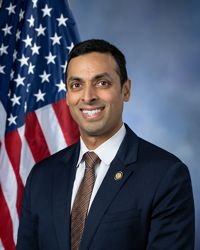
Suhas Subramanyam
DDemocratVA-10 · Representative
66
/ 100
Above Average
Attendance100
Avg: 96
Independence4
Avg: 4
Bipartisan Tone27
Avg: 15
Ethics Record100
Avg: 99
Transparency100
Avg: 53
Accountability Score — composite of attendance, independence, bipartisan tone, ethics record & transparency.
Methodology39
Bills Sponsored
0
Enacted into Law
2
Passed a Chamber
37
In Committee
All Sponsored Bills
HR10712In Committee
First Responder Behavioral Health Access Act
HR10715In Committee
Domestic Visa Renewal Modernization Act
HR10713In Committee
Federal Telework Protection Act
HR10714In Committee
Strengthening Emergency Responses Act
HR10711In Committee
Reducing Visa Delays Act
HR10610In Committee
Stop Spam Calls Act
HR5058Passed House
To designate the facility of the United States Postal Service located at 46164 Westlake Drive in Sterling, Virginia, as the "Firefighter Trevor Brown Post Office Building".
This bill designates the facility of the United States Postal Service located at 46164 Westlake Drive in Sterling, Virginia, as the "Firefighter Trevor Brown Post Office Building".
HR10321In Committee
Responsible Data Center Siting Act of 2026
HR10322In Committee
Data Center Fair Share Act
HR10289In Committee
Government Travel Transparency Act
HR10290In Committee
No Pardon Paydays Act of 2026
HR10291In Committee
JARED Act
HR10179In Committee
Reserve Organization of America Charter Amendments Act of 2026
HR9372In Committee
Data Infrastructure Energy Measurement and Standards Act
Data Infrastructure Energy Measurement and Standards Act This bill requires the National Institute of Standards and Technology (NIST) to carry out a program to inform the development of best practices, technical standards, and other resources for measuring workloads and energy and water use of data centers, including measurements relating to training and processing of artificial intelligence models. Specifically, NIST must develop or identify best practices and other resources for such measurements, taking into account specified factors such as workload type and system configuration; conduct research and testing to improve the accuracy, timeliness, and reliability of such measurements; study data needs for energy and water demand forecasting and other research; and support the development of standardized metrics and data sharing mechanisms to promote improved energy and water demand forecasting. Further, NIST must coordinate with the Department of Energy to ensure applicable metrics and data are managed and archived appropriately and promote open exchange of metrics and data as appropriate. NIST must also coordinate with international partners to maintain global data center energy measurement standards. Finally, NIST must periodically brief Congress on the program.
HR9204In Committee
Gun Safety Innovation Opportunity Act of 2026
The federal government would provide funding to develop and promote safe firearm storage devices that prevent unauthorized access, particularly by children and teenagers. This money would support research, manufacturing, and distribution of locks, safes, and other storage solutions designed to reduce accidental shootings and theft of firearms. Gun owners, manufacturers, and public health organizations would be the primary beneficiaries of these grants.
HR9371In Committee
SLASH Prices Act
Companies that use computer algorithms to charge different prices to different customers would have to tell people when this is happening. The requirement would apply to online retailers, subscription services, and other businesses that adjust prices based on personal information like browsing history or location. This would help consumers understand why they might see different prices than their neighbors for the same product or service.
HR9205In Committee
Protect Every Preschooler Act of 2026
The proposal would expand federal restrictions on firearms in and around schools by broadening the definition of school zones and potentially increasing penalties for gun violations in these areas. It would affect gun owners, school administrators, and law enforcement by creating stricter rules about where firearms can be carried near educational facilities. The measure is currently under review by the House Judiciary Committee.
HRES1318In Committee
Expressing support for the designation of the month of May 2026 as "Progressive Supranuclear Palsy and Corticobasal Degeneration Awareness Month".
This resolution asks Congress to officially recognize May 2026 as a month dedicated to raising awareness about two rare neurological diseases: progressive supranuclear palsy and corticobasal degeneration. The designation would help bring attention to these conditions, which affect the brain and cause movement problems, and could encourage more research and support for patients and families dealing with these diseases. This type of resolution doesn't create new laws or programs but serves as a symbolic statement of support from Congress.
HR1352Passed House
To designate the General George C. Marshall House, in the Commonwealth of Virginia, as an affiliated area of the National Park System, and for other purposes.
This bill designates the General George C. Marshall House in Leesburg, Virginia, as an affiliated area of the National Park System (NPS). (George Catlett Marshall, Jr. served as Army Chief of Staff during World War II, and later as Secretary of State, president of the American Red Cross, and Secretary of Defense.) The bill designates the George C. Marshall International Center as the management entity for the affiliated area. The Department of the Interior must enter into an agreement with the center that delineates the roles and responsibilities for management of the affiliated area that are in accordance with policies and standards applicable to NPS. Further, Interior may provide technical assistance and enter into cooperative agreements with the center for the purpose of providing financial assistance for the marketing, marking, interpretation, and preservation of the affiliated area. Interior must complete a management plan for the affiliated area within three years of funds being made available to carry out this bill.
HR8712In Committee
Uyghur Forced Labor Disclosure Act
Companies that sell stock to the public would have to disclose whether they have business connections to China's Xinjiang region, including supply chains and investments there. This requirement would help investors understand potential risks related to human rights concerns in that area. The rule would affect publicly traded companies and give investors more information to make informed decisions about where their money goes.
HR8711In Committee
Data Infrastructure Risk Reduction Act
The federal government would be required to develop a comprehensive plan to protect data centers from cyberattacks and other security threats, while also safeguarding the communities where these facilities are located. This affects technology companies, internet service providers, and communities near major data center operations, as it would establish new security standards and protections for critical digital infrastructure.
HR8710In Committee
National Defense Data Resilience Act
The Department of Defense would be required to develop and maintain backup systems to protect critical military data from being permanently lost, damaged, or destroyed by accidents, cyberattacks, or other incidents. This ensures that essential defense information can be quickly recovered and restored so military operations and decision-making aren't disrupted by data loss. The change affects how the Pentagon manages and safeguards its computer systems and information infrastructure.
HR8492In Committee
Public Safety UAS Readiness Act
The federal government would create a new grant program to help fund training for people who want to operate drones professionally. This would make it easier and more affordable for workers, businesses, and organizations to learn how to safely pilot unmanned aircraft for various purposes like delivery, inspection, or surveying. The Transportation Department would oversee the program and distribute the grants to training providers.
HR8493In Committee
Peer Support for Our First Responders Act of 2026
The federal government would create a task force to develop and promote mental health support programs where police officers and first responders help each other deal with stress, trauma, and substance abuse issues. This group would bring together different government agencies to share best practices and coordinate efforts to improve mental health services specifically designed for law enforcement and emergency workers. The goal is to make peer support programs more available and effective for these high-stress professions.
HR8427In Committee
Congressional Pension Integrity Act of 2026
The bill would change how pensions work for members of Congress, likely by adjusting benefits, eligibility requirements, or how the pension system operates to ensure it functions fairly and sustainably. Members of Congress and potentially taxpayers would be affected by these changes to the retirement benefits that lawmakers receive. The specific details of what changes are being proposed have been sent to two House committees for review and discussion.
HR8191In Committee
Immigration Status Notification and Transparency Act of 2026
This bill would require federal agencies to notify Congress and the public about the immigration status of individuals involved in certain incidents or crimes, and would establish new transparency requirements for how immigration information is shared and reported. The legislation aims to make immigration enforcement data more visible to lawmakers and the general public, potentially affecting how federal agencies handle and disclose information about undocumented immigrants and immigration violations. It would likely impact immigration enforcement agencies, law enforcement departments that work with federal authorities, and individuals whose immigration status information could be disclosed.
HR5339In Committee
Susan E. Lukas 9/11 Servicemember Fairness Act
This bill would ensure that military members and first responders who were exposed to hazardous materials while serving at Ground Zero after 9/11 receive the same health care and benefits as other 9/11-related illness victims. The legislation aims to recognize and support those who developed illnesses from their service during the recovery and cleanup efforts at the World Trade Center site.
HR7968In Committee
Small AI Innovators Empowerment Act
This bill would likely provide support and resources to small companies and startups working on artificial intelligence technology, possibly through funding, regulatory relief, or access to government data and computing resources. The goal appears to be helping smaller AI businesses compete with large tech companies and grow their innovations. It would primarily affect startup founders, small tech companies, and potentially the broader AI industry landscape.
HR7778In Committee
Medicaid PNA Modernization Act
Medicaid Personal Needs Allowance Modernization Act or the Medicaid PNA Modernization Act This bill increases the minimum monthly personal needs allowance under Medicaid for an institutionalized individual and couple from $30 to $60 and from $60 to $120, respectively. (The personal needs allowance is deducted from an individual's total income when determining the individual's contribution to the cost of institutionalized care under Medicaid.)
HR7779In Committee
HEALTHY BRAINS Act of 2026
The bill aims to support brain health and neurological disease prevention through funding for research, public education, and healthcare programs. It likely affects patients with conditions like Alzheimer's, Parkinson's, and other brain disorders, as well as researchers and healthcare providers working in neurology and mental health. The legislation has been sent to the House Committee on Energy and Commerce for review and consideration.
HR7516In Committee
No Funds for Forced Labor Act
This bill would prohibit the federal government from spending money on goods, services, or investments that involve forced labor anywhere in the world. It aims to prevent American taxpayer dollars from supporting companies or countries that use coerced workers, affecting federal agencies, contractors, and international trade decisions. The measure targets both direct purchases and financial investments made by the U.S. government.
HR7193In Committee
Campaign and Election Accountability Act
This bill would likely establish new rules for campaign financing and election conduct to increase transparency and accountability in federal elections. It probably affects political candidates, donors, and election officials by requiring stricter disclosure of campaign money sources and spending. The specific requirements would depend on the bill's detailed provisions, which are currently under review by the House Administration Committee.
HR6542In Committee
First Home Savings Opportunity Act of 2025
HR5689In Committee
Shutdown Guidance for Financial Institutions Act
Shutdown Guidance for Financial Institutions Act This bill directs financial regulators—including the Federal Reserve Board, the Consumer Financial Protection Bureau, the Office of the Comptroller of the Currency, the Federal Deposit Insurance Corporation, and the National Credit Union Administration—to jointly issue guidance relating to a government shutdown. Specifically, financial regulators must issue guidance encouraging financial institutions to work with consumers and businesses affected by a shutdown, recognize that consumers and businesses affected by a shutdown may lose access to credit and face temporary hardship in making payments on debts, consider efforts to modify terms on existing loans or extend new credit to assist consumers and businesses affected by a shutdown, and take steps to prevent adverse credit information from being reported in a manner that harms consumers affected by a shutdown. In addition, financial regulators must jointly issue a press release to notify financial institutions, consumers, and businesses of this guidance in the event of a government shutdown. Financial regulators must also complete a report after a government shutdown regarding the guidance's effectiveness and update the guidance if any shortcoming are identified in the report.
HR5560In Committee
Statutes of Limitation for Child Sexual Abuse Reform Act
Statutes of Limitation for Child Sexual Abuse Reform Act This bill authorizes the Children's Bureau's Office of Child Abuse and Neglect to award grants to states to (1) eliminate their criminal and civil statutes of limitations for child sexual abuse, and (2) revive previously time-barred civil claims. These grants are in addition to any funds a state is otherwise eligible to receive under the Children's Justice Act grant program, which provides grants to states to support the investigation and prosecution of child abuse and neglect cases. The bill additionally requires states, as a condition of receiving funds under the Children's Justice Act grant program, to adopt recommendations from their program task force on eliminating statutes of limitations for child sexual abuse claims and reviving previously time-barred civil claims.
HR4738In Committee
Baby Safety Tax Relief Act
Baby Safety Tax Relief Act This bill prohibits the imposition of duties (i.e., tariffs) on specified baby safety items (i.e., baby carriages, strollers, carriers, and car seats) pursuant to certain presidential powers. Specifically, the bill prohibits the President from exercising authorities under the International Emergency Economic Powers Act (IEEPA) to impose duties on specified baby safety items entering the United States. (IEEPA provides the President with broad authority to regulate various economic transactions following a declaration of a national emergency.) Further, the President must terminate the duties on these items that were imposed pursuant to IEEPA and are in effect as of the date of the bill's enactment. The bill also prohibits the President from using any other authorities to impose duties on these items that are substantially similar to the duties imposed pursuant to IEEPA.
HRES456In Committee
Expressing support for the designation of the month of May 2025 as "Progressive Supranuclear Palsy Awareness Month".
This resolution expresses support for the designation of Progressive Supranuclear Palsy Awareness Month.
HR3470In Committee
AGRITOURISM Act
Accelerating the Growth of Rural Innovation and Tourism Opportunities to Uphold Rural Industries and Sustainable Marketplaces Act or the AGRITOURISM Act This bill establishes an Office of Agritourism within the Department of Agriculture to encourage and promote agritourism activities and businesses in each state. Under the bill, agritourism activities and agritourism businesses include educational experiences, outdoor recreation, entertainment and special events, direct sales, and accommodations.
HR2470In Committee
COST of Relocations Act
This bill would require the federal government to track and report the costs associated with relocating federal employees and offices between locations. The measure aims to give Congress and the public better visibility into how much money the government spends on moves, transfers, and facility changes, which could help inform decisions about future government reorganizations and budget planning.