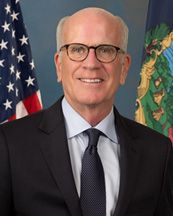
Peter Welch
DDemocratVT · Senator
65
/ 100
Above Average
Attendance94
Avg: 97
Independence16
Avg: 23
Bipartisan Tone16
Avg: 14
Ethics Record100
Avg: 100
Transparency100
Avg: 47
Accountability Score — composite of attendance, independence, bipartisan tone, ethics record & transparency.
Methodology62
Bills Sponsored
0
Enacted into Law
1
Passed a Chamber
59
In Committee
All Sponsored Bills
SRES941Introduced
A resolution expressing support for the designation of the week of October 24, 2026, to October 31, 2026, as "Bat Week".
S5525In Committee
Banning Toxics from Plastic Bottles Act of 2026
S5472In Committee
Supporting Small Affordable Housing Developers Act
S5434In Committee
American Renewable Energy Act of 2026
S5281In Committee
Consumer Advocacy and Protection Act of 2026
S5159In Committee
STRONG GRID Act of 2026
The proposal would update federal energy rules to help communities and businesses build and operate microgrids—small, localized power systems that can operate independently or connect to the main electrical grid. This would make it easier for neighborhoods, hospitals, military bases, and other facilities to generate and manage their own electricity, potentially improving reliability during outages and reducing energy costs. The changes would affect utility companies, property owners, and consumers who could benefit from more flexible and resilient local power options.
S5122In Committee
Inclusive Democracy Act of 2026
The proposal would restore voting rights to people with criminal convictions, allowing them to vote regardless of whether they are currently incarcerated, on probation, or have completed their sentences. Currently, many states restrict voting for people with felony convictions, either temporarily or permanently, and this bill would eliminate those restrictions at the federal level. The change would affect millions of Americans with criminal records and could significantly increase voter participation in elections.
S3885In Committee
Aviation Innovation and Global Competitiveness Act
This bill aims to strengthen the U.S. aviation industry's ability to compete globally by likely promoting new aircraft technologies, streamlining regulations, and supporting research and development in aerospace. It would affect airlines, aircraft manufacturers, and workers in the aviation sector by potentially making it easier to develop and deploy innovative aviation solutions. The bill is still in early stages and has been sent to the Senate Commerce Committee for review.
S5074In Committee
Enhancing Electric Grid Resilience Act
The bill would change how costs are divided among states and companies when building power lines that cross state borders or run offshore in ocean waters. Currently, there are unclear rules about who pays for these expensive infrastructure projects, and this legislation would establish a clearer system for sharing those costs fairly. This affects electric utility companies, states, and ultimately consumers who pay electricity bills.
S4239In Committee
Plug Offshore Wells Act
This bill would require oil and gas companies to permanently seal and abandon offshore wells that are no longer in use, preventing them from leaking oil or gas into the ocean. The measure aims to protect marine environments and reduce environmental hazards by ensuring that old drilling operations in federal waters are properly decommissioned rather than left inactive indefinitely.
S4996In Committee
Fairness for Small-Scale Farmers and Ranchers Act of 2026
The legislation would give the federal government stronger tools to prevent large companies from dominating the food and agriculture industry, potentially blocking mergers or breaking up existing companies that reduce competition and harm farmers or consumers. The bill aims to address concerns that a few massive corporations control too much of the market for seeds, meat processing, grain handling, and other agricultural sectors, which can lead to higher prices for shoppers and lower prices paid to farmers. The measure is currently under review by the Senate Agriculture Committee.
SRES805Introduced
A resolution celebrating the historic significance of the 2026 Federation Internationale de Football Association (FIFA) World Cup and welcoming the international community to North America for the first tournament hosted by 3 nations.
Congress is formally recognizing the 2026 FIFA World Cup as a historic event and welcoming the international soccer community to North America, where the tournament will be jointly hosted by the United States, Canada, and Mexico for the first time with three nations sharing hosting duties. The resolution celebrates this milestone sporting event and expresses support for the countries involved in organizing it. This symbolic measure passed the Senate unanimously without any changes.
S4995In Committee
Agricultural Worker Justice Act of 2026
The legislation would establish new protections for farmworkers, likely including standards for working conditions, wages, and safety on agricultural operations. It would affect millions of workers employed in farming and food production across the country, as well as the agricultural businesses that employ them. The bill is currently under review by the Senate committee responsible for labor and workplace issues.
S4912In Committee
BUFFER Act
Building Up Farmland Frontiers for Ecological Resilience Act or the BUFFER Act This bill provides that certain land (that is under state regulations) is eligible to participate under the Conservation Reserve Program (CRP). Under CRP, the Department of Agriculture provides annual payments to agricultural producers to take highly erodible and environmentally sensitive land out of production and install resource-conserving practices. Specifically, land otherwise eligible under the program remains eligible for enrollment even if a tribal, state, or other local law, ordinance, or other regulation requires any resource-conserving or environmental protection measure or practice. The bill includes an exception that makes the land ineligible under the program if the implementation requirement has been imposed by an administrative order or a court order. Current regulations exclude from enrollment eligibility (with exceptions) land that is subject to tribal, state, or other local laws, ordinances, or other regulations that require any resource-conserving or environmental protection measures or practices.
S4881In Committee
Unlocking Low-Income Taxpayer Clinic Funding Act
The bill would change how the government funds free tax help clinics that serve low-income people by reducing the amount of money these clinics need to raise on their own to receive federal grants. Currently, clinics must match federal funding dollar-for-dollar with their own resources, which can be difficult for smaller organizations; this change would make it easier for them to operate and help more low-income taxpayers prepare their returns and resolve tax issues.
SRES797In Committee
A resolution requesting information on Israel's human rights practices pursuant to section 502B(c) of the Foreign Assistance Act of 1961.
This resolution requests that the Department of State provide Congress with specified information on Israel’s human rights practices in Lebanon since February 28, 2026.
S4906In Committee
Milk From Family Dairies Act of 2026
The bill would create a new program to help stabilize dairy prices and production when market conditions become unstable, protecting dairy farmers from extreme price swings. The program would give farmers tools to manage their milk supply during periods of oversupply or undersupply, similar to existing programs for other agricultural products. This affects dairy farmers, milk processors, and ultimately consumers who buy milk and dairy products.
SRES767In Committee
A resolution celebrating the historic significance of the 2026 Federation Internationale de Football Association (FIFA) World Cup and welcoming the international community to North America for the first tournament hosted by 3 nations.
This resolution celebrates the 2026 FIFA World Cup, which will be hosted jointly by the United States, Canada, and Mexico—marking the first time three nations have co-hosted the tournament together. The resolution welcomes international teams and fans to North America for this historic sporting event. It has been referred to the Senate Committee on Commerce, Science, and Transportation for consideration.
S71Passed Senate
Baby Changing on Board Act
Baby Changing on Board Act This bill requires Amtrak passenger rail trains to have a baby changing table in at least one restroom in each car, including in an Americans with Disabilities Act of 1990-compliant restroom. The bill applies to passenger rail trains that are (1) owned and operated by Amtrak, and (2) solicited for purchase after the bill's enactment for use by Amtrak.
SRES683In Committee
A resolution raising awareness of lake sturgeon.
This resolution calls attention to lake sturgeon, a large freshwater fish species found in North American lakes, and aims to increase public awareness about their ecological importance and conservation needs. The measure highlights efforts to protect these fish from threats like habitat loss and overfishing, which have significantly reduced their populations over the past century. Lake sturgeon matter to fishing communities, environmental groups, and anyone interested in preserving native fish species and healthy freshwater ecosystems.
S1327In Committee
Advancing GETs Act of 2025
This bill would likely establish or expand programs related to geothermal energy technology and development, helping the U.S. tap into heat from beneath the Earth's surface as a renewable energy source. The legislation would probably affect energy companies, utilities, and communities looking to develop geothermal projects by providing funding, research support, or regulatory changes to make this energy source more practical and affordable. Geothermal energy could help reduce dependence on fossil fuels while providing reliable, consistent power generation.
SJRES157In Committee
A joint resolution providing for congressional disapproval under chapter 8 of title 5, United States Code, of the rule submitted by the Bureau of Consumer Financial Protection relating to the withdrawal of the rule relating to "Bulletin 2012-04: Lending discrimination (April 18, 2012)".
Congress is considering blocking a recent decision by the Consumer Financial Protection Bureau to withdraw guidance that had warned banks and lenders about illegal discrimination in lending practices. If approved, this resolution would overturn the agency's action and keep the original anti-discrimination guidance in place, protecting borrowers from unfair treatment based on race, gender, or other protected characteristics. The measure would affect banks, credit unions, and other lenders that provide mortgages, auto loans, and other forms of credit.
S4169In Committee
Student Loan Interest Elimination Act
Student Loan Interest Elimination Act This bill eliminates interest on existing and new federal student loans beginning on July 1, 2026. Specifically, for existing federal student loans, the bill directs the Department of Education (ED) to establish and implement procedures to (1) modify the terms of Federal Direct Loans so that beginning on July 1, 2026, no interest shall accrue on such a loan; and (2) allow a borrower to opt out of this loan modification. Additionally, ED must establish and implement procedures to (1) refinance eligible loans that are not Federal Direct Loans (e.g., privately held Federal Family Education Loans and Perkins Loans), and (2) allow a borrower to opt out of this loan refinancing. The bill outlines the terms and conditions of these refinanced loans, including by prohibiting ED from charging origination fees and specifying that no interest shall accrue on these loans. For new federal student loans made on or after July 1, 2026, the bill sets the applicable interest rate at 0%. The bill establishes the Education Affordability Trust Fund. ED must deposit all payments made on federal student loans into this trust fund. The Education Affordability Trust Fund Board, as established by this bill, must transfer the assets from investments of this trust fund to ED to pay for the administrative costs of carrying out federal student loan programs. The bill allows ED to use excess amounts of funds in the trust fund to carry out a Supplemental Pell Grant Program.
S4182In Committee
FARM Home Loans Act of 2026
This bill would likely make it easier for farmers to get home loans by modifying lending rules or expanding access to affordable financing for agricultural workers and their families. The changes would probably affect both individual farmers seeking to buy or improve homes and the lenders or government agencies that provide these loans. The bill is currently under review by the Senate Agriculture Committee.
S2333In Committee
Health Records Enhancement Act
The bill would improve how the military and Veterans Affairs share medical records, making it easier for veterans to access their health information and for doctors to see their complete medical history when treating them. This could help prevent duplicate tests, reduce medical errors, and speed up care for veterans transitioning from active duty to civilian life or VA hospitals. The change would primarily affect veterans and military service members who need coordinated healthcare across different military and VA facilities.
S4095In Committee
Justice for Hind Rajab Act
This bill addresses international affairs matters related to a specific case or situation involving Hind Rajab, though the exact provisions are not detailed in the available information. Based on the title's focus on "justice," the bill likely aims to advance accountability, investigation, or humanitarian response related to this case through U.S. foreign policy or international mechanisms. The bill has been referred to the Senate Foreign Relations Committee for consideration.
S3926In Committee
E-Access Act
The E-Access Act would likely expand access to energy resources or improve how people can obtain energy services, though the specific details aren't clear from the title alone. Based on its referral to the Energy Committee, it probably addresses issues like broadening access to renewable energy, improving electrical grid connections for underserved areas, or making energy information more accessible to consumers. The bill would affect energy companies, utility providers, and households or businesses seeking reliable energy access.
S3866In Committee
A bill to provide for updates to the Federal Aviation Administration type certification process to support development of new and novel technologies, and for other purposes.
The bill would streamline how the Federal Aviation Administration approves new aircraft designs and aviation technologies, making it faster and easier for companies to get permission to test and sell innovative planes and equipment. This would help manufacturers bring new aviation technologies to market more quickly while still maintaining safety standards. The changes would affect aircraft makers, aviation companies, and ultimately travelers who could benefit from newer, more advanced aircraft.
S3861In Committee
Rural Innovation Stronger Economy (RISE) Reauthorization Act of 2026
This bill would renew and update federal programs that help rural communities develop new agricultural technologies, businesses, and economic opportunities. It likely provides funding and support for farmers, small rural businesses, and agricultural researchers to improve farming practices and create jobs in countryside areas. The legislation aims to strengthen rural economies by encouraging innovation in agriculture and food production.
S3833In Committee
LCBP Enhancements Act of 2026
This bill would strengthen the Lake Champlain Basin Program, which works to protect and restore the water quality and ecosystem health of Lake Champlain shared by Vermont and New York. The changes would likely expand funding, research, or cleanup efforts to address pollution and environmental challenges affecting the lake, its communities, and the people who depend on it for drinking water, fishing, and recreation.
S3730In Committee
Emergency Medical Services Reimbursement for On-Scene Care and Support Act
This bill would allow emergency medical services (EMS) providers and ambulance companies to get paid by Medicare and insurance companies for treating patients at the scene of an emergency, even if the patient doesn't go to the hospital. Currently, these providers often don't receive reimbursement for on-scene care, which affects paramedics, EMTs, and the ambulance services that employ them across the country.
S3717In Committee
Opportunities in Organic Act
This bill would likely expand opportunities for farmers to grow and sell organic products by making it easier to get certified as an organic farm or reducing costs associated with organic certification. The changes would help both small and large farmers transition to organic farming practices and could increase the availability of organic food for consumers. Organic farmers and food companies would be the primary beneficiaries of any new programs or support the bill creates.
S3603In Committee
COLAs Don’t Count Act of 2026
COLAs Don't Count Act of 2026 This bill revises requirements for determining eligibility and benefits under the Supplemental Nutrition Assistance Program (SNAP) to exclude income received from certain (1) cost-of-living adjustments under the Social Security Act and to railroad retirement and veterans' benefits, and (2) supplementary payments under the Social Security Act.
S3509In Committee
Global Climate Resilience Act of 2025
The legislation would direct the U.S. government to work with other countries to help communities around the world prepare for and adapt to climate change impacts like extreme weather, flooding, and droughts. It would likely increase funding and coordination for international climate resilience programs that assist developing nations in building stronger infrastructure and protecting vulnerable populations from climate-related disasters. The bill affects U.S. foreign policy, international aid organizations, and countries that depend on American support for climate adaptation efforts.
SRES541In Committee
A resolution congratulating Vermont Green Football Club on winning the United Soccer League Two National Championship.
Congress is recognizing Vermont Green Football Club for winning the United Soccer League Two National Championship, honoring their athletic achievement. The resolution celebrates the team's success and the accomplishment of its players and coaches. This type of resolution has no direct impact on laws or policies but serves as an official commendation from the federal government.
S3441In Committee
Nuclear Plant Decommissioning Act of 2025
SRES483In Committee
A resolution honoring the extraordinary life, leadership, and legacy of Dr. Jane Goodall.
SRES529In Committee
A resolution condemning anti-Palestinian hatred on the anniversary of the attack in Burlington, Vermont, on November 25, 2023.
S3357In Committee
Social Security Survivor Benefits Equity Act
This bill would change how Social Security calculates survivor benefits for families when a worker dies, likely aiming to make the benefit amounts fairer or more consistent across different family situations. The changes would affect widows, widowers, children, and other dependents who receive monthly payments based on a deceased family member's work record. The bill is currently being reviewed by the Senate Finance Committee to determine whether these adjustments should become law.
SRES530In Committee
A resolution condemning the pardon of ex-Honduran President Juan Orlando Hernandez.
S3295In Committee
A bill to amend the Internal Revenue Code of 1986 to establish a credit for adult child caregivers.
This bill would create a tax credit for adults who provide unpaid care for aging or disabled family members, allowing them to reduce their taxes based on caregiving expenses or time spent caring for relatives. The credit would help offset the financial burden on working-age people who take on caregiving responsibilities while potentially reducing their own income or career opportunities. The proposal affects millions of American families who juggle employment with caring for elderly parents or disabled relatives.
S3127In Committee
Farm to School Act of 2025
The legislation would expand programs that connect local farms directly to school cafeterias, making it easier and more affordable for schools to buy fresh produce and other food products from nearby farmers. This would help students eat healthier meals while supporting local agriculture businesses and farmers in their communities. The bill aims to increase funding and remove barriers that currently prevent schools from purchasing more locally-grown food.
S3068In Committee
FARM Act
SRES454In Committee
A resolution expressing support for the designation of the week of October 24, 2025, to October 31, 2025, as "Bat Week".
This resolution expresses support for the designation of the week of October 24-October 31, 2025, as Bat Week and acknowledges the important role bats play as pollinators and pest control for agriculture.
SRES439In Committee
A resolution condemning antisemitic hatred on the anniversary of the terrorist attacks of October 7, 2023.
S2835In Committee
Energizing Our Communities Act
This bill aims to boost energy production and infrastructure in American communities, likely through measures that support renewable energy development, grid modernization, or domestic energy resources. The specific provisions would affect energy companies, utilities, and consumers by potentially changing how electricity is generated, distributed, or priced. The bill is currently under review by the Senate's energy committee to determine its final details and viability.
S2775In Committee
Measuring the Cost of Disasters Act of 2025
S2455In Committee
TRAIN Act
S2383In Committee
CANADA Act
Creating Access to Necessary American-Canadian Duty Adjustments Act or the CANADA Act This bill exempts goods imported by or for the use of small business concerns from duties (i.e., tariffs) imposed under Executive Order 14193 . This executive order, issued by President Donald J. Trump on February 1, 2025, imposed a 25% tariff on most imports from Canada (except for Canadian energy or energy resources, which have a 10% tariff).
S2276In Committee
ETHIC Act
S2247In Committee
Disaster Assistance Improvement and Decentralization Act
This bill would change how the federal government delivers disaster aid by giving more decision-making power to state and local officials rather than centralizing it at the federal level, potentially allowing communities to respond faster to emergencies like hurricanes, floods, and wildfires. The changes would affect disaster victims seeking assistance, state emergency management agencies, and federal agencies like FEMA that currently coordinate relief efforts. By decentralizing the system, the bill aims to make disaster recovery more efficient and tailored to each region's specific needs.
S2077In Committee
Expanded Coverage for Former Foster Youth Act
Expanded Coverage for Former Foster Youth Act This bill modifies provisions relating to the coverage of former foster youths under Medicaid. Under current law, a state Medicaid program must cover former foster youths until the age of 26 if the youths were in a state's foster care system at the age of 18 and were enrolled in a state's Medicaid program while in foster care. The bill requires state Medicaid programs to also cover former foster youths who were placed in a legal guardianship with a kinship caregiver or were emancipated from foster care before the age of 18. The bill repeals the provision that requires former foster youths to have been enrolled in a state Medicaid program while in foster care in order to qualify for Medicaid coverage until the age of 26. The bill also requires states to establish Medicaid outreach and enrollment programs for former foster youths.
S2023In Committee
Bicycle Commuter Act of 2025
Workers who bike to their jobs would be able to receive tax-free payments from their employers to help cover the cost of bicycles, bike maintenance, and related commuting expenses, similar to existing benefits for transit passes and parking. This would make biking a more affordable commuting option for employees while giving employers a tax incentive to support environmentally friendly transportation. The benefit would apply to workers across different income levels who choose cycling as part of their commute.
S599In Committee
DRIVE Act of 2025
Driver Reimbursement Increase for Veteran Equity Act of 2025 or the DRIVE Act of 2025 This bill increases the mileage reimbursement rate available to beneficiaries for travel to or from Department of Veterans Affairs (VA) facilities in connection with vocational rehabilitation, required counseling, or for the purpose of examination, treatment, or care. Specifically, the bill makes the reimbursement rate for such travel equal to or greater than the mileage reimbursement rate for government employees using private vehicles when no government vehicle is available. The bill also requires the VA to ensure that an allowance based on mileage is paid not later than 90 days after the request is properly submitted to the VA.
S1628In Committee
Improving Access to Nutrition Act of 2025
This bill would make it easier for people to access nutritious food, likely by expanding or improving federal nutrition assistance programs like food stamps and school meal programs. The changes could affect low-income families, students, and seniors who rely on government food support, as well as farmers and food retailers who participate in these programs. The bill is currently being reviewed by the Senate Agriculture Committee to determine what specific improvements it would make.
S1578In Committee
Nulhegan River and Paul Stream Wild and Scenic River Study Act of 2025
The bill would direct the federal government to study whether the Nulhegan River and Paul Stream in Vermont should be protected as Wild and Scenic Rivers, a designation that would restrict development and dam construction while preserving their natural character. The study would examine the rivers' ecological, recreational, and cultural value to determine if they meet federal standards for protection. If Congress later approves protection based on the study's findings, it would affect landowners and local communities by limiting certain industrial uses while potentially boosting outdoor recreation and tourism in the area.
S1212In Committee
LOCAL Foods Act of 2025
Livestock Owned by Communities to Advance Local Foods Act of 2025 or the LOCAL Foods Act of 2025 This bill provides statutory authority for expanding the personal use exemption from inspection requirements for livestock that are slaughtered and prepared by the owner or at custom animal slaughter facilities for meat products intended for personal consumption. Under current law, the personal use exemption from certain Food Safety and Inspection Service meat inspection requirements applies to a person who raises an animal and slaughters the animal exclusively for personal, household, guest, or employee uses. The bill applies the exemption to any person who meets these requirements and is the owner of an animal, in whole or in part. This allows for an animal to have multiple owners (e.g., a community or a group of people buying shares in livestock). Further, the owner may designate an agent to assist in the slaughter, preparation, or transportation of the carcasses (or parts thereof) or meat and meat food products. If the owner designates an agent, the owner must maintain custody and specific identification of the carcasses or meat.
S1101In Committee
SHARE Act of 2025
Without access to the bill's specific text or detailed provisions, the SHARE Act of 2025 appears to address government operations and political processes based on its referral to the Judiciary Committee. The bill likely aims to modify how government agencies operate or how political activities are conducted, though the exact changes would depend on its specific provisions. To understand what this bill would concretely do—such as whether it affects voting procedures, campaign finance, government transparency, or agency authority—the full legislative text would need to be reviewed.
S927In Committee
Protecting Pharmacies in Medicaid Act
Protecting Pharmacies in Medicaid Act This bill provides funds beginning in FY2026 for the Centers for Medicare & Medicaid Services to survey retail and non-retail pharmacies (e.g., mail-order pharmacies) to determine average prices of covered outpatient drugs under Medicaid. Pharmacies that fail to participate in the surveys are subject to civil penalties. The bill additionally provides funds for FY2026 for the Office of the Inspector General of the Department of Health and Human Services to study the results of the survey and report accordingly to Congress. The bill also requires pass-through pricing models, and prohibits spread-pricing, for payment arrangements with pharmacy benefit managers under Medicaid.
S840In Committee
Digital Integrity in Democracy Act
Digital Integrity in Democracy Act This bill requires large social media platforms to promptly remove from their sites false information about election logistics and voter eligibility. Specifically, platforms notified of potential false election information must investigate the veracity of the flagged information and, if it is false, remove it. Covered information includes false information about the time and place of, or voter eligibility for, an election. Platforms must generally remove false information within 48 hours of receipt of notification of its existence. If notification is received on the day of an election, including during an early or absentee voting period, the information must be removed within 24 hours. The Department of Justice may bring a civil suit against a social media platform that violates the timely removal requirement. States may bring suit against a platform if the false information at issue related to an election in the state, and candidates may bring suit against a platform if the candidate was aggrieved by the false information. Such suits may seek money damages and injunctive relief. The bill also specifies that Section 230 protection does not apply to false election information that is knowingly hosted on a social media platform. (Section 230 generally precludes providers and users of an interactive computer service (e.g., a social media platform) from being held legally responsible under federal law for content provided by a third party.) However, platforms that comply with the timely removal requirements with respect to false election information retain Section 230 protection.
S482In Committee
A bill to include Czechia in the list of foreign states whose nationals are eligible for admission into the United States as E-1 nonimmigrants if United States nationals are treated similarly by the Government of Czechia.
S416In Committee
Marsh-Billings-Rockefeller National Historical Park Establishment Act Amendments Act of 2025
Marsh-Billings-Rockefeller National Historical Park Establishment Act Amendments Act of 2025 This bill expands the boundaries of the Marsh-Billings-Rockefeller National Historical Park in Woodstock, Vermont, allows the National Park Service (NPS) to acquire land within the boundaries through a variety of means, and provides statutory authority for the National Park Service Stewardship Institute, which is a program of the park. Specifically, the bill expands the boundary of the park to include the King Farm. The bill also allows the NPS to acquire lands within the park by purchasing, transferring, or exchanging land in addition to the current authorization to acquire land by donation. The acquired King Farm land must include rights of access between the acquired land and the park. The acquired King Farm land may be used for certain agricultural, forestry, conservation, and educational purposes. The bill also outlines the purposes of the National Park Service Stewardship Institute.