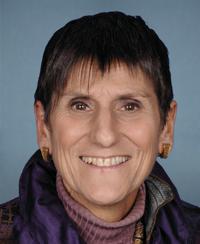
Rosa L. DeLauro
DDemocratCT-3 · Representative
59
/ 100
Average
Attendance99
Avg: 96
Independence2
Avg: 4
Bipartisan Tone20
Avg: 15
Ethics Record100
Avg: 99
Transparency66
Avg: 53
Accountability Score — composite of attendance, independence, bipartisan tone, ethics record & transparency.
Methodology39
Bills Sponsored
0
Enacted into Law
1
Passed a Chamber
38
In Committee
All Sponsored Bills
HRES1578In Committee
Supporting the designation of September 2026 as "National Ovarian Cancer Awareness Month".
HR10544In Committee
To modernize and strengthen Federal efforts to improve ovarian cancer awareness, hereditary cancer risk assessment, access to genetic counseling and testing, and access to specialty care, and for other purposes.
HRES1547In Committee
Recognizing the importance of diapers to infant health and family well-being, and expressing support for the designation of the week of September 14-20, 2026, as "National Diaper Need Awareness Week".
HR4647Passed House
Captain Paul W. Bud Bucha VA Medical Center Act of 2025
Captain Paul W. "Bud" Bucha VA Medical Center Act of 2025 This bill designates the medical center of the Department of Veterans Affairs in West Haven, Connecticut, as the Captain Paul W. "Bud" Bucha Department of Veterans Affairs Medical Center or the Captain Paul W. "Bud" Bucha VA Medical Center.
HR9458In Committee
Wage Theft Prevention and Wage Recovery Act
The legislation would strengthen protections against wage theft by giving the Department of Labor new tools to recover unpaid wages for workers and authority to award grants to organizations that help prevent wage violations. It would also update decades-old labor laws to make it easier for employees to pursue claims when employers fail to pay them properly or don't compensate them for all hours worked. The changes would primarily affect low-wage workers and small businesses, with the goal of reducing instances where employers illegally withhold or underpay employee wages.
HR9347In Committee
CHILD Labor Act
The proposal would increase penalties and enforcement actions against companies that violate child labor laws, making it harder for businesses to employ minors illegally or in dangerous conditions. It would affect employers across industries, workers who investigate labor violations, and families whose children might be at risk of exploitation. The bill aims to strengthen existing protections by giving government agencies stronger tools to crack down on child labor violations.
HR9015In Committee
Physician Education for Fistula Treatment Act
The bill would provide funding and support to train doctors who specialize in women's health, particularly obstetrician-gynecologists and urogynecology specialists, in developing countries around the world. This assistance aims to help these countries improve medical care for women by building up their healthcare workforce in these specialized areas. The funding would help address gaps in women's healthcare services in the poorest nations globally.
HR8964In Committee
DONOR Milk Act
The federal government would establish new safety standards and oversight rules for pasteurized donor human milk, which is used in hospitals and by families with newborns and infants. The measure would require facilities that process and distribute this milk to follow stricter safety protocols and reporting requirements to prevent contamination and ensure the product meets quality standards. This would primarily affect milk banks, hospitals, and families who rely on donor milk for infants who cannot be breastfed.
HRES1286In Committee
Calling for a trade policy that supports workers, consumers, independent farmers, small businesses, and the environment.
The resolution calls for the federal government to develop trade policies that prioritize the interests of American workers, consumers, farmers, small business owners, and environmental protection rather than focusing solely on large corporations. It suggests that future trade agreements should be designed to keep jobs in the U.S., keep prices affordable for shoppers, support independent farmers against large agricultural corporations, help small businesses compete fairly, and prevent damage to the environment. The proposal is currently being reviewed by the House Committee on Ways and Means, which handles tax and trade matters.
HR8606In Committee
CHARTER Act
This bill would prevent charter schools from receiving federal education funding if they hire for-profit companies to run or manage their operations, requiring them to be operated by nonprofit organizations instead. The change would affect charter schools and the for-profit management companies that currently contract with them, potentially forcing schools to restructure their management or lose access to federal dollars for education programs and special education services. The goal is to ensure that federal education money goes directly to nonprofit educational organizations rather than for-profit businesses.
HR8475In Committee
Savings Opportunity and Affordable Repayment Act
Savings Opportunity and Affordable Repayment Act This bill creates a new income-driven repayment plan for student loans called the Savings Opportunity and Affordable Repayment (SOAR) plan. The SOAR plan has similar provisions to, but further expands on, the Department of Education's (ED's) final rule published on July 10, 2023, that created the Saving on a Valuable Education (SAVE) plan. The SAVE plan was blocked by federal courts. The bill directs ED to carry out a SOAR plan program that complies with specified requirements. The bill allows all federal student loan types to be eligible for repayment under the SOAR plan, including Parent PLUS Loans and Federal Family Education Loans. Under the SOAR plan, a federal student loan borrower whose income is at or below 250% of the federal poverty level (FPL) has $0 monthly payments. A borrower whose income is over 250% of the FPL pays 5% of their discretionary income on loans obtained for undergraduate study and 10% of their discretionary income for all other outstanding loans (e.g., loans obtained for graduate study). Additionally, under the SOAR plan, holders of eligible federal student loans (e.g., ED or private lenders) must apply 50% of the borrower's monthly payment toward outstanding principal. The other 50% must be applied in the following order: (1) accrued charges and collection costs on the loan, (2) outstanding interest, and (3) outstanding principal. ED must forgive any loan balance that remains outstanding after a specified maximum repayment period (e.g., 10 years or 15 years).
HRES1096In Committee
Providing for consideration of the bill (H.R. 4213) making appropriations for the Department of Homeland Security for the fiscal year ending September 30, 2026, and for other purposes.
This resolution provides for the consideration of the bill (H.R. 4213) making appropriations for the Department of Homeland Security for the fiscal year ending September 30, 2026, and for other purposes.
HR7867In Committee
Infant Formula Safety Modernization Act of 2026
This bill would update the rules that the FDA uses to inspect and regulate infant formula manufacturers, making safety standards more current and giving the agency stronger tools to catch problems before formula reaches store shelves. It would likely require companies to follow stricter testing and reporting requirements, and could give the FDA faster authority to recall unsafe products. Parents and infants would benefit from tighter oversight, while formula manufacturers would need to meet more rigorous safety standards.
HR7822In Committee
Tariff Relief for Consumers Act
This bill would likely reduce or eliminate tariffs (taxes on imported goods) on certain products to lower prices for American consumers and businesses. By making imported goods cheaper, the legislation aims to ease inflation and reduce what families pay for everyday items, though it could affect domestic manufacturers who compete with foreign producers. The bill is currently being reviewed by the House committee that handles tax and trade policy.
HR7531In Committee
Healthy Families Act
The Healthy Families Act would require employers to provide paid sick leave to their workers, allowing employees to take time off for their own illness or to care for sick family members without losing pay. The law would apply to most private employers and would give workers a set number of paid sick days each year that they could use for medical appointments, preventive care, or caring for relatives. This would primarily affect workers who currently lack paid sick leave benefits and employers who would need to adjust their leave policies.
HR7481In Committee
Department of Homeland Security Appropriations Act, 2026
Department of Homeland Security Appropriations Act, 2026 This bill provides FY2026 appropriations for various agencies and offices within the Department of Homeland Security (DHS), except for U.S. Immigration and Customs Enforcement (ICE), U.S. Customs and Border Protection (CBP), and management and oversight activities of the Office of the Secretary. Specifically, the bill provides appropriations to DHS for the Federal Protective Service, the Office of Inspector General, the Transportation Security Administration, the U.S. Coast Guard, the U.S. Secret Service, the Cybersecurity and Infrastructure Security Agency, the Federal Emergency Management Agency (FEMA), U.S. Citizenship and Immigration Services, the Federal Law Enforcement Training Centers, and the Science and Technology Directorate. The bill does not provide appropriations for some agencies and activities that have been funded in prior DHS appropriations acts, including ICE, CBP, and management and oversight activities of the Office of the Secretary.
HR7424In Committee
American Business for American Companies Act of 2026
This bill would likely require the federal government and military to prioritize buying products and services from American companies rather than foreign ones. The measure would affect government spending decisions across agencies and defense contracts, potentially making it more expensive or complicated for federal agencies to purchase goods and services but aiming to support domestic businesses and workers.
HR6182In Committee
Find It Early Act
The bill aims to improve early detection and screening for diseases by expanding access to diagnostic tests and preventive health services. It would likely affect patients, healthcare providers, and insurance companies by making it easier and more affordable for people to catch serious health conditions in their early stages when treatment is typically more effective. The specific mechanisms for achieving this—such as which tests would be covered or how screening programs would be funded—would be determined as the bill moves through the legislative process.
HR4648In Committee
Access to Fertility Treatment and Care Act
The legislation would expand insurance coverage for fertility treatments and reproductive care services, requiring health plans to cover procedures like in vitro fertilization and fertility medications for people struggling to conceive. The bill aims to make these expensive treatments more affordable and accessible to workers and their families by treating fertility care similarly to other medical services covered by insurance plans.
HR6786In Committee
Schedules That Work Act
The bill would likely establish new rules about work schedules for federal employees and possibly private sector workers, aiming to give employees more predictable or flexible scheduling options. The measure has been referred to multiple committees that oversee labor practices, government operations, and workplace rules, suggesting it could address issues like advance notice of schedules, part-time work arrangements, or scheduling consistency. The bill's specific provisions would determine whether it primarily affects federal workers, private employers, or both.
HR6567In Committee
Federal Food Administration Act of 2025
This bill would establish a new federal agency to oversee food safety and nutrition standards across the United States, consolidating food-related regulatory responsibilities that are currently spread across multiple government departments. The agency would set and enforce rules about food labeling, contamination prevention, and nutritional content, affecting food producers, restaurants, grocery stores, and consumers who buy food products. The goal appears to be streamlining how the government manages food safety to reduce confusion and improve public health protections.
HR6318In Committee
No GOUGE Act
The bill aims to prevent price gouging on goods and services, likely by giving federal agencies tools to monitor and penalize sudden, unjustified price increases during emergencies or supply disruptions. It would affect businesses across multiple sectors and potentially protect consumers from paying inflated prices when products become scarce or hard to obtain. The bill has been referred to multiple committees because it touches on trade, energy, taxes, and labor issues.
HRES813In Committee
Urging the people of the United States to observe the month of October 2025 as Italian and Italian American Heritage Month.
HRES775In Committee
Supporting the designation of September 2025 as "National Ovarian Cancer Awareness Month".
This resolution expresses support for the designation of National Ovarian Cancer Awareness Month and expresses support for the month's goals and ideals.
HRES736In Committee
Recognizing the importance of diapers to infant health and family well-being, and expressing support for the designation of the week of September 15 to September 21, 2025, as "National Diaper Need Awareness Week".
This resolution expresses support for the designation of National Diaper Need Awareness Week.
HR5450In Committee
Continuing Appropriations and Extensions and Other Matters Act, 2026
Continuing Appropriations and Extensions and Other Matters Act, 2026 This bill provides continuing FY2026 appropriations for federal agencies, permanently extends the expanded premium tax credit for purchasing health insurance, provides additional funding for Medicaid and security for federal officials, and extends various expiring programs. Specifically, the bill provides continuing FY2026 appropriations to federal agencies through the earlier of October 31, 2025, or the enactment of the applicable appropriations act. It is known as a continuing resolution (CR) and prevents a government shutdown that would otherwise occur if the FY2026 appropriations bills have not been enacted when FY2026 begins on October 1, 2025. The CR funds most programs and activities at the FY2025 levels with several exceptions that provide funding flexibility and additional appropriations for various programs. For example, the CR provides additional funding for the Corporation for Public Broadcasting and security for federal officials. In addition, the CR permanently extends provisions that expanded the premium tax credit, which generally reduces premiums for health insurance purchased through a health insurance exchange; repeals health care provisions that were included in the One Big Beautiful Bill Act, including provisions that reduced Medicaid funding; authorizes the District of Columbia to spend local funds at the rates included in its FY2026 local budget; extends the availability of certain funds that are being withheld by the Office of Management and Budget (OMB); and limits the authority of OMB to withhold appropriations. Finally, the bill extends several expiring programs and authorities, including programs related to health care, veterans, homeland security, and agriculture.
HR5390In Committee
FAMILY Act
The FAMILY Act would create a national paid family and medical leave program that allows workers to take time off for major life events—like having a baby, caring for a sick family member, or recovering from their own serious illness—while receiving partial income replacement. Workers and employers would contribute to this program through small payroll deductions, similar to Social Security. This would give millions of American workers access to paid leave without having to choose between their paycheck and caring for themselves or their families.
HR5309In Committee
Congressional Tribute to Constance Baker Motley Act of 2025
This bill honors the legacy of Constance Baker Motley, a pioneering civil rights lawyer and federal judge who fought against racial discrimination and helped advance voting rights and desegregation efforts. The tribute recognizes her groundbreaking work as one of the first African American women to achieve prominence in the legal field and her lasting impact on civil rights law. The bill is primarily a commemorative measure rather than one that creates new policies or programs.
HR4557In Committee
BEACON Act
The BEACON Act would establish new requirements for how federal agencies operate and report their activities to Congress and the public. Based on its referral to the Oversight Committee, the bill likely aims to improve government transparency, efficiency, or accountability by creating clearer standards for federal operations. The changes would affect federal employees and agencies, as well as taxpayers and citizens seeking information about how their government works.
HR4253In Committee
Expanding Access to Mental Health Services in Schools Act of 2025
The proposal would increase funding and resources for mental health services in schools, allowing more students to access counseling, therapy, and crisis support during the school day. It aims to help schools hire additional mental health professionals and expand programs that address student anxiety, depression, and other emotional challenges. Students, teachers, and school administrators would benefit from these expanded services, particularly in districts that currently lack adequate mental health support.
HR3508In Committee
End Diaper Need Act of 2025
This legislation would provide federal funding to help low-income families afford diapers and incontinence products, which are currently not covered by most government assistance programs like SNAP or Medicaid. The bill aims to reduce the financial burden on families with young children and elderly or disabled individuals who struggle to pay for these essential hygiene items. It would affect millions of Americans living below or near the poverty line who must choose between buying diapers and other necessities.
HR3335In Committee
Children Don't Belong on Tobacco Farms Act
The proposal would restrict children under 18 from working on tobacco farms, with limited exceptions for family farms and educational purposes. It aims to protect young workers from exposure to nicotine and other hazardous chemicals used in tobacco production, which can cause serious health problems. The bill would affect tobacco farming operations across the country and establish new labor standards for agricultural employers in the tobacco industry.
HR2763In Committee
American Family Act
The American Family Act would expand the child tax credit, increasing the amount of money families can claim on their taxes for each child they have. The expanded credit would provide larger tax refunds or reduce taxes owed for millions of working families with children, particularly benefiting lower and middle-income households. The bill aims to help families afford basic expenses like food, housing, and childcare.
HR17In Committee
Paycheck Fairness Act
The bill would strengthen equal pay laws by making it harder for employers to justify paying workers different salaries based on sex, requiring them to prove pay differences are based on job-related factors rather than gender. It would also allow workers to compare salaries with coworkers without fear of retaliation and increase penalties on companies that violate equal pay rules. The legislation primarily affects employers and workers, particularly women who may be earning less than male colleagues in similar positions.
HR1974In Committee
Further Additional Continuing Appropriations and Other Extensions Act, 2025
Further Additional Continuing Appropriations and Other Extensions Act, 2025 This bill provides continuing FY2025 appropriations for federal agencies through April 11, 2025. It also extends various expiring programs and authorities, including several public health programs. Specifically, the bill provides continuing FY2025 appropriations to federal agencies through the earlier of April 11, 2025, or the enactment of the applicable appropriations act. It is known as a continuing resolution (CR) and prevents a government shutdown that would otherwise occur if the FY2025 appropriations bills have not been enacted when the existing CR expires on March 14, 2025. The CR funds most programs and activities at the FY2024 levels with some exceptions that provide funding flexibility and additional appropriations for various programs. For example, the CR provides additional emergency funding for the Federal Emergency Management Agency's Disaster Relief Fund, permits the Navy to apportion funds at the rate necessary to fund the Columbia-class submarine program and cost increases for certain shipbuilding programs, and provides additional funding for the Office of Navajo and Hopi Relocation. In addition, the bill extends several expiring programs and authorities, including several public health, Medicare, and Medicaid authorities and programs; authorities related to the Commodity Futures Trading Commission whistleblower program; authorities for the Department of Homeland Security and the Department of Justice to take actions to mitigate a credible threat from an unmanned aircraft system; the special assessment on nonindigent persons or entities convicted of certain offenses involving sexual abuse or human trafficking; and the National Cybersecurity Protection System.
HR1783In Committee
American Apprenticeship Act
American Apprenticeship Act This bill authorizes the Department of Labor to make grants to assist states in carrying out projects that defray the cost of pre-apprenticeship or related instruction for qualified apprenticeship programs. Labor shall (1) establish performance measures and an evaluation system for such grant program; and (2) identify in-demand occupations that lack the use of apprenticeships, analyze the use of the qualified apprenticeship program model in those occupations, and report on such analysis to states and Congress.
HR1564In Committee
Ethan's Law
Ethan's Law This bill establishes a framework to regulate the storage of firearms on residential premises at the federal, state, and tribal levels. At the federal level, the bill establishes statutory requirements for firearms on residential premises to be safely stored if a minor is likely to gain access without permission or if a resident is ineligible to possess a firearm. An individual who violates the requirements is subject to criminal penalties. A firearm stored in violation of the requirements is subject to seizure and forfeiture. At the state and tribal levels, the bill requires the Department of Justice to award grants to implement functionally identical requirements for the safe storage of firearms.
HRES1589In Committee
Commending the Women's Bureau of the U.S. Department of Labor on its 90th anniversary.
Commends the Women's Bureau of the Department of Labor on its 90th anniversary.
HR4092In Committee
Pandemic Protection for Workers, Families, and Businesses Act
Pandemic Protection for Workers, Families, and Businesses Act - Requires certain covered employers to provide annually to each of their covered: (1) full-time employees at least seven days of paid sick time, and specified employment benefits; and (2) part-time employees the same employment benefits and a number of days or hours of paid sick time, determined under a specified pro rata formula. Allows the covered employee to use such sick time for an absence: (1) resulting from a medical condition involving symptoms of a contagious illness (including influenza-like illnesses such as the 2009 H1N1 virus), the need to obtain medical diagnosis or care, or to obtain preventive care for such illness; (2) due to determination by a health authority or a health care provider that the employee's presence on the job, after exposure to a contagious illness, would jeopardize the health of others; (3) to care for a child experiencing such symptoms; or (4) to care for a child due to determination by a health authority or a health care provider that the child's presence in the community, after exposure to a contagious illness, would jeopardize the health of others. Permits use of sick leave if the covered employee's place of business is closed due to a contagious illness or his or her need to care for a child whose school or child care or early childhood program has been closed for such reason. Specifies prohibited acts by an employer, and penalties for violations.