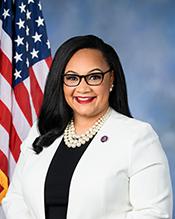
Nikema Williams
DDemocratGA-5 · Representative
53
/ 100
Average
Attendance96
Avg: 96
Independence2
Avg: 4
Bipartisan Tone3
Avg: 15
Ethics Record100
Avg: 99
Transparency54
Avg: 53
Accountability Score — composite of attendance, independence, bipartisan tone, ethics record & transparency.
Methodology45
Bills Sponsored
0
Enacted into Law
1
Passed a Chamber
44
In Committee
All Sponsored Bills
HRES1620In Committee
Supporting the goals and ideals of "National Nonviolence Week" to raise awareness of youth violence in the United States.
HJRES216In Committee
Proposing an amendment to the Constitution of the United States to prohibit the use of slavery and involuntary servitude as a punishment for a crime.
HR10239In Committee
Equal Pay for Equal Work Act
HR1640In Committee
HEIRS Act of 2025
Heirs Estate Inheritance Resolution and Succession Act of 2025 or the HEIRS Act of 2025 This bill requires the Department of Housing and Urban Development (HUD) to provide grants to assist individuals with the legal processes associated with inheriting certain real property. Under the first program, HUD must provide grants to states that have enacted the Uniform Partition of Heirs Property Act (UPHPA) (or similar state law). The UPHPA provides due process protections against forced property sales for individuals who inherit real property from a landowner without a will. Historically, state property laws have provided that recipients of such property become tenants-in-common, which permits a single tenant to exercise their right to partition and sell the property. A state or local government must use grant funds to assist residents with expenses related to establishing and documenting property ownership rights or settling a decedent's estate, including costs related to obtaining title reports, title abstracts, copies of public records, and land surveys; estate planning; heirs searches or tracing services; and recording and filing fees, notary fees, and legal fees and expenses. Under the second program, HUD must provide grants to housing counseling agencies, legal services clinics at institutions of higher education, and qualified nonprofits. Such organizations must use grant funds to provide housing counseling, legal assistance, and financial assistance related to title clearing and home retention efforts for individuals who inherit property as tenants-in-common.
HR10182In Committee
CEDS Act
HR9946In Committee
Equity in STI Testing Act
Equity in STI Testing Act This bill provides for coverage, without cost-sharing, of testing for certain sexually transmitted infections under Medicare Advantage, Medicaid, the Children's Health Insurance Program (CHIP), TRICARE, Department of Veterans Affairs health benefits, and the Indian Health Service.
HR9890In Committee
Polling Place Standards Act
This bill would require states and local governments to maintain a minimum number of polling places spread throughout their communities so voters have reasonable access to cast ballots in federal elections. The law would prevent polling places from being clustered in just one area, ensuring that voters across different neighborhoods and regions have convenient voting locations. The bill aims to reduce long wait times and make it easier for all eligible voters to participate in elections for federal offices.
HRES1420In Committee
Honoring the 31st International President and CEO of Alpha Kappa Alpha Sorority, Inc., Danette Anthony Reed.
This resolution congratulates and commends Danette Anthony Reed for her service and leadership as International President and Chief Executive Officer of Alpha Kappa Alpha Sorority Inc.
HR9493In Committee
Home Internet Accessibility Act
The federal government would be required to study and report on whether public housing developments have the infrastructure needed to support high-speed internet service. This report would help Congress understand what upgrades or investments might be necessary to bring broadband access to residents of federally funded housing programs. The findings could inform future decisions about improving internet connectivity in low-income communities that rely on government housing assistance.
HR9380In Committee
Expanding Access to Credit through Consumer-Permissioned Data Act
The proposal would require mortgage lenders to consider additional types of credit information beyond traditional credit scores when deciding whether to approve home loans, potentially allowing borrowers with limited credit histories to qualify more easily. This could help people who don't have traditional credit records—such as those who pay rent, utilities, or other bills on time but don't use credit cards—get mortgages they might otherwise be denied. The change would affect both lenders and borrowers seeking home loans.
HR9309In Committee
PRIDE Act of 2026
The proposal would expand the diversity offices at financial regulatory agencies to specifically include LGBTQI+ inclusion alongside their existing focus on minority and women inclusion. This would require these offices to develop policies and programs aimed at ensuring LGBTQI+ individuals and businesses have fair access to financial services and employment opportunities in the banking and finance industry. The change affects major financial regulators, banks, and LGBTQI+ workers and entrepreneurs seeking equal treatment in the financial sector.
HR8950In Committee
REPORTS Act
The federal government would be required to study and report on how its rules, programs, and policies affect poverty levels and racial inequality, including differences in wealth between racial groups. Agencies would need to analyze whether their existing policies help or hurt efforts to reduce these disparities, giving Congress and the public better information about which government actions are working or failing to address economic inequality. This would apply across all federal departments and programs.
HR8717In Committee
Negating Neighborhood Noise Act of 2026
The proposal would allow states and local governments to use federal highway funding to build noise barriers along highways, helping reduce traffic sounds in nearby neighborhoods and communities. Currently, these noise reduction projects have limited access to Highway Trust Fund money, so this change would make it easier for transportation officials to protect residents from highway noise pollution. The measure would affect communities near major roads, highway construction projects, and the agencies responsible for managing federal transportation funds.
HR8716In Committee
Blood Pressure MATTERS Act
The proposal would require health insurance plans—including Medicaid, Medicare, and private employer plans—to cover the cost of home blood pressure monitors for pregnant women and those in the postpartum period without requiring patients to pay out-of-pocket fees. This would help pregnant and recently pregnant people track their blood pressure at home, which is important for detecting serious pregnancy-related conditions like preeclampsia that can threaten both mother and baby's health.
HJRES171In Committee
Providing for congressional disapproval under chapter 8 of title 5, United States Code, of the rule submitted by the Bureau of Consumer Financial Protection relating to the withdrawal of the rule relating to "Bulletin 2022-06: Unfair Returned Deposited Item Fee Assessment Practices".
Congress would reject a decision by the Consumer Financial Protection Bureau to withdraw its 2022 guidance that limited banks' ability to charge excessive fees when customers' deposits are returned unpaid. If approved, this would force the agency to keep the rule in place, protecting consumers from unfair banking fees.
HR8459In Committee
WISE Act
The proposal would require that a portion of federal money given to states for water infrastructure projects be spent specifically on environmentally friendly "green" projects, such as those that reduce pollution or improve water quality through sustainable methods. This affects state and local governments that manage water systems, as well as communities that depend on clean water infrastructure. The bill is currently under review by the House Committee on Transportation and Infrastructure.
HR8361In Committee
Clean Slate through Rehabilitation Act
If a borrower successfully rehabilitates a defaulted student loan by making on-time payments, this bill would require that the default and negative credit history be completely removed from their credit report. This would help borrowers who have gotten back on track with their loans rebuild their credit scores and improve their ability to qualify for mortgages, car loans, and other credit in the future. The change would primarily benefit student loan borrowers who have struggled with payments but have demonstrated they can repay their debts.
HR8317In Committee
Tech to Save Moms Act
The federal government would provide grants to hospitals, clinics, and health organizations to test and expand programs that use technology and teamwork to improve care for pregnant women and new mothers. These grants would fund projects that share best practices, train healthcare workers, and use tools like video conferencing or online learning to help reduce maternal deaths and complications, particularly in underserved communities. The money would support both evaluating whether these approaches work and scaling up the successful ones nationwide.
HRES1163In Committee
Supporting the recognition of a "Day of Remembrance and Commitment to Maternal Health Equity", honoring the life of Kira Johnson, and commending 4Kira4Moms for its unwavering dedication to improving maternal health in Atlanta, throughout Georgia, and across the United States, and for other purposes.
The bill would establish an official "Day of Remembrance and Commitment to Maternal Health Equity" to honor Kira Johnson and recognize the work of 4Kira4Moms, an organization focused on improving maternal health outcomes and reducing maternal mortality in Atlanta, Georgia, and nationwide. This is a symbolic measure that acknowledges the importance of maternal health equity and celebrates efforts to address disparities in pregnancy and childbirth care that disproportionately affect certain communities. The bill does not create new programs or funding, but rather designates a day for national recognition and commendation of the organization's advocacy work.
HR8246In Committee
OHH SNAP Act of 2026
Without specific subjects listed, this bill appears to relate to the Supplemental Nutrition Assistance Program (SNAP), commonly known as food stamps, based on its referral to the House Agriculture Committee. The bill likely proposes changes to how SNAP operates, eligibility rules, or benefits for low-income individuals and families who rely on the program to purchase food. The exact nature of the proposed changes cannot be determined from the information provided, but they would affect millions of Americans currently receiving nutrition assistance.
HRES1064In Committee
Expressing support for the designation of February 16, 2026, as "International Black Aviation Professionals Day".
This resolution expresses support for the designation of International Black Aviation Professionals Day. It also encourages the observation of the day through recognition and celebration of the contributions of Black aviation professionals.
HR6682In Committee
Endometriosis CARE Act
The legislation would improve medical care and research for people with endometriosis, a painful condition where tissue grows outside the uterus, by increasing funding for research, improving training for doctors to recognize and treat the disease, and expanding access to treatments. The bill would affect millions of women and people with female reproductive systems who suffer from endometriosis, as well as healthcare providers and medical researchers. It aims to reduce the time it takes to get a diagnosis and improve the quality of care available to patients.
HCONRES65In Committee
Commending State and local governments for championing reproductive rights as human rights.
This concurrent resolution urges states to repeal laws that criminalize abortions.
HR4423Passed House
No New Burma Funds Act
No New Burma Funds Act This bill requires the U.S. Executive Director at the International Bank for Reconstruction and Development (IBRD) to advocate and vote for a continued pause on IBRD disbursements and new financing commitments to Burma unless the Department of the Treasury determines this is not in the national interest. The IBRD is one of the two major lending facilities of the World Bank and provides loans, guarantees, risk management products, and advisory services to middle-income countries and some creditworthy low-income countries. The World Bank paused disbursements and new financing to Burma after a 2021 military coup in that country.
HR6245In Committee
PLAY Act
The bill would require health insurance companies to cover play therapy and recreational therapy as mental health treatments for children and adolescents. This would help young people access these therapeutic activities through their insurance plans, potentially making these treatments more affordable for families. The measure is currently being reviewed by the House Committee on Energy and Commerce.
HR6045In Committee
COACH Act
The legislation would establish new support programs and resources to help small business owners and entrepreneurs access coaching, mentoring, and training services to improve their operations and growth. It aims to connect business owners with experienced advisors who can provide guidance on management, finances, marketing, and other key areas of running a successful company. The bill would primarily benefit small business owners and startup founders seeking professional guidance to strengthen their businesses.
HR5990In Committee
Whole-Home Repairs Act of 2025
The legislation would establish a federal program to help homeowners afford repairs and improvements to their houses, particularly those with lower incomes who struggle to pay for necessary maintenance like roof fixes, plumbing work, or weatherization upgrades. The program would provide grants or loans to make homes safer, more energy-efficient, and more livable without forcing families into debt. Homeowners across the country, especially those in rural areas and underserved communities, would be the primary beneficiaries of this assistance.
HR4917In Committee
Expanding the VOTE Act
Expanding the Voluntary Opportunities for Translations in Elections Act or the Expanding the VOTE Act This bill expands access to voting materials for individuals with limited proficiency in the English language. Section 203 of the Voting Rights Act of 1965 (VRA) requires covered states and political subdivisions to provide voting materials and other language assistance to persons who are American Indian, Asian American, Alaskan Natives, or of Spanish heritage and whose ability to speak or understand English limits electoral participation. A state or political subdivision that is subject to Section 203 is prohibited from providing English-only voting materials in an election. Among other requirements, this bill (1) requires the Department of Justice to issue a notice of prohibition, including the trigger threshold at which the prohibition applies, to certain states and political subdivisions; and (2) requires covered states and political subdivisions to provide written translations of all voting materials, with the consent of any applicable tribal government, to election workers. Additionally, the bill requires the Election Assistance Commission to make incentive grants for states and political subdivisions to provide translated voting materials. The bill also directs the Government Accountability Office to study and report on the impact of (1) reducing the threshold requirement under Section 203 of the VRA, and (2) expanding the definition of language minorities to include native speakers of additional languages.
HR4911In Committee
POLL Act
People Over Long Lines Act or the POLL Act This bill sets forth provisions related to voting and the administration of federal elections. Specifically, the bill requires states to ensure that voters wait no more than 30 minutes at any polling place to cast their vote in a federal election, establishes a private right of action for voters who experience longer waiting times, and directs the Election Assistance Commission to make payments to eligible states to prevent unreasonable waiting times. Next, the bill requires each state to provide for the minimum required number of voting systems, poll workers, and other election resources for each polling location on the day of any federal election and each day of early voting. The Department of Justice's Civil Rights Division must issue uniform standards regarding the minimum number and distribution of such systems, workers, and other resources. The bill also prohibits a chief state election administration official from taking an active part in political management or in a political campaign with respect to any federal election over which the official has supervisory authority, with certain exceptions.
HR4908In Committee
Time Off to Vote Act
Time Off to Vote Act This bill requires an employer, upon the request of an employee, to provide the employee with a minimum of two consecutive hours of paid leave while polls or sites that facilitate voting-related activity are open on the day of a federal election. This allotted time may be used to vote, return a mail-in ballot, or perform other voting-related activities. The employer may determine the two-hour period, excluding any lunch break or other break. Taking such leave shall not result in the employee losing accrued employment benefits. The bill makes it unlawful for an employer to interfere with the right to take such leave or for an employer to discriminate against an employee for taking such leave. Further, the bill makes it unlawful for any employer to retaliate against an employee for (1) opposing any practice made unlawful by this bill; (2) filing a charge, or instituting or causing to be instituted any proceeding, under or related to this bill; or (3) testifying or preparing to testify in an inquiry or proceeding relating to such leave. The bill specifies penalties for employers who violate these provisions.
HR4915In Committee
Election Mail Act
Election Mail Act This bill addresses the delivery and processing of election mail for federal elections, including by establishing certain standards for mail-in ballots. Specifically, the bill requires the U.S. Postal Service (USPS) to ensure (to the maximum extent practicable) same-day processing of mail-in ballots, postmark each ballot, carry election mail (e.g., voter registration applications and mail-in ballots) as first-class mail that is free of postage, appoint an election mail coordinator at each area office and district office, and consult annually with Indian tribes regarding barriers to voting for eligible voters living on Indian lands. The bill prohibits the USPS, within 120 days of a federal election, from making any operational change that would restrict the prompt and reliable delivery of election mail. Each state and jurisdiction must provide with each mail-in ballot a return envelope with an intelligent mail barcode. This requirement does not apply to a state or jurisdiction that uses an alternative system that enables voters to track the ballot through the mail. The bill requires election officials to count mail-in ballots that are postmarked by election day and arrive within seven days after the election.
HR4914In Committee
Unhoused Voter Opportunity Through Elections Act
Unhoused Voter Opportunity Through Elections Act or the Unhoused VOTE Act This bill expands voter registration and voting access for unhoused individuals. The bill specifies that no state or political subdivision may deny or abridge the right of any U.S. citizen to vote because the citizen resides at or in a nontraditional abode. Additionally, the bill requires jurisdictions that allow for ballot drop boxes to ensure that these drop boxes are available for in-person use and are accessible and clearly labeled. If a state requires individuals to show proof of residence in order to vote in a federal election, then the state must accept the individual’s written attestation of residence. A state may not prohibit an individual who is residing in a homeless shelter from using the shelter as the individual’s residence for purposes of voting in a federal election. The bill requires chief state election officials to conduct outreach to unhoused individuals. The bill directs the Election Assistance Commission to (1) develop best practices for election officials regarding voter registration and voting access for unhoused individuals, and (2) make grants to eligible states and local governments for programs and activities to support access to voting for unhoused individuals. The bill also revises the National Voter Registration Act of 1993, including by (1) treating emergency shelters as voter registration agencies, and (2) allowing an unhoused individual to use an unsheltered street location as the individual's place of residence for purposes of a voter registration application.
HR4910In Committee
Sustaining Our Democracy Act
Sustaining Our Democracy Act This bill establishes and provides funds through FY2035 for the State Election Assistance and Innovation Trust Fund for purposes of promoting election activities. Specifically, the bill establishes the Democracy Advancement and Innovation Program, through which the Office of Democracy Advancement and Innovation (also established by this bill) shall make allocations to states for carrying out democracy promotion activities. These activities include improving the administration of federal elections, recruiting and training nonpartisan election officials and poll workers, and increasing voting access. The bill requires each state, in order to receive allocated funds, to (1) submit a plan for approval that describes how the state will distribute resources and carry out democracy promotion activities, and (2) establish uniform and nondiscriminatory state-based administrative complaint procedures. The bill prohibits states from using funds for certain activities, including any activity that diminishes the ability of any eligible voter to participate in the electoral process.
HR4916In Committee
Youth Voting Rights Act
Youth Voting Rights Act This bill expands voting access for youth. Specifically, the bill establishes a private right of action to enforce the Twenty-Sixth Amendment, which prohibits denying or abridging the right to vote based on age. Further, the bill authorizes the Department of Justice to enforce the Twenty-Sixth Amendment against age-based restrictions for voting by mail. Additionally, the bill directs each state to designate as voter registration agencies all offices within public institutions of higher education (IHEs) that provide assistance to students, implement a preregistration process to allow minors who are 16 years or older to register to vote in federal elections that take place when or after the preregistered individual turns age 18, and ensure the availability of polling places on campuses of IHEs (with the availability of waivers). The bill prohibits durational residency requirements for voting in all federal elections. Currently, this prohibition applies only to voting for the offices of President and Vice President. States and local jurisdictions with voter identification requirements must treat IHE-issued student identification cards as voter identification. The Election Assistance Commission (EAC) must make grants to states to increase the involvement of individuals under age 18 in public election activities. The Government Accountability Office must report to Congress on trends related to voter registration, absentee voting, and provisional voting. The EAC must also collect and make publicly available certain data from states.
HR4909In Committee
Voters on the Move Registration Act of 2025
HR4827In Committee
Medical Debt Relief Act of 2025
This bill would likely allow people to remove or reduce medical debt from their credit reports and possibly provide other protections for consumers struggling with healthcare bills. It could help patients who have unpaid medical bills improve their credit scores and access loans more easily, even if they still owe money to hospitals or doctors. The measure would primarily affect individuals with medical debt and the credit reporting agencies that track their payment history.
HR4623In Committee
Plain Prescription Prices Act
Plain Prescription Prices Act This bill requires the Centers for Medicare & Medicaid Services to issue a rule requiring direct-to-consumer television advertisements for prescription drugs that are covered by Medicare or Medicaid to include a textual statement of the drug's list price.
HR4150In Committee
Advancing Maternal Health Equity Under Medicaid Act
Advancing Maternal Health Equity Under Medicaid Act This bill provides a 90% federal matching rate for Medicaid maternal health care expenditures that exceed 2019 levels. Qualifying services must be provided by maternity care providers or perinatal health workers (e.g., doulas) and include prenatal and postpartum telehealth services, home visits, and behavioral health care.
HR4066In Committee
Countering White Supremacist Extremism Act
The legislation would direct the federal government to develop and implement strategies to identify, monitor, and counter white supremacist extremism within the military and among the general population. It would require the Department of Defense and intelligence agencies to establish policies addressing recruitment of extremists into the armed forces and to track domestic threats posed by white supremacist groups. Military personnel, intelligence officials, and law enforcement agencies would be affected by new reporting requirements and coordination efforts under this proposal.
HRES151In Committee
Expressing support for the designation of February 16, 2025, as "International Black Aviation Professionals Day".
This resolution expresses support for the designation of International Black Aviation Professionals Day. It also encourages the observation of the day through recognition and celebration of the contributions of Black aviation professionals.
HCONRES7In Committee
Establishing the Task Force on the Legislative Process.
This concurrent resolution temporarily establishes a bipartisan and bicameral Task Force on the Legislative Process. The task force must analyze and report on ways to expedite the consideration of legislation that passed in its originating chamber with wide and bipartisan support. The task force must submit a final report of its recommendations within one year of the passage of this concurrent resolution. Congress must make the report publicly available . The task force terminates upon the submission of the report.
HCONRES5In Committee
Legislative Proxy and Absence Accommodation Resolution
Legislative Proxy and Absence Accommodation Resolution This concurrent resolution authorizes proxy voting and remote appearances by Members of Congress who are absent due to an illness, military service, jury duty, or other circumstances. The concurrent resolution establishes grounds and procedures by which an absent Member of the House of Representatives or the Senate may (1) designate another Member to cast a vote or record the presence of the absent Member; and (2) remotely appear at a committee proceeding. The concurrent resolution authorizes proxy voting and remote appearances for absences due to jury duty; the death of a family member; a family member who has a serious health condition; the Member's own illness or serious health condition; the birth, adoption, or foster placement of a son or daughter; the Member serving in the armed services; a family member being called to active duty; or a condition preventing the Member from safely traveling to or performing work at the proceeding. Certain purposes are time-limited; for example, an absence due to a Member's own illness is limited to seven days in a calendar year. Further, a Member must provide to the Clerk of the House or the Secretary of the Senate, respectively (1) a written proxy designation or notice of remote appearance, (2) the grounds for the absence, and (3) such documentation as they may require. The Clerk and Secretary must maintain and make publicly available a list of the grounds, time frames, and other details about Members using these provisions.
HRES78In Committee
Amending the Rules of the House of Representatives to permit certain resolutions to be privileged only if they are based on conduct which was the subject of an investigation and report by the appropriate committee of jurisdiction or if they are offered by direction of a party caucus or conference.
This resolution amends the House rules to permit certain resolutions to be privileged only if they are based on conduct which was the subject of an investigation and report by the appropriate committee of jurisdiction or if they are offered by direction of a party caucus or conference. This applies to a resolution (1) impeaching an officer of the government; (2) censuring, reprimanding, or expelling a Member, Delegate, or Resident Commissioner; or (3) causing a vacancy to occur in the office of the Speaker or in the position of a chair or ranking minority member of a committee.
HCONRES6In Committee
Majority Rule Resolution
Majority Rule Resolution This concurrent resolution provides that the House of Representatives and the Senate may not require more than a simple majority of those voting, a quorum being present, in order to bring debate to a close in such chamber.
HRES30In Committee
Honoring the life, achievements, legacy, and public service of former President James Earl "Jimmy" Carter, Jr.
This resolution honors the life, achievements, legacy, and distinguished public service of former President Jimmy Carter. The resolution also (1) acknowledges President Carter's contributions to the state of Georgia, the United States, and the world; and (2) establishes his legacy as one of the great leaders and statesmen of the United States.